Abteilung Umwelttoxikologie

In-vitro-Vorhersage der Biokonzentration und Bioakkumulation von organischen Chemikalien in Fischen
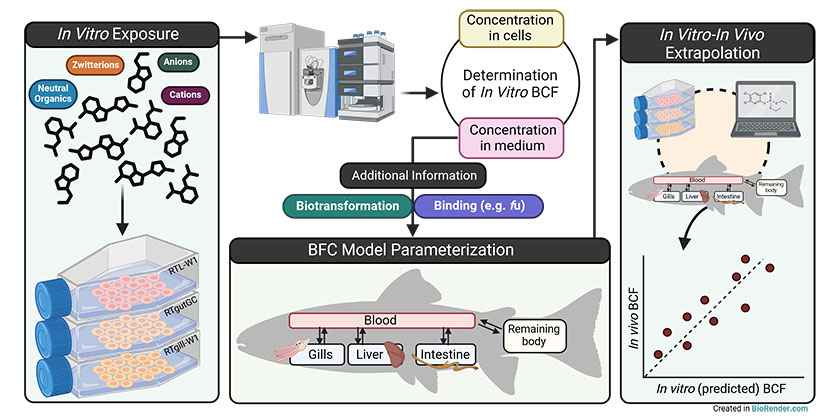

Das Potenzial von Chemikalien, sich in einem Organismus anzusammeln, ist eine der wichtigsten Eigenschaften, die bei Umweltverträglichkeitsprüfungen (UVP) bewertet werden. Zur Bioakkumulation kommt es, wenn die Aufnahmeprozesse die Biotransformation und die anschliessenden Eliminationsprozesse übertreffen. Während die Bioakkumulation üblicherweise anhand von ressourcenintensiven Tierversuchen mit Fischen (z. B. OECD 305) bewertet wird, zielen wir darauf ab zellbasierte Systeme zur Vorhersage der Bioakkumulation auf In-vivo-Ebene zu entwickeln und zu implementieren. Zu diesem Zweck messen wir die Aufnahme von Chemikalien und die Biotransformationsraten in permanenten Zelllinien der Regenbogenforelle (Oncorhynchus mykiss), die aus der Leber (RTL-W1), dem Darm (RTgutGC) und den Kiemen (RTgill-W1) isoliert werden, um sowohl die hepatische als auch die extrahepatische Biotransformation zu berücksichtigen. Wir arbeiten daran, die Fähigkeit von Zellen zur Darstellung von Prozessen, die die Bioakkumulation beeinflussen (z. B. Biotransformationswege), weiter zu erforschen und die Anwendbarkeit unserer zellbasierten Systeme zur Bewertung eines breiten Spektrums von Chemikalien zu verbessern, einschließlich solcher mit technisch anspruchsvollen physikochemischen Eigenschaften wie Ionisierbarkeit, hoher Flüchtigkeit und Hydrophobie. Wir arbeiten auch an der Weiterentwicklung der physiologisch basierten Toxikokinetik (PBTK), um die Bioakkumulation auf zellulärer Ebene (in vitro) auf den gesamten Organismus (in vivo) zu übertrage.


Publikationen

Extbase Variable Dump
array(2 items)
   publications => '32425,30435,18923,16710,15007,7026' (34 chars)
   libraryUrl => '' (0 chars)
Extbase Variable Dump
array(6 items)
   0 => Snowflake\Publications\Domain\Model\Publicationprototypepersistent entity (uid=32425, pid=124)
      originalId => protected32425 (integer)
      authors => protected'Balk, F.; Hüsser, B.; Hollender, J.; Schirmer, K.' (70 chars)
      title => protected'Bioconcentration assessment of three cationic surfactants in permanent fish 
         cell lines
' (86 chars) journal => protected'Environmental Science and Technology' (36 chars) year => protected2024 (integer) volume => protected2024 (integer) issue => protected'58' (2 chars) startpage => protected'1452' (4 chars) otherpage => protected'1461' (4 chars) categories => protected'new approach methodologies (NAM); ionizable organic compounds (IOC); quatern
         ary ammonium ion; alkyl amines; rainbow trout cell lines; phospholipids
' (147 chars) description => protected'Cationic surfactants are used in many industrial processes and in consumer p
         roducts with concurrent release into the aquatic environment, where they may
          accumulate in aquatic organisms to regulatoryly relevant thresholds. Here,
         we aimed to better understand the bioconcentration behavior of three selecte
         d cationic surfactants, namely <em>N,N</em>-dimethyldecylamine (T10), <em>N<
         /em>-methyldodecylamine (S12), and <em>N,N,N</em>-trimethyltetradecylammoniu
         m cation (Q14), in the cells of fish liver (RTL-W1) and gill (RTgill-W1) cel
         l lines. We conducted full mass balances for bioconcentration tests with the
          cell cultures, in which the medium, the cell surface, the cells themselves,
          and the plastic compartment were sampled and quantified for each surfactant
          by HPLC MS/MS. Accumulation in/to cells correlated with the surfactants' al
         kyl chain lengths and their membrane lipid–water partitioning coefficient,
          <em>D</em><sub>MLW</sub>. Cell-derived bioconcentration factors (BCF) of T1
         0 and S12 were within a factor of 3.5 to <em>in vivo</em> BCF obtained from
         the literature, while the cell-derived BCF values for Q14 were &gt;100 times
          higher than the <em>in vivo</em> BCF. From our experiments, rainbow trout c
         ell lines appear as a suitable conservative <em>in vitro</em> screening meth
         od for bioconcentration assessment of cationic surfactants and are promising
          for further testing.
' (1389 chars) serialnumber => protected'0013-936X' (9 chars) doi => protected'10.1021/acs.est.3c05360' (23 chars) uid => protected32425 (integer) _localizedUid => protected32425 (integer)modified _languageUid => protectedNULL _versionedUid => protected32425 (integer)modified pid => protected124 (integer)
1 => Snowflake\Publications\Domain\Model\Publicationprototypepersistent entity (uid=30435, pid=124) originalId => protected30435 (integer) authors => protected'Balk,&nbsp;F.; Hollender,&nbsp;J.; Schirmer,&nbsp;K.' (52 chars) title => protected'Investigating the bioaccumulation potential of anionic organic compounds usi
         ng a permanent rainbow trout liver cell line
' (120 chars) journal => protected'Environment International' (25 chars) year => protected2023 (integer) volume => protected174 (integer) issue => protected'' (0 chars) startpage => protected'107798 (13 pp.)' (15 chars) otherpage => protected'' (0 chars) categories => protected'bioaccumulation; RTL-W1; in vitro - in vivo extrapolation; ionizable organic
          compounds (IOC); biotransformation; HPLC HRMS/MS; new approach methodology
         (NAM)
' (157 chars) description => protected'Permanent rainbow trout (<em>Oncorhynchus mykiss</em>) cell lines represent
         potential <em>in vitro</em> alternatives to experiments with fish. We here d
         eveloped a method to assess the bioaccumulation potential of anionic organic
          compounds in fish, using the rainbow trout liver-derived RTL-W1 cell line.
         Based on the availability of high quality <em>in vivo</em> bioconcentration
         (BCF) and biomagnification (BMF) data and the substances’ charge state at
         physiological pH, four anionic compounds were selected: pentachlorophenol (P
         CP), diclofenac (DCF), tecloftalam (TT) and benzotriazol-<em>tert</em>-butyl
         -hydroxyl-phenyl propanoic acid (BHPP). The fish cell line acute toxicity as
         say (OECD TG249) was used to derive effective concentrations 50 % and non-t
         oxic exposure concentrations to determine exposure concentrations for bioacc
         umulation experiments. Bioaccumulation experiments were performed over 48 h
          with a total of six time points, at which cell, medium and plastic fraction
         s were sampled and measured using high resolution tandem mass spectrometry a
         fter online solid phase extraction. Observed cell internal concentrations we
         re over-predicted by K<sub>OW</sub>-derived predictions while pH-dependent o
         ctanol–water partitioning (D<sub>OW</sub>) and membrane lipid-water partit
         ioning (D<sub>MLW</sub>) gave better predictions of cell internal concentrat
         ions. Measured medium and cell internal concentrations at steady state were
         used to calculate RTL-W1-based BCF, which were compared to D<sub>OW</sub>- o
         r D<sub>MLW</sub>-based model approaches and <em>in vivo</em> data. With the
          exception of PCP, the cell-derived BCF best compared to D<sub>OW</sub>-base
         d model predictions, which were higher than predictions based on D<sub>MLW</
         sub>. All methods predicted the <em>in vivo</em> BCF for diclofenac well. Fo
         r PCP, the cell-derived BCF was lowest although all BCF predictions underest
         imated the <em>in vivo</em> BCF by ≥ 1 order of magnitude. The RTL-W1 ce
         lls, and all other predi...
' (2314 chars) serialnumber => protected'0160-4120' (9 chars) doi => protected'10.1016/j.envint.2023.107798' (28 chars) uid => protected30435 (integer) _localizedUid => protected30435 (integer)modified _languageUid => protectedNULL _versionedUid => protected30435 (integer)modified pid => protected124 (integer)
2 => Snowflake\Publications\Domain\Model\Publicationprototypepersistent entity (uid=18923, pid=124) originalId => protected18923 (integer) authors => protected'Stadnicka-Michalak,&nbsp;J.; Schirmer,&nbsp;K.' (46 chars) title => protected'In vitro-in vivo extrapolation to predict bioaccumulation and toxicity of ch
         emicals in fish using physiologically based toxicokinetic models
' (140 chars) journal => protected'In: Seiler,&nbsp;T.-B.; Brinkmann,&nbsp;M. (Eds.), In situ bioavailability a
         nd toxicity of organic chemicals in aquatic systems
' (127 chars) year => protected2022 (integer) volume => protected0 (integer) issue => protected'' (0 chars) startpage => protected'229' (3 chars) otherpage => protected'258' (3 chars) categories => protected'PBTK model; fish growth; lethality; integrated testing design; predictive mo
         deling; chemical risk assessment; fish cell lines; toxicokinetics and toxico
         dynamics
' (160 chars) description => protected'Out of the &gt;107 million chemicals already registered with the Chemical Ab
         stracts Services, less than 0.5% are being regulated, and even fewer are eva
         luated for their safety. Consequently, a new paradigm in risk assessment is
         urgently needed. It should encompass faster and less costly methods and redu
         ce the number of animals needed for testing. One proposal is to combine comp
         utational modeling with small-scale bioassay methods. This chapter describes
          the methods that link in vitro bioassays using fish cells with physiologica
         lly based toxicokinetic (PBTK) modeling in order to predict the acute toxici
         ty, bioaccumulation, and impact of chemicals on fish growth. The main focus
         is on PBTK modeling; thus all the model equations and parameters available f
         or eight fish species as well as suggestions for possible software implement
         ation will be provided. The PBTK model described here can account for respir
         atory and dietary uptake routes and for chemical biotransformation processes
         .
' (989 chars) serialnumber => protected'' (0 chars) doi => protected'10.1007/7653_2019_34' (20 chars) uid => protected18923 (integer) _localizedUid => protected18923 (integer)modified _languageUid => protectedNULL _versionedUid => protected18923 (integer)modified pid => protected124 (integer)
3 => Snowflake\Publications\Domain\Model\Publicationprototypepersistent entity (uid=16710, pid=124) originalId => protected16710 (integer) authors => protected'Stadnicka-Michalak,&nbsp;J.; Weiss,&nbsp;F.&nbsp;T.; Fischer,&nbsp;M.; Tanne
         berger,&nbsp;K.; Schirmer,&nbsp;K.
' (110 chars) title => protected'Biotransformation of benzo [<i>a</i>] pyrene by three rainbow trout (<i>Onch
         orhynchus mykiss</i>) cell lines and extrapolation to derive a fish bioconce
         ntration factor
' (167 chars) journal => protected'Environmental Science and Technology' (36 chars) year => protected2018 (integer) volume => protected52 (integer) issue => protected'5' (1 chars) startpage => protected'3091' (4 chars) otherpage => protected'3100' (4 chars) categories => protected'' (0 chars) description => protected'Permanent fish cell lines constitute a promising complement or substitute fo
         r fish in the environmental risk assessment of chemicals. We demonstrate the
          potential of a set of cell lines originating from rainbow trout (<i>Oncorhy
         nchus mykiss</i>) to aid in the prediction of chemical bioaccumulation in fi
         sh, using benzo[<i>a</i>]pyrene (BaP) as a model chemical. We selected three
          cell lines from different tissues to more fully account for whole-body biot
         ransformation in vivo: the RTL-W1 cell line, representing the liver as major
          site of biotransformation, and the RTgill-W1 (gill) and RTgutGC (intestine)
          cell lines, as important environment-organism interfaces, which likely infl
         uence chemical uptake. All three cell lines were found to effectively biotra
         nsform BaP. However, rates of in vitro clearance differed, with the RTL-W1 c
         ell line being most efficient, followed by RTgutGC. Co-exposures with α-nap
         hthoflavone as potent inhibitor of biotransformation, assessment of CYP1A ca
         talytic activity, and the progression of cellular toxicity upon prolonged Ba
         P exposure revealed that BaP is handled differently in the RTgill-W1 compare
         d to the other two cell lines. Application of the cell-line-derived in vitro
          clearance rates into a physiology-based toxicokinetic model predicted a BaP
          bioconcentration factor (BCF) of 909-1057 compared to 920 reported for rain
         bow trout in vivo.
' (1386 chars) serialnumber => protected'0013-936X' (9 chars) doi => protected'10.1021/acs.est.7b04548' (23 chars) uid => protected16710 (integer) _localizedUid => protected16710 (integer)modified _languageUid => protectedNULL _versionedUid => protected16710 (integer)modified pid => protected124 (integer)
4 => Snowflake\Publications\Domain\Model\Publicationprototypepersistent entity (uid=15007, pid=124) originalId => protected15007 (integer) authors => protected'Stadnicka-Michalak,&nbsp;J.; Knöbel,&nbsp;M.; Županič,&nbsp;A.; Schirmer,
         &nbsp;K.
' (84 chars) title => protected'A validated algorithm for selecting non-toxic chemical concentrations' (69 chars) journal => protected'ALTEX: Alternatives to Animal Experimentation' (45 chars) year => protected2018 (integer) volume => protected35 (integer) issue => protected'1' (1 chars) startpage => protected'37' (2 chars) otherpage => protected'50' (2 chars) categories => protected'fish cell lines and embryos; in vitro; bioassays; toxicology; animal testing
          alternatives
' (89 chars) description => protected'The maximal chemical concentration that causes an acceptably small or no eff
         ect in an organism or isolated cells is an often - sought - after value in t
         oxicology. Existing approaches to derive this value have raised several conc
         erns; thus, it is often chosen case - by - case based on personal experience
         . To overcome this ambiguity, we propose an approach for choosing the non -
         toxic concentration (NtC) of a chemical in a rational, tractable way. We dev
         eloped an algorithm that identifies the highest chemical concentration which
          causes no more than 10% effect (≤ EC10) including the modeled 95% confide
         nce intervals and considering each of the measured biological replicates; an
         d whose toxicity is not significantly different from no effect.The developed
          algorithm was validated in two steps: by comparing its results with measure
         d and modeled data for 91 dose - response experiments with fish cell lines a
         nd/or zebrafish embryos; and by measuring actual effects caused by NtCs in a
          separate set of experiments using a fish cell line and zebrafish emb ryos.
         The algorithm provided an NtC that is more protective than NOEC (No - Observ
         ed - Effect - Concentration), NEC (modeled No - Effect Concentration), EC10
         and Benchmark Dose (BMD). Despite focusing on small scale bioassays here, th
         is study indicates that the NtC algorithm could be used in various systems.
         Its application on the survival of zebrafish embryos and on metabolic activi
         ty in cell lines showed that NtCs can be applied to different effect measure
         ments, time points and levels of biological organization. The algorithm is a
         vailable as Matlab and R code, and as a free, user friendly online applicati
         on.
' (1675 chars) serialnumber => protected'1868-596X' (9 chars) doi => protected'10.14573/altex.1701231' (22 chars) uid => protected15007 (integer) _localizedUid => protected15007 (integer)modified _languageUid => protectedNULL _versionedUid => protected15007 (integer)modified pid => protected124 (integer)
5 => Snowflake\Publications\Domain\Model\Publicationprototypepersistent entity (uid=7026, pid=124) originalId => protected7026 (integer) authors => protected'Stadnicka,&nbsp;J.; Schirmer,&nbsp;K.; Ashauer,&nbsp;R.' (55 chars) title => protected'Predicting concentrations of organic chemicals in fish by using toxicokineti
         c models
' (84 chars) journal => protected'Environmental Science and Technology' (36 chars) year => protected2012 (integer) volume => protected46 (integer) issue => protected'6' (1 chars) startpage => protected'3273' (4 chars) otherpage => protected'3280' (4 chars) categories => protected'' (0 chars) description => protected'Quantification of chemical toxicity continues to be generally based on measu
         red external concentrations. Yet, internal chemical concentrations have been
          suggested to be a more suitable parameter. To better understand the relatio
         nship between the external and internal concentrations of chemicals in fish,
          and to quantify internal concentrations, we compared three toxicokinetic (T
         K) models with each other and with literature data of measured concentration
         s of 39 chemicals. Two one-compartment models, together with the physiologic
         ally based toxicokinetic (PBTK) model, in which we improved the treatment of
          lipids, were used to predict concentrations of organic chemicals in two fis
         h species: rainbow trout (<em>Oncorhynchus mykiss</em>) and fathead minnow (
         <em>Pimephales promelas</em>). All models predicted the measured internal co
         ncentrations in fish within 1 order of magnitude for at least 68% of the che
         micals. Furthermore, the PBTK model outperformed the one-compartment models
         with respect to simulating chemical concentrations in the whole body (at lea
         st 88% of internal concentrations were predicted within 1 order of magnitude
          using the PBTK model). All the models can be used to predict concentrations
          in different fish species without additional experiments. However, further
         development of TK models is required for polar, ionizable, and easily biotra
         nsformed compounds.
' (1387 chars) serialnumber => protected'0013-936X' (9 chars) doi => protected'10.1021/es2043728' (17 chars) uid => protected7026 (integer) _localizedUid => protected7026 (integer)modified _languageUid => protectedNULL _versionedUid => protected7026 (integer)modified pid => protected124 (integer)
Balk, F.; Hüsser, B.; Hollender, J.; Schirmer, K. (2024) Bioconcentration assessment of three cationic surfactants in permanent fish cell lines, Environmental Science and Technology, 2024(58), 1452-1461, doi:10.1021/acs.est.3c05360, Institutional Repository
Balk, F.; Hollender, J.; Schirmer, K. (2023) Investigating the bioaccumulation potential of anionic organic compounds using a permanent rainbow trout liver cell line, Environment International, 174, 107798 (13 pp.), doi:10.1016/j.envint.2023.107798, Institutional Repository
Stadnicka-Michalak, J.; Schirmer, K. (2022) In vitro-in vivo extrapolation to predict bioaccumulation and toxicity of chemicals in fish using physiologically based toxicokinetic models, In: Seiler, T.-B.; Brinkmann, M. (Eds.), In situ bioavailability and toxicity of organic chemicals in aquatic systems, 229-258, doi:10.1007/7653_2019_34, Institutional Repository
Stadnicka-Michalak, J.; Weiss, F. T.; Fischer, M.; Tanneberger, K.; Schirmer, K. (2018) Biotransformation of benzo [a] pyrene by three rainbow trout (Onchorhynchus mykiss) cell lines and extrapolation to derive a fish bioconcentration factor, Environmental Science and Technology, 52(5), 3091-3100, doi:10.1021/acs.est.7b04548, Institutional Repository
Stadnicka-Michalak, J.; Knöbel, M.; Županič, A.; Schirmer, K. (2018) A validated algorithm for selecting non-toxic chemical concentrations, ALTEX: Alternatives to Animal Experimentation, 35(1), 37-50, doi:10.14573/altex.1701231, Institutional Repository
Stadnicka, J.; Schirmer, K.; Ashauer, R. (2012) Predicting concentrations of organic chemicals in fish by using toxicokinetic models, Environmental Science and Technology, 46(6), 3273-3280, doi:10.1021/es2043728, Institutional Repository