Die Verschmutzung von Süsswasser-Ökosystemen durch Mikroverunreinigungen gilt heute als ein wichtiges Umweltproblem. Die Wirkung von Mikroverunreinigungen auf spezifische Organismen ist mit einer Fülle von Daten dokumentiert. Noch wenig bekannt ist hingegen, wie sich Mikroverunreinigungen auf die komplexen Strukturen und Funktionen ganzer aquatischer Ökosysteme auswirken.
EcoImpact 1 war ein abteilungsübergreifendes, interdisziplinäres Forschungsprojekt der Eawag mit dem Ziel, diese Wissenslücke zu schliessen. EcoImpact 1startete 2013 und wurde im Hinblick auf die künftige technische Aufrüstung von ARAs in der Schweiz initiiert. Die damit verbundenen Veränderungen bieten eine einmalige Gelegenheit, die Auswirkungen von Mikroverunreinigungen auf natürliche aquatische Ökosysteme zu untersuchen. Dazu wurden zwei komplementäre Ansätze verfolgt: eine Feldstudie an ausgewählten Ausläufen von ARA's sowie Experimente unter kontrollierten Bedingungen im Rinnensystem Maiandros.
Mikroverunreinigungen (MV) sind organische und anorganische chemische Schadstoffe, die in sehr geringen Konzentrationen in Gewässern vorkommen. Trotz dieser geringen Konzentrationen können MV jedoch negative Auswirkungen auf Organismen und auf die Trinkwasserqualität haben. MV stammen aus vielen Produkten, die in Industrie-, Landwirtschafts- und Tourismusbetrieben oder in Privathaushalten verwendet werden, wie Kosmetika, Baustoffe, Arzneimittel oder Biozide. Sie gelangen über verschiedene Eintragspfade in die aquatische Umwelt, so etwa über die Siedlungsentwässerung oder durch Abschwemmung aus Landwirtschafts- oder Verkehrsflächen.
Auswirkungen von Mikroverunreinigungen (MV)
MV können schon in sehr geringer Konzentration Auswirkungen auf Organismen haben. Da sie als biologisch aktive Substanzen entwickelt wurden (z.B. Biozide, Arznei- und Pflanzenschutzmittel), ist zu erwarten, dass ähnliche, aber unerwünschte Effekte in der Umwelt beobachtet werden können. Zum Beispiel hemmen Pflanzenschutzprodukte auch die Entwicklung von photosynthetischen Organismen in Gewässern. Genauso können Wirbeltiere wie Fische auf Hormone und Insekten im aquatischen Umfeld auf Insektizide reagieren.
Unvollständige Entfernung von Mikroverunreinigungen (MV) in konventionellen ARAs
Viele MVs gelangen über die Kläranlagen in die Gewässer. Die heutigen ARAs sind in erster Linie auf die Entfernung von Nährstoffen ausgelegt. Damit haben sie erfolgreich zur Erreichung der Gewässerschutzziele beigetragen. In den letzten Jahren zeigte sich aber, dass in den Kläranlagen viele MVs nicht vollständig entfernt werden und daher zusätzliche Reinigungsstufen nötig sind. Im Rahmen der Strategie Mikroverunreinigung haben die Schweizer Behörden entschieden, etwa 100 der 700 Schweizer ARAs mit zusätzlichen Reinigungsstufen auszustatten. Die damit verbundenen Veränderungen sind eine einmalige Gelegenheit, die Auswirkungen von MV auf natürliche aquatische Ökosysteme in unserem Forschungsprojekt EcoImpact zu untersuchen.
Hypothesen und Ziele
Mit einer Kombination von Feldstudien und experimentellen Ansätzen wurden in EcoImpact 1 die folgenden Hypothesen getestet:
Der Eintrag von MV aus ARAs führt zu Veränderungen, die über die Effekte anderer Bestandteile des Abwassers wie Nährstoffe hinausgehen (zum Beispiel der Verlust und die Abnahme sensitiver Arten unterhalb der Einleitungsstelle oder induzierte Toleranz gegenüber MV).
Es gibt indirekte Effekte von MV, die von biologischen Interaktionen vermittelt werden, die über die direkten Effekte von MV auf Schlüsselorganismen und Schlüsselfunktionen hinausgehen.
Das Projekt EcoImpact 1 verfolgte drei Ziele:
Herstellung kausaler Zusammenhänge Die Eawag untersuchte, ob ökologische Unterschiede zwischen verschiedenen Standorten auf unterschiedliche Expositionen gegenüber (spezifischen) Gruppen von MV zurückzuführen sind. Die Auswirkungen von MV sollen von denjenigen anderer Einflussfaktoren abgegrenzt werden.
Integration Das Projekt umfasste eine Vielzahl molekularer, physiologischer und ökologischer Endpunkte und integrierte die verschiedenen Messungen, Beobachtungen und Muster.
Erarbeitung von allgemeingültigen Aussagen Das Projekt zielte nicht auf spezifische Aussagen für bestimmte Standorte, sondern auf allgemeingültige Aussagen.
Feldstudie und Untersuchungsstandorte
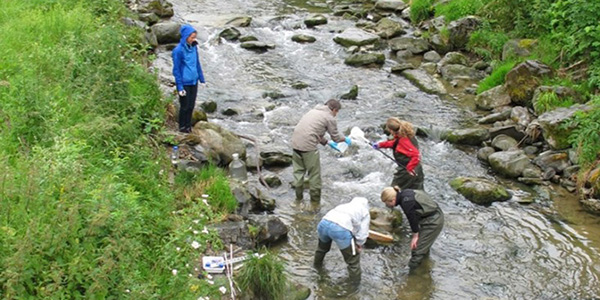
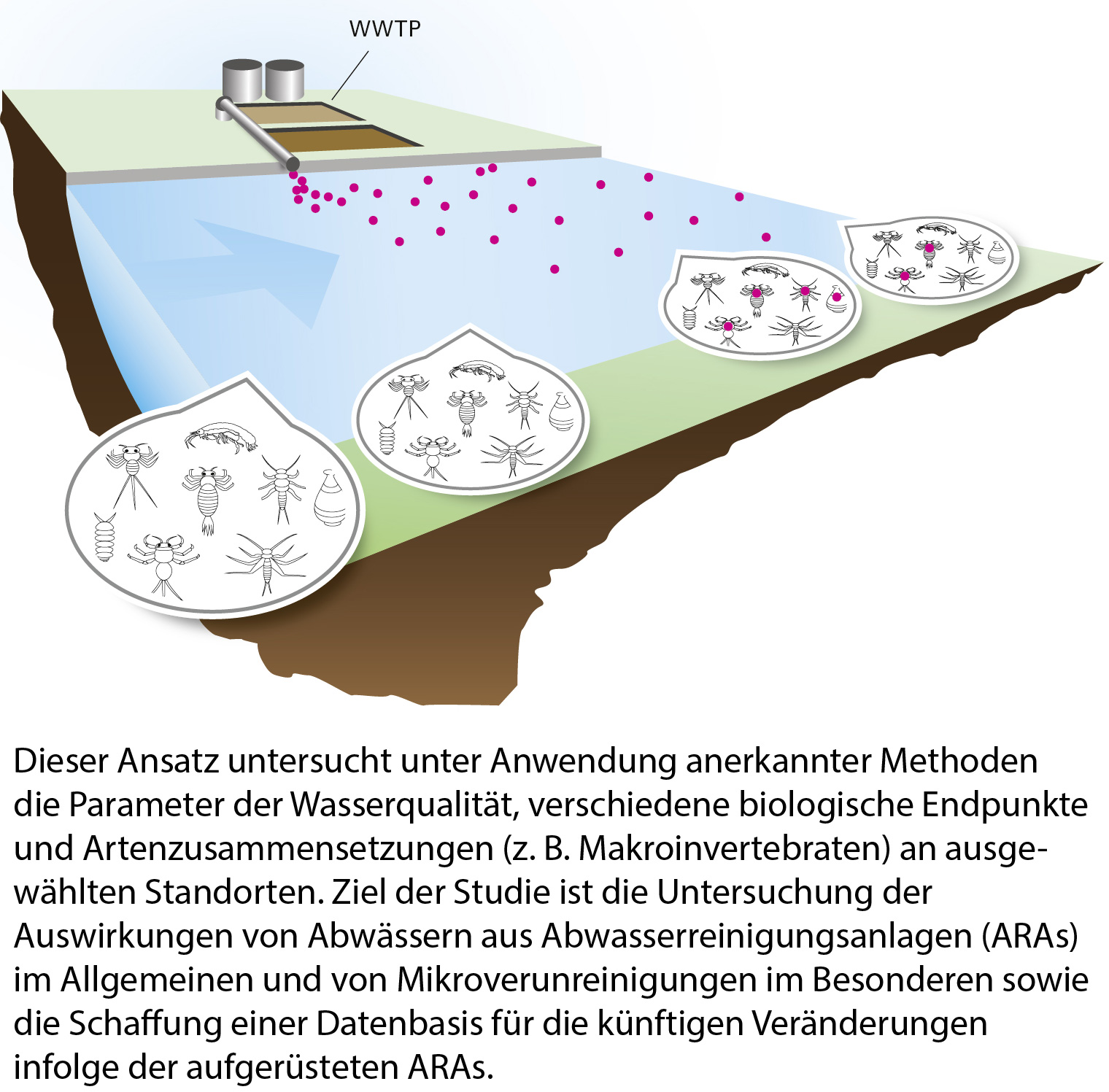
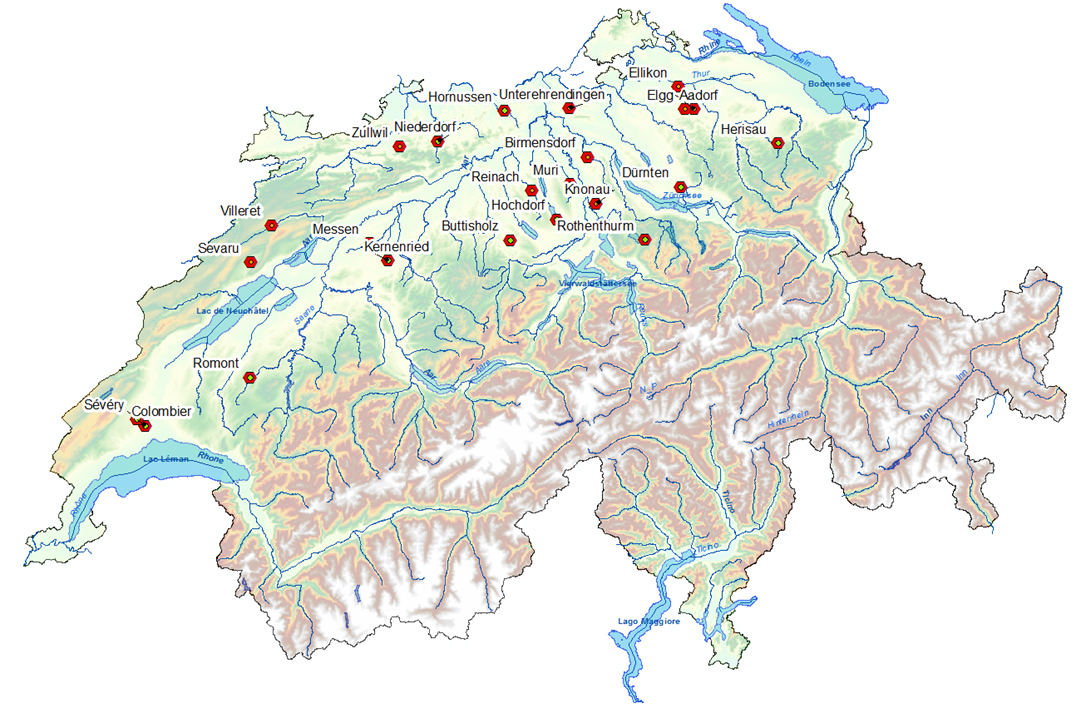
Dieser Ansatz untersuchte unter Anwendung anerkannter Methoden die Parameter der Wasserqualität, verschiedene biologische Endpunkte, die Biodiversität und funktionelle Merkmale an ausgewählten Standorten. Die 24 ausgewählten Flussstrecken ober- und unterhalb von ARA-Ausläufen befinden sich im Schweizer Mittelland und im Jura. Ziel der Studie war die Untersuchung der biologischen Auswirkungen von geklärten Abwässern im Allgemeinen und von MV im Besonderen sowie die Schaffung einer Datenbasis um die künftigen Veränderungen infolge der aufgerüsteten ARAs zu überwachen.
Die Auswahl der untersuchten Standorte beruhte auf den folgenden Kriterien:
Nur Fliessgewässer werden als Gewässer betrachtet, keine Seen
Kein Abwasserauslauf oberhalb der ausgewählten ARAs
Bei trockenem Wetter sind mindestens 20% der gesamten Abflussmenge Abwasser der ARA (Q347)
Siedlungsfläche im Einzugsgebiet < 21%
Flächenanteil Reben und Obst im Einzugsgebiet < 10%
Experimentelle Ansätze
Um den Einfluss verschiedener Umweltfaktoren auf die Struktur und Funktion aquatischer Ökosysteme auseinanderzuhalten, braucht es Experimente. Um die besondere Rolle von MV zu studieren, haben wir sowohl kleinräumige Experimente im Labor durchgeführt als auch Maiandros entworfen – ein System von Durchflussrinnen, welches nach der griechischen Gottheit Μαίανδρος des Flusses Mäander (in der heutigen Türkei) benannt ist.
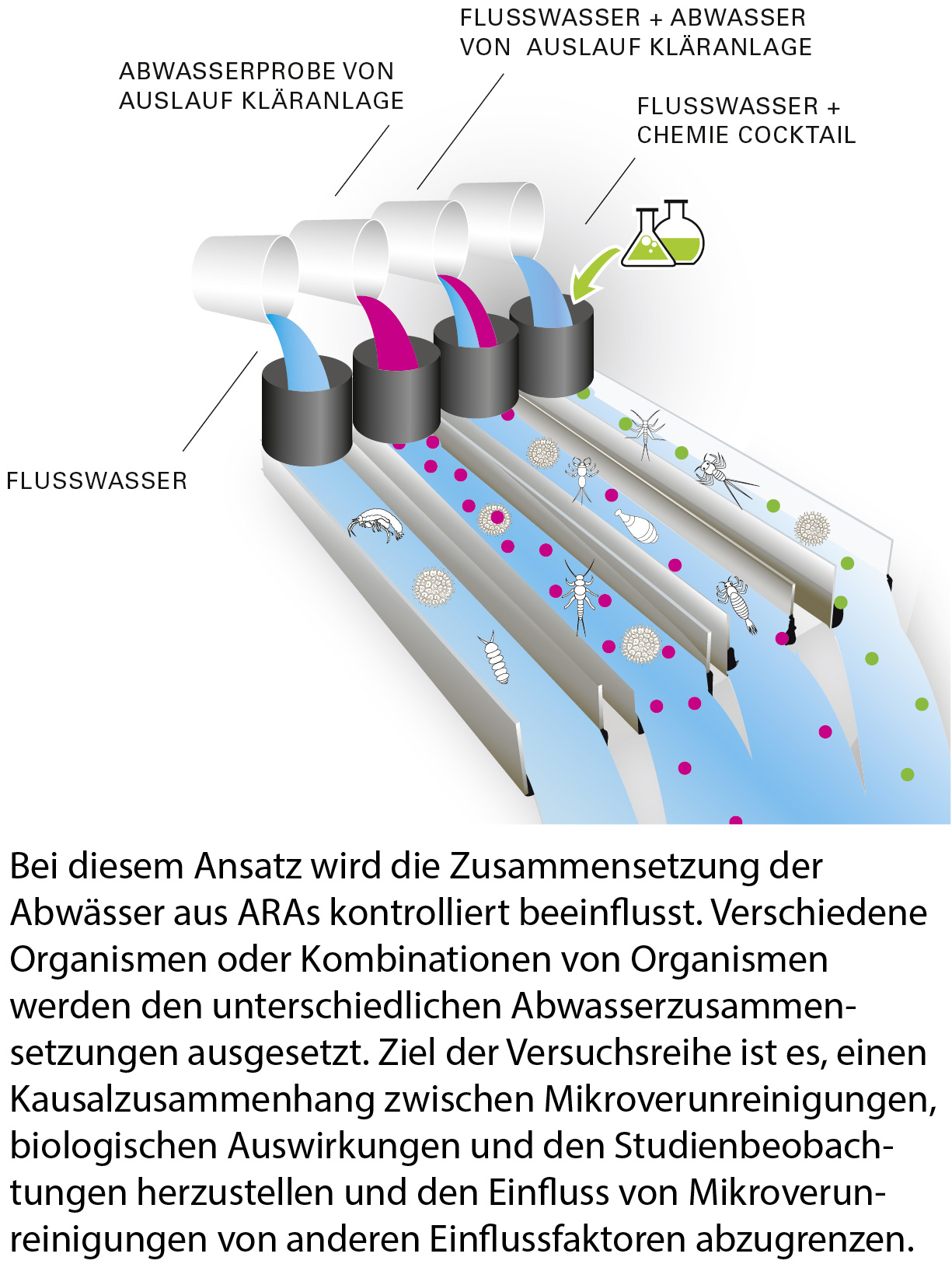
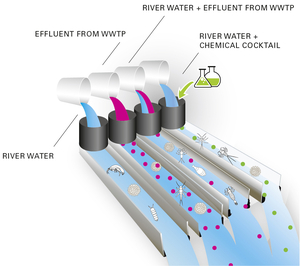
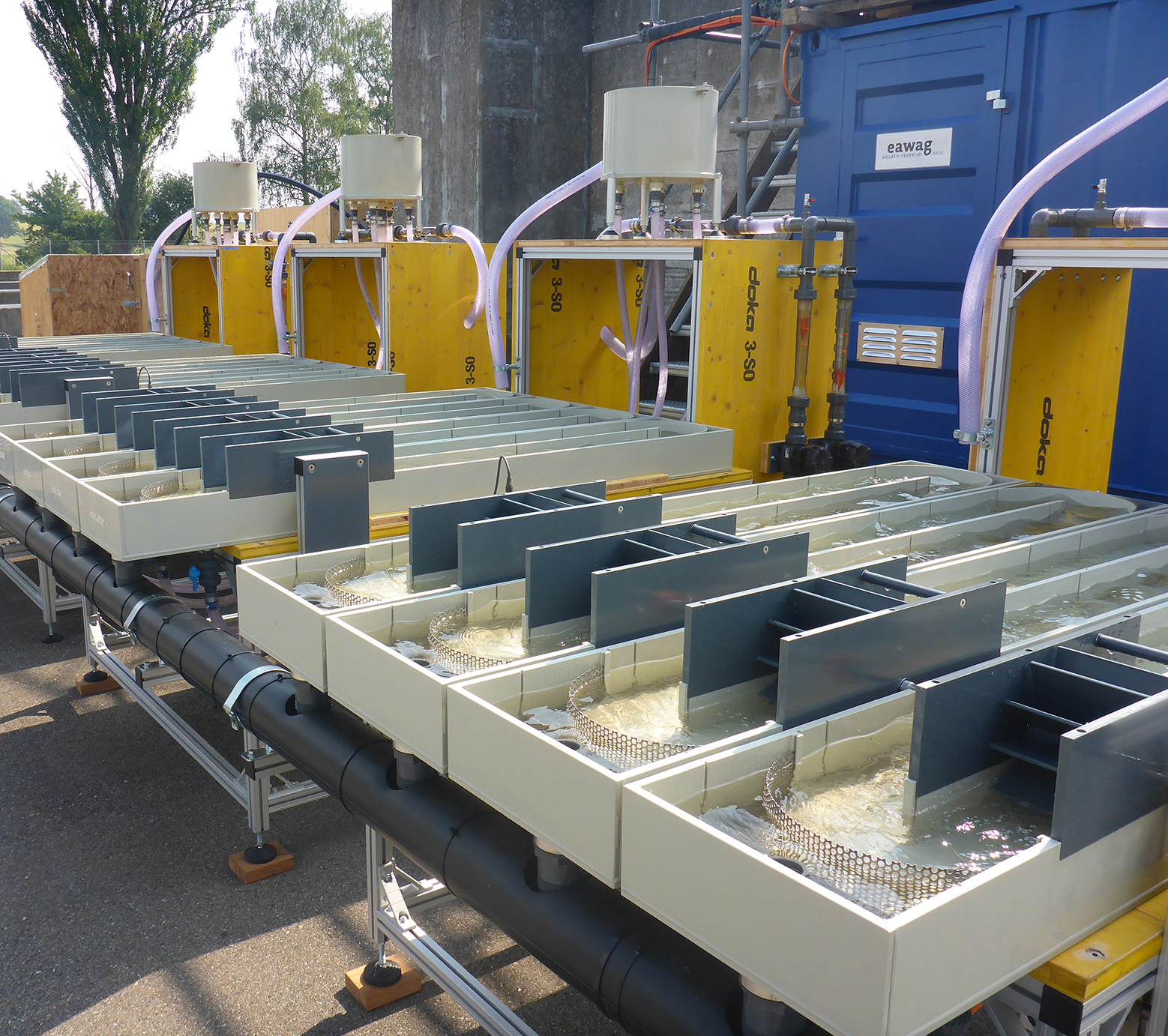
Im Maiandros-System können verschiedene Organismen vier unterschiedlichen, kontrollierten Wasserqualitäten ausgesetzt werden. Dazu wurde Maiandros auf der ARA Fällanden (Schweiz) aufgebaut, wo verschiedene Experimente durchgeführt wurden. Einerseits wurde die Wasserqualität durch die Vermischung von Flusswasser mit gereinigtem Abwasser in verschiedenen Mischungsverhältnissen variiert. Andererseits wurde Flusswasser mit ausgewählten Nährstoffen und/oder Mischungen von MV versetzt, um etwaige gegenteilige Effekte von Nährstoffen und MV auseinander zu halten.
Das experimentelle Rinnensystem „Maiandros"
Resultate
Die bislang erhobenen Ergebnisse zeigen, dass MV Auswirkungen auf Fliessgewässer-Ökosysteme haben. Bei allen Feldstandorten hat die Abwassereinleitung die Fracht und die Konzentrationen von MV in den Flussabschnitten unterhalb der ARA erhöht. Biologische Tests zeigen, dass diese Konzentrationen die ökotoxikologischen Effekte an verschiedenen Endpunkten erhöhen, sodass zum Beispiel die Photosynthese stärker gehemmt wird. Flussabwärts gelegene Peryphytongemeinschaften (Biofilm aus Algen, Bakterien und Pilzen) sind toleranter gegenüber diesen MV und Bachforellen induzierten an ausgewählten Standorten die Expression von Genen, die für Entgiftungs-Aktivitäten benötigt werden. All diese Resultate zeigen, dass MV in den Organismen physiologischen Stress induzieren. Solche Effekte wurden auch bei Makroinvertebraten beobachtet. Insbesondere Arten, die sensibel auf Pestizide reagieren, waren an flussabwärts gelegenen Standorten dezimiert. Das Abwasser und möglicherweise auch die MV beeinflussten auch Ökosystemfunktionen wie den Blattabbau.
Im Maiandros-Rinnensystem wurden Experimente durchgeführt, die es erlaubten, einige der komplexen Prozesse aus den Feldstudien zu entflechten. Abbautests mit Baumwollstreifen haben zum Beispiel gezeigt, dass Nährstoffe die toxischen Effekte von MV ‚verbergen’. Die Resultate aus der Feldstudie und dem Rinnensystem werden nun miteinander verglichen, um die im Feld beobachteten Muster besser zu verstehen.
Publikationen
Die folgenden ausgewählten Publikationen stammen aus dem Projekt EcoImpact oder sind stark mit dem Thema verknüpft.
array(21 items)0 => Snowflake\Publications\Domain\Model\Publicationprototypepersistent entity (uid=26086, pid=124)originalId => protected26086 (integer)
authors => protected'Burdon, F. J.; Reyes, M.; Schönenberger, U.; Räsänen, K.; Tiegs, S. D.; Eggen, R. I. L.; Stamm,&nbs p;C.' (156 chars)
title => protected'Environmental context determines pollution impacts on ecosystem functioning' (75 chars)
journal => protected'Oikos' (5 chars)
year => protected2023 (integer)
volume => protected2023 (integer)
issue => protected'2' (1 chars)
startpage => protected'e09131 (14 pp.)' (15 chars)
otherpage => protected'' (0 chars)
categories => protected'biodiversity; decomposition; micropollutants; multiple stressors; nutrients; wastewater' (87 chars)
description => protected'Global change assessments have typically ignored synthetic chemical pollutio n, despite the rapid increase of pharmaceuticals, pesticides and industrial chemicals in the environment. Part of the problem reflects the multifarious origins of these micropollutants, which can derive from urban and agricultur al sources. Understanding how micropollutants harm ecosystems is a major sci entific challenge due to asymmetries of stress across trophic levels and eco logical surprises generated by multiple drivers interacting in human-impacte d landscapes. We used field assays above and below municipal wastewater trea tment plants (WWTPs) in 60 sampling locations across 20 Swiss streams to tes t how micropollutants and nutrients originating from WWTPs affect two trophi c levels (microbes and detritivores) and their role in leaf litter processin g. Wastewater impacts were asymmetric across trophic levels, with the detrit ivore contribution declining relative to microbial-driven decomposition. The strength of negative impacts were context dependent, peaking at sites with the highest upstream abundances of detritivorous invertebrates. Diffuse poll ution from intensive agriculture and wastewater-born micropollutants contrib uted to reduced litter processing rates, including indirect effects apparent ly mediated through negative influences of insecticides on detritivores. Asy mmetries in stress responses across trophic levels can introduce quantitativ e changes in consumer–resource dynamics and leaf litter processing. This m eans functional redundancies at different trophic levels are insufficient to compensate for biodiversity losses, causing environmental stressors such as chemical pollutants to have pervasive ecosystem-level impacts.' (1735 chars)
serialnumber => protected'0030-1299' (9 chars)
doi => protected'10.1111/oik.09131' (17 chars)
uid => protected26086 (integer)
_localizedUid => protected26086 (integer)modified_languageUid => protectedNULL
_versionedUid => protected26086 (integer)modifiedpid => protected124 (integer)1 => Snowflake\Publications\Domain\Model\Publicationprototypepersistent entity (uid=23923, pid=124)originalId => protected23923 (integer)
authors => protected'Tamminen, M.; Spaak, J.; Tlili, A.; Eggen, R.; Stamm,&nb sp;C.; Räsänen, K.' (101 chars)
title => protected'Wastewater constituents impact biofilm microbial community in receiving stre ams' (79 chars)
journal => protected'Science of the Total Environment' (32 chars)
year => protected2022 (integer)
volume => protected807 (integer)
issue => protected'3' (1 chars)
startpage => protected'151080 (8 pp.)' (14 chars)
otherpage => protected'' (0 chars)
categories => protected'biofilm; wastewater treatment; bacterial community; diatom; micropollutant' (74 chars)
description => protected'Microbial life in natural biofilms is dominated by prokaryotes and microscop ic eukaryotes living in dense association. In stream ecosystems, microbial b iofilms influence primary production, elemental cycles, food web interaction s as well as water quality. Understanding how biofilm communities respond to anthropogenic impacts, such as wastewater treatment plant (WWTP) effluent, is important given the key role of biofilms in stream ecosystem function. He re, we implemented 16S and 18S rRNA gene sequencing of stream biofilms upstr eam (US) and downstream (DS) of WWTP effluents in four Swiss streams to test how bacterial and eukaryotic communities respond to wastewater constituents
munity members was related to micropollutants in the wastewater – among ba cteria, micropollutant-associated members were found e.g. in <em>Alphaproteo bacteria</em>, and among eukaryotes e.g. in <em>Bacillariophyta</em> (algal diatoms). This study corroborates several previously characterized responses (e.g. as seen in diatoms), but also reveals previously unknown community re sponses – such as seen in <em>Alphaproteobacteria</em>. This study advance s our understanding of the ecological impact of the current wastewater treat ment practices and provides information about potential new marker organisms to assess ecological change in stream biofilms.' (1492 chars)
serialnumber => protected'0048-9697' (9 chars)
doi => protected'10.1016/j.scitotenv.2021.151080' (31 chars)
uid => protected23923 (integer)
_localizedUid => protected23923 (integer)modified_languageUid => protectedNULL
_versionedUid => protected23923 (integer)modifiedpid => protected124 (integer)2 => Snowflake\Publications\Domain\Model\Publicationprototypepersistent entity (uid=21300, pid=124)originalId => protected21300 (integer)
authors => protected'Tlili, A.; Corcoll, N.; Arrhenius, Å.; Backhaus, T.; Ho llender, J.; Creusot, N.; Wagner, B.; Behra, R.' (143 chars)
title => protected'Tolerance patterns in stream biofilms link complex chemical pollution to eco logical impacts' (91 chars)
journal => protected'Environmental Science and Technology' (36 chars)
year => protected2020 (integer)
volume => protected54 (integer)
issue => protected'17' (2 chars)
startpage => protected'10745' (5 chars)
otherpage => protected'10753' (5 chars)
categories => protected'' (0 chars)
description => protected'Preventing and remedying fresh waters from chemical pollution is a fundament al societal and scientific challenge. With other nonchemical stressors poten tially co-occurring, assessing the ecological consequences of reducing chemi cal loads in the environment is arduous. In this case study, we comparativel y assessed the community structure, functions, and tolerance of stream biofi lms to micropollutant mixtures extracted from deployed passive samplers at w astewater treatment plant effluents. These biofilms were growing up- and dow nstream of one upgraded and two nonupgraded wastewater treatment plants befo re being sampled for analyses. Our results showed a substantial decrease in micropollutant concentrations by 85%, as the result of upgrading the wastewa ter treatment plant at one of the sampling sites with activated carbon filtr ation. This decrease was positively correlated with a loss of community tole rance to micropollutants and the recovery of the community structure downstr eam of the effluent. On the other hand, downstream biofilms at the nonupgrad ed sites displayed higher tolerance to the extracts than the upstream biofil ms. The observed higher tolerance was positively linked to micropollutant le vels both in stream water and in biofilm samples, and to shifts in the commu nity structure. Although more investigations of upgraded sites are needed, o ur findings point toward the suitability of using community tolerance for th e retrospective assessment of the risks posed by micropollutants, to assess community recovery, and to relate effects to causes in complex environmental conditions.' (1608 chars)
serialnumber => protected'0013-936X' (9 chars)
doi => protected'10.1021/acs.est.0c02975' (23 chars)
uid => protected21300 (integer)
_localizedUid => protected21300 (integer)modified_languageUid => protectedNULL
_versionedUid => protected21300 (integer)modifiedpid => protected124 (integer)3 => Snowflake\Publications\Domain\Model\Publicationprototypepersistent entity (uid=20593, pid=124)originalId => protected20593 (integer)
authors => protected'Creusot, N.; Casado-Martinez, C.; Chiaia-Hernandez, A.; Kiefe r, K.; Ferrari, B. J. D.; Fu, Q.; Munz, N.; St amm, C.; Tlili, A.; Hollender, J.' (200 chars)
title => protected'Retrospective screening of high-resolution mass spectrometry archived digita l samples can improve environmental risk assessment of emerging contaminants : a case study on antifungal azoles' (187 chars)
journal => protected'Environment International' (25 chars)
year => protected2020 (integer)
volume => protected139 (integer)
issue => protected'' (0 chars)
startpage => protected'105708 (10 pp.)' (15 chars)
otherpage => protected'' (0 chars)
categories => protected'environmental risk assessment; antifungal-azoles; high resolution mass spect rometry; partitioning; exposure assessment; retrospective screening; digital samples' (160 chars)
description => protected'Environmental risk assessment associated with aquatic and terrestrial contam ination is mostly based on predicted or measured environmental concentration s of a limited list of chemicals in a restricted number of environmental com partments. High resolution mass spectrometry (HRMS) can provide a more compr ehensive picture of exposure to harmful chemicals, particularly through the retrospective analysis of digitally stored HRMS data. Using this methodology , our study characterized the contamination of various environmental compart ments including 154 surface water, 46 urban effluent, 67 sediment, 15 soil, 34 groundwater, 24 biofilm, 41 gammarid and 49 fish samples at 95 sites wide ly distributed over the Swiss Plateau. As a proof-of-concept, we focused our investigation on antifungal azoles, a class of chemicals of emerging concer n due to their endocrine disrupting effects on aquatic organisms and humans. Our results demonstrated the occurrence of antifungal azoles and some of th eir (bio)transformation products in all the analyzed compartments (0.1-100 ng/L or ng/g d.w.). Comparison of actual and predicted concentrations showed the partial suitability of level 1 fugacity modelling in predicting the exp osure to azoles. Risk quotient calculations additionally revealed risk of ex posure especially if some of the investigated rivers and streams are used fo r drinking water production. The case study clearly shows that the retrospec tive analysis of HRMS/MS data can improve the current knowledge on exposure and the related risks to chemicals of emerging concern and can be effectivel y employed in the future for such purposes.' (1639 chars)
serialnumber => protected'0160-4120' (9 chars)
doi => protected'10.1016/j.envint.2020.105708' (28 chars)
uid => protected20593 (integer)
_localizedUid => protected20593 (integer)modified_languageUid => protectedNULL
_versionedUid => protected20593 (integer)modifiedpid => protected124 (integer)4 => Snowflake\Publications\Domain\Model\Publicationprototypepersistent entity (uid=21286, pid=124)originalId => protected21286 (integer)
authors => protected'Burdon, F. J.; Bai, Y.; Reyes, M.; Tamminen, M.; St audacher, P.; Mangold, S.; Singer, H.; Räsänen, K.; Jo ss, A.; Tiegs, S. D.; Jokela, J.; Eggen, R. I. L.; Stamm, C.' (252 chars)
title => protected'Stream microbial communities and ecosystem functioning show complex response s to multiple stressors in wastewater' (113 chars)
journal => protected'Global Change Biology' (21 chars)
year => protected2020 (integer)
volume => protected26 (integer)
issue => protected'11' (2 chars)
startpage => protected'6363' (4 chars)
otherpage => protected'6382' (4 chars)
categories => protected'biodiversity; carbon processing; cotton-strip assay; micropollutants; next-g eneration sequencing; nutrients; temperature; warming' (129 chars)
description => protected'Multiple anthropogenic drivers are changing ecosystems globally, with a disp roportionate and intensifying impact on freshwater habitats. A major impact of urbanization are inputs from wastewater treatment plants (WWTPs). Initial ly designed to reduce eutrophication and improve water quality, WWTPs increa singly release a multitude of micropollutants (MPs; i.e., synthetic chemical s) and microbes (including antibiotic‐resistant bacteria) to receiving env ironments. This pollution may have pervasive impacts on biodiversity and eco system services. Viewed through multiple lenses of macroecological and ecoto xicological theory, we combined field, flume, and laboratory experiments to determine the effects of wastewater (WW) on microbial communities and organi c‐matter processing using a standardized decomposition assay. First, we co nducted a mensurative experiment sampling 60 locations above and below WWTP discharges in 20 Swiss streams. Microbial respiration and decomposition rate s were positively influenced by WW inputs via warming and nutrient enrichmen t, but with a notable exception: WW decreased the activation energy of decom position, indicating a "slowing" of this fundamental ecosystem process in re sponse to temperature. Second, next‐generation sequencing indicated that m icrobial community structure below WWTPs was altered, with significant compo sitional turnover, reduced richness, and evidence of negative MP influences. Third, a series of flume experiments confirmed that although diluted WW gen erally has positive influences on microbial‐mediated processes, the negati ve effects of MPs are "masked" by nutrient enrichment. Finally, transplant e xperiments suggested that WW‐borne microbes enhance decomposition rates. T aken together, our results affirm the multiple stressor paradigm by showing that different aspects of WW (warming, nutrients, microbes, and MPs) jointly influence ecosystem functioning in complex ways. Increased respiration rate s below WWTPs potentiall...' (2269 chars)
serialnumber => protected'1354-1013' (9 chars)
doi => protected'10.1111/gcb.15302' (17 chars)
uid => protected21286 (integer)
_localizedUid => protected21286 (integer)modified_languageUid => protectedNULL
_versionedUid => protected21286 (integer)modifiedpid => protected124 (integer)5 => Snowflake\Publications\Domain\Model\Publicationprototypepersistent entity (uid=19987, pid=124)originalId => protected19987 (integer)
authors => protected'Arlos, M. J.; Schürz, F.; Fu, Q.; Lauper, B. B.; Stamm, C.; Hollender, J.' (114 chars)
title => protected'Coupling river concentration simulations with a toxicokinetic model effectiv ely predicts the internal concentrations of wastewater-derived micropollutan ts in field gammarids' (173 chars)
journal => protected'Environmental Science and Technology' (36 chars)
year => protected2020 (integer)
volume => protected54 (integer)
issue => protected'3' (1 chars)
startpage => protected'1710' (4 chars)
otherpage => protected'1719' (4 chars)
categories => protected'' (0 chars)
description => protected'Although the exposure assessment of wastewater-derived micropollutants via c hemical, bioanalytical, and modeling methods in environmental compartments i s becoming more frequent, the whole-body burden (i.e., internal concentratio ns) in nontarget organisms is rarely assessed. An understanding of the inter nal concentration fluctuation is especially important when exploring the mec hanistic linkage between exposure and effects. In this study, we coupled a s imple river model with a first-order toxicokinetic (TK) model to predict the concentrations of wastewater-derived micropollutants in freshwater inverteb rates (<em>Gammarus</em> spp.). We applied Monte Carlo simulations and condu cted laboratory experiments to account for the uncertain input data and the lack of uptake/depuration rate constants required for the TK model. The inte rnal concentrations in field gammarids were predicted well, and the estimate s varied only by a factor of 0.1-1.9. Fast equilibrium may also be assumed s uch that bioconcentration factors (BCFs) are used together with the daily ri ver dilution patterns to predict internal concentrations. While this assumpt ion is suitable for compounds observed in our experiment to reach the steady state within 48 h in gammarids, the model overpredicted the concentrations of substances that reach this condition after longer periods. Nevertheless, this approach provides conservative estimates and simplifies the coupling of models as BCFs are slightly more accessible than the rate constants. Howeve r, if one is interested in a more detailed exposure information (e.g., peak concentration and the whole-body burden recovery after a spill), then the no nsteady-state formulation should be employed.' (1717 chars)
serialnumber => protected'0013-936X' (9 chars)
doi => protected'10.1021/acs.est.9b05736' (23 chars)
uid => protected19987 (integer)
_localizedUid => protected19987 (integer)modified_languageUid => protectedNULL
_versionedUid => protected19987 (integer)modifiedpid => protected124 (integer)6 => Snowflake\Publications\Domain\Model\Publicationprototypepersistent entity (uid=19882, pid=124)originalId => protected19882 (integer)
authors => protected'Kienle, C.; Vermeirssen, E. L. M.; Schifferli, A.; Singer, H.; Stamm, C.; Werner, I.' (124 chars)
title => protected'Effects of treated wastewater on the ecotoxicity of small streams – unrave lling the contribution of chemicals causing effects' (127 chars)
journal => protected'PLoS One' (8 chars)
year => protected2019 (integer)
volume => protected14 (integer)
issue => protected'12' (2 chars)
startpage => protected'e0226278 (30 pp.)' (17 chars)
otherpage => protected'' (0 chars)
categories => protected'' (0 chars)
description => protected'Wastewater treatment plant effluents are important point sources of micropol lutants. To assess how the discharge of treated wastewater affects the ecoto xicity of small to medium-sized streams we collected water samples up- and d ownstream of 24 wastewater treatment plants across the Swiss Plateau and the Jura regions of Switzerland. We investigated estrogenicity, inhibition of a lgal photosynthetic activity (photosystem II, PSII) and growth, and acetylch olinesterase (AChE) inhibition. At four sites, we measured feeding activity of amphipods (<em>Gammarus fossarum</em>) <em>in situ</em> as well as water flea (<em>Ceriodaphnia dubia</em>) reproduction in water samples. Ecotoxicol ogical endpoints were compared with results from analyses of general water q uality parameters as well as a target screening of a wide range of organic m icropollutants with a focus on pesticides and pharmaceuticals using liquid c hromatography high-resolution tandem mass spectrometry. Measured ecotoxicolo gical effects in stream water varied substantially among sites: 17β-estradi ol equivalent concentrations (EEQ<sub>bio</sub>, indicating the degree of es trogenicity) were relatively low and ranged from 0.04 to 0.85 ng/L, never ex ceeding a proposed effect-based trigger (EBT) value of 0.88 ng/L. Diuron equ ivalent (DEQ<sub>bio</sub>) concentrations (indicating the degree of photosy stem II inhibition in algae) ranged from 2.4 to 1576 ng/L and exceeded the E BT value (70 ng/L) in one third of the rivers studied, sometimes even upstre am of the WWTP. Parathion equivalent (PtEQ<sub>bio</sub>) concentrations (in dicating the degree of AChE inhibition) reached relatively high values (37 t o 1278 ng/L) mostly exceeding the corresponding EBT (196 ng/L PtEQ<sub>bio</ sub>). Decreased feeding activity by amphipods or decreased water flea repro duction downstream compared to the upstream site was observed at one of four investigated sites only. Results of the combined algae assay (PSII inhibiti on) correlated best with...' (2588 chars)
serialnumber => protected'' (0 chars)
doi => protected'10.1371/journal.pone.0226278' (28 chars)
uid => protected19882 (integer)
_localizedUid => protected19882 (integer)modified_languageUid => protectedNULL
_versionedUid => protected19882 (integer)modifiedpid => protected124 (integer)7 => Snowflake\Publications\Domain\Model\Publicationprototypepersistent entity (uid=19840, pid=124)originalId => protected19840 (integer)
authors => protected'Mansfeldt, C.; Deiner, K.; Mächler, E.; Fenner, K.; Egg en, R. I. L.; Stamm, C.; Schönenberger, U.; Walser , J.-C.; Altermatt, F.' (184 chars)
title => protected'Microbial community shifts in streams receiving treated wastewater effluent' (75 chars)
journal => protected'Science of the Total Environment' (32 chars)
year => protected2020 (integer)
volume => protected709 (integer)
issue => protected'' (0 chars)
startpage => protected'135727 (12 pp.)' (15 chars)
otherpage => protected'' (0 chars)
categories => protected'headwater streams; wastewater treatment plant effluent; Ruminococcus; Cyanob acteria' (83 chars)
description => protected'Wastewater treatment plant (WWTP) effluents release not only chemical consti tuents in watersheds, but also contain microorganisms. Thus, an understandin g of what microorganisms are released and how they change microbial communit ies within natural streams is needed. To characterize the community shifts i n streams receiving WWTP effluent, we sampled water-column microorganisms fr om upstream, downstream, and the effluent of WWTPs located on 23 headwater s treams in which no other effluent was released upstream. We characterized th e bacterial community by sequencing the V3-V4 region of the 16S rRNA gene. W e hypothesized that the downstream community profile would be a hydraulic mi xture between the two sources (i.e., upstream and effluent). In ordination a nalyses, the downstream bacterial community profile was a mixture between th e upstream and effluent. For 14 of the sites, the main contribution (>50% ) to the downstream community originated from bacteria in the WWTP effluent and significant shifts in relative abundance of specific sequence variants w ere detected. These shifts in sequence variants may serve as general bioindi cators of wastewater-effluent influenced streams, with a human-gut related < em>Ruminococcus</em> genus displaying the highest shift (30-fold higher abun dances downstream). However, not all taxa composition changes were predicted based on hydraulic mixing alone. Specifically, the decrease of <em>Cyanobac teria</em>/Chloroplast reads was not adequately described by hydraulic mixin g. The potential alteration of stream microbial communities via a high inflo w of human-gut related bacteria and a decrease in autotrophic functional gro ups resulting from WWTP effluent creates the potential for general shifts in stream ecosystem function.' (1775 chars)
serialnumber => protected'0048-9697' (9 chars)
doi => protected'10.1016/j.scitotenv.2019.135727' (31 chars)
uid => protected19840 (integer)
_localizedUid => protected19840 (integer)modified_languageUid => protectedNULL
_versionedUid => protected19840 (integer)modifiedpid => protected124 (integer)8 => Snowflake\Publications\Domain\Model\Publicationprototypepersistent entity (uid=18220, pid=124)originalId => protected18220 (integer)
authors => protected'Burdon, F. J.; Munz, N. A.; Reyes, M.; Focks, A.; Joss, A.; Räsänen, K.; Altermatt, F.; Eggen, R.&nb sp;I. L.; Stamm, C.' (181 chars)
title => protected'Agriculture versus wastewater pollution as drivers of macroinvertebrate comm unity structure in streams' (102 chars)
journal => protected'Science of the Total Environment' (32 chars)
year => protected2019 (integer)
volume => protected659 (integer)
issue => protected'' (0 chars)
startpage => protected'1256' (4 chars)
otherpage => protected'1265' (4 chars)
categories => protected'aquatic ecosystems; chemical pollution; land use; multiple stressors; microp ollutants; pesticides' (97 chars)
description => protected'Water pollution is ubiquitous globally, yet how the effects of pollutants pr opagate through natural ecosystems remains poorly understood. This is becaus e the interactive effects of multiple stressors are generally hard to predic t. Agriculture and municipal wastewater treatment plants (WWTPs) are often m ajor sources of contaminants for streams, but their relative importance and the role of different pollutants (e.g. nutrients or pesticides) are largely unknown. Using a 'real world experiment' with sampling locations up- and dow nstream of WWTPs, we studied how effluent discharges affected water quality and macroinvertebrate communities in 23 Swiss streams across a broad land-us e gradient. <br/> Variation partitioning of community composition revealed t hat overall water quality explained approximately 30% of community variabili ty, whereby nutrients and pesticides each independently explained 10% and 2% , respectively. Excluding oligochaetes (which were highly abundant downstrea m of the WWTPs) from the analyses, resulted in a relatively stronger influen ce (3%) of pesticides on the macroinvertebrate community composition, wherea s nutrients had no influence. Generally, the macroinvertebrate community com position downstream of the WWTPs strongly reflected the upstream conditions, likely due to a combination of efficient treatment processes, environmental filtering and organismal dispersal. Wastewater impacts were most prominentl y by the Saprobic index, whereas the SPEAR index (a trait-based macroinverte brate metrics reflecting sensitivity to pesticides) revealed a strong impact of arable cropping but only a weak impact of wastewater. <br/> Overall, our results indicate that agriculture can have a stronger impact on headwater s tream macroinvertebrate communities than discharges from WWTP. Yet, effects of wastewater-born micropollutants were clearly quantifiable among all other influence factors. Improving our ability to further quantify the impacts of micropollutants require...' (2288 chars)
serialnumber => protected'0048-9697' (9 chars)
doi => protected'10.1016/j.scitotenv.2018.12.372' (31 chars)
uid => protected18220 (integer)
_localizedUid => protected18220 (integer)modified_languageUid => protectedNULL
_versionedUid => protected18220 (integer)modifiedpid => protected124 (integer)9 => Snowflake\Publications\Domain\Model\Publicationprototypepersistent entity (uid=17474, pid=124)originalId => protected17474 (integer)
authors => protected'Munz, N. A.; Fu, Q.; Stamm, C.; Hollender, J.' (70 chars)
title => protected'Internal concentrations in gammarids reveal increased risk of organic microp ollutants in wastewater-impacted streams' (116 chars)
journal => protected'Environmental Science and Technology' (36 chars)
year => protected2018 (integer)
volume => protected52 (integer)
issue => protected'18' (2 chars)
startpage => protected'10347' (5 chars)
otherpage => protected'10358' (5 chars)
categories => protected'' (0 chars)
description => protected'Internal concentrations link external exposure to the potential effect, as t hey reflect what the organisms actually take up and experience physiological ly. In this study, we investigated whether frequently detected risk-driving substances in water were found in the exposed organisms and if they are clas sified the same based on the whole body internal concentrations. Field gamma rids were collected upstream and downstream of ten wastewater treatment plan ts in mixed land use catchments. The sampling was conducted in autumn and wi nter, during low flow conditions when diffuse agricultural input was reduced . The field study was complemented with laboratory and flume experiments to determine the bioaccumulation potentials of selected substances. For 32 subs tances, apparent bioaccumulation factors in gammarids were determined for th e first time. With a sensitive multiresidue method based on online-solid pha se extraction followed by liquid chromatography coupled to high resolution m ass spectrometry, we detected 63 (semi-) polar organic substances in the fie ld gammarids, showing higher concentrations downstream than upstream. Intere stingly, neonicotinoids, which are particularly toxic toward invertebrates, were frequently detected and were further determined as major contributors t o the toxic pressure based on the toxic unit approach integrating internal c oncentration and toxic potency. The total toxic pressure based on internal c oncentrations was substantially higher compared to when external concentrati ons were used. Thus, internal concentrations may add more value to the curre nt environmental risk assessment that is typically based solely on external exposure.' (1681 chars)
serialnumber => protected'0013-936X' (9 chars)
doi => protected'10.1021/acs.est.8b03632' (23 chars)
uid => protected17474 (integer)
_localizedUid => protected17474 (integer)modified_languageUid => protectedNULL
_versionedUid => protected17474 (integer)modifiedpid => protected124 (integer)10 => Snowflake\Publications\Domain\Model\Publicationprototypepersistent entity (uid=14404, pid=124)originalId => protected14404 (integer)
authors => protected'Stamm, C.; Burdon, F.; Fischer, S.; Kienle, C.; Munz,&nb sp;N.; Tlili, A.; Altermatt, F.; Behra, R.; Bürgmann, H .; Joss, A.; Räsänen, K.; Eggen, R.' (204 chars)
title => protected'Einfluss von Mikroverunreinigungen' (34 chars)
journal => protected'Aqua & Gas' (10 chars)
year => protected2017 (integer)
volume => protected97 (integer)
issue => protected'6' (1 chars)
startpage => protected'90' (2 chars)
otherpage => protected'95' (2 chars)
categories => protected'' (0 chars)
description => protected'Im Projekt EcoImpact wurden die ökotoxikologischen und ökologischen Effekt e von Mikroverunreinigungen aus Kläranlagen auf aquatische Lebensgemeinscha ften untersucht. Chemische und biologische Untersuchungen oberhalb und unter halb von Kläranlagen deuten auf Effekte dieser Stoffe hin, die von physiolo gischen Antworten der Organismen bis hin zu veränderten Ökosystemfunktione n wie z. B. dem Laubabbau reichen. Gezielte Rinnenexperimente mit kontrollie rter Wasserqualität unterstützen diese Befunde.' (505 chars)
serialnumber => protected'2235-5197' (9 chars)
doi => protected'' (0 chars)
uid => protected14404 (integer)
_localizedUid => protected14404 (integer)modified_languageUid => protectedNULL
_versionedUid => protected14404 (integer)modifiedpid => protected124 (integer)11 => Snowflake\Publications\Domain\Model\Publicationprototypepersistent entity (uid=14038, pid=124)originalId => protected14038 (integer)
authors => protected'Neale, P. A.; Munz, N. A.; Aїt-Aїssa, S.; Altenbu rger, R.; Brion, F.; Busch, W.; Escher, B. I.; Hils cherová, K.; Kienle, C.; Novák, J.; Seiler, T.-B.; Sha o, Y.; Stamm, C.; Hollender, J.' (274 chars)
title => protected'Integrating chemical analysis and bioanalysis to evaluate the contribution o f wastewater effluent on the micropollutant burden in small streams' (143 chars)
journal => protected'Science of the Total Environment' (32 chars)
year => protected2017 (integer)
volume => protected576 (integer)
issue => protected'' (0 chars)
startpage => protected'785' (3 chars)
otherpage => protected'795' (3 chars)
categories => protected'wastewater; micropollutant; chemical analysis; bioassays; surface water; mix ture modeling' (89 chars)
description => protected'Surface waters can contain a range of micropollutants from point sources, su ch as wastewater effluent, and diffuse sources, such as agriculture. Charact erizing the source of micropollutants is important for reducing their burden and thus mitigating adverse effects on aquatic ecosystems. In this study, c hemical analysis and bioanalysis were applied to assess the micropollutant b urden during low flow conditions upstream and downstream of three wastewater treatment plants (WWTPs) discharging into small streams in the Swiss Platea u. The upstream sites had no input of wastewater effluent, allowing a direct comparison of the observed effects with and without the contribution of was tewater. Four hundred and five chemicals were analyzed, while the applied bi oassays included activation of the aryl hydrocarbon receptor, activation of the androgen receptor, activation of the estrogen receptor, photosystem II i nhibition, acetylcholinesterase inhibition and adaptive stress responses for oxidative stress, genotoxicity and inflammation, as well as assays indicati ve of estrogenic activity and developmental toxicity in zebrafish embryos. C hemical analysis and bioanalysis showed higher chemical concentrations and e ffects for the effluent samples, with the lowest chemical concentrations and effects in most assays for the upstream sites. Mixture toxicity modeling wa s applied to assess the contribution of detected chemicals to the observed e ffect. For most bioassays, very little of the observed effects could be expl ained by the detected chemicals, with the exception of photosystem II inhibi tion, where herbicides explained the majority of the effect. This emphasizes the importance of combining bioanalysis with chemical analysis to provide a more complete picture of the micropollutant burden. While the wastewater ef fluents had a significant contribution to micropollutant burden downstream, both chemical analysis and bioanalysis showed a relevant contribution of dif fuse sources from upstre...' (2170 chars)
serialnumber => protected'0048-9697' (9 chars)
doi => protected'10.1016/j.scitotenv.2016.10.141' (31 chars)
uid => protected14038 (integer)
_localizedUid => protected14038 (integer)modified_languageUid => protectedNULL
_versionedUid => protected14038 (integer)modifiedpid => protected124 (integer)12 => Snowflake\Publications\Domain\Model\Publicationprototypepersistent entity (uid=14051, pid=124)originalId => protected14051 (integer)
authors => protected'Munz, N. A.; Burdon, F. J.; de Zwart, D.; Junghans, M.; Melo, L.; Reyes, M.; Schönenberger, U.; Singer,&nb sp;H. P.; Spycher, B.; Hollender, J.; Stamm, C.' (219 chars)
title => protected'Pesticides drive risk of micropollutants in wastewater-impacted streams duri ng low flow conditions' (98 chars)
journal => protected'Water Research' (14 chars)
year => protected2017 (integer)
volume => protected110 (integer)
issue => protected'' (0 chars)
startpage => protected'366' (3 chars)
otherpage => protected'377' (3 chars)
categories => protected'pesticides; pharmaceuticals; wastewater treatment plants; mixture toxicity; multi-substance potentially affected fraction (msPAF); risk assessment' (146 chars)
description => protected'Micropollutants enter surface waters through various pathways, of which wast ewater treatment plants (WWTPs) are a major source. The large diversity of m icropollutants and their many modes of toxic action pose a challenge for ass essing environmental risks. In this study, we investigated the potential imp act of WWTPs on receiving ecosystems by describing concentration patterns of micropollutants, predicting acute risks for aquatic organisms and validatin g these results with macroinvertebrate biomonitoring data. Grab samples were taken upstream, downstream and at the effluent of 24 Swiss WWTPs during low flow conditions across independent catchments with different land uses. Usi ng liquid chromatography high resolution tandem mass spectrometry, a compreh ensive target screening of almost 400 organic substances, focusing mainly on pesticides and pharmaceuticals, was conducted at two time points, and compl emented with the analysis of a priority mixture of 57 substances over eight time points. Acute toxic pressure was predicted using the risk assessment ap proach of the multi-substance potentially affected fraction, first applying concentration addition for substances with the same toxic mode of action and subsequently response addition for the calculation of the risk of the total mixture. This toxic pressure was compared to macroinvertebrate sensitivity to pesticides (SPEAR index) upstream and downstream of the WWTPs. The concen trations were, as expected, especially for pharmaceuticals and other househo ld chemicals higher downstream than upstream, with the detection frequency o f plant protection products upstream correlating with the fraction of arable land in the catchments. While the concentration sums downstream were clearl y dominated by pharmaceuticals or other household chemicals, the acute toxic pressure was mainly driven by pesticides, often caused by the episodic occu rrence of these compounds even during low flow conditions. In general, five single substances explai...' (2427 chars)
serialnumber => protected'0043-1354' (9 chars)
doi => protected'10.1016/j.watres.2016.11.001' (28 chars)
uid => protected14051 (integer)
_localizedUid => protected14051 (integer)modified_languageUid => protectedNULL
_versionedUid => protected14051 (integer)modifiedpid => protected124 (integer)13 => Snowflake\Publications\Domain\Model\Publicationprototypepersistent entity (uid=14102, pid=124)originalId => protected14102 (integer)
authors => protected'Tlili, A.; Hollender, J.; Kienle, C.; Behra, R.' (67 chars)
title => protected'Micropollutant-induced tolerance of <I>in situ</I> periphyton: establishing causality in wastewater-impacted streams' (116 chars)
journal => protected'Water Research' (14 chars)
year => protected2017 (integer)
volume => protected111 (integer)
issue => protected'' (0 chars)
startpage => protected'185' (3 chars)
otherpage => protected'194' (3 chars)
categories => protected'pollution-induced community tolerance; passive samplers; wastewater treatmen t plants; causality; micropollutant mixture; biofilm' (128 chars)
description => protected'The overarching aim of this field study was to examine causal links between <I>in-situ</I> exposure to complex mixtures of micropollutants from wastewat er treatment plants and effects on freshwater microbial communities in the r eceiving streams. To reach this goal, we assessed the toxicity of serial dil utions of micropollutant mixtures, extracted from deployed passive samplers at the discharge sites of four Swiss wastewater treatment plants, to <I>in s itu</I> periphyton from upstream and downstream of the effluents. On the one hand, comparison of the sensitivities of upstream and downstream periphyton to the micropollutant mixtures indicated that algal and bacterial communiti es composing the periphyton displayed higher tolerance towards these micropo llutants downstream than upstream. On the other hand, molecular analyses of the algal and bacterial structure showed a clear separation between upstream and downstream periphyton across the sites. This finding provides an additi onal line of evidence that micropollutants from the wastewater discharges we re directly responsible for the change in the community structure at the sam pling sites by eliminating the micropollutant-sensitive species and favourin g the tolerant ones. What is more, the fold increase of algal and bacterial tolerance from upstream to downstream locations was variable among sampling sites and was strongly correlated to the intensity of contamination by micro pollutants at the respective sites. Overall, our study highlights the sensit ivity of the proposed approach to disentangle effects of micropollutant mixt ures from other environmental factors occurring in the field and, thus, esta blishing a causal link between exposure and the observed ecological effects on freshwater microbial communities.' (1784 chars)
serialnumber => protected'0043-1354' (9 chars)
doi => protected'10.1016/j.watres.2017.01.016' (28 chars)
uid => protected14102 (integer)
_localizedUid => protected14102 (integer)modified_languageUid => protectedNULL
_versionedUid => protected14102 (integer)modifiedpid => protected124 (integer)14 => Snowflake\Publications\Domain\Model\Publicationprototypepersistent entity (uid=11677, pid=124)originalId => protected11677 (integer)
authors => protected'Stamm, C.; Räsänen, K.; Burdon, F. J.; Altermatt,  ;F.; Jokela, J.; Joss, A.; Ackermann, M.; Eggen, R.  ;I. L.' (163 chars)
title => protected'Unravelling the impacts of micropollutants in aquatic ecosystems: interdisci plinary studies at the interface of large-scale ecology' (131 chars)
journal => protected'In: Dumbrell, A. J.; Kordas, R. L.; Woodward, G. (E ds.), Large-scale ecology: model systems to global perspectives' (139 chars)
year => protected2016 (integer)
volume => protected0 (integer)
issue => protected'' (0 chars)
startpage => protected'183' (3 chars)
otherpage => protected'223' (3 chars)
categories => protected'' (0 chars)
description => protected'Human-induced environmental changes are causing major shifts in ecosystems a round the globe. To support environmental management, scientific research ha s to infer both general trends and context dependency in these shifts at glo bal and local scales. Combining replicated <em>real-world experiments</em>, which take advantage of implemented mitigation measures or other forms of hu man impact, with <em>research-led</em> experimental manipulations can provid e powerful scientific tools for inferring causal drivers of ecological chang e and the generality of their effects. Additionally, combining these two app roaches can facilitate communication with stakeholders involved in implement ing management strategies. We demonstrate such an integrative approach usin g the case study <em>EcoImpact</em>, which aims at empirically unravelling t he impacts of wastewater-born micropollutants on aquatic ecosystems.' (904 chars)
serialnumber => protected'' (0 chars)
doi => protected'10.1016/bs.aecr.2016.07.002' (27 chars)
uid => protected11677 (integer)
_localizedUid => protected11677 (integer)modified_languageUid => protectedNULL
_versionedUid => protected11677 (integer)modifiedpid => protected124 (integer)15 => Snowflake\Publications\Domain\Model\Publicationprototypepersistent entity (uid=10437, pid=124)originalId => protected10437 (integer)
authors => protected'Burdon, F. J.; Reyes, M.; Alder, A. C.; Joss, A.; Ort, C.; Räsänen, K.; Jokela, J.; Eggen, R. I . L.; Stamm, C.' (177 chars)
title => protected'Environmental context and magnitude of disturbance influence trait-mediated community responses to wastewater in streams' (120 chars)
journal => protected'Ecology and Evolution' (21 chars)
year => protected2016 (integer)
volume => protected6 (integer)
issue => protected'12' (2 chars)
startpage => protected'3923' (4 chars)
otherpage => protected'3939' (4 chars)
categories => protected'land use; macroinvertebrates; multiple stressors; pollution; resistance; sen sitivity' (84 chars)
description => protected'Human land uses and population growth represent major global threats to biod iversity and ecosystem services. Understanding how biological communities re spond to multiple drivers of human-induced environmental change is fundament al for conserving ecosystems and remediating degraded habitats. Here, we use d a replicated ‘real-world experiment’ to study the responses of inverte brate communities to wastewater perturbations across a land-use intensity gr adient in 12 Swiss streams. We used different taxonomy and trait-based commu nity descriptors to establish the most sensitive indicators detecting impact s and to help elucidate potential causal mechanisms of change. First, we pre dicted that streams in catchments adversely impacted by human land-uses woul d be less impaired by wastewater inputs because their invertebrate communiti
invertebrate communities should be larger in streams that receive proportion ally more wastewater (‘magnitude of disturbance’). In support of the ‘ environmental context’ hypothesis, we found that change in the Saprobic In dex (a trait-based indicator of tolerance to organic pollution) was associat ed with upstream community composition; communities in catchments with inten sive agricultural land uses (e.g., arable cropping and pasture) were general ly more resistant to eutrophication associated with wastewater inputs. We al so found support for the ‘magnitude of disturbance’ hypothesis. The SPEA R Index (a trait-based indicator of sensitivity to pesticides) was more sens itive to the relative input of effluent, suggesting that toxic influences of wastewater scale with dilution. Whilst freshwater pollution continues to be a major environmental problem, our findings highlight that the same anthrop ogenic pressure (i.e., inputs of wastewater) may induce different ecological responses depending on ...' (2276 chars)
serialnumber => protected'2045-7758' (9 chars)
doi => protected'10.1002/ece3.2165' (17 chars)
uid => protected10437 (integer)
_localizedUid => protected10437 (integer)modified_languageUid => protectedNULL
_versionedUid => protected10437 (integer)modifiedpid => protected124 (integer)16 => Snowflake\Publications\Domain\Model\Publicationprototypepersistent entity (uid=7597, pid=124)originalId => protected7597 (integer)
authors => protected'Czekalski, N.; Díez, E. G.; Bürgmann, H.' (62 chars)
title => protected'Wastewater as a point source of antibiotic-resistance genes in the sediment of a freshwater lake' (96 chars)
journal => protected'ISME Journal' (12 chars)
year => protected2014 (integer)
volume => protected8 (integer)
issue => protected'7' (1 chars)
startpage => protected'1381' (4 chars)
otherpage => protected'1390' (4 chars)
categories => protected'antibiotic-resistance genes; qPCR; transport; 2-D mapping; aquatic; environm ent' (79 chars)
description => protected'Antibiotic-resistance genes (ARGs) are currently discussed as emerging envir onmental contaminants. Hospital and municipal sewage are important sources o f ARGs for the receiving freshwater bodies. We investigated the spatial dist ribution of different ARGs (<I>sul</I>1, <I>sul</I>2, <I>tet</I>(<I>B</I>), <I>tet</I>(<I>M</I>), <I>tet</I>(<I>W</I>) and <I>qnrA</I>) in freshwater la ke sediments in the vicinity of a point source of treated wastewater. ARG co ntamination of Vidy Bay, Lake Geneva, Switzerland was quantified using real- time PCR and compared with total mercury (THg), a frequently particle-bound inorganic contaminant with known natural background levels. Two-dimensional mapping of the investigated contaminants in lake sediments with geostatistic al tools revealed total and relative abundance of ARGs in close proximity of the sewage discharge point were up to 200-fold above levels measured at a r emote reference site (center of the lake) and decreased exponentially with d istance. Similar trends were observed in the spatial distribution of differe nt ARGs, whereas distributions of ARGs and THg were only moderately correlat ed, indicating differences in the transport and fate of these pollutants or additional sources of ARG contamination. The spatial pattern of ARG contamin ation and supporting data suggest that deposition of particle-associated was tewater bacteria rather than co-selection by, for example, heavy metals was the main cause of sediment ARG contamination.' (1489 chars)
serialnumber => protected'1751-7362' (9 chars)
doi => protected'10.1038/ismej.2014.8' (20 chars)
uid => protected7597 (integer)
_localizedUid => protected7597 (integer)modified_languageUid => protectedNULL
_versionedUid => protected7597 (integer)modifiedpid => protected124 (integer)17 => Snowflake\Publications\Domain\Model\Publicationprototypepersistent entity (uid=7860, pid=124)originalId => protected7860 (integer)
authors => protected'Deiner, K.; Walser, J.-C.; Mächler, E.; Altermatt, F.' (74 chars)
title => protected'Choice of capture and extraction methods affect detection of freshwater biod iversity from environmental DNA' (107 chars)
journal => protected'Biological Conservation' (23 chars)
year => protected2015 (integer)
volume => protected183 (integer)
issue => protected'' (0 chars)
startpage => protected'53' (2 chars)
otherpage => protected'63' (2 chars)
categories => protected'16S; cytochrome c oxidase I; eDNA; freshwater; molecular protocols; targeted species detection' (94 chars)
description => protected'Environmental DNA (eDNA) is used to detect biodiversity by the capture, extr action, and identification of DNA shed to the environment. However, eDNA cap ture and extraction protocols vary widely across studies. This use of differ ent protocols potentially biases detection results and could significantly h inder a reliable use of eDNA to detect biodiversity. We tested whether choic e of eDNA capture and extraction protocols significantly influenced biodiver sity detection in aquatic systems. We sampled lake and river water, captured and extracted eDNA using six combinations of different protocols with repli cation, and tested for the detection of four macroinvertebrate species. Addi tionally, using the same lake water technical replicates, we compared the ef fect of capture and extraction protocols on metabarcode detections of biodiv ersity using 16S for eubacteria and cytochrome c oxidase I (COI) for eukaryo tes. Protocol combinations for capture and extraction of eDNA significantly influenced DNA yield and number of sequences obtained from next generation s equencing. We found significantly different detection rates of species rangi ng from zero percent to thirty-three percent. Differences in which protocol combinations produced the highest metabarcoded biodiversity were detected an d demonstrate that different protocols are required for different biodiversi ty targets. Our results highlight that the choice of molecular protocols use d for capture and extraction of eDNA from water can strongly affect biodiver sity detection. Consideration of biases caused by choice of protocols should lead to a more consistent and reliable molecular workflow for repeatable an d increased detection of biodiversity in aquatic communities.' (1733 chars)
serialnumber => protected'0006-3207' (9 chars)
doi => protected'10.1016/j.biocon.2014.11.018' (28 chars)
uid => protected7860 (integer)
_localizedUid => protected7860 (integer)modified_languageUid => protectedNULL
_versionedUid => protected7860 (integer)modifiedpid => protected124 (integer)18 => Snowflake\Publications\Domain\Model\Publicationprototypepersistent entity (uid=7719, pid=124)originalId => protected7719 (integer)
authors => protected'Eggen, R. I. L.; Hollender, J.; Joss, A.; Schärer, M.; Stamm, C.' (100 chars)
title => protected'Reducing the discharge of micropollutants in the aquatic environment: the be nefits of upgrading wastewater treatment plants' (123 chars)
journal => protected'Environmental Science and Technology' (36 chars)
year => protected2014 (integer)
volume => protected48 (integer)
issue => protected'14' (2 chars)
startpage => protected'7683' (4 chars)
otherpage => protected'7689' (4 chars)
categories => protected'' (0 chars)
description => protected'Micropollutants (MPs) as individual compounds or in complex mixtures are rel evant for water quality and may trigger unwanted ecological effects. MPs ori ginate from different point and diffuse sources and enter water bodies via d ifferent flow paths. Effluents from conventional wastewater treatment plants (WWTPs), in which various MPs are not or not completely removed, is one maj or source. To improve the water quality and avoid potential negative ecologi cal effects by micropollutants, various measures to reduce the discharge sho uld be taken. In this feature we discuss one of these measures; the benefits of upgrading WWTPs toward reduced MP loads and toxicities from wastewater e ffluents, using the recently decided Swiss strategy as an example. Based on (i) full-scale case studies using ozonation or powder activated carbon treat ment, showing substantial reduction of MP discharges and concomitant reduced toxicities, (ii) social and political acceptance, (iii) technical feasibili ty and sufficient cost-effectiveness, the Swiss authorities recently decided to implement additional wastewater treatment steps as mitigation strategy t o improve water quality. Since MPs are of growing global concern, the concep ts and considerations behind the Swiss strategy are explained in this featur e, which could be of use for other countries as well. It should be realized that upgrading WWTPs is not the only solution to reduce the discharge of MPs entering the environment, but is part of a broader, multipronged mitigation strategy.' (1530 chars)
serialnumber => protected'0013-936X' (9 chars)
doi => protected'10.1021/es500907n' (17 chars)
uid => protected7719 (integer)
_localizedUid => protected7719 (integer)modified_languageUid => protectedNULL
_versionedUid => protected7719 (integer)modifiedpid => protected124 (integer)19 => Snowflake\Publications\Domain\Model\Publicationprototypepersistent entity (uid=6162, pid=124)originalId => protected6162 (integer)
authors => protected'Ort, C.; Hollender, J.; Schaerer, M.; Siegrist, H.' (70 chars)
title => protected'Model-based evaluation of reduction strategies for micropollutants from wast ewater treatment plants in complex river networks' (125 chars)
journal => protected'Environmental Science and Technology' (36 chars)
year => protected2009 (integer)
volume => protected43 (integer)
issue => protected'9' (1 chars)
startpage => protected'3214' (4 chars)
otherpage => protected'3220' (4 chars)
categories => protected'' (0 chars)
description => protected'A model based on graph theory was developed to efficiently evaluate the impa ct of the effluent from 742 wastewater treatment plants (WWTPs) on micropoll utant loading throughout all river catchments in Switzerland. Model results agree well with measured loads for 12 compounds in river water samples, reve aling mean predictive accuracy factors between 0.8 and 3.4. Subsequently, po llutant concentrations were predicted for river sections downstream from 543 WWTPs where hydrological information was available, and compared with recen t recommendations for water quality criteria. At base flow conditions, carba mazepine concentrations (parent compound only) are ubiquitously below a wate r quality criterion of 0.5 μg L<SUP>−1</SUP>. In contrast, the sum of dic lofenac and its metabolites is expected to exceed the corresponding water qu ality criterion of 0.1 μg L<SUP>−1</SUP> in 224 river sections. If diclof enac cannot be eliminated at the source, the model suggests a directed upgra de of 173 WWTPs to meet the condition that concentrations are never to excee d this water quality criterion.' (1095 chars)
serialnumber => protected'0013-936X' (9 chars)
doi => protected'10.1021/es802286v' (17 chars)
uid => protected6162 (integer)
_localizedUid => protected6162 (integer)modified_languageUid => protectedNULL
_versionedUid => protected6162 (integer)modifiedpid => protected124 (integer)20 => Snowflake\Publications\Domain\Model\Publicationprototypepersistent entity (uid=8135, pid=124)originalId => protected8135 (integer)
authors => protected'Tlili, A.; Berard, A.; Blanck, H.; Bouchez, A.; Cássio, F.; Eriksson, K. M.; Morin, S.; Montuelle, B.; Nav arro, E.; Pascoal, C.; Pesce, S.; Schmitt-Jansen, M.; Be hra, R.' (240 chars)
title => protected'Pollution-induced community tolerance (PICT): towards an ecologically releva nt risk assessment of chemicals in aquatic systems' (126 chars)
journal => protected'Freshwater Biology' (18 chars)
year => protected2016 (integer)
volume => protected61 (integer)
issue => protected'12' (2 chars)
startpage => protected'2141' (4 chars)
otherpage => protected'2151' (4 chars)
categories => protected'aquatic ecology; bioindicator; chemical status; ecological status; ecotoxico logy' (80 chars)
description => protected'1. A major challenge in environmental risk assessment of pollutants is estab lishing a causal relationship between field exposure and community effects t hat integrates both structural and functional complexity within ecosystems.< BR/>2. Pollution-induced community tolerance (PICT) is a concept that evalua tes whether pollutants have exerted a selection pressure on natural communit ies. PICT detects whether a pollutant has eliminated sensitive species from a community and thereby increased its tolerance. PICT has the potential to l ink assessments of the ecological and chemical status of ecosystems by provi ding causal analysis for effect-based monitoring of impacted field sites.<BR />3. Using PICT measurements and microbial community endpoints in environmen tal assessment schemes could give more ecological relevance to the tools tha t are now used in environmental risk assessment. Here, we propose practical guidance and a list of research issues that should be further considered to apply the PICT concept in the field.' (1024 chars)
serialnumber => protected'0046-5070' (9 chars)
doi => protected'10.1111/fwb.12558' (17 chars)
uid => protected8135 (integer)
_localizedUid => protected8135 (integer)modified_languageUid => protectedNULL
_versionedUid => protected8135 (integer)modifiedpid => protected124 (integer)
Environmental context determines pollution impacts on ecosystem functioning
Global change assessments have typically ignored synthetic chemical pollution, despite the rapid increase of pharmaceuticals, pesticides and industrial chemicals in the environment. Part of the problem reflects the multifarious origins of these micropollutants, which can derive from urban and agricultural sources. Understanding how micropollutants harm ecosystems is a major scientific challenge due to asymmetries of stress across trophic levels and ecological surprises generated by multiple drivers interacting in human-impacted landscapes. We used field assays above and below municipal wastewater treatment plants (WWTPs) in 60 sampling locations across 20 Swiss streams to test how micropollutants and nutrients originating from WWTPs affect two trophic levels (microbes and detritivores) and their role in leaf litter processing. Wastewater impacts were asymmetric across trophic levels, with the detritivore contribution declining relative to microbial-driven decomposition. The strength of negative impacts were context dependent, peaking at sites with the highest upstream abundances of detritivorous invertebrates. Diffuse pollution from intensive agriculture and wastewater-born micropollutants contributed to reduced litter processing rates, including indirect effects apparently mediated through negative influences of insecticides on detritivores. Asymmetries in stress responses across trophic levels can introduce quantitative changes in consumer–resource dynamics and leaf litter processing. This means functional redundancies at different trophic levels are insufficient to compensate for biodiversity losses, causing environmental stressors such as chemical pollutants to have pervasive ecosystem-level impacts.
Burdon, F. J.; Reyes, M.; Schönenberger, U.; Räsänen, K.; Tiegs, S. D.; Eggen, R. I. L.; Stamm, C. (2023) Environmental context determines pollution impacts on ecosystem functioning, Oikos, 2023(2), e09131 (14 pp.), doi:10.1111/oik.09131, Institutional Repository
Wastewater constituents impact biofilm microbial community in receiving streams
Microbial life in natural biofilms is dominated by prokaryotes and microscopic eukaryotes living in dense association. In stream ecosystems, microbial biofilms influence primary production, elemental cycles, food web interactions as well as water quality. Understanding how biofilm communities respond to anthropogenic impacts, such as wastewater treatment plant (WWTP) effluent, is important given the key role of biofilms in stream ecosystem function. Here, we implemented 16S and 18S rRNA gene sequencing of stream biofilms upstream (US) and downstream (DS) of WWTP effluents in four Swiss streams to test how bacterial and eukaryotic communities respond to wastewater constituents. Stream biofilm composition was strongly affected by geographic location – particularly for bacteria. However, the abundance of certain microbial community members was related to micropollutants in the wastewater – among bacteria, micropollutant-associated members were found e.g. in Alphaproteobacteria, and among eukaryotes e.g. in Bacillariophyta (algal diatoms). This study corroborates several previously characterized responses (e.g. as seen in diatoms), but also reveals previously unknown community responses – such as seen in Alphaproteobacteria. This study advances our understanding of the ecological impact of the current wastewater treatment practices and provides information about potential new marker organisms to assess ecological change in stream biofilms.
Tamminen, M.; Spaak, J.; Tlili, A.; Eggen, R.; Stamm, C.; Räsänen, K. (2022) Wastewater constituents impact biofilm microbial community in receiving streams, Science of the Total Environment, 807(3), 151080 (8 pp.), doi:10.1016/j.scitotenv.2021.151080, Institutional Repository
Tolerance patterns in stream biofilms link complex chemical pollution to ecological impacts
Preventing and remedying fresh waters from chemical pollution is a fundamental societal and scientific challenge. With other nonchemical stressors potentially co-occurring, assessing the ecological consequences of reducing chemical loads in the environment is arduous. In this case study, we comparatively assessed the community structure, functions, and tolerance of stream biofilms to micropollutant mixtures extracted from deployed passive samplers at wastewater treatment plant effluents. These biofilms were growing up- and downstream of one upgraded and two nonupgraded wastewater treatment plants before being sampled for analyses. Our results showed a substantial decrease in micropollutant concentrations by 85%, as the result of upgrading the wastewater treatment plant at one of the sampling sites with activated carbon filtration. This decrease was positively correlated with a loss of community tolerance to micropollutants and the recovery of the community structure downstream of the effluent. On the other hand, downstream biofilms at the nonupgraded sites displayed higher tolerance to the extracts than the upstream biofilms. The observed higher tolerance was positively linked to micropollutant levels both in stream water and in biofilm samples, and to shifts in the community structure. Although more investigations of upgraded sites are needed, our findings point toward the suitability of using community tolerance for the retrospective assessment of the risks posed by micropollutants, to assess community recovery, and to relate effects to causes in complex environmental conditions.
Tlili, A.; Corcoll, N.; Arrhenius, Å.; Backhaus, T.; Hollender, J.; Creusot, N.; Wagner, B.; Behra, R. (2020) Tolerance patterns in stream biofilms link complex chemical pollution to ecological impacts, Environmental Science and Technology, 54(17), 10745-10753, doi:10.1021/acs.est.0c02975, Institutional Repository
Retrospective screening of high-resolution mass spectrometry archived digital samples can improve environmental risk assessment of emerging contaminants: a case study on antifungal azoles
Environmental risk assessment associated with aquatic and terrestrial contamination is mostly based on predicted or measured environmental concentrations of a limited list of chemicals in a restricted number of environmental compartments. High resolution mass spectrometry (HRMS) can provide a more comprehensive picture of exposure to harmful chemicals, particularly through the retrospective analysis of digitally stored HRMS data. Using this methodology, our study characterized the contamination of various environmental compartments including 154 surface water, 46 urban effluent, 67 sediment, 15 soil, 34 groundwater, 24 biofilm, 41 gammarid and 49 fish samples at 95 sites widely distributed over the Swiss Plateau. As a proof-of-concept, we focused our investigation on antifungal azoles, a class of chemicals of emerging concern due to their endocrine disrupting effects on aquatic organisms and humans. Our results demonstrated the occurrence of antifungal azoles and some of their (bio)transformation products in all the analyzed compartments (0.1-100 ng/L or ng/g d.w.). Comparison of actual and predicted concentrations showed the partial suitability of level 1 fugacity modelling in predicting the exposure to azoles. Risk quotient calculations additionally revealed risk of exposure especially if some of the investigated rivers and streams are used for drinking water production. The case study clearly shows that the retrospective analysis of HRMS/MS data can improve the current knowledge on exposure and the related risks to chemicals of emerging concern and can be effectively employed in the future for such purposes.
Creusot, N.; Casado-Martinez, C.; Chiaia-Hernandez, A.; Kiefer, K.; Ferrari, B. J. D.; Fu, Q.; Munz, N.; Stamm, C.; Tlili, A.; Hollender, J. (2020) Retrospective screening of high-resolution mass spectrometry archived digital samples can improve environmental risk assessment of emerging contaminants: a case study on antifungal azoles, Environment International, 139, 105708 (10 pp.), doi:10.1016/j.envint.2020.105708, Institutional Repository
Stream microbial communities and ecosystem functioning show complex responses to multiple stressors in wastewater
Multiple anthropogenic drivers are changing ecosystems globally, with a disproportionate and intensifying impact on freshwater habitats. A major impact of urbanization are inputs from wastewater treatment plants (WWTPs). Initially designed to reduce eutrophication and improve water quality, WWTPs increasingly release a multitude of micropollutants (MPs; i.e., synthetic chemicals) and microbes (including antibiotic‐resistant bacteria) to receiving environments. This pollution may have pervasive impacts on biodiversity and ecosystem services. Viewed through multiple lenses of macroecological and ecotoxicological theory, we combined field, flume, and laboratory experiments to determine the effects of wastewater (WW) on microbial communities and organic‐matter processing using a standardized decomposition assay. First, we conducted a mensurative experiment sampling 60 locations above and below WWTP discharges in 20 Swiss streams. Microbial respiration and decomposition rates were positively influenced by WW inputs via warming and nutrient enrichment, but with a notable exception: WW decreased the activation energy of decomposition, indicating a "slowing" of this fundamental ecosystem process in response to temperature. Second, next‐generation sequencing indicated that microbial community structure below WWTPs was altered, with significant compositional turnover, reduced richness, and evidence of negative MP influences. Third, a series of flume experiments confirmed that although diluted WW generally has positive influences on microbial‐mediated processes, the negative effects of MPs are "masked" by nutrient enrichment. Finally, transplant experiments suggested that WW‐borne microbes enhance decomposition rates. Taken together, our results affirm the multiple stressor paradigm by showing that different aspects of WW (warming, nutrients, microbes, and MPs) jointly influence ecosystem functioning in complex ways. Increased respiration rates below WWTPs potentially generate ecosystem "disservices" via greater carbon evasion from streams and rivers. However, toxic MP effects may fundamentally alter ecological scaling relationships, indicating the need for a rapprochement between ecotoxicological and macroecological perspectives.
Burdon, F. J.; Bai, Y.; Reyes, M.; Tamminen, M.; Staudacher, P.; Mangold, S.; Singer, H.; Räsänen, K.; Joss, A.; Tiegs, S. D.; Jokela, J.; Eggen, R. I. L.; Stamm, C. (2020) Stream microbial communities and ecosystem functioning show complex responses to multiple stressors in wastewater, Global Change Biology, 26(11), 6363-6382, doi:10.1111/gcb.15302, Institutional Repository
Coupling river concentration simulations with a toxicokinetic model effectively predicts the internal concentrations of wastewater-derived micropollutants in field gammarids
Although the exposure assessment of wastewater-derived micropollutants via chemical, bioanalytical, and modeling methods in environmental compartments is becoming more frequent, the whole-body burden (i.e., internal concentrations) in nontarget organisms is rarely assessed. An understanding of the internal concentration fluctuation is especially important when exploring the mechanistic linkage between exposure and effects. In this study, we coupled a simple river model with a first-order toxicokinetic (TK) model to predict the concentrations of wastewater-derived micropollutants in freshwater invertebrates (Gammarus spp.). We applied Monte Carlo simulations and conducted laboratory experiments to account for the uncertain input data and the lack of uptake/depuration rate constants required for the TK model. The internal concentrations in field gammarids were predicted well, and the estimates varied only by a factor of 0.1-1.9. Fast equilibrium may also be assumed such that bioconcentration factors (BCFs) are used together with the daily river dilution patterns to predict internal concentrations. While this assumption is suitable for compounds observed in our experiment to reach the steady state within 48 h in gammarids, the model overpredicted the concentrations of substances that reach this condition after longer periods. Nevertheless, this approach provides conservative estimates and simplifies the coupling of models as BCFs are slightly more accessible than the rate constants. However, if one is interested in a more detailed exposure information (e.g., peak concentration and the whole-body burden recovery after a spill), then the nonsteady-state formulation should be employed.
Arlos, M. J.; Schürz, F.; Fu, Q.; Lauper, B. B.; Stamm, C.; Hollender, J. (2020) Coupling river concentration simulations with a toxicokinetic model effectively predicts the internal concentrations of wastewater-derived micropollutants in field gammarids, Environmental Science and Technology, 54(3), 1710-1719, doi:10.1021/acs.est.9b05736, Institutional Repository
Effects of treated wastewater on the ecotoxicity of small streams – unravelling the contribution of chemicals causing effects
Wastewater treatment plant effluents are important point sources of micropollutants. To assess how the discharge of treated wastewater affects the ecotoxicity of small to medium-sized streams we collected water samples up- and downstream of 24 wastewater treatment plants across the Swiss Plateau and the Jura regions of Switzerland. We investigated estrogenicity, inhibition of algal photosynthetic activity (photosystem II, PSII) and growth, and acetylcholinesterase (AChE) inhibition. At four sites, we measured feeding activity of amphipods (Gammarus fossarum) in situ as well as water flea (Ceriodaphnia dubia) reproduction in water samples. Ecotoxicological endpoints were compared with results from analyses of general water quality parameters as well as a target screening of a wide range of organic micropollutants with a focus on pesticides and pharmaceuticals using liquid chromatography high-resolution tandem mass spectrometry. Measured ecotoxicological effects in stream water varied substantially among sites: 17β-estradiol equivalent concentrations (EEQbio, indicating the degree of estrogenicity) were relatively low and ranged from 0.04 to 0.85 ng/L, never exceeding a proposed effect-based trigger (EBT) value of 0.88 ng/L. Diuron equivalent (DEQbio) concentrations (indicating the degree of photosystem II inhibition in algae) ranged from 2.4 to 1576 ng/L and exceeded the EBT value (70 ng/L) in one third of the rivers studied, sometimes even upstream of the WWTP. Parathion equivalent (PtEQbio) concentrations (indicating the degree of AChE inhibition) reached relatively high values (37 to 1278 ng/L) mostly exceeding the corresponding EBT (196 ng/L PtEQbio). Decreased feeding activity by amphipods or decreased water flea reproduction downstream compared to the upstream site was observed at one of four investigated sites only. Results of the combined algae assay (PSII inhibition) correlated best with results of chemical analysis for PSII inhibiting herbicides. Estrogenicity was partly and AChE inhibition strongly underestimated based on measured steroidal estrogens respectively organophosphate and carbamate insecticides. An impact of dissolved organic carbon on results of the AChE inhibition assay was obvious. For this assay more work is required to further explore the missing correlation of bioassay data with chemical analytical data. Overall, the discharge of WWTP effluent led to increased estrogenicity, PSII and AChE inhibition downstream, irrespective of upstream land use.
Kienle, C.; Vermeirssen, E. L. M.; Schifferli, A.; Singer, H.; Stamm, C.; Werner, I. (2019) Effects of treated wastewater on the ecotoxicity of small streams – unravelling the contribution of chemicals causing effects, PLoS One, 14(12), e0226278 (30 pp.), doi:10.1371/journal.pone.0226278, Institutional Repository
Microbial community shifts in streams receiving treated wastewater effluent
Wastewater treatment plant (WWTP) effluents release not only chemical constituents in watersheds, but also contain microorganisms. Thus, an understanding of what microorganisms are released and how they change microbial communities within natural streams is needed. To characterize the community shifts in streams receiving WWTP effluent, we sampled water-column microorganisms from upstream, downstream, and the effluent of WWTPs located on 23 headwater streams in which no other effluent was released upstream. We characterized the bacterial community by sequencing the V3-V4 region of the 16S rRNA gene. We hypothesized that the downstream community profile would be a hydraulic mixture between the two sources (i.e., upstream and effluent). In ordination analyses, the downstream bacterial community profile was a mixture between the upstream and effluent. For 14 of the sites, the main contribution (>50%) to the downstream community originated from bacteria in the WWTP effluent and significant shifts in relative abundance of specific sequence variants were detected. These shifts in sequence variants may serve as general bioindicators of wastewater-effluent influenced streams, with a human-gut related Ruminococcus genus displaying the highest shift (30-fold higher abundances downstream). However, not all taxa composition changes were predicted based on hydraulic mixing alone. Specifically, the decrease of Cyanobacteria/Chloroplast reads was not adequately described by hydraulic mixing. The potential alteration of stream microbial communities via a high inflow of human-gut related bacteria and a decrease in autotrophic functional groups resulting from WWTP effluent creates the potential for general shifts in stream ecosystem function.
Mansfeldt, C.; Deiner, K.; Mächler, E.; Fenner, K.; Eggen, R. I. L.; Stamm, C.; Schönenberger, U.; Walser, J.-C.; Altermatt, F. (2020) Microbial community shifts in streams receiving treated wastewater effluent, Science of the Total Environment, 709, 135727 (12 pp.), doi:10.1016/j.scitotenv.2019.135727, Institutional Repository
Agriculture versus wastewater pollution as drivers of macroinvertebrate community structure in streams
Water pollution is ubiquitous globally, yet how the effects of pollutants propagate through natural ecosystems remains poorly understood. This is because the interactive effects of multiple stressors are generally hard to predict. Agriculture and municipal wastewater treatment plants (WWTPs) are often major sources of contaminants for streams, but their relative importance and the role of different pollutants (e.g. nutrients or pesticides) are largely unknown. Using a 'real world experiment' with sampling locations up- and downstream of WWTPs, we studied how effluent discharges affected water quality and macroinvertebrate communities in 23 Swiss streams across a broad land-use gradient. Variation partitioning of community composition revealed that overall water quality explained approximately 30% of community variability, whereby nutrients and pesticides each independently explained 10% and 2%, respectively. Excluding oligochaetes (which were highly abundant downstream of the WWTPs) from the analyses, resulted in a relatively stronger influence (3%) of pesticides on the macroinvertebrate community composition, whereas nutrients had no influence. Generally, the macroinvertebrate community composition downstream of the WWTPs strongly reflected the upstream conditions, likely due to a combination of efficient treatment processes, environmental filtering and organismal dispersal. Wastewater impacts were most prominently by the Saprobic index, whereas the SPEAR index (a trait-based macroinvertebrate metrics reflecting sensitivity to pesticides) revealed a strong impact of arable cropping but only a weak impact of wastewater. Overall, our results indicate that agriculture can have a stronger impact on headwater stream macroinvertebrate communities than discharges from WWTP. Yet, effects of wastewater-born micropollutants were clearly quantifiable among all other influence factors. Improving our ability to further quantify the impacts of micropollutants requires highly-resolved water quality and taxonomic data with adequate spatial and temporal sampling. These improvements would help to better account for the underlying causal pathways that drive observed biological responses, such as episodic contaminant peaks and dispersal-related processes.
Burdon, F. J.; Munz, N. A.; Reyes, M.; Focks, A.; Joss, A.; Räsänen, K.; Altermatt, F.; Eggen, R. I. L.; Stamm, C. (2019) Agriculture versus wastewater pollution as drivers of macroinvertebrate community structure in streams, Science of the Total Environment, 659, 1256-1265, doi:10.1016/j.scitotenv.2018.12.372, Institutional Repository
Internal concentrations in gammarids reveal increased risk of organic micropollutants in wastewater-impacted streams
Internal concentrations link external exposure to the potential effect, as they reflect what the organisms actually take up and experience physiologically. In this study, we investigated whether frequently detected risk-driving substances in water were found in the exposed organisms and if they are classified the same based on the whole body internal concentrations. Field gammarids were collected upstream and downstream of ten wastewater treatment plants in mixed land use catchments. The sampling was conducted in autumn and winter, during low flow conditions when diffuse agricultural input was reduced. The field study was complemented with laboratory and flume experiments to determine the bioaccumulation potentials of selected substances. For 32 substances, apparent bioaccumulation factors in gammarids were determined for the first time. With a sensitive multiresidue method based on online-solid phase extraction followed by liquid chromatography coupled to high resolution mass spectrometry, we detected 63 (semi-) polar organic substances in the field gammarids, showing higher concentrations downstream than upstream. Interestingly, neonicotinoids, which are particularly toxic toward invertebrates, were frequently detected and were further determined as major contributors to the toxic pressure based on the toxic unit approach integrating internal concentration and toxic potency. The total toxic pressure based on internal concentrations was substantially higher compared to when external concentrations were used. Thus, internal concentrations may add more value to the current environmental risk assessment that is typically based solely on external exposure.
Munz, N. A.; Fu, Q.; Stamm, C.; Hollender, J. (2018) Internal concentrations in gammarids reveal increased risk of organic micropollutants in wastewater-impacted streams, Environmental Science and Technology, 52(18), 10347-10358, doi:10.1021/acs.est.8b03632, Institutional Repository
Einfluss von Mikroverunreinigungen
Im Projekt EcoImpact wurden die ökotoxikologischen und ökologischen Effekte von Mikroverunreinigungen aus Kläranlagen auf aquatische Lebensgemeinschaften untersucht. Chemische und biologische Untersuchungen oberhalb und unterhalb von Kläranlagen deuten auf Effekte dieser Stoffe hin, die von physiologischen Antworten der Organismen bis hin zu veränderten Ökosystemfunktionen wie z. B. dem Laubabbau reichen. Gezielte Rinnenexperimente mit kontrollierter Wasserqualität unterstützen diese Befunde.
Integrating chemical analysis and bioanalysis to evaluate the contribution of wastewater effluent on the micropollutant burden in small streams
Surface waters can contain a range of micropollutants from point sources, such as wastewater effluent, and diffuse sources, such as agriculture. Characterizing the source of micropollutants is important for reducing their burden and thus mitigating adverse effects on aquatic ecosystems. In this study, chemical analysis and bioanalysis were applied to assess the micropollutant burden during low flow conditions upstream and downstream of three wastewater treatment plants (WWTPs) discharging into small streams in the Swiss Plateau. The upstream sites had no input of wastewater effluent, allowing a direct comparison of the observed effects with and without the contribution of wastewater. Four hundred and five chemicals were analyzed, while the applied bioassays included activation of the aryl hydrocarbon receptor, activation of the androgen receptor, activation of the estrogen receptor, photosystem II inhibition, acetylcholinesterase inhibition and adaptive stress responses for oxidative stress, genotoxicity and inflammation, as well as assays indicative of estrogenic activity and developmental toxicity in zebrafish embryos. Chemical analysis and bioanalysis showed higher chemical concentrations and effects for the effluent samples, with the lowest chemical concentrations and effects in most assays for the upstream sites. Mixture toxicity modeling was applied to assess the contribution of detected chemicals to the observed effect. For most bioassays, very little of the observed effects could be explained by the detected chemicals, with the exception of photosystem II inhibition, where herbicides explained the majority of the effect. This emphasizes the importance of combining bioanalysis with chemical analysis to provide a more complete picture of the micropollutant burden. While the wastewater effluents had a significant contribution to micropollutant burden downstream, both chemical analysis and bioanalysis showed a relevant contribution of diffuse sources from upstream during low flow conditions, suggesting that upgrading WWTPs will not completely reduce the micropollutant burden, but further source control measures will be required.
Neale, P. A.; Munz, N. A.; Aїt-Aїssa, S.; Altenburger, R.; Brion, F.; Busch, W.; Escher, B. I.; Hilscherová, K.; Kienle, C.; Novák, J.; Seiler, T.-B.; Shao, Y.; Stamm, C.; Hollender, J. (2017) Integrating chemical analysis and bioanalysis to evaluate the contribution of wastewater effluent on the micropollutant burden in small streams, Science of the Total Environment, 576, 785-795, doi:10.1016/j.scitotenv.2016.10.141, Institutional Repository
Pesticides drive risk of micropollutants in wastewater-impacted streams during low flow conditions
Micropollutants enter surface waters through various pathways, of which wastewater treatment plants (WWTPs) are a major source. The large diversity of micropollutants and their many modes of toxic action pose a challenge for assessing environmental risks. In this study, we investigated the potential impact of WWTPs on receiving ecosystems by describing concentration patterns of micropollutants, predicting acute risks for aquatic organisms and validating these results with macroinvertebrate biomonitoring data. Grab samples were taken upstream, downstream and at the effluent of 24 Swiss WWTPs during low flow conditions across independent catchments with different land uses. Using liquid chromatography high resolution tandem mass spectrometry, a comprehensive target screening of almost 400 organic substances, focusing mainly on pesticides and pharmaceuticals, was conducted at two time points, and complemented with the analysis of a priority mixture of 57 substances over eight time points. Acute toxic pressure was predicted using the risk assessment approach of the multi-substance potentially affected fraction, first applying concentration addition for substances with the same toxic mode of action and subsequently response addition for the calculation of the risk of the total mixture. This toxic pressure was compared to macroinvertebrate sensitivity to pesticides (SPEAR index) upstream and downstream of the WWTPs. The concentrations were, as expected, especially for pharmaceuticals and other household chemicals higher downstream than upstream, with the detection frequency of plant protection products upstream correlating with the fraction of arable land in the catchments. While the concentration sums downstream were clearly dominated by pharmaceuticals or other household chemicals, the acute toxic pressure was mainly driven by pesticides, often caused by the episodic occurrence of these compounds even during low flow conditions. In general, five single substances explained much of the total risk, with diclofenac, diazinon and clothianidin as the main drivers. Despite the low predicted acute risk of 0%–2.1% for affected species, a significant positive correlation with macroinvertebrate sensitivity to pesticides was observed. However, more effect data for pharmaceuticals and a better quantification of episodic pesticide pollution events are needed for a more comprehensive risk assessment.
Munz, N. A.; Burdon, F. J.; de Zwart, D.; Junghans, M.; Melo, L.; Reyes, M.; Schönenberger, U.; Singer, H. P.; Spycher, B.; Hollender, J.; Stamm, C. (2017) Pesticides drive risk of micropollutants in wastewater-impacted streams during low flow conditions, Water Research, 110, 366-377, doi:10.1016/j.watres.2016.11.001, Institutional Repository
Micropollutant-induced tolerance of in situ periphyton: establishing causality in wastewater-impacted streams
The overarching aim of this field study was to examine causal links between in-situ exposure to complex mixtures of micropollutants from wastewater treatment plants and effects on freshwater microbial communities in the receiving streams. To reach this goal, we assessed the toxicity of serial dilutions of micropollutant mixtures, extracted from deployed passive samplers at the discharge sites of four Swiss wastewater treatment plants, to in situ periphyton from upstream and downstream of the effluents. On the one hand, comparison of the sensitivities of upstream and downstream periphyton to the micropollutant mixtures indicated that algal and bacterial communities composing the periphyton displayed higher tolerance towards these micropollutants downstream than upstream. On the other hand, molecular analyses of the algal and bacterial structure showed a clear separation between upstream and downstream periphyton across the sites. This finding provides an additional line of evidence that micropollutants from the wastewater discharges were directly responsible for the change in the community structure at the sampling sites by eliminating the micropollutant-sensitive species and favouring the tolerant ones. What is more, the fold increase of algal and bacterial tolerance from upstream to downstream locations was variable among sampling sites and was strongly correlated to the intensity of contamination by micropollutants at the respective sites. Overall, our study highlights the sensitivity of the proposed approach to disentangle effects of micropollutant mixtures from other environmental factors occurring in the field and, thus, establishing a causal link between exposure and the observed ecological effects on freshwater microbial communities.
Tlili, A.; Hollender, J.; Kienle, C.; Behra, R. (2017) Micropollutant-induced tolerance of in situ periphyton: establishing causality in wastewater-impacted streams, Water Research, 111, 185-194, doi:10.1016/j.watres.2017.01.016, Institutional Repository
Unravelling the impacts of micropollutants in aquatic ecosystems: interdisciplinary studies at the interface of large-scale ecology
Human-induced environmental changes are causing major shifts in ecosystems around the globe. To support environmental management, scientific research has to infer both general trends and context dependency in these shifts at global and local scales. Combining replicated real-world experiments, which take advantage of implemented mitigation measures or other forms of human impact, with research-led experimental manipulations can provide powerful scientific tools for inferring causal drivers of ecological change and the generality of their effects. Additionally, combining these two approaches can facilitate communication with stakeholders involved in implementing management strategies. We demonstrate such an integrative approach using the case study EcoImpact, which aims at empirically unravelling the impacts of wastewater-born micropollutants on aquatic ecosystems.
Stamm, C.; Räsänen, K.; Burdon, F. J.; Altermatt, F.; Jokela, J.; Joss, A.; Ackermann, M.; Eggen, R. I. L. (2016) Unravelling the impacts of micropollutants in aquatic ecosystems: interdisciplinary studies at the interface of large-scale ecology, In: Dumbrell, A. J.; Kordas, R. L.; Woodward, G. (Eds.), Large-scale ecology: model systems to global perspectives, 183-223, doi:10.1016/bs.aecr.2016.07.002, Institutional Repository
Environmental context and magnitude of disturbance influence trait-mediated community responses to wastewater in streams
Human land uses and population growth represent major global threats to biodiversity and ecosystem services. Understanding how biological communities respond to multiple drivers of human-induced environmental change is fundamental for conserving ecosystems and remediating degraded habitats. Here, we used a replicated ‘real-world experiment’ to study the responses of invertebrate communities to wastewater perturbations across a land-use intensity gradient in 12 Swiss streams. We used different taxonomy and trait-based community descriptors to establish the most sensitive indicators detecting impacts and to help elucidate potential causal mechanisms of change. First, we predicted that streams in catchments adversely impacted by human land-uses would be less impaired by wastewater inputs because their invertebrate communities should be dominated by pollution-tolerant taxa (‘environmental context’). Second, we predicted that the negative effects of wastewater on stream invertebrate communities should be larger in streams that receive proportionally more wastewater (‘magnitude of disturbance’). In support of the ‘environmental context’ hypothesis, we found that change in the Saprobic Index (a trait-based indicator of tolerance to organic pollution) was associated with upstream community composition; communities in catchments with intensive agricultural land uses (e.g., arable cropping and pasture) were generally more resistant to eutrophication associated with wastewater inputs. We also found support for the ‘magnitude of disturbance’ hypothesis. The SPEAR Index (a trait-based indicator of sensitivity to pesticides) was more sensitive to the relative input of effluent, suggesting that toxic influences of wastewater scale with dilution. Whilst freshwater pollution continues to be a major environmental problem, our findings highlight that the same anthropogenic pressure (i.e., inputs of wastewater) may induce different ecological responses depending on the environmental context and community metrics used. Thus, remediation strategies aiming to improve stream ecological status (e.g., rehabilitating degraded reaches) need to consider upstream anthropogenic influences and the most appropriate indicators of restoration success.
Burdon, F. J.; Reyes, M.; Alder, A. C.; Joss, A.; Ort, C.; Räsänen, K.; Jokela, J.; Eggen, R. I. L.; Stamm, C. (2016) Environmental context and magnitude of disturbance influence trait-mediated community responses to wastewater in streams, Ecology and Evolution, 6(12), 3923-3939, doi:10.1002/ece3.2165, Institutional Repository
Wastewater as a point source of antibiotic-resistance genes in the sediment of a freshwater lake
Antibiotic-resistance genes (ARGs) are currently discussed as emerging environmental contaminants. Hospital and municipal sewage are important sources of ARGs for the receiving freshwater bodies. We investigated the spatial distribution of different ARGs (sul1, sul2, tet(B), tet(M), tet(W) and qnrA) in freshwater lake sediments in the vicinity of a point source of treated wastewater. ARG contamination of Vidy Bay, Lake Geneva, Switzerland was quantified using real-time PCR and compared with total mercury (THg), a frequently particle-bound inorganic contaminant with known natural background levels. Two-dimensional mapping of the investigated contaminants in lake sediments with geostatistical tools revealed total and relative abundance of ARGs in close proximity of the sewage discharge point were up to 200-fold above levels measured at a remote reference site (center of the lake) and decreased exponentially with distance. Similar trends were observed in the spatial distribution of different ARGs, whereas distributions of ARGs and THg were only moderately correlated, indicating differences in the transport and fate of these pollutants or additional sources of ARG contamination. The spatial pattern of ARG contamination and supporting data suggest that deposition of particle-associated wastewater bacteria rather than co-selection by, for example, heavy metals was the main cause of sediment ARG contamination.
Czekalski, N.; Díez, E. G.; Bürgmann, H. (2014) Wastewater as a point source of antibiotic-resistance genes in the sediment of a freshwater lake, ISME Journal, 8(7), 1381-1390, doi:10.1038/ismej.2014.8, Institutional Repository
Choice of capture and extraction methods affect detection of freshwater biodiversity from environmental DNA
Environmental DNA (eDNA) is used to detect biodiversity by the capture, extraction, and identification of DNA shed to the environment. However, eDNA capture and extraction protocols vary widely across studies. This use of different protocols potentially biases detection results and could significantly hinder a reliable use of eDNA to detect biodiversity. We tested whether choice of eDNA capture and extraction protocols significantly influenced biodiversity detection in aquatic systems. We sampled lake and river water, captured and extracted eDNA using six combinations of different protocols with replication, and tested for the detection of four macroinvertebrate species. Additionally, using the same lake water technical replicates, we compared the effect of capture and extraction protocols on metabarcode detections of biodiversity using 16S for eubacteria and cytochrome c oxidase I (COI) for eukaryotes. Protocol combinations for capture and extraction of eDNA significantly influenced DNA yield and number of sequences obtained from next generation sequencing. We found significantly different detection rates of species ranging from zero percent to thirty-three percent. Differences in which protocol combinations produced the highest metabarcoded biodiversity were detected and demonstrate that different protocols are required for different biodiversity targets. Our results highlight that the choice of molecular protocols used for capture and extraction of eDNA from water can strongly affect biodiversity detection. Consideration of biases caused by choice of protocols should lead to a more consistent and reliable molecular workflow for repeatable and increased detection of biodiversity in aquatic communities.
Deiner, K.; Walser, J.-C.; Mächler, E.; Altermatt, F. (2015) Choice of capture and extraction methods affect detection of freshwater biodiversity from environmental DNA, Biological Conservation, 183, 53-63, doi:10.1016/j.biocon.2014.11.018, Institutional Repository
Reducing the discharge of micropollutants in the aquatic environment: the benefits of upgrading wastewater treatment plants
Micropollutants (MPs) as individual compounds or in complex mixtures are relevant for water quality and may trigger unwanted ecological effects. MPs originate from different point and diffuse sources and enter water bodies via different flow paths. Effluents from conventional wastewater treatment plants (WWTPs), in which various MPs are not or not completely removed, is one major source. To improve the water quality and avoid potential negative ecological effects by micropollutants, various measures to reduce the discharge should be taken. In this feature we discuss one of these measures; the benefits of upgrading WWTPs toward reduced MP loads and toxicities from wastewater effluents, using the recently decided Swiss strategy as an example. Based on (i) full-scale case studies using ozonation or powder activated carbon treatment, showing substantial reduction of MP discharges and concomitant reduced toxicities, (ii) social and political acceptance, (iii) technical feasibility and sufficient cost-effectiveness, the Swiss authorities recently decided to implement additional wastewater treatment steps as mitigation strategy to improve water quality. Since MPs are of growing global concern, the concepts and considerations behind the Swiss strategy are explained in this feature, which could be of use for other countries as well. It should be realized that upgrading WWTPs is not the only solution to reduce the discharge of MPs entering the environment, but is part of a broader, multipronged mitigation strategy.
Eggen, R. I. L.; Hollender, J.; Joss, A.; Schärer, M.; Stamm, C. (2014) Reducing the discharge of micropollutants in the aquatic environment: the benefits of upgrading wastewater treatment plants, Environmental Science and Technology, 48(14), 7683-7689, doi:10.1021/es500907n, Institutional Repository
Model-based evaluation of reduction strategies for micropollutants from wastewater treatment plants in complex river networks
A model based on graph theory was developed to efficiently evaluate the impact of the effluent from 742 wastewater treatment plants (WWTPs) on micropollutant loading throughout all river catchments in Switzerland. Model results agree well with measured loads for 12 compounds in river water samples, revealing mean predictive accuracy factors between 0.8 and 3.4. Subsequently, pollutant concentrations were predicted for river sections downstream from 543 WWTPs where hydrological information was available, and compared with recent recommendations for water quality criteria. At base flow conditions, carbamazepine concentrations (parent compound only) are ubiquitously below a water quality criterion of 0.5 μg L−1. In contrast, the sum of diclofenac and its metabolites is expected to exceed the corresponding water quality criterion of 0.1 μg L−1 in 224 river sections. If diclofenac cannot be eliminated at the source, the model suggests a directed upgrade of 173 WWTPs to meet the condition that concentrations are never to exceed this water quality criterion.
Ort, C.; Hollender, J.; Schaerer, M.; Siegrist, H. (2009) Model-based evaluation of reduction strategies for micropollutants from wastewater treatment plants in complex river networks, Environmental Science and Technology, 43(9), 3214-3220, doi:10.1021/es802286v, Institutional Repository
Pollution-induced community tolerance (PICT): towards an ecologically relevant risk assessment of chemicals in aquatic systems
1. A major challenge in environmental risk assessment of pollutants is establishing a causal relationship between field exposure and community effects that integrates both structural and functional complexity within ecosystems. 2. Pollution-induced community tolerance (PICT) is a concept that evaluates whether pollutants have exerted a selection pressure on natural communities. PICT detects whether a pollutant has eliminated sensitive species from a community and thereby increased its tolerance. PICT has the potential to link assessments of the ecological and chemical status of ecosystems by providing causal analysis for effect-based monitoring of impacted field sites. 3. Using PICT measurements and microbial community endpoints in environmental assessment schemes could give more ecological relevance to the tools that are now used in environmental risk assessment. Here, we propose practical guidance and a list of research issues that should be further considered to apply the PICT concept in the field.
Tlili, A.; Berard, A.; Blanck, H.; Bouchez, A.; Cássio, F.; Eriksson, K. M.; Morin, S.; Montuelle, B.; Navarro, E.; Pascoal, C.; Pesce, S.; Schmitt-Jansen, M.; Behra, R. (2016) Pollution-induced community tolerance (PICT): towards an ecologically relevant risk assessment of chemicals in aquatic systems, Freshwater Biology, 61(12), 2141-2151, doi:10.1111/fwb.12558, Institutional Repository
Das Projekt wird in enger Zusammenarbeit mit den Mitgliedern des erweiterten Projektteams durchgeführt, das sich aus Vertretern der verschiedenen Disziplinen der Eawag und dem Oekotoxzentrum der Eawag/EPFL zusammensetzt.
Dr. Francis J. Burdon ehemaliger Eawag PostDoc in EcoImpact 1
Die verschiedenen Projektaufgaben werden von Arbeitsgruppen mit wissenschaftlichen und technischen Mitarbeitenden aus allen Funktionsebenen ausgeführt und von einem Gruppenleiter überwacht.
Forschungspartner
Assoc. Prof. Scott D. Tiegs, Biological Sciences, Oakland University, Michigan, USA Dr. Yaohui Bai, Research Center for Eco-Environmental Sciences, Chinese Academy of Sciences, Beijing, China
Wissenschaftliche Beratungskommission
Prof. Dr. R. Brouwer Professor in Environmental Economy, University of Waterloo, Canada