News

Hybride fördern Fischvielfalt der ostafrikanischen Seen

5. Dezember 2019 | Stephanie Schnydrig

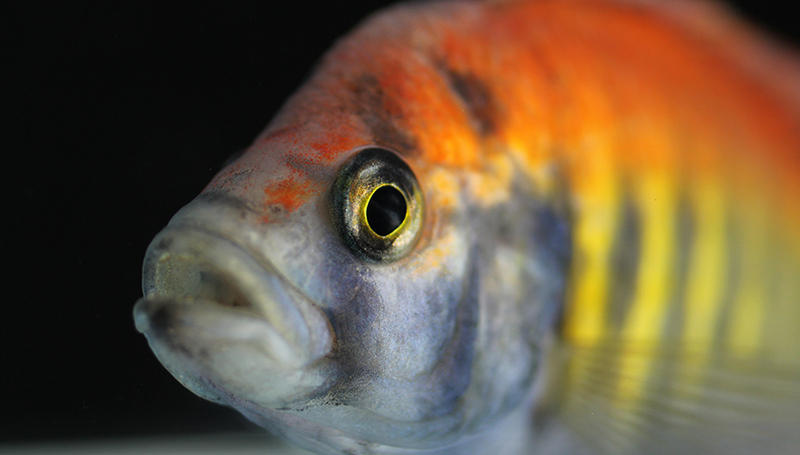
In den Seen Ostafrikas leben besonders viele verschiedene Arten von Buntbarschen. Diese Vielfalt entwickelte sich unter anderem dank Hybriden, denen es gelang, neue ökologische Nischen in ihren Lebensräumen zu erobern. Das fanden Wissenschaftlerinnen und Wissenschaftler des Wasserforschungsinstituts Eawag und der Universität Bern heraus.

Paaren sich zwei Tiere verschiedener Arten, nennt man den Nachwuchs einen Hybriden. Durch das Vermischen der Genome bilden sich in manchen Fällen Phänotypen aus, die mit neuen Umweltbedingungen besser zurechtkommen als die beiden Elternarten. Oftmals sind Hybriden nicht fortpflanzungsfähig, doch es gibt etliche Ausnahmen, etwa bei den Buntbarschen. Aus solchen fortpflanzungsfähigen Hybridpopulationen können neue Arten entstehen. In anderen Fällen kommen Hybriden jedoch weniger gut zurecht und tragen wenig zum Genpool zukünftiger Generationen bei. Welcher Fall eintritt, hängt unter anderem davon ab, wie viele ökologische Nischen im Lebensraum der Hybriden ungenutzt sind.

Dass die Hybridisierung in afrikanischen Seen wahrscheinlich eine wichtige Rolle bei der Entstehung der Artenvielfalt spielt, haben Ole Seehausen und sein Team der Eawag und Universität Bern in mehreren früheren Arbeiten aufgezeigt. Seehausen und sein Mitarbeiter Oliver Selz führten nun im Labor Experimente mit Buntbarschen aus dem Victoriasee in Afrika durch, um die ökologischen Mechanismen dahinter zu untersuchen.

Sie fanden heraus, dass Hybride die Nahrung, auf die die Elternarten spezialisiert sind, weniger effizient nutzen können. Weitet man das Angebot hingegen über die ökologischen Nischen der Elternarten aus, können Hybriden diese neuen Nischen häufig besser als ihre Elternarten erschliessen. Vielfältige Ökosysteme mit noch unbesetzten Nischen könnten daher die Bildung neuer Arten begünstigen.

Hybridisierung förderte Artbildung im Mweru-See

Eine ebenfalls kürzlich erschienene Studie im Fachmagazin Nature Communications unterstreicht den Einfluss der Hybridisierung auf die Artbildung. Joana Meier und Ole Seehausen haben mit einem internationalen Forscherteam die Vielfalt und evolutionäre Geschichte von Fischen in zwei grossen, nahe beieinanderliegenden afrikanischen Seen, dem Bangweulu- sowie dem Mweru-See, untersucht. Während elf Buntbarscharten den Mweru-See aus dem Fluss Kongo und Fluss Zambesi kolonisierten, gelangten einzig aus dem Zambesi sechs Arten in den Bangweulu-See.

Nun konnten die Forschenden nachweisen, dass im Mweru-See etwa 40 neue Arten aus Hybridpopulationen zwischen Kongo- und Zambesi-Arten hervorgegangen sind. Hingegen fanden die Forscher im Bangweulu-See keine neuen Arten und auch keine Hybridisierungen zwischen den kolonisierenden Arten. «Die Untersuchungen zeigen, dass Hybridisierung zwischen zwei Arten unter gewissen ökologischen Voraussetzungen zur Entstehung zahlreicher neuer Arten beitragen kann», sagt Ole Seehausen.

Originalpublikationen

Extbase Variable Dump
array(2 items)
   publications => '19388,19761' (11 chars)
   libraryUrl => '' (0 chars)
Extbase Variable Dump
array(2 items)
   0 => Snowflake\Publications\Domain\Model\Publicationprototypepersistent entity (uid=19388, pid=124)
      originalId => protected19388 (integer)
      authors => protected'Selz, O. M.; Seehausen, O.' (41 chars)
      title => protected'Interspecific hybridization can generate functional novelty in cichlid fish' (75 chars)
      journal => protected'Proceedings of the Royal Society B: Biological Sciences' (55 chars)
      year => protected2019 (integer)
      volume => protected286 (integer)
      issue => protected'1913' (4 chars)
      startpage => protected'20191621 (9 pp.)' (16 chars)
      otherpage => protected'' (0 chars)
      categories => protected'adaptive radiation; hybridization; ecological speciation; cichlid fish' (70 chars)
      description => protected'The role of interspecific hybridization in evolution is still being debated.
          Interspecific hybridization has been suggested to facilitate the evolution
         of ecological novelty, and hence the invasion of new niches and adaptive rad
         iation when ecological opportunity is present beyond the parental species ni
         ches. On the other hand, hybrids between two ecologically divergent species
         may perform less well than parental species in their respective niches becau
         se hybrids would be intermediate in performance in both niches. The evolutio
         nary consequences of hybridization may hence be context-dependent, depending
          on whether ecological opportunities, beyond those of the parental species,
         do or do not exist. Surprisingly, these complementary predictions may never
         have been tested in the same experiment in animals. To do so, we investigate
          if hybrids between ecologically distinct cichlid species perform less well
         than the parental species when feeding on food either parent is adapted to,
         and if the same hybrids perform better than their parents when feeding on fo
         od none of the species are adapted to. We generated two first-generation hyb
         rid crosses between species of African cichlids. In feeding efficiency exper
         iments we measured the performance of hybrids and parental species on food t
         ypes representing both parental species niches and additional ‘novel’ ni
         ches, not used by either of the parental species but by other species in the
          African cichlid radiations. We found that hybrids can have higher feeding e
         fficiencies on the 'novel' food types but typically have lower efficiencies
         on parental food types when compared to parental species. This suggests that
          hybridization can generate functional variation that can be of ecological r
         elevance allowing the access to resources outside of either parental species
          niche. Hence, we provide support for the hypothesis of ecological context-d
         ependency of the evolutionary impact of interspecific hybridization.
' (1968 chars) serialnumber => protected'0962-8452' (9 chars) doi => protected'10.1098/rspb.2019.1621' (22 chars) uid => protected19388 (integer) _localizedUid => protected19388 (integer)modified _languageUid => protectedNULL _versionedUid => protected19388 (integer)modified pid => protected124 (integer)
1 => Snowflake\Publications\Domain\Model\Publicationprototypepersistent entity (uid=19761, pid=124) originalId => protected19761 (integer) authors => protected'Meier, J. I.; Stelkens, R. B.; Joyce, D. A.; M
         waiko, S.; Phiri, N.; Schliewen, U. K.; Selz, O.&nb
         sp;M.; Wagner, C. E.; Katongo, C.; Seehausen, O.
' (220 chars) title => protected'The coincidence of ecological opportunity with hybridization explains rapid
         adaptive radiation in Lake Mweru cichlid fishes
' (124 chars) journal => protected'Nature Communications' (21 chars) year => protected2019 (integer) volume => protected10 (integer) issue => protected'' (0 chars) startpage => protected'5391 (11 pp.)' (13 chars) otherpage => protected'' (0 chars) categories => protected'' (0 chars) description => protected'The process of adaptive radiation was classically hypothesized to require i
         solation of a lineage from its source (no gene flow) and from related specie
         s (no competition). Alternatively, hybridization between species may generat
         e genetic variation that facilitates adaptive radiation. Here we study haplo
         chromine cichlid assemblages in two African Great Lakes to test these hypoth
         eses. Greater biotic isolation (fewer lineages) predicts fewer constraints b
         y competition and hence more ecological opportunity in Lake Bangweulu, where
         as opportunity for hybridization predicts increased genetic potential in Lak
         e Mweru. In Lake Bangweulu, we find no evidence for hybridization but also
         no adaptive radiation. We show that the Bangweulu lineages also colonized La
         ke Mweru, where they hybridized with Congolese lineages and then underwent m
         ultiple adaptive radiations that are strikingly complementary in ecology an
         d morphology. Our data suggest that the presence of several related lineage
         s does not necessarily prevent adaptive radiation, although it constrains th
         e trajectories of morphological diversification. It might instead facilitate
          adaptive radiation when hybridization generates genetic variation, without
         which radiation may start much later, progress more slowly or never occur.
' (1290 chars) serialnumber => protected'' (0 chars) doi => protected'10.1038/s41467-019-13278-z' (26 chars) uid => protected19761 (integer) _localizedUid => protected19761 (integer)modified _languageUid => protectedNULL _versionedUid => protected19761 (integer)modified pid => protected124 (integer)
Selz, O. M.; Seehausen, O. (2019) Interspecific hybridization can generate functional novelty in cichlid fish, Proceedings of the Royal Society B: Biological Sciences, 286(1913), 20191621 (9 pp.), doi:10.1098/rspb.2019.1621, Institutional Repository
Meier, J. I.; Stelkens, R. B.; Joyce, D. A.; Mwaiko, S.; Phiri, N.; Schliewen, U. K.; Selz, O. M.; Wagner, C. E.; Katongo, C.; Seehausen, O. (2019) The coincidence of ecological opportunity with hybridization explains rapid adaptive radiation in Lake Mweru cichlid fishes, Nature Communications, 10, 5391 (11 pp.), doi:10.1038/s41467-019-13278-z, Institutional Repository