News Detail

Hybrids increase fish biodiversity in lakes of East Africa

December 5, 2019 | Stephanie Schnydrig

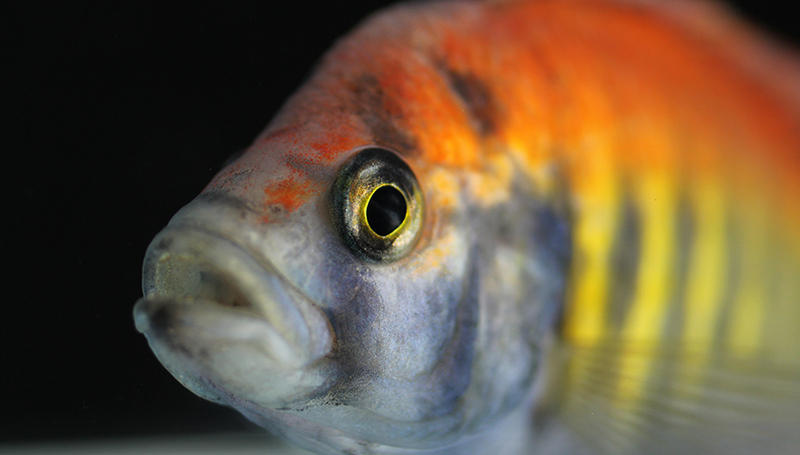
The lakes of East Africa are home to a surprising number of different cichlid species. This level of biodiversity has developed partly due to hybrids that managed to take over new ecological niches in their habitats, according to recent research carried out by scientists at the Swiss Federal Institute of Aquatic Science and Technology, Eawag, and the University of Bern.

When two individuals from different species mate, the offspring is known as a hybrid. As a result of the genomes being mixed, sometimes phenotypes are produced that deal with new environmental conditions better than the two parent species. Very often, hybrids are not able to reproduce, but there are quite a number of exceptions to this, including the cichlids. New species can emerge from such fertile hybrid populations. In other cases, however, hybrids are less well-suited to their environment and so contribute little to the gene pool of future generations. Which of these situations arises depends, among other things, on how many unoccupied ecological niches exist in the hybrids’ habitat.

In several earlier studies, Ole Seehausen and his team at Eawag and the University of Bern have highlighted the probable importance of hybridisation for the development of biodiversity in African lakes. Seehausen and his colleague Oliver Selz have now performed laboratory experiments with cichlids from Lake Victoria in Africa, in order to investigate the ecological mechanisms behind this phenomenon.

They discovered that hybrids are less efficient at using the food that the parent species are specialised to eat. But if the available food is expanded beyond the ecological niches of the parent species, hybrids are often then better able to exploit these new niches than their parents. Diverse ecosystems with as-yet unoccupied niches could therefore favour the emergence of new species.

Hybridisation promoted speciation in Lake Mweru

Another recent study that was reported in the journal Nature Communications also highlights the influence of hybridisation on speciation. Joana Meier and Ole Seehausen worked with an international research team to investigate the biodiversity and evolutionary history of fish in two large neighbouring African lakes – Lake Bangweulu and Lake Mweru. While eleven cichlid species colonised Lake Mweru from the Congo and Zambezi Rivers, only six species from the Zambezi ended up in Lake Bangweulu.

The researchers have now been able to show that around 40 new species have emerged in Lake Mweru from hybridisation between Congo and Zambezi species. However, the researchers did not find any new species in Lake Bangweulu, nor did they find any hybridisation between the colonising species. “The studies show that hybridisation between two species under certain ecological conditions can play a part in the emergence of numerous new species”, says Ole Seehausen.

Original publications

Extbase Variable Dump
array(2 items)
   publications => '19388,19761' (11 chars)
   libraryUrl => '' (0 chars)
Extbase Variable Dump
array(2 items)
   0 => Snowflake\Publications\Domain\Model\Publicationprototypepersistent entity (uid=19388, pid=124)
      originalId => protected19388 (integer)
      authors => protected'Selz, O. M.; Seehausen, O.' (41 chars)
      title => protected'Interspecific hybridization can generate functional novelty in cichlid fish' (75 chars)
      journal => protected'Proceedings of the Royal Society B: Biological Sciences' (55 chars)
      year => protected2019 (integer)
      volume => protected286 (integer)
      issue => protected'1913' (4 chars)
      startpage => protected'20191621 (9 pp.)' (16 chars)
      otherpage => protected'' (0 chars)
      categories => protected'adaptive radiation; hybridization; ecological speciation; cichlid fish' (70 chars)
      description => protected'The role of interspecific hybridization in evolution is still being debated.
          Interspecific hybridization has been suggested to facilitate the evolution
         of ecological novelty, and hence the invasion of new niches and adaptive rad
         iation when ecological opportunity is present beyond the parental species ni
         ches. On the other hand, hybrids between two ecologically divergent species
         may perform less well than parental species in their respective niches becau
         se hybrids would be intermediate in performance in both niches. The evolutio
         nary consequences of hybridization may hence be context-dependent, depending
          on whether ecological opportunities, beyond those of the parental species,
         do or do not exist. Surprisingly, these complementary predictions may never
         have been tested in the same experiment in animals. To do so, we investigate
          if hybrids between ecologically distinct cichlid species perform less well
         than the parental species when feeding on food either parent is adapted to,
         and if the same hybrids perform better than their parents when feeding on fo
         od none of the species are adapted to. We generated two first-generation hyb
         rid crosses between species of African cichlids. In feeding efficiency exper
         iments we measured the performance of hybrids and parental species on food t
         ypes representing both parental species niches and additional ‘novel’ ni
         ches, not used by either of the parental species but by other species in the
          African cichlid radiations. We found that hybrids can have higher feeding e
         fficiencies on the 'novel' food types but typically have lower efficiencies
         on parental food types when compared to parental species. This suggests that
          hybridization can generate functional variation that can be of ecological r
         elevance allowing the access to resources outside of either parental species
          niche. Hence, we provide support for the hypothesis of ecological context-d
         ependency of the evolutionary impact of interspecific hybridization.
' (1968 chars) serialnumber => protected'0962-8452' (9 chars) doi => protected'10.1098/rspb.2019.1621' (22 chars) uid => protected19388 (integer) _localizedUid => protected19388 (integer)modified _languageUid => protectedNULL _versionedUid => protected19388 (integer)modified pid => protected124 (integer)
1 => Snowflake\Publications\Domain\Model\Publicationprototypepersistent entity (uid=19761, pid=124) originalId => protected19761 (integer) authors => protected'Meier, J. I.; Stelkens, R. B.; Joyce, D. A.; M
         waiko, S.; Phiri, N.; Schliewen, U. K.; Selz, O.&nb
         sp;M.; Wagner, C. E.; Katongo, C.; Seehausen, O.
' (220 chars) title => protected'The coincidence of ecological opportunity with hybridization explains rapid
         adaptive radiation in Lake Mweru cichlid fishes
' (124 chars) journal => protected'Nature Communications' (21 chars) year => protected2019 (integer) volume => protected10 (integer) issue => protected'' (0 chars) startpage => protected'5391 (11 pp.)' (13 chars) otherpage => protected'' (0 chars) categories => protected'' (0 chars) description => protected'The process of adaptive radiation was classically hypothesized to require i
         solation of a lineage from its source (no gene flow) and from related specie
         s (no competition). Alternatively, hybridization between species may generat
         e genetic variation that facilitates adaptive radiation. Here we study haplo
         chromine cichlid assemblages in two African Great Lakes to test these hypoth
         eses. Greater biotic isolation (fewer lineages) predicts fewer constraints b
         y competition and hence more ecological opportunity in Lake Bangweulu, where
         as opportunity for hybridization predicts increased genetic potential in Lak
         e Mweru. In Lake Bangweulu, we find no evidence for hybridization but also
         no adaptive radiation. We show that the Bangweulu lineages also colonized La
         ke Mweru, where they hybridized with Congolese lineages and then underwent m
         ultiple adaptive radiations that are strikingly complementary in ecology an
         d morphology. Our data suggest that the presence of several related lineage
         s does not necessarily prevent adaptive radiation, although it constrains th
         e trajectories of morphological diversification. It might instead facilitate
          adaptive radiation when hybridization generates genetic variation, without
         which radiation may start much later, progress more slowly or never occur.
' (1290 chars) serialnumber => protected'' (0 chars) doi => protected'10.1038/s41467-019-13278-z' (26 chars) uid => protected19761 (integer) _localizedUid => protected19761 (integer)modified _languageUid => protectedNULL _versionedUid => protected19761 (integer)modified pid => protected124 (integer)
Selz, O. M.; Seehausen, O. (2019) Interspecific hybridization can generate functional novelty in cichlid fish, Proceedings of the Royal Society B: Biological Sciences, 286(1913), 20191621 (9 pp.), doi:10.1098/rspb.2019.1621, Institutional Repository
Meier, J. I.; Stelkens, R. B.; Joyce, D. A.; Mwaiko, S.; Phiri, N.; Schliewen, U. K.; Selz, O. M.; Wagner, C. E.; Katongo, C.; Seehausen, O. (2019) The coincidence of ecological opportunity with hybridization explains rapid adaptive radiation in Lake Mweru cichlid fishes, Nature Communications, 10, 5391 (11 pp.), doi:10.1038/s41467-019-13278-z, Institutional Repository