Department Fish Ecology and Evolution

Speciation Genomics of Alpine Whitefish
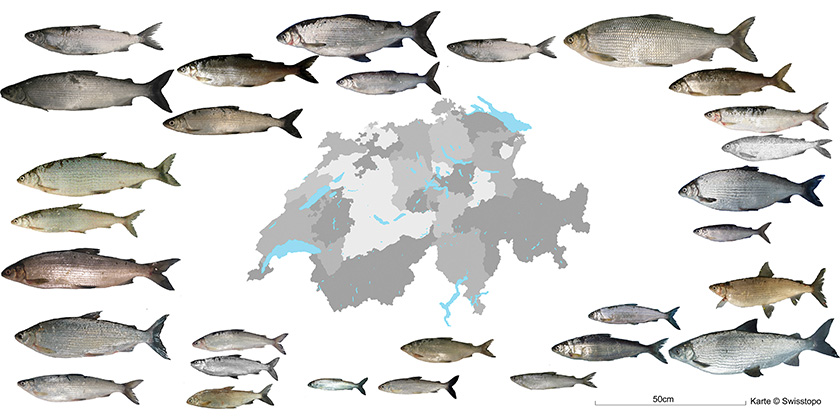
In our whitefish speciation genomics project we aim to ultimately understand the properties of the genome structure and the genomic architecture of traits facilitating the adaptive radiation of Alpine whitefish. To achieve this we build genomic resources for the Alpine whitefish radiation and we assess the genome evolution accompanying the diversification of this group. We investigate the genomic architecture of relevant ecological traits, like body size, shape, gill raker number and bring this together with a population genomic analysis across multiple lakes, species, and populations. In addition, we provide a genome-wide perspective of environmental change-induced speciation reversal that affected an entire whitefish radiation by comparing whole-genome resequencing data of pre- and post-speciation reversal populations.

Legacy of extinct species is retained in genomes of their extant relatives
February 24, 2022 – 

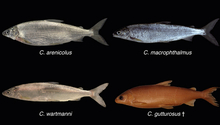
Nearly a hundred year old tissue samples from Lake Constance have enabled Eawag researchers to compare genetic material of an extinct whitefish species with that of extant co-occurring species. Their investigation showed that fragments of the genome of the extinct species have survived in today’s species. This could potentially facilitate the recolonization of the currently not occupied deep-water habitat. read more

Publication: Frei, D.; De-Kayne, R.; Selz, O.M.; Seehausen, O.; Feulner, P. (2022) Genomic variation from an extinct species is retained in the extant radiation following speciation reversal, DOI: 10.1038/s41559-022-01665-7Nature Ecology and Evolution

Gone but not forgotten: entire radiation retains genomic fragments from their lost sister species. Access the blogpost 'behind the paper' here


Selected Publications

Extbase Variable Dump
array(2 items)
   publications => '32245,26070,25558,20700,24480,18184,17867,15184' (47 chars)
   libraryUrl => '' (0 chars)
Extbase Variable Dump
array(8 items)
   0 => Snowflake\Publications\Domain\Model\Publicationprototypepersistent entity (uid=32245, pid=124)
      originalId => protected32245 (integer)
      authors => protected'Frei, D.; Mwaiko, S.; Seehausen, O.; Feulner, P. G.
          D.
' (84 chars) title => protected'Ecological disturbance reduces genomic diversity across an Alpine whitefish
         adaptive radiation
' (94 chars) journal => protected'Evolutionary Applications' (25 chars) year => protected2024 (integer) volume => protected17 (integer) issue => protected'2' (1 chars) startpage => protected'e13617 (12 pp.)' (15 chars) otherpage => protected'' (0 chars) categories => protected'Alpine whitefish; anthropogenic environmental change; genomic diversity decl
         ine
' (79 chars) description => protected'Genomic diversity is associated with the adaptive potential of a population
         and thereby impacts the extinction risk of a species during environmental ch
         ange. However, empirical data on genomic diversity of populations before env
         ironmental perturbations are rare and hence our understanding of the impact
         of perturbation on diversity is often limited. We here assess genomic divers
         ity utilising whole-genome resequencing data from all four species of the La
         ke Constance Alpine whitefish radiation. Our data covers a period of strong
         but transient anthropogenic environmental change and permits us to track cha
         nges in genomic diversity in all species over time. Genomic diversity became
          strongly reduced during the period of anthropogenic disturbance and has not
          recovered yet. The decrease in genomic diversity varies between 18% and 30%
         , depending on the species. Interspecific allele frequency differences of SN
         Ps located in potentially ecologically relevant genes were homogenized over
         time. This suggests that in addition to the reduction of genome-wide genetic
          variation, the differentiation that evolved in the process of adaptation to
          alternative ecologies between species might have been lost during the ecolo
         gical disturbance. The erosion of substantial amounts of genomic variation w
         ithin just a few generations in combination with the loss of potentially ada
         ptive genomic differentiation, both of which had evolved over thousands of y
         ears, demonstrates the sensitivity of biodiversity in evolutionary young ada
         ptive radiations towards environmental disturbance. Natural history collecti
         ons, such as the one used for this study, are instrumental in the assessment
          of genomic consequences of anthropogenic environmental change. Historical s
         amples enable us to document biodiversity loss against the shifting baseline
          syndrome and advance our understanding of the need for efficient biodiversi
         ty conservation on a global scale.
' (1934 chars) serialnumber => protected'1752-4571' (9 chars) doi => protected'10.1111/eva.13617' (17 chars) uid => protected32245 (integer) _localizedUid => protected32245 (integer)modified _languageUid => protectedNULL _versionedUid => protected32245 (integer)modified pid => protected124 (integer)
1 => Snowflake\Publications\Domain\Model\Publicationprototypepersistent entity (uid=26070, pid=124) originalId => protected26070 (integer) authors => protected'Frei, D.; Reichlin, P.; Seehausen, O.; Feulner, P. 
         G. D.
' (86 chars) title => protected'Introgression from extinct species facilitates adaptation to its vacated nic
         he
' (78 chars) journal => protected'Molecular Ecology' (17 chars) year => protected2023 (integer) volume => protected32 (integer) issue => protected'4' (1 chars) startpage => protected'841' (3 chars) otherpage => protected'853' (3 chars) categories => protected'adaptive radiation; deep-water adaptation; environmental change; extinction
         by hybridization; introgression
' (107 chars) description => protected'Anthropogenic disturbances of ecosystems are causing a loss of biodiversity
         at an unprecedented rate. Species extinctions often leave ecological niches
         underutilized, and their colonization by other species may require new adapt
         ation. In Lake Constance, on the borders of Germany, Austria and Switzerland
         , an endemic profundal whitefish species went extinct during a period of ant
         hropogenic eutrophication. In the process of extinction, the deep-water spec
         ies hybridized with three surviving whitefish species of Lake Constance, res
         ulting in introgression of genetic variation that is potentially adaptive in
          deep-water habitats. Here, we sampled a water depth gradient across a known
          spawning ground of one of these surviving species, <em>Coregonus macrophtha
         lmus</em>, and caught spawning individuals at greater depths (down to 90 m
         ) than historically recorded. We sequenced a total of 96 whole genomes, 11-1
         7 for each of six different spawning depth populations (4, 12, 20, 40, 60 an
         d 90 m), to document genomic intraspecific differentiation along a water d
         epth gradient. We identified 52 genomic regions that are potentially under d
         ivergent selection between the deepest (90 m) and all shallower (4-60 m)
          spawning habitats. At 12 (23.1%) of these 52 loci, the allele frequency pat
         tern across historical and contemporary populations suggests that introgress
         ion from the extinct species potentially facilitates ongoing adaptation to d
         eep water. Our results are consistent with the syngameon hypothesis, proposi
         ng that hybridization between members of an adaptive radiation can promote f
         urther niche expansion and diversification. Furthermore, our findings demons
         trate that introgression from extinct into extant species can be a source of
          evolvability, enabling rapid adaptation to environmental change, and may co
         ntribute to the ecological recovery of ecosystem functions after extinctions
         .
' (1901 chars) serialnumber => protected'0962-1083' (9 chars) doi => protected'10.1111/mec.16791' (17 chars) uid => protected26070 (integer) _localizedUid => protected26070 (integer)modified _languageUid => protectedNULL _versionedUid => protected26070 (integer)modified pid => protected124 (integer)
2 => Snowflake\Publications\Domain\Model\Publicationprototypepersistent entity (uid=25558, pid=124) originalId => protected25558 (integer) authors => protected'De-Kayne,&nbsp;R.; Selz,&nbsp;O.&nbsp;M.; Marques,&nbsp;D.&nbsp;A.; Frei,&nb
         sp;D.; Seehausen,&nbsp;O.; Feulner,&nbsp;P.&nbsp;G.&nbsp;D.
' (135 chars) title => protected'Genomic architecture of adaptive radiation and hybridization in Alpine white
         fish
' (80 chars) journal => protected'Nature Communications' (21 chars) year => protected2022 (integer) volume => protected13 (integer) issue => protected'1' (1 chars) startpage => protected'4479 (13 pp.)' (13 chars) otherpage => protected'' (0 chars) categories => protected'' (0 chars) description => protected'Adaptive radiations represent some of the most remarkable explosions of dive
         rsification across the tree of life. However, the constraints to rapid diver
         sification and how they are sometimes overcome, particularly the relative ro
         les of genetic architecture and hybridization, remain unclear. Here, we addr
         ess these questions in the Alpine whitefish radiation, using a whole-genome
         dataset that includes multiple individuals of each of the 22 species belongi
         ng to six ecologically distinct ecomorph classes across several lake-systems
         . We reveal that repeated ecological and morphological diversification along
          a common environmental axis is associated with both genome-wide allele freq
         uency shifts and a specific, larger effect, locus, associated with the gene
         <em>edar</em>. Additionally, we highlight the possible role of introgression
          between species from different lake-systems in facilitating the evolution a
         nd persistence of species with unique trait combinations and ecology. These
         results highlight the importance of both genome architecture and secondary c
         ontact with hybridization in fuelling adaptive radiation.
' (1121 chars) serialnumber => protected'' (0 chars) doi => protected'10.1038/s41467-022-32181-8' (26 chars) uid => protected25558 (integer) _localizedUid => protected25558 (integer)modified _languageUid => protectedNULL _versionedUid => protected25558 (integer)modified pid => protected124 (integer)
3 => Snowflake\Publications\Domain\Model\Publicationprototypepersistent entity (uid=20700, pid=124) originalId => protected20700 (integer) authors => protected'De-Kayne,&nbsp;R.; Zoller,&nbsp;S.; Feulner,&nbsp;P.&nbsp;G.&nbsp;D.' (68 chars) title => protected'<em>A de novo</em> chromosome-level genome assembly of <em>Coregonus sp. "Ba
         lchen"</em>: one representative of the Swiss Alpine whitefish radiation
' (147 chars) journal => protected'Molecular Ecology Resources' (27 chars) year => protected2020 (integer) volume => protected20 (integer) issue => protected'4' (1 chars) startpage => protected'1093' (4 chars) otherpage => protected'1109' (4 chars) categories => protected'Alpine whitefish; Coregonus; whitefish; Salmonidae; genome assembly' (67 chars) description => protected'Salmonids are of particular interest to evolutionary biologists due to their
          incredible diversity of life-history strategies and the speed at which many
          salmonid species have diversified. In Switzerland alone, over 30 species of
          Alpine whitefish from the subfamily Coregoninae have evolved since the last
          glacial maximum, with species exhibiting a diverse range of morphological a
         nd behavioural phenotypes. This, combined with the whole genome duplication
         which occurred in the ancestor of all salmonids, makes the Alpine whitefish
         radiation a particularly interesting system in which to study the genetic ba
         sis of adaptation and speciation and the impacts of ploidy changes and subse
         quent rediploidization on genome evolution. Although well curated genome ass
         emblies exist for many species within Salmonidae, genomic resources for the
         subfamily Coregoninae are lacking. To assemble a whitefish reference genome,
          we carried out PacBio sequencing from one wild-caught <em>Coregonus sp. "Ba
         lchen"</em> from Lake Thun to ~90x coverage. PacBio reads were assembled ind
         ependently using three different assemblers, Falcon, Canu and wtdbg2 and sub
         sequently scaffolded with additional Hi-C data. All three assemblies were hi
         ghly contiguous, had strong synteny to a previously published <em>Coregonus<
         /em> linkage map, and when mapping additional short-read data to each of the
          assemblies, coverage was fairly even across most chromosome-scale scaffolds
         . Here, we present the first <em>de novo</em> genome assembly for the Salmon
         id subfamily Coregoninae. The final 2.2 Gb wtdbg2 assembly included 40 scaff
         olds, an N50 of 51.9 Mb, and was 93.3% complete for BUSCOs. The assembly con
         sisted of ~52% TEs and contained 44,525 genes.
' (1718 chars) serialnumber => protected'1755-098X' (9 chars) doi => protected'10.1111/1755-0998.13187' (23 chars) uid => protected20700 (integer) _localizedUid => protected20700 (integer)modified _languageUid => protectedNULL _versionedUid => protected20700 (integer)modified pid => protected124 (integer)
4 => Snowflake\Publications\Domain\Model\Publicationprototypepersistent entity (uid=24480, pid=124) originalId => protected24480 (integer) authors => protected'Frei,&nbsp;D.; De-Kayne,&nbsp;R.; Selz,&nbsp;O.&nbsp;M.; Seehausen,&nbsp;O.;
          Feulner,&nbsp;P.&nbsp;G.&nbsp;D.
' (109 chars) title => protected'Genomic variation from an extinct species is retained in the extant radiatio
         n following speciation reversal
' (107 chars) journal => protected'Nature Ecology & Evolution' (26 chars) year => protected2022 (integer) volume => protected6 (integer) issue => protected'' (0 chars) startpage => protected'461' (3 chars) otherpage => protected'468' (3 chars) categories => protected'' (0 chars) description => protected'Ecosystem degradation and biodiversity loss are major global challenges. Whe
         n reproductive isolation between species is contingent on the interaction of
          intrinsic lineage traits with features of the environment, environmental ch
         ange can weaken reproductive isolation and result in extinction through hybr
         idization. By this process called speciation reversal, extinct species can l
         eave traces in genomes of extant species through introgressive hybridization
         . Using historical and contemporary samples, we sequenced all four species o
         f an Alpine whitefish radiation before and after anthropogenic lake eutrophi
         cation and the associated loss of one species through speciation reversal. D
         espite the extinction of this taxon, substantial fractions of its genome, in
         cluding regions shaped by positive selection before eutrophication, persist
         within surviving species as a consequence of introgressive hybridization dur
         ing eutrophication. Given the prevalence of environmental change, studying s
         peciation reversal and its genomic consequences provides fundamental insight
         s into evolutionary processes and informs biodiversity conservation.
' (1132 chars) serialnumber => protected'' (0 chars) doi => protected'10.1038/s41559-022-01665-7' (26 chars) uid => protected24480 (integer) _localizedUid => protected24480 (integer)modified _languageUid => protectedNULL _versionedUid => protected24480 (integer)modified pid => protected124 (integer)
5 => Snowflake\Publications\Domain\Model\Publicationprototypepersistent entity (uid=18184, pid=124) originalId => protected18184 (integer) authors => protected'Feulner,&nbsp;P.&nbsp;G.&nbsp;D.; Seehausen,&nbsp;O.' (52 chars) title => protected'Genomic insights into the vulnerability of sympatric whitefish species flock
         s
' (77 chars) journal => protected'Molecular Ecology' (17 chars) year => protected2019 (integer) volume => protected28 (integer) issue => protected'' (0 chars) startpage => protected'615' (3 chars) otherpage => protected'629' (3 chars) categories => protected'coregonus spp; ecological speciation; RADseq; speciation reversal' (65 chars) description => protected'The erosion of habitat heterogeneity can reduce species diversity directly b
         ut can also lead to the loss of distinctiveness of sympatric species through
          speciation reversal. We know little about changes in genomic differentiatio
         n during the early stages of these processes, which can be mediated by anthr
         opogenic perturbation. Here, we analyse three sympatric whitefish species (<
         em>Coregonus</em> spp) sampled across two neighbouring and connected Swiss p
         re‐alpine lakes, which have been differentially affected by anthropogenic
         eutrophication. Our data set comprises 16,173 loci genotyped across 138 whit
         efish using restriction‐site associated DNA sequencing (RADseq). Our analy
         sis suggests that in each of the two lakes the population of a different, bu
         t ecologically similar, whitefish species declined following a recent period
          of eutrophication. Genomic signatures consistent with hybridisation are mor
         e pronounced in the more severely impacted lake. Comparisons between sympatr
         ic pairs of whitefish species with contrasting ecology, where one is shallow
          benthic and the other one more profundal pelagic, reveal genomic differenti
         ation that is largely correlated along the genome, while differentiation is
         uncorrelated between pairs of allopatric provenance with similar ecology. We
          identify four genomic loci that provide evidence of parallel divergent adap
         tation between the shallow benthic species and the two different more profun
         dal species. Functional annotations available for two of those loci are cons
         istent with divergent ecological adaptation. Our genomic analysis indicates
         the action of divergent natural selection between sympatric whitefish specie
         s in pre‐alpine lakes and reveals the vulnerability of these species to an
         thropogenic alterations of the environment and associated adaptive landscape
         .
' (1825 chars) serialnumber => protected'0962-1083' (9 chars) doi => protected'10.1111/mec.14977' (17 chars) uid => protected18184 (integer) _localizedUid => protected18184 (integer)modified _languageUid => protectedNULL _versionedUid => protected18184 (integer)modified pid => protected124 (integer)
6 => Snowflake\Publications\Domain\Model\Publicationprototypepersistent entity (uid=17867, pid=124) originalId => protected17867 (integer) authors => protected'De-Kayne,&nbsp;R.; Feulner,&nbsp;P.&nbsp;G.&nbsp;D.' (51 chars) title => protected'A European whitefish linkage map and its implications for understanding geno
         me-wide synteny between salmonids following whole genome duplication
' (144 chars) journal => protected'G3: Genes, Genomes, Genetics' (28 chars) year => protected2018 (integer) volume => protected8 (integer) issue => protected'12' (2 chars) startpage => protected'3745' (4 chars) otherpage => protected'3755' (4 chars) categories => protected'Coregonus; RAD; recombination rate; Salmonidae; sex-specific linkage maps; s
         ynteny
' (82 chars) description => protected'Genomic datasets continue to increase in number due to the ease of productio
         n for a wider selection of species including non-model organisms. For many o
         f these species, especially those with large or polyploid genomes, highly co
         ntiguous and well-annotated genomes are still rare due to the complexity and
          cost involved in their assembly. As a result, a common starting point for g
         enomic work in non-model species is the production of a linkage map. Dense l
         inkage maps facilitate the analysis of genomic data in a variety of ways, fr
         om broad scale observations regarding genome structure e.g. chromosome numbe
         r and type or sex-related structural differences, to fine scale patterns e.g
         . recombination rate variation and co-localization of differentiated regions
         . Here we present both sex-averaged and sex-specific linkage maps for <em>Co
         regonus sp. "Albock"</em>, a member of the European whitefish lineage (<em>C
         . lavaretus</em> spp. complex), containing 5395 single nucleotide polymorphi
         sm (SNP) loci across 40 linkage groups to facilitate future investigation in
         to the genomic basis of whitefish adaptation and speciation. The map was pro
         duced using restriction-site associated digestion (RAD) sequencing data from
          two wild-caught parents and 156 F1 offspring. We discuss the differences be
         tween our sex-averaged and sex-specific maps and identify genome-wide synten
         y between <em>C. sp. "Albock"</em> and Atlantic Salmon (<em>Salmo salar</em>
         ), which have diverged following the salmonid-specific whole genome duplicat
         ion. Our analysis confirms that many patterns of synteny observed between At
         lantic Salmon and <em>Oncorhynchus and Salvelinus</em> species are also shar
         ed by members of the Coregoninae subfamily. We also show that regions known
         for their species-specific rediploidization history can pose challenges for
         synteny identification since these regions have diverged independently in ea
         ch salmonid species following the salmonid-specific whole genome duplication
         . The European whitefish...
' (2243 chars) serialnumber => protected'' (0 chars) doi => protected'10.1534/g3.118.200552' (21 chars) uid => protected17867 (integer) _localizedUid => protected17867 (integer)modified _languageUid => protectedNULL _versionedUid => protected17867 (integer)modified pid => protected124 (integer)
7 => Snowflake\Publications\Domain\Model\Publicationprototypepersistent entity (uid=15184, pid=124) originalId => protected15184 (integer) authors => protected'Feulner,&nbsp;P.&nbsp;G.&nbsp;D.; De-Kayne,&nbsp;R.' (51 chars) title => protected'Genome evolution, structural rearrangements and speciation' (58 chars) journal => protected'Journal of Evolutionary Biology' (31 chars) year => protected2017 (integer) volume => protected30 (integer) issue => protected'8' (1 chars) startpage => protected'1488' (4 chars) otherpage => protected'1490' (4 chars) categories => protected'' (0 chars) description => protected'' (0 chars) serialnumber => protected'1010-061X' (9 chars) doi => protected'10.1111/jeb.13101' (17 chars) uid => protected15184 (integer) _localizedUid => protected15184 (integer)modified _languageUid => protectedNULL _versionedUid => protected15184 (integer)modified pid => protected124 (integer)
Frei, D.; Mwaiko, S.; Seehausen, O.; Feulner, P. G. D. (2024) Ecological disturbance reduces genomic diversity across an Alpine whitefish adaptive radiation, Evolutionary Applications, 17(2), e13617 (12 pp.), doi:10.1111/eva.13617, Institutional Repository
Frei, D.; Reichlin, P.; Seehausen, O.; Feulner, P. G. D. (2023) Introgression from extinct species facilitates adaptation to its vacated niche, Molecular Ecology, 32(4), 841-853, doi:10.1111/mec.16791, Institutional Repository
De-Kayne, R.; Selz, O. M.; Marques, D. A.; Frei, D.; Seehausen, O.; Feulner, P. G. D. (2022) Genomic architecture of adaptive radiation and hybridization in Alpine whitefish, Nature Communications, 13(1), 4479 (13 pp.), doi:10.1038/s41467-022-32181-8, Institutional Repository
De-Kayne, R.; Zoller, S.; Feulner, P. G. D. (2020) A de novo chromosome-level genome assembly of Coregonus sp. "Balchen": one representative of the Swiss Alpine whitefish radiation, Molecular Ecology Resources, 20(4), 1093-1109, doi:10.1111/1755-0998.13187, Institutional Repository
Frei, D.; De-Kayne, R.; Selz, O. M.; Seehausen, O.; Feulner, P. G. D. (2022) Genomic variation from an extinct species is retained in the extant radiation following speciation reversal, Nature Ecology & Evolution, 6, 461-468, doi:10.1038/s41559-022-01665-7, Institutional Repository
Feulner, P. G. D.; Seehausen, O. (2019) Genomic insights into the vulnerability of sympatric whitefish species flocks, Molecular Ecology, 28, 615-629, doi:10.1111/mec.14977, Institutional Repository
De-Kayne, R.; Feulner, P. G. D. (2018) A European whitefish linkage map and its implications for understanding genome-wide synteny between salmonids following whole genome duplication, G3: Genes, Genomes, Genetics, 8(12), 3745-3755, doi:10.1534/g3.118.200552, Institutional Repository
Feulner, P. G. D.; De-Kayne, R. (2017) Genome evolution, structural rearrangements and speciation, Journal of Evolutionary Biology, 30(8), 1488-1490, doi:10.1111/jeb.13101, Institutional Repository

Contacts

Funding

One PhD project was funded by the Swiss National Science Foundation.
 

Another PhD project was integrated into a larger project on Lake Constance 'SeeWandel' funded by multiple partners
SeeWandel homepage