Department Surface Waters - Research and Management

Carbon Cycle in the Danube Delta
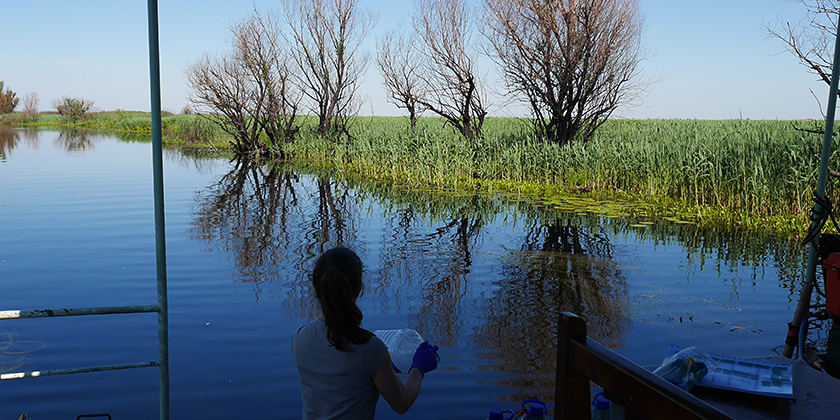

Rivers and lakes release significant amounts of greenhouse gases like carbon dioxide and methane to the atmosphere. Climate modelers have only limited information on this process. The C-CASCADES project aims at changing this.
As part of this project, we are studying the temporal and spatial variation of carbon dioxide and methane concentrations, together with their sources and emission rates in the Danube Delta. This second largest river delta in Europe receives stream water from 19 European countries. With its closely connected river branches, channels, and flow-through lakes, it offers an interesting setting to study carbon cycling and atmospheric emissions in different aquatic environments.

Approaches

We investigate the temporal and spatial variability of the transformation and outgassing of carbon in different aquatic habitats of the delta. Over a 2-year period, we monitor dissolved and particulate carbon species. We combine this with stable and radiocarbon analysis and in-situ measurements of carbon dioxide and methane concentrations and fluxes.

Publications

Tim Kalvelage (2016): Dünger fürs Klima? Forschung im Mündungsdelta der Donau, Polykum, Ausgabe 01 2016/2017, 14-17. pdf, 492KB

Extbase Variable Dump
array(2 items)
   publications => '22136,24741' (11 chars)
   libraryUrl => '' (0 chars)
Extbase Variable Dump
array(2 items)
   0 => Snowflake\Publications\Domain\Model\Publicationprototypepersistent entity (uid=22136, pid=124)
      originalId => protected22136 (integer)
      authors => protected'Maier, M.-S.; Teodoru, C. R.; Wehrli, B.' (60 chars)
      title => protected'Spatio-temporal variations in lateral and atmospheric carbon fluxes from the
          Danube Delta
' (89 chars) journal => protected'Biogeosciences' (14 chars) year => protected2021 (integer) volume => protected18 (integer) issue => protected'4' (1 chars) startpage => protected'1417' (4 chars) otherpage => protected'1437' (4 chars) categories => protected'' (0 chars) description => protected'River deltas, with their mosaic of ponds, channels and seasonally inundated
         areas, act as the last continental hot spots of carbon turnover along the la
         nd–ocean aquatic continuum. There is increasing evidence for the important
          role of riparian wetlands in the transformation and emission of terrestrial
          carbon to the atmosphere. The considerable spatial heterogeneity of river d
         eltas, however, forms a major obstacle for quantifying carbon emissions and
         their seasonality. The water chemistry in the river reaches is defined by th
         e upstream catchment, whereas delta lakes and channels are dominated by loca
         l processes such as aquatic primary production, respiration or lateral excha
         nge with the wetlands. In order to quantify carbon turnover and emissions in
          the complex mosaic of the Danube Delta, we conducted monthly field campaign
         s over 2 years at 19 sites spanning river reaches, channels and lakes. Here
          we report on the greenhouse gas fluxes (CO<sub>2</sub> and CH<sub>4</sub>)
         from the freshwater systems of the Danube Delta and present the first season
         ally resolved estimates of its freshwater carbon emissions to the atmosphere
         . Furthermore, we quantify the lateral carbon transport of the Danube River
         to the Black Sea.<br /> We estimate the delta's CO<sub>2</sub> and CH<sub>4<
         /sub> emissions to be 65 GgC yr<sup>-1</sup> (30–120 GgC yr<sup>-1
         </sup>, a range calculated using 25 to 75 percentiles of observed fluxes), o
         f which about 8 % are released as CH<sub>4</sub>. The median CO<sub>2</sub
         
         
         fluxes amount to 0.42, 2.0 and 1.5 mmol m<sup>-2</sup> d<sup>-1</sup>.
          While lakes do have the potential to act as CO<sub>2</sub> sinks in summer,
          they are generally the largest emitters of CH<sub>4</sub>. Small channels s
         howed the largest range in emissions, including a CO<sub>2</sub> and CH<sub>
         4</sub> hot spot sustain...
' (2819 chars) serialnumber => protected'1726-4170' (9 chars) doi => protected'10.5194/bg-18-1417-2021' (23 chars) uid => protected22136 (integer) _localizedUid => protected22136 (integer)modified _languageUid => protectedNULL _versionedUid => protected22136 (integer)modified pid => protected124 (integer)
1 => Snowflake\Publications\Domain\Model\Publicationprototypepersistent entity (uid=24741, pid=124) originalId => protected24741 (integer) authors => protected'Maier,&nbsp;M.-S.; Canning,&nbsp;A.&nbsp;R.; Brennwald,&nbsp;M.&nbsp;S.; Teo
         doru,&nbsp;C.&nbsp;R.; Wehrli,&nbsp;B.
' (114 chars) title => protected'Spatial mapping of dissolved gases in the Danube Delta reveals intense plant
         -mediated gas transfer
' (98 chars) journal => protected'Frontiers in Environmental Science' (34 chars) year => protected2022 (integer) volume => protected10 (integer) issue => protected'' (0 chars) startpage => protected'838126 (16 pp.)' (15 chars) otherpage => protected'' (0 chars) categories => protected'carbon cycle; greenhouse gases; noble gases; plant-mediated gas transfer; eb
         ullition; excess air; Danube Delta; membrane-inlet mass spectrometry
' (144 chars) description => protected'Global estimates see river deltas and estuaries contributing about equally t
         o CO<sub>2</sub> and CH<sub>4</sub> emissions as lakes and reservoirs, despi
         te a factor 6 smaller surface area. Assessing the horizontal gradients in di
         ssolved gas concentrations from large river reaches to connecting canals and
          wetland lakes remains a challenge in many deltaic systems. To elucidate the
          processes affecting local CO<sub>2</sub> and CH<sub>4</sub> concentrations
         in the Romanian part of the Danube Delta, we mapped dissolved O<sub>2</sub>,
          N<sub>2</sub>, He and Ar using a portable gas-equilibration membrane-inlet
         mass spectrometer (GE-MIMS), along with CO<sub>2</sub>, CH<sub>4</sub>, wate
         r temperature and conductivity. We measured the concentrations along the aqu
         atic continuum from a small houseboat during two campaigns, in spring and au
         tumn, to capture different hydrological and plant growth conditions. Delta-s
         cale concentration patterns were comparably stable across seasons. Small con
         necting channels were highly influenced by the riparian wetland, which was s
         trongest in the eastern part of the biosphere reserve. These sites represent
         ed the delta’s CO<sub>2</sub> and CH<sub>4</sub> hotspots and showed clear
          signs of excess air, i.e., supersaturation of dissolved noble gases with re
         spect to air-saturated water. As the adjacent wetland was permanently inunda
         ted, this signal was likely caused by root aeration of <em>Phragmites austra
         lis</em>, as opposed to traditional excess air formation via water table flu
         ctuations in the unsaturated zone. The special vegetation setting with reed
         growing on floating peat coincided with the highest CO<sub>2</sub> and CH<su
         b>4</sub> concentrations (&gt;700 μmol/L CO<sub>2</sub> and 13 μmol/L CH
         <sub>4</sub>, respectively) observed in an adjacent channel. Shallow lakes,
         on the other hand, were major sites of photosynthetic production with O<sub>
         2</sub> oversaturation reaching up to 150% in spring. The observed deficit i
         n non-reactive gases (He...
' (2487 chars) serialnumber => protected'' (0 chars) doi => protected'10.3389/fenvs.2022.838126' (25 chars) uid => protected24741 (integer) _localizedUid => protected24741 (integer)modified _languageUid => protectedNULL _versionedUid => protected24741 (integer)modified pid => protected124 (integer)
Maier, M.-S.; Teodoru, C. R.; Wehrli, B. (2021) Spatio-temporal variations in lateral and atmospheric carbon fluxes from the Danube Delta, Biogeosciences, 18(4), 1417-1437, doi:10.5194/bg-18-1417-2021, Institutional Repository
Maier, M.-S.; Canning, A. R.; Brennwald, M. S.; Teodoru, C. R.; Wehrli, B. (2022) Spatial mapping of dissolved gases in the Danube Delta reveals intense plant-mediated gas transfer, Frontiers in Environmental Science, 10, 838126 (16 pp.), doi:10.3389/fenvs.2022.838126, Institutional Repository

Contact

Cooperations

Tim Eglington (ETH Zürich), Asa Horgby, Tom Battin (EPFL) Anna Canning, Peer Fietzek (Kongsberg Maritime Contros GmbH)

Funding

C-CASCADES project (EU Horizon 2020 program)