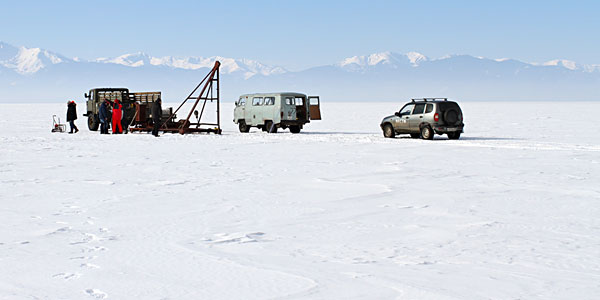
Lake Baikal (Siberia) is a unique system. It is the largest surface freshwater reservoir in the world, it harbours an incredible amount of endemic species at all trophic levels, and its sediments are a climate archive of exceptional quality. In collaboration with the Limnological Institute of the Siberian Branch of the Russian Academy of Science, the Department of Applied Physics at the Irkutsk State University, and several other partners, we investigated the mixing processes and the cycling of nutrients and methane within the lake.
Mixing processes
Despite its enormous depth of more than 1600 m, the lake is oxygenated down to the deepest reaches. This is due to two processes: a very efficient turbulent transport within the extremely weakly stratified water body, and regularly occurring intrusions of water masses plunging from the surface to the bottom of the lake. We investigated the mechanisms that lead to both the turbulent and the advective deep-water renewal, using moored thermistors and current meters, vertical profiles of temperature and conductivity, and temperature microstructure profiles.
Cycling of nutrients and methane
Based on our knowledge about the mixing processes in the lake, combined with data from sediment traps and sediment cores, we estimated the internal fluxes of nutrients within the lake. Lake Baikal is also the only lake containing significant amounts of methane hydrates. Previous estimates indicated that it could be a significant source of methane to the atmosphere. Based on numerous measurements of methane concentrations in the water (performed by Pacific Oceanological Insitute in Vladivostok) and the near-surface air (Institute of Atmospheric Optics, Tomsk), we estimated the large-scale methane fluxes within the lake and between the lake and the atmosphere.
array(6 items)0 => Snowflake\Publications\Domain\Model\Publicationprototypepersistent entity (uid=8157, pid=124)originalId => protected8157 (integer)
authors => protected'Tsimitri, C.; Rockel, B.; Wüest, A.; Budnev, N. M. ; Sturm, M.; Schmid, M.' (109 chars)
title => protected'Drivers of deep-water renewal events observed over 13 years in the South Bas in of Lake Baikal' (93 chars)
journal => protected'Journal of Geophysical Research: Oceans' (39 chars)
year => protected2015 (integer)
volume => protected120 (integer)
issue => protected'3' (1 chars)
startpage => protected'1508' (4 chars)
otherpage => protected'1526' (4 chars)
categories => protected'' (0 chars)
description => protected'Lake Baikal, with a depth of 1637 m, is characterized by deep-water intrusio ns that bridge the near-surface layer to the hypolimnion. These episodic eve nts transfer heat and oxygen over large vertical scales and maintain the per manent temperature stratified deep-water status of the lake. Here we evaluat e a series of intrusion events that reached the bottom of the lake in terms of the stratification and the wind conditions under which they occurred and provide a new insight into the triggering mechanisms. We make use of long-te rm temperature and current meter data (2000–2013) recorded in the South Ba sin of the lake combined with wind data produced with a regional downscaling of the global NCEP-RA1 reanalysis product. A total of 13 events were observ ed during which near-surface cold water reached the bottom of the South Basi n at 1350 m depth. We found that the triggering mechanism of the events is r elated to the time of the year that they take place. We categorized the even ts in three groups: (1) winter events, observed shortly before the complete ice cover of the lake that are triggered by Ekman coastal downwelling, (2) u nder-ice events, and (3) spring events, that show no correlation to the wind conditions and are possibly connected to the increased spring outflow of th e Selenga River.' (1308 chars)
serialnumber => protected'2169-9275' (9 chars)
doi => protected'10.1002/2014JC010449' (20 chars)
uid => protected8157 (integer)
_localizedUid => protected8157 (integer)modified_languageUid => protectedNULL
_versionedUid => protected8157 (integer)modifiedpid => protected124 (integer)1 => Snowflake\Publications\Domain\Model\Publicationprototypepersistent entity (uid=5718, pid=124)originalId => protected5718 (integer)
authors => protected'Schmid, M.; Budnev, N. M.; Granin, N. G.; Sturm,&nb sp;M.; Schurter, M.; Wüest, A.' (117 chars)
title => protected'Lake Baikal deepwater renewal mystery solved' (44 chars)
journal => protected'Geophysical Research Letters' (28 chars)
year => protected2008 (integer)
volume => protected35 (integer)
issue => protected'9' (1 chars)
startpage => protected'1' (1 chars)
otherpage => protected'5' (1 chars)
categories => protected'' (0 chars)
description => protected'Deepwater renewal by intrusions and turbulent diffusion in Lake Baikal is ve ry effective despite the enormous depth of up to 1642 m and the permanently stable stratification below ∼300 m depth. Temperature time series recorded at the bottom of a mooring installed since March 2000 in the South Basin of the lake indicate recurrent freshwater intrusions with volumes of 50 to 100 km<SUP>3</SUP>, about one order of magnitude larger than previously observe d intrusions. Numerous mechanisms have been proposed to explain the advectiv e deep water renewal. Here we present for the first time direct observations which prove that they are caused by coastal downwelling and subsequent ther mobaric instability along the steep lake shores. Understanding these mechani sms is an important prerequisite for studying biogeochemical cycles, for pre dicting the effects of climate change on this unique ecosystem and for evalu ating the local climate history from the extraordinary sedimentary record of Lake Baikal.' (1001 chars)
serialnumber => protected'0094-8276' (9 chars)
doi => protected'10.1029/2008GL033223' (20 chars)
uid => protected5718 (integer)
_localizedUid => protected5718 (integer)modified_languageUid => protectedNULL
_versionedUid => protected5718 (integer)modifiedpid => protected124 (integer)2 => Snowflake\Publications\Domain\Model\Publicationprototypepersistent entity (uid=5539, pid=124)originalId => protected5539 (integer)
authors => protected'Schmid, M.; De Batist, M.; Granin, N. G.; Kapitanov,&nbs p;V. A.; McGinnis, D. F.; Mizandrontsev, I. B.; Obz hirov, A. I.; Wüest, A.' (191 chars)
title => protected'Sources and sinks of methane in Lake Baikal: a synthesis of measurements and modeling' (85 chars)
journal => protected'Limnology and Oceanography' (26 chars)
year => protected2007 (integer)
volume => protected52 (integer)
issue => protected'5' (1 chars)
startpage => protected'1824' (4 chars)
otherpage => protected'1837' (4 chars)
categories => protected'' (0 chars)
description => protected'We studied the methane (CH<sub>4</sub>) budget of Lake Baikal, the most volu minous lake in the world and the only freshwater body with known occurrences of methane hydrates in the sediments. CH<sub>4</sub> concentrations were me asured in water samples taken during six expeditions between October 2002 an d June 2004; these expeditions covered the entire lake volume. A one-dimensi onal model was applied to (1) estimate the large-scale vertical CH<sub>4</su b> fluxes within the South Basin of Lake Baikal, (2) determine the exchange with the atmosphere, and (3) constrain the CH<sub>4</sub> inputs from seeps and mud volcanoes to the deep water. Fluxes were generally several orders of magnitude below previous estimates. The annual internal source of CH<sub>4< /sub> to the pelagic surface mixed layer was roughly estimated to be 40 Mg C H<sub>4</sub>. A large part of this input diffuses downwards and is consumed in the water column, with a CH<sub>4</sub> residence time of about 4 yr. Th e input of CH<sub>4</sub> from deep gas seeps and mud volcanoes is less than a few 10 Mg CH<sub>4</sub> yr<sup>-1</sup>, most of which is oxidized befor e reaching the surface. The net CH4 flux between the atmosphere and the main waterbody distant from shallow areas is negligible and not significantly di fferent from zero. However, occasional high CH<sub>4</sub> concentrations, b oth in the surface water and in the atmosphere, indicate that the region nea r the Selenga delta is a local CH<sub>4</sub> source to the atmosphere. CH<s ub>4</sub> fluxes in the Central Basin are very similar to those in the Sout h Basin, whereas in the North Basin, the shallow CH<sub>4</sub> sources are weaker.' (1679 chars)
serialnumber => protected'0024-3590' (9 chars)
doi => protected'10.4319/lo.2007.52.5.1824' (25 chars)
uid => protected5539 (integer)
_localizedUid => protected5539 (integer)modified_languageUid => protectedNULL
_versionedUid => protected5539 (integer)modifiedpid => protected124 (integer)3 => Snowflake\Publications\Domain\Model\Publicationprototypepersistent entity (uid=4933, pid=124)originalId => protected4933 (integer)
authors => protected'Müller, B.; Maerki, M.; Schmid, M.; Vologina, E. G .; Wehrli, B.; Wüest, A.; Sturm, M.' (127 chars)
title => protected'Internal carbon and nutrient cycling in Lake Baikal: sedimentation, upwellin g, and early diagenesis' (99 chars)
journal => protected'Global and Planetary Change' (27 chars)
year => protected2005 (integer)
volume => protected46 (integer)
issue => protected'' (0 chars)
startpage => protected'101' (3 chars)
otherpage => protected'124' (3 chars)
categories => protected'Lake Baikal; sediment; nutrient cycle; sediment traps; porewater; turbulence ; advection' (87 chars)
description => protected'The internal cycles of carbon, silica, nitrogen, and phosphorus in the South and North Basins of Lake Baikal were quantified in the frame of a multidisc iplinary collaboration. Fluxes of particulate organic matter from the epilim nion to the deep water were quantified with integrating sediment traps deplo yed at 200- to 250-m water depth and compared with fluxes measured in near-b ottom traps to reveal mineralization in the water column. Sedimentation rate s were determined with dated sediment cores to calculate mass accumulation r ates of elements in the sediment. Advective and turbulent transport of disso lved nutrients in the water column was based on a set of monitoring data, wh ich included temperature and current data, as well as hydrochemical data of the water column. Diffusive fluxes from the sediment to the overlying water column were determined by applying different porewater sampling techniques. The combination of these data resulted in consistent internal budgets for ca rbon, nitrogen, and phosphorus in Lake Baikal: the new production in the Sou th Basin was 1730 mmol C m<sup>-2</sup> year<sup>-1</sup> and the mass accum ulation rate in the sediment 220 mmol C m<sup>-2</sup> year<sup>-1</sup>, wh ereas in the more secluded North Basin, new production was only 1220 mmol C m<sup>-2</sup> year<sup>-1</sup> and mass accumulation rate 125 mmol C m<sup >-2</sup> year <sup>-1</sup>. Fluxes of particle-bound nitrogen, phosphorus, and biogenic silica were by about 30% smaller in the North Basin than in th e South Basin. Export fluxes of nitrogen from the surface zone to the deep w ater were 150 mmol N and 100 mmol N m<sup>-2</sup> year<sup>-1</sup>. Denitr ification rates in the sediment were estimated from mass-loss calculation to 38 and 53 mmol N m <sup>-2</sup> year<sup>-1</sup> for the South and North Basin, respectively, corresponding to 25% and 52% of the total nitrogen inpu t to the hypolimnion. Nitrogen (19 and 13 mmol m<sup>-2</sup> year<sup>-1</s up>) was finally buried ...' (2643 chars)
serialnumber => protected'0921-8181' (9 chars)
doi => protected'10.1016/j.gloplacha.2004.11.008' (31 chars)
uid => protected4933 (integer)
_localizedUid => protected4933 (integer)modified_languageUid => protectedNULL
_versionedUid => protected4933 (integer)modifiedpid => protected124 (integer)4 => Snowflake\Publications\Domain\Model\Publicationprototypepersistent entity (uid=4918, pid=124)originalId => protected4918 (integer)
authors => protected'Wüest, A.; Ravens, T. M.; Granin, N. G.; Kocsis,&n bsp;O.; Schurter, M.; Sturm, M.' (117 chars)
title => protected'Cold intrusions in Lake Baikal: direct observational evidence for deep-water renewal' (84 chars)
journal => protected'Limnology and Oceanography' (26 chars)
year => protected2005 (integer)
volume => protected50 (integer)
issue => protected'1' (1 chars)
startpage => protected'184' (3 chars)
otherpage => protected'196' (3 chars)
categories => protected'' (0 chars)
description => protected'We studied cold, deep-water intrusions in the South Basin of Lake Baikal on the basis of 2 yr of data (December 1995-November 1997) from near-bottom and near-surface thermistor strings, monthly conductivity-temperature-depth (CT D) profiles, and a near-bottom current meter, all collected near the South B asin maximum depth of 1,461 m. The data show intrusions into the greatest de pths with temperatures of 0.08–0.20°C below ambient (~3.33 to ~3.38°C at maximum depth). The intrusions were observed three times per year between J anuary and June, when surface water is always cooler than deep water, with d urations of a few (at least 1–3) days. The estimated water input ranged fr om 1 to 10 km3 per event, and the annually accumulated volume was estimated to be 10–30 km<sup>3</sup>, which is significantly less than the steady-st ate indirect estimates of 30–70 km<sup>3</sup> yr<sup>-1</sup> to the perm anently stratified deep water (depth > 300 m). This indicates that not al l of the cold intrusions reach the deepest area. Because the cooling of the near-bottom waters was not accompanied by a significant increase in ion or p article content and because deep sediment traps did not contain significant enrichments of minerogenic particles, we concluded that Selenga River inflow is not a possible source of the cold intrusions. Two CTD profiles in June 1 996 and 1997 showed lower temperature throughout the deep water, as expected from thermobaric instabilities. The required downwelling is definitely not occurring in the pelagic interior but most probably by near-coast counterclo ckwise currents. The source of the regularly occurring deep intrusions is cl early cold surface water, but the actual mechanism is uncertain.' (1736 chars)
serialnumber => protected'0024-3590' (9 chars)
doi => protected'10.4319/lo.2005.50.1.0184' (25 chars)
uid => protected4918 (integer)
_localizedUid => protected4918 (integer)modified_languageUid => protectedNULL
_versionedUid => protected4918 (integer)modifiedpid => protected124 (integer)5 => Snowflake\Publications\Domain\Model\Publicationprototypepersistent entity (uid=3962, pid=124)originalId => protected3962 (integer)
authors => protected'Ravens, T. M.; Kocsis, O.; Wüest, A.; Granin, N.' (74 chars)
title => protected'Small-scale turbulence and vertical mixing in Lake Baikal' (57 chars)
journal => protected'Limnology and Oceanography' (26 chars)
year => protected2000 (integer)
volume => protected45 (integer)
issue => protected'1' (1 chars)
startpage => protected'159' (3 chars)
otherpage => protected'173' (3 chars)
categories => protected'' (0 chars)
description => protected'The water column of Lake Baikal is extremely weakly—but permanently—stra tified below 250 m. Despite the thickness of this relatively stagnant water mass of more than 1000 m, the water age (time since last contact with the at mosphere) is only slightly more than a decade, indicating large-scale advect ive exchange. In the stratified deep water, the fate of water constituents i s determined by the combined action of advective processes (deep-water intru sions) and small-scale turbulent vertical diffusion.<br />Here, vertical dif fusivity is addressed through the analysis of 25 temperature microstructure profiles collected in the three major basins of Lake Baikal to a depth of 60 0 m. In addition, in the 1,432-m deep south basin, monthly CTD profiles and a two year record of near-bottom currents were analyzed. Balancing turbulent kinetic energy and small-scale temperature variance leads to the conclusion s that (1) vertical diffusivity in the stratified deep water ranges from 10- 90 X 10<sup>-4</sup> m<sup>2</sup> s<sup>-1</sup> (between 600 and 250 m), w hich is three orders of magnitude more than estimated by Killworth et al. (1 996), (2) the mixing efficiency is ~0.16, comparable to that found in strong er stratification (e.g, the ocean interior), (3) turbulence under ice decays with a time scale of 40 ± 2 d and (4) the interior of the permanently stra tified deep water below 250 m and the bottom boundary layer contribute rough ly equally to the TKE production. The latter implies, that mixing in the dee p water of Lake Baikal's three sub-basins is dominated by bottom boundary mi xing as found in smaller lakes and ocean basins.' (1644 chars)
serialnumber => protected'0024-3590' (9 chars)
doi => protected'10.4319/lo.2000.45.1.0159' (25 chars)
uid => protected3962 (integer)
_localizedUid => protected3962 (integer)modified_languageUid => protectedNULL
_versionedUid => protected3962 (integer)modifiedpid => protected124 (integer)
Drivers of deep-water renewal events observed over 13 years in the South Basin of Lake Baikal
Lake Baikal, with a depth of 1637 m, is characterized by deep-water intrusions that bridge the near-surface layer to the hypolimnion. These episodic events transfer heat and oxygen over large vertical scales and maintain the permanent temperature stratified deep-water status of the lake. Here we evaluate a series of intrusion events that reached the bottom of the lake in terms of the stratification and the wind conditions under which they occurred and provide a new insight into the triggering mechanisms. We make use of long-term temperature and current meter data (2000–2013) recorded in the South Basin of the lake combined with wind data produced with a regional downscaling of the global NCEP-RA1 reanalysis product. A total of 13 events were observed during which near-surface cold water reached the bottom of the South Basin at 1350 m depth. We found that the triggering mechanism of the events is related to the time of the year that they take place. We categorized the events in three groups: (1) winter events, observed shortly before the complete ice cover of the lake that are triggered by Ekman coastal downwelling, (2) under-ice events, and (3) spring events, that show no correlation to the wind conditions and are possibly connected to the increased spring outflow of the Selenga River.
Tsimitri, C.; Rockel, B.; Wüest, A.; Budnev, N. M.; Sturm, M.; Schmid, M. (2015) Drivers of deep-water renewal events observed over 13 years in the South Basin of Lake Baikal, Journal of Geophysical Research: Oceans, 120(3), 1508-1526, doi:10.1002/2014JC010449, Institutional Repository
Lake Baikal deepwater renewal mystery solved
Deepwater renewal by intrusions and turbulent diffusion in Lake Baikal is very effective despite the enormous depth of up to 1642 m and the permanently stable stratification below ∼300 m depth. Temperature time series recorded at the bottom of a mooring installed since March 2000 in the South Basin of the lake indicate recurrent freshwater intrusions with volumes of 50 to 100 km3, about one order of magnitude larger than previously observed intrusions. Numerous mechanisms have been proposed to explain the advective deep water renewal. Here we present for the first time direct observations which prove that they are caused by coastal downwelling and subsequent thermobaric instability along the steep lake shores. Understanding these mechanisms is an important prerequisite for studying biogeochemical cycles, for predicting the effects of climate change on this unique ecosystem and for evaluating the local climate history from the extraordinary sedimentary record of Lake Baikal.
Schmid, M.; Budnev, N. M.; Granin, N. G.; Sturm, M.; Schurter, M.; Wüest, A. (2008) Lake Baikal deepwater renewal mystery solved, Geophysical Research Letters, 35(9), 1-5, doi:10.1029/2008GL033223, Institutional Repository
Sources and sinks of methane in Lake Baikal: a synthesis of measurements and modeling
We studied the methane (CH4) budget of Lake Baikal, the most voluminous lake in the world and the only freshwater body with known occurrences of methane hydrates in the sediments. CH4 concentrations were measured in water samples taken during six expeditions between October 2002 and June 2004; these expeditions covered the entire lake volume. A one-dimensional model was applied to (1) estimate the large-scale vertical CH4 fluxes within the South Basin of Lake Baikal, (2) determine the exchange with the atmosphere, and (3) constrain the CH4 inputs from seeps and mud volcanoes to the deep water. Fluxes were generally several orders of magnitude below previous estimates. The annual internal source of CH4 to the pelagic surface mixed layer was roughly estimated to be 40 Mg CH4. A large part of this input diffuses downwards and is consumed in the water column, with a CH4 residence time of about 4 yr. The input of CH4 from deep gas seeps and mud volcanoes is less than a few 10 Mg CH4 yr-1, most of which is oxidized before reaching the surface. The net CH4 flux between the atmosphere and the main waterbody distant from shallow areas is negligible and not significantly different from zero. However, occasional high CH4 concentrations, both in the surface water and in the atmosphere, indicate that the region near the Selenga delta is a local CH4 source to the atmosphere. CH4 fluxes in the Central Basin are very similar to those in the South Basin, whereas in the North Basin, the shallow CH4 sources are weaker.
Schmid, M.; De Batist, M.; Granin, N. G.; Kapitanov, V. A.; McGinnis, D. F.; Mizandrontsev, I. B.; Obzhirov, A. I.; Wüest, A. (2007) Sources and sinks of methane in Lake Baikal: a synthesis of measurements and modeling, Limnology and Oceanography, 52(5), 1824-1837, doi:10.4319/lo.2007.52.5.1824, Institutional Repository
Internal carbon and nutrient cycling in Lake Baikal: sedimentation, upwelling, and early diagenesis
The internal cycles of carbon, silica, nitrogen, and phosphorus in the South and North Basins of Lake Baikal were quantified in the frame of a multidisciplinary collaboration. Fluxes of particulate organic matter from the epilimnion to the deep water were quantified with integrating sediment traps deployed at 200- to 250-m water depth and compared with fluxes measured in near-bottom traps to reveal mineralization in the water column. Sedimentation rates were determined with dated sediment cores to calculate mass accumulation rates of elements in the sediment. Advective and turbulent transport of dissolved nutrients in the water column was based on a set of monitoring data, which included temperature and current data, as well as hydrochemical data of the water column. Diffusive fluxes from the sediment to the overlying water column were determined by applying different porewater sampling techniques. The combination of these data resulted in consistent internal budgets for carbon, nitrogen, and phosphorus in Lake Baikal: the new production in the South Basin was 1730 mmol C m-2 year-1 and the mass accumulation rate in the sediment 220 mmol C m-2 year-1, whereas in the more secluded North Basin, new production was only 1220 mmol C m-2 year-1 and mass accumulation rate 125 mmol C m-2 year -1. Fluxes of particle-bound nitrogen, phosphorus, and biogenic silica were by about 30% smaller in the North Basin than in the South Basin. Export fluxes of nitrogen from the surface zone to the deep water were 150 mmol N and 100 mmol N m-2 year-1. Denitrification rates in the sediment were estimated from mass-loss calculation to 38 and 53 mmol N m -2 year-1 for the South and North Basin, respectively, corresponding to 25% and 52% of the total nitrogen input to the hypolimnion. Nitrogen (19 and 13 mmol m-2 year-1) was finally buried in the sediments of the South and North Basins; 10.1 and 3.5 mmol P m-2 year-1, and 1830 and 1400 mmol Si m-2 year-1 were transferred to the deep water in the South and North Basin where 28% and 70% P, and 64% and 54% Si were retained in the sediments. A diatom bloom occurred during our sampling period of 2 years, which usually occurs only every 3 to 5 years. Accordingly, Si flux data from sediment traps were increased by an estimated 50% compared with the long-term average illustrating the necessity of several years of field measurements to compensate for the natural dynamics of Lake Baikal.
Müller, B.; Maerki, M.; Schmid, M.; Vologina, E. G.; Wehrli, B.; Wüest, A.; Sturm, M. (2005) Internal carbon and nutrient cycling in Lake Baikal: sedimentation, upwelling, and early diagenesis, Global and Planetary Change, 46, 101-124, doi:10.1016/j.gloplacha.2004.11.008, Institutional Repository
Cold intrusions in Lake Baikal: direct observational evidence for deep-water renewal
We studied cold, deep-water intrusions in the South Basin of Lake Baikal on the basis of 2 yr of data (December 1995-November 1997) from near-bottom and near-surface thermistor strings, monthly conductivity-temperature-depth (CTD) profiles, and a near-bottom current meter, all collected near the South Basin maximum depth of 1,461 m. The data show intrusions into the greatest depths with temperatures of 0.08–0.20°C below ambient (~3.33 to ~3.38°C at maximum depth). The intrusions were observed three times per year between January and June, when surface water is always cooler than deep water, with durations of a few (at least 1–3) days. The estimated water input ranged from 1 to 10 km3 per event, and the annually accumulated volume was estimated to be 10–30 km3, which is significantly less than the steady-state indirect estimates of 30–70 km3 yr-1 to the permanently stratified deep water (depth > 300 m). This indicates that not all of the cold intrusions reach the deepest area. Because the cooling of the near-bottom waters was not accompanied by a significant increase in ion or particle content and because deep sediment traps did not contain significant enrichments of minerogenic particles, we concluded that Selenga River inflow is not a possible source of the cold intrusions. Two CTD profiles in June 1996 and 1997 showed lower temperature throughout the deep water, as expected from thermobaric instabilities. The required downwelling is definitely not occurring in the pelagic interior but most probably by near-coast counterclockwise currents. The source of the regularly occurring deep intrusions is clearly cold surface water, but the actual mechanism is uncertain.
Wüest, A.; Ravens, T. M.; Granin, N. G.; Kocsis, O.; Schurter, M.; Sturm, M. (2005) Cold intrusions in Lake Baikal: direct observational evidence for deep-water renewal, Limnology and Oceanography, 50(1), 184-196, doi:10.4319/lo.2005.50.1.0184, Institutional Repository
Small-scale turbulence and vertical mixing in Lake Baikal
The water column of Lake Baikal is extremely weakly—but permanently—stratified below 250 m. Despite the thickness of this relatively stagnant water mass of more than 1000 m, the water age (time since last contact with the atmosphere) is only slightly more than a decade, indicating large-scale advective exchange. In the stratified deep water, the fate of water constituents is determined by the combined action of advective processes (deep-water intrusions) and small-scale turbulent vertical diffusion. Here, vertical diffusivity is addressed through the analysis of 25 temperature microstructure profiles collected in the three major basins of Lake Baikal to a depth of 600 m. In addition, in the 1,432-m deep south basin, monthly CTD profiles and a two year record of near-bottom currents were analyzed. Balancing turbulent kinetic energy and small-scale temperature variance leads to the conclusions that (1) vertical diffusivity in the stratified deep water ranges from 10-90 X 10-4 m2 s-1 (between 600 and 250 m), which is three orders of magnitude more than estimated by Killworth et al. (1996), (2) the mixing efficiency is ~0.16, comparable to that found in stronger stratification (e.g, the ocean interior), (3) turbulence under ice decays with a time scale of 40 ± 2 d and (4) the interior of the permanently stratified deep water below 250 m and the bottom boundary layer contribute roughly equally to the TKE production. The latter implies, that mixing in the deep water of Lake Baikal's three sub-basins is dominated by bottom boundary mixing as found in smaller lakes and ocean basins.
Ravens, T. M.; Kocsis, O.; Wüest, A.; Granin, N. (2000) Small-scale turbulence and vertical mixing in Lake Baikal, Limnology and Oceanography, 45(1), 159-173, doi:10.4319/lo.2000.45.1.0159, Institutional Repository