
Department Urban Water Management
Valuing Adaptation to Climate Change Risks in the Water Sector
Abstract
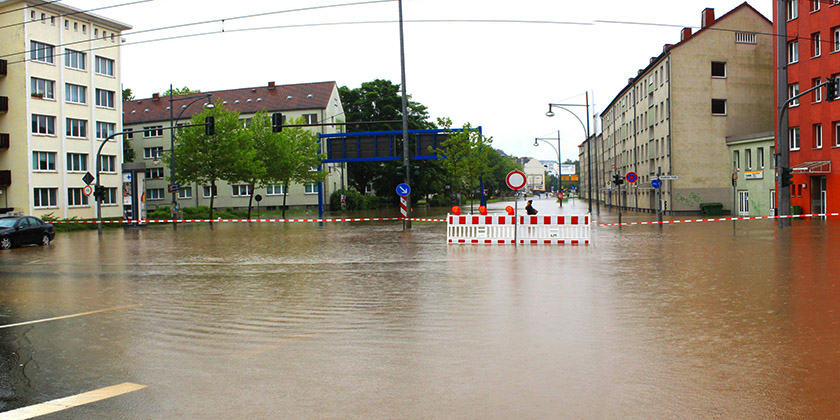
Scientists expect an increase in heavy rainfalls in Switzerland in the future because of climate change. During heavy rainfall, the wastewater system might not be able to cope with all the rainwater anymore, leading to surcharges of wastewater in combined sewer systems. Untreated wastewater can therefore reach surface waters, which is known as combined sewer overflows (CSOs). Wastewater can also overflow from manholes or sewers, thus flooding streets or cellars. With climate change, these events are expected to occur more often. It is possible to improve the wastewater system with structural measures to cope with such events, but the costs are high. Ultimately, this would result in an increase of the wastewater taxes paid by the population.
The aim of our study was to elicit the willingness to pay of the Swiss population for improving the wastewater system in the context of climate change. We implemented an online survey representative of the Swiss population and interviewed 1’022 individuals from the three linguistic regions of Switzerland. We elicited the willingness to pay of the respondents using a conjoint choice analysis. Conjoint choice analysis entails the description of hypothetical scenarios where respondents are shown alternative representations of a policy and are asked to pick their most preferred option. In our study, respondents first received information on the wastewater system and on climate change to help them choosing between the different policy options. We focused on the following events: a) wastewater overflows in rivers and lakes; b) street flooding; or c) cellar flooding with wastewater.
The results show that the Swiss people are concerned about the consequences of wastewater surcharges on the environment and on human health. Overall, 56% of the respondents would be willing to pay additional annual local taxes to reduce the risk of wastewater flooding or combined sewer overflows (CSOs). The average willingness to pay is about 240 CHF per person and year. This is in the same order of magnitude of the wastewater taxes they are paying today. On average, respondents would be willing to pay more to prevent CSOs (302 CHF, 71% of the respondents). The willingness to pay to prevent street flooding is about 237 CHF (with 53% of the respondents willing to pay). The willingness to pay to prevent wastewater flooding in cellars is about 184 CHF (with 43% of the respondents). One-to-one interviews indicated that the lower willingness to pay related to cellar flooding might be due to the fact that respondents think that measures against cellar floodings are rather a personal than a public responsibility.
We want to emphasize that the estimation of the willingness to pay is based on hypothetical scenarios. For different reasons it is possible that the method over-estimates the absolute values of the willingness to pay. However, concretely for policy makers, our results clearly show that the population strongly values the protection of water bodies. Measures that reduce the effects of climate change on the wastewater system would likely be well perceived by the majority of the Swiss population, especially if ecological and health risks are reduced and accordingly communicated.
Publications
Chawla, F., M. Veronesi, M. Maurer, J. Lienert (2011) Economic valuation and perception of personal and environmental risks in the wastewater sector: Evidence from a representative stated preference survey in Switzerland. Final report of the project “Umweltrelevante gesellschaftliche Entscheidungsprozesse” to FOEN (Federal Office for the Environment), Eawag, Dübendorf, Switzerland, pp. 154.