Department Environmental Chemistry

DEMEAU
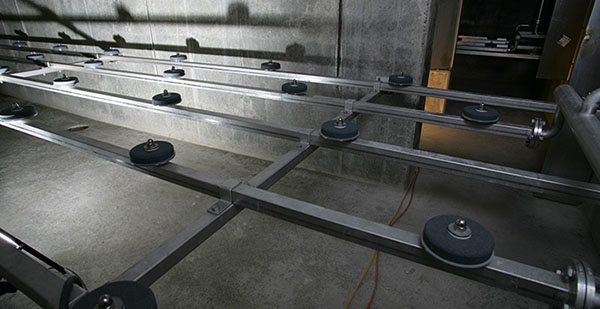
The Project Demeau (Demonstration of promising technologies to address emerging pollutants in water and wastewater) is a EU project within FP7 running from Sept. 2012 – August 2015. The overall objective of DEMEAU is to promote the uptake of knowledge, prototypes and practices from previous EU research enabling the water and wastewater sector to face emerging pollutants.

Eawag focuses on demonstrating the potential of ozonation for water and waste water application in full scale in a collaboration of the Departments of Environmental Chemistry, Process Engineering and Water Resources and Drinking Water as well as the Ecotox Center. Removal processes and the influence of the source water composition on the efficiency of eliminating micropollutants with ozone will be studied. Appropriate online control of the technologies to assure constant high water quality with minimal energy consumption is an important task to improve the long-term stability and robustness of the processes, a prerequisite for implementation. The up-scaling, controlling, and validation of ozonation will be demonstrated for waste water and drinking water treatment together with the wastewater treatment plant ARA Neugut (Dübendorf) and the waterworks of Zurich (WVZ).

Moreover, the removal processes in ozonation will be investigated in more details to close research gaps hampering the technology transfer to practice. The mitigation of transformation products from micropollutants by post-treatment will be studied and evaluated by theoretical concepts (including kinetics and mechanisms), chemical analysis and bioassays. The experiences and results will be used to develop a decision tool for the implementation of oxidation technologies based on a quantitative comparison of the different treatment technologies and on the framework requirements in different European regions.

Publications

Extbase Variable Dump
array(2 items)
   publications => '24398,15883,14377,10551,15001,15004' (35 chars)
   libraryUrl => '' (0 chars)
Extbase Variable Dump
array(6 items)
   0 => Snowflake\Publications\Domain\Model\Publicationprototypepersistent entity (uid=24398, pid=124)
      originalId => protected24398 (integer)
      authors => protected'Kienle, C.; Werner, I.; Fischer, S.; Lüthi, C.; Schiffe
         rli, A.; Besselink, H.; Langer, M.; McArdell, C. S.
         ; Vermeirssen, E. L. M.
' (190 chars) title => protected'Evaluation of a full-scale wastewater treatment plant with ozonation and dif
         ferent post-treatments using a broad range of <em>in vitro</em> and <em>in v
         ivo</em> bioassays
' (170 chars) journal => protected'Water Research' (14 chars) year => protected2022 (integer) volume => protected212 (integer) issue => protected'' (0 chars) startpage => protected'118084 (13 pp.)' (15 chars) otherpage => protected'' (0 chars) categories => protected'bioassays; aquatic contaminants; biomarker gene expression; histopathology' (74 chars) description => protected'Micropollutants present in the effluent of wastewater treatment plants (WWTP
         s) after biological treatment are largely eliminated by effective advanced t
         echnologies such as ozonation. Discharge of contaminants into freshwater eco
         systems can thus be minimized, while simultaneously protecting drinking wate
         r resources. However, ozonation can lead to reactive and potentially toxic t
         ransformation products. To remove these, the Swiss Federal Office for the En
         vironment recommends additional "post-treatment" of ozonated WWTP effluent u
         sing sand filtration, but other treatments may be similarly effective. In th
         is study, 48 h composite wastewater samples were collected before and after
          full-scale ozonation, and after post-treatments (full-scale sand filtration
         , pilot-scale fresh and pre-loaded granular activated carbon, and fixed and
         moving beds). Ecotoxicological tests were performed to quantify the changes
         in water quality following different treatment steps. These included standar
         d <em>in vitro</em> bioassays for the detection of endocrine, genotoxic and
         mutagenic effects, as well as toxicity to green algae and bacteria, and flow
         -through <em>in vivo</em> bioassays using oligochaetes and early life stages
          of rainbow trout.<br />Results show that ozonation reduced a number of ecot
         oxicological effects of biologically treated wastewater by 66 - 93%: It impr
         oved growth and photosynthesis of green algae, decreased toxicity to lumines
         cent bacteria, reduced concentrations of hormonally active contaminants and
         significantly changed expression of biomarker genes in rainbow trout liver.
         Bioassay results showed that ozonation did not produce problematic levels of
          reaction products overall. Small increases in toxicity observed in a few sa
         mples were reduced or eliminated by post-treatments. However, only relativel
         y fresh granular activated carbon (analyzed at 13,000 - 20,000 bed volumes)
         significantly reduced effects additionally (by up to 66%) compared to ozonat
         ion alone. Inhibition of...
' (2199 chars) serialnumber => protected'0043-1354' (9 chars) doi => protected'10.1016/j.watres.2022.118084' (28 chars) uid => protected24398 (integer) _localizedUid => protected24398 (integer)modified _languageUid => protectedNULL _versionedUid => protected24398 (integer)modified pid => protected124 (integer)
1 => Snowflake\Publications\Domain\Model\Publicationprototypepersistent entity (uid=15883, pid=124) originalId => protected15883 (integer) authors => protected'Bourgin,&nbsp;M.; Beck,&nbsp;B.; Boehler,&nbsp;M.; Borowska,&nbsp;E.; Fleine
         r,&nbsp;J.; Salhi,&nbsp;E.; Teichler,&nbsp;R.; von Gunten,&nbsp;U.; Siegrist
         ,&nbsp;H.; McArdell,&nbsp;C.&nbsp;S.
' (188 chars) title => protected'Evaluation of a full-scale wastewater treatment plant upgraded with ozonatio
         n and biological post-treatments: abatement of micropollutants, formation of
          transformation products and oxidation by-products
' (202 chars) journal => protected'Water Research' (14 chars) year => protected2018 (integer) volume => protected129 (integer) issue => protected'' (0 chars) startpage => protected'486' (3 chars) otherpage => protected'498' (3 chars) categories => protected'wastewater treatment; ozonation; granular activated carbon; transformation p
         roducts; bromate; nitrosamines
' (106 chars) description => protected'<div id="abssec0010"> <p id="abspara0010">To protect the ecosystem and drink
         ing water resources in Switzerland and in the countries of the downstream ca
         tchments, a new Swiss water protection act entered into force in 2016 aiming
          to reduce the discharge of micropollutants from wastewater treatment plants
          (WWTPs). As a consequence, selected WWTPs must be upgraded by an advanced t
         reatment for micropollutant abatement with suitable and economic options suc
         h as (powdered) activated carbon treatment or ozonation. WWTP Neugut (105′
         000 people equivalent) was the first WWTP in Switzerland to implement a long
         -term full-scale ozonation. Differing specific ozone doses in the range of 0
         .35–0.97 g O<sub>3</sub>/g DOC were applied to determine the adequate ozo
         ne dose to fulfill the requirements of the Swiss water protection act. Based
          on this assessment, a specific ozone dose of 0.55 g O<sub>3</sub>/g DOC is
          recommended at this plant to ensure an average abatement of the twelve sele
         cted indicator substances by ≥80% over the whole treatment. A monitoring o
         f 550 substances confirmed that this dose was very efficient to abate a broa
         d range of micropollutants by >79% on average. After ozonation, an additiona
         l biological post-treatment is required to eliminate possible negative ecoto
         xicological effects generated during ozonation caused by biodegradable ozona
         tion transformation products (OTPs) and oxidation by-products (OBPs). Three
         biological treatments (sand filtration, moving bed, fixed bed) and granular
         activated carbon (GAC, fresh and pre-loaded) filtration were evaluated as po
         st-treatments after ozonation. In parallel, a fresh GAC filter directly conn
         ected to the effluent of the secondary clarifier was assessed. Among the thr
         ee purely biological post-treatments, the sand filtration performed best in
         terms of removal of dissolved organic carbon (DOC), assimilable organic carb
         on (AOC) and total suspended solids (TSS). The fresh activated carbon filtra
         tion ensured a significa...
' (3274 chars) serialnumber => protected'0043-1354' (9 chars) doi => protected'10.1016/j.watres.2017.10.036' (28 chars) uid => protected15883 (integer) _localizedUid => protected15883 (integer)modified _languageUid => protectedNULL _versionedUid => protected15883 (integer)modified pid => protected124 (integer)
2 => Snowflake\Publications\Domain\Model\Publicationprototypepersistent entity (uid=14377, pid=124) originalId => protected14377 (integer) authors => protected'Bourgin,&nbsp;M.; Borowska,&nbsp;E.; Helbing,&nbsp;J.; Hollender,&nbsp;J.; K
         aiser,&nbsp;H.-P.; Kienle,&nbsp;C.; McArdell,&nbsp;C.&nbsp;S.; Simon,&nbsp;E
         .; von Gunten,&nbsp;U.
' (174 chars) title => protected'Effect of operational and water quality parameters on conventional ozonation
          and the advanced oxidation process O<SUB>3</SUB>/H<SUB>2</SUB>O<SUB>2</SUB>
         : kinetics of micropollutant abatement, transformation product and bromate f
         ormation in a surface water
' (255 chars) journal => protected'Water Research' (14 chars) year => protected2017 (integer) volume => protected122 (integer) issue => protected'' (0 chars) startpage => protected'234' (3 chars) otherpage => protected'245' (3 chars) categories => protected'surface water; AOP O3/H2O2; micropollutants; transformation products; bromat
         e; ozonation reactors
' (97 chars) description => protected'The efficiency of ozone-based processes under various conditions was studied
          for the treatment of a surface water (Lake Zürich water, Switzerland) spik
         ed with 19 micropollutants (pharmaceuticals, pesticides, industrial chemical
         , X-ray contrast medium, sweetener) each at 1 μg L<sup>−1</sup>. Two pilo
         t-scale ozonation reactors (4–5 m<sup>3</sup> h<sup>−1</sup>), a 4-chamb
         er reactor and a tubular reactor were investigated by either conventional oz
         onation and/or the advanced oxidation process (AOP) O<sub>3</sub>/H<sub>2</s
         ub>O<sub>2</sub>. The effects of selected operational parameters, such as oz
         one dose (0.5–3 mg L<sup>−1</sup>) and H<sub>2</sub>O<sub>2</sub> dose (
         O<sub>3</sub>:H<sub>2</sub>O<sub>2</sub> = 1:3–3:1 (mass ratio)), and sele
         cted water quality parameters, such as pH (6.5–8.5) and initial bromide co
         ncentration (15–200 μg L<sup>−1</sup>), on micropollutant abatement and
          bromate formation were investigated. Under the studied conditions, compound
         
         
         90%) even for the lowest ozone dose of 0.5 mg/L. Conversely, the abatement e
         fficiency of sucralose, which only reacts with hydroxyl radicals (<B>·</B>O
         H), varied between 19 and 90%. Generally, the abatement efficiency increased
          with higher ozone doses and higher pH and lower bromide concentrations. H<s
         ub>2</sub>O<sub>2</sub> addition accelerated the ozone conversion to radical
          <B>·</B>OH, which enables a faster abatement of ozone-resistant micropollu
         tants. Interestingly, the abatement of micropollutants decreased with higher
          bromide concentrations during conventional ozonation due to competitive ozo
         ne-consuming reactions, except for lamotrigine, due to the suspected reactio
         n of HOBr/OBr<sup>−</sup> with the primary amine moieties. In addition to
         the abatement of micropollutants, the evolution of the two main transformati
         on products (TPs) of hyd...
' (3133 chars) serialnumber => protected'0043-1354' (9 chars) doi => protected'10.1016/j.watres.2017.05.018' (28 chars) uid => protected14377 (integer) _localizedUid => protected14377 (integer)modified _languageUid => protectedNULL _versionedUid => protected14377 (integer)modified pid => protected124 (integer)
3 => Snowflake\Publications\Domain\Model\Publicationprototypepersistent entity (uid=10551, pid=124) originalId => protected10551 (integer) authors => protected'Borowska,&nbsp;E.; Bourgin,&nbsp;M.; Hollender,&nbsp;J.; Kienle,&nbsp;C.; Mc
         Ardell,&nbsp;C.&nbsp;S.; von Gunten,&nbsp;U.
' (120 chars) title => protected'Oxidation of cetirizine, fexofenadine and hydrochlorothiazide during ozonati
         on: kinetics and formation of transformation products
' (129 chars) journal => protected'Water Research' (14 chars) year => protected2016 (integer) volume => protected94 (integer) issue => protected'' (0 chars) startpage => protected'350' (3 chars) otherpage => protected'362' (3 chars) categories => protected'ozonation; second-order rate constant; kinetics; transformation products; hi
         gh-resolution mass spectrometry
' (107 chars) description => protected'The efficiency of wastewater ozonation for the abatement of three nitrogen-c
         ontaining pharmaceuticals, two antihistamine drugs, cetirizine (CTR) and fex
         ofenadine (FXF), and the diuretic drug, hydrochlorothiazide (HCTZ), was inve
         stigated. Species-specific second-order rate constants for the reactions of
         the molecular, protonated (CTR, FXF) or deprotonated (HCTZ) forms of these c
         ompounds with ozone were determined. All three compounds are very reactive w
         ith ozone (apparent second order rate constants at pH 7: <I>k</I><I><SUB>O3,
         pH7</SUB></I> = 1.7·10<SUP>5</SUP> M<SUP>−1</SUP>s<SUP>−1</SUP>, 8.5
         ·10<SUP>4</SUP> M<SUP>−1</SUP>s<SUP>−1</SUP> and 9.0·10<SUP>3</SUP> 
         M<SUP>−1</SUP>s<SUP>−1</SUP> for CTR, HCTZ and FXF, respectively). Trans
         formation product (TP) structures were elucidated using liquid chromatograph
         y coupled with high-resolution tandem mass spectrometry, including isotope-l
         abeled standards. For cetirizine and hydrochlorothiazide 8 TPs each and for
         fexofenadine 7 TPs were identified. The main TPs of cetirizine and fexofenad
         ine are their respective <I>N</I>-oxides, whereas chlorothiazide forms to al
         most 100% from hydrochlorothiazide. In the bacteria bioluminescence assay th
         e toxicity was slightly increased only during the ozonation of cetirizine at
          very high cetirizine concentrations. The main TPs detected in bench-scale e
         xperiments were also detected in full-scale ozonation of a municipal wastewa
         ter, for >90% elimination of the parent compounds.
' (1494 chars) serialnumber => protected'0043-1354' (9 chars) doi => protected'10.1016/j.watres.2016.02.020' (28 chars) uid => protected10551 (integer) _localizedUid => protected10551 (integer)modified _languageUid => protectedNULL _versionedUid => protected10551 (integer)modified pid => protected124 (integer)
4 => Snowflake\Publications\Domain\Model\Publicationprototypepersistent entity (uid=15001, pid=124) originalId => protected15001 (integer) authors => protected'Bourgin,&nbsp;M.; von Gunten,&nbsp;U.; McArdell,&nbsp;C.&nbsp;S.; Hollender,
         &nbsp;J.; Hofman-Caris,&nbsp;R.
' (107 chars) title => protected'Compilation of kinetics and mechanisms for the oxidative transformation of o
         rganic substances
' (93 chars) journal => protected'' (0 chars) year => protected2015 (integer) volume => protected0 (integer) issue => protected'' (0 chars) startpage => protected'35&nbsp;p' (9 chars) otherpage => protected'' (0 chars) categories => protected'' (0 chars) description => protected'This deliverable aims at presenting the reactivity of selected compounds tow
         ards the oxidative treatments investigated in Work Area 3, <i>i.e.</i> ozona
         tion and UV photolysis. Therefore , mechanisms of oxidation by molecular ozo
         ne and hydroxyl radicals on reactive moieties are first described for a bett
         er understanding of oxidants reactivity . Since the reactivity of compounds
         is finally quantified with kinetic laws and kinetic rate constants, protocol
         s for the determination of reaction rate constants (k - values) are here des
         cribed and discussed. Based on literature data or recent lab studies, k - va
         lues of selected compounds a re also compiled in this manuscript . These val
         ues are particularly useful since they can be implemented for prediction of
         their elimination during oxidative water treatment based on models presented
          here.
' (842 chars) serialnumber => protected'' (0 chars) doi => protected'' (0 chars) uid => protected15001 (integer) _localizedUid => protected15001 (integer)modified _languageUid => protectedNULL _versionedUid => protected15001 (integer)modified pid => protected124 (integer)
5 => Snowflake\Publications\Domain\Model\Publicationprototypepersistent entity (uid=15004, pid=124) originalId => protected15004 (integer) authors => protected'McArdell,&nbsp;C.&nbsp;S.; Bourgin,&nbsp;M.; von Gunten,&nbsp;U.; Hollender,
         &nbsp;J.; Kienle,&nbsp;C.; Hofman-Caris,&nbsp;R.
' (124 chars) title => protected'Decision basis for implementation of oxidation technologies' (59 chars) journal => protected'' (0 chars) year => protected2015 (integer) volume => protected0 (integer) issue => protected'' (0 chars) startpage => protected'22&nbsp;p' (9 chars) otherpage => protected'' (0 chars) categories => protected'' (0 chars) description => protected'Oxidative treatment is one of the options to eliminate emerging pollutants (
         EPs) from drinking water or wastewater. For drinking water treatment, the oz
         onation technology is already implemented at many sites all around the world
         , so far mostly for disinfection purposes. However, in some countries such a
         s the Netherlands surface water contains relatively high bromide concentrati
         ons, which leads upon reaction with ozone to the formation of bromate, a sus
         pe cted carcinogen. In such a case, UV/H<sub>2</sub>O<sub>2</sub> treatment
         is considered a useful alternative, despite the fact that energy requirement
         s are substantially higher compared to treatment with ozone or O<sub>3</sub>
         /H<sub>2</sub>O<sub>2</sub>. Only in recent years, the oxidative treatment o
         f wastewat er has been investigated to not only protect our water resources,
          but also the ecosystem from pollution with chemicals used in our daily life
         . In Switzerland, the first permanent full scale plant with ozonat ion, WWTP
          Neugut in Dübendorf, is running since March 2014. Its performance was inve
         stigated i n detail in the DEMEAU project.<br />The goal of this paper is to
          present a decision basis for the implementation of oxidation technologies t
         o eliminate EPs. Depending on the composition of the water in different Euro
         pean regions, one or the other treatment is recommended. The different param
         eters that influence the efficiency of oxidation and the formation of by - p
         roducts are discussed. A decision tool is presented to decide if oxidative t
         reatment of wastewater is rec ommended and under which circumstances the tre
         atment of drinking water with ozone, O<sub>3</sub>/H<sub>2</sub>O<sub>2</sub
         >, or UV/H<sub>2</sub>O<sub>2</sub> may be the treatment of choice.
' (1739 chars) serialnumber => protected'' (0 chars) doi => protected'' (0 chars) uid => protected15004 (integer) _localizedUid => protected15004 (integer)modified _languageUid => protectedNULL _versionedUid => protected15004 (integer)modified pid => protected124 (integer)
Kienle, C.; Werner, I.; Fischer, S.; Lüthi, C.; Schifferli, A.; Besselink, H.; Langer, M.; McArdell, C. S.; Vermeirssen, E. L. M. (2022) Evaluation of a full-scale wastewater treatment plant with ozonation and different post-treatments using a broad range of in vitro and in vivo bioassays, Water Research, 212, 118084 (13 pp.), doi:10.1016/j.watres.2022.118084, Institutional Repository
Bourgin, M.; Beck, B.; Boehler, M.; Borowska, E.; Fleiner, J.; Salhi, E.; Teichler, R.; von Gunten, U.; Siegrist, H.; McArdell, C. S. (2018) Evaluation of a full-scale wastewater treatment plant upgraded with ozonation and biological post-treatments: abatement of micropollutants, formation of transformation products and oxidation by-products, Water Research, 129, 486-498, doi:10.1016/j.watres.2017.10.036, Institutional Repository
Bourgin, M.; Borowska, E.; Helbing, J.; Hollender, J.; Kaiser, H.-P.; Kienle, C.; McArdell, C. S.; Simon, E.; von Gunten, U. (2017) Effect of operational and water quality parameters on conventional ozonation and the advanced oxidation process O3/H2O2: kinetics of micropollutant abatement, transformation product and bromate formation in a surface water, Water Research, 122, 234-245, doi:10.1016/j.watres.2017.05.018, Institutional Repository
Borowska, E.; Bourgin, M.; Hollender, J.; Kienle, C.; McArdell, C. S.; von Gunten, U. (2016) Oxidation of cetirizine, fexofenadine and hydrochlorothiazide during ozonation: kinetics and formation of transformation products, Water Research, 94, 350-362, doi:10.1016/j.watres.2016.02.020, Institutional Repository
Bourgin, M.; von Gunten, U.; McArdell, C. S.; Hollender, J.; Hofman-Caris, R. (2015) Compilation of kinetics and mechanisms for the oxidative transformation of organic substances, 35 p, Institutional Repository
McArdell, C. S.; Bourgin, M.; von Gunten, U.; Hollender, J.; Kienle, C.; Hofman-Caris, R. (2015) Decision basis for implementation of oxidation technologies, 22 p, Institutional Repository

Contact

Dr. Christa McArdell Senior scientist / group leader Tel. +41 58 765 5483 Send Mail

Project team

Marc Böhler Application and Development Tel. +41 58 765 5379 Send Mail
Dr. Cornelia Kienle Ecotox Centre Tel. +41 58 765 5563 Send Mail
Prof. Dr. Juliane Hollender Senior scientist / Group leader Tel. +41 58 765 5493 Send Mail

Duration

September 2012 – August 2015