Department Environmental Chemistry

HypoTRAIN
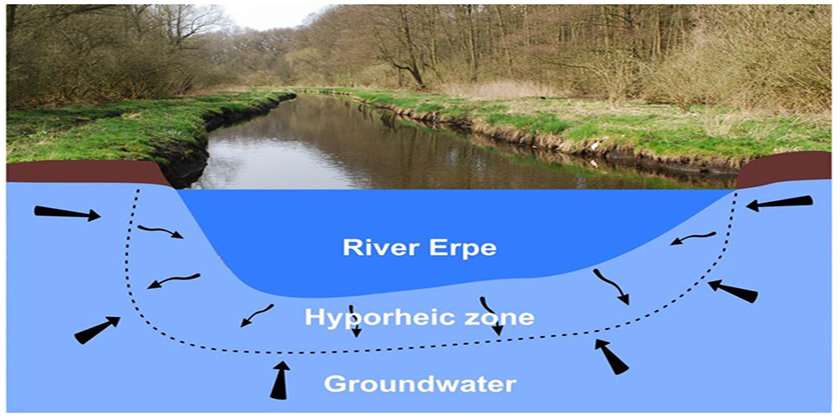
A contemporary view of rivers recognizes them as having multiple vertical and lateral flow paths serving as bidirectional links to the surrounding landscape. These links create water-saturated areas beneath the stream bed and within stream banks containing some proportion of channel water, so called ‘hyporheic’ zones. A hyporheic exchange flow can be described as river water that downwells into subsurface flow paths, travels for some distance beneath the stream bed or inside stream banks, eventually mixes with ground water and then returns to the river.

Recent studies have led to the hypothesis, that biotransformation in hyporheic zones can be a major removal pathway of organic pollutants, contributing significantly to the self-purification of natural waters. To test this hypothesis and fill significant knowledge gaps with respect to hyporheic processes, 16 PhD candidates from different disciplines investigate hyporheic zone-related topics in a Marie Curie Innovative Training Network (ITN) called HypoTRAIN - ‘Hyporheic Zone Processes – A training network for enhancing the understanding of complex physical, chemical and biological process interactions’.

In this PhD project, biotransformation of polar organic pollutants will be investigated along hyporheic subsurface flow paths, to which end a novel time-integrative low flow passive sampling device will be developed, validated and applied in river field studies. Biotransformation of parent compounds and the formation of transformation products will be investigated using target and suspect liquid chromatography high-resolution tandem mass spectrometry workflows. Enantioselective biodegradation serves as a complementary biotransformation indicator and will be traced using enantioselective separation.

Publications

Extbase Variable Dump
array(2 items)
   publications => '19072,18536' (11 chars)
   libraryUrl => '' (0 chars)
Extbase Variable Dump
array(2 items)
   0 => Snowflake\Publications\Domain\Model\Publicationprototypepersistent entity (uid=19072, pid=124)
      originalId => protected19072 (integer)
      authors => protected'Mechelke, J.; Vermeirssen, E. L. M.; Hollender, J.' (75 chars)
      title => protected'Passive sampling of organic contaminants across the water-sediment interface
          of an urban stream
' (95 chars) journal => protected'Water Research' (14 chars) year => protected2019 (integer) volume => protected165 (integer) issue => protected'' (0 chars) startpage => protected'114966 (11 pp.)' (15 chars) otherpage => protected'' (0 chars) categories => protected'o-DGT; chemcatcher; micropollutants; hyporheic zone; urban stream; transform
         ation products
' (90 chars) description => protected'Passive sampling is a well-established tool for monitoring time-weighted ave
         rage concentrations of polar and semi-polar organic contaminants in streams
         at flow velocities between 0.1 and 0.4 m s<sup>−1</sup>. However, its
         application under low-flow conditions (10<sup>−5</sup> to 0.01 m s<sup
         >−1</sup>) – as encountered in hyporheic zones – has been scarcely rep
         orted. In this study, 3 novel passive sampler configurations were developed
         for the monitoring of (semi-)polar organic pollutants and related transforma
         tion products across the water-sediment interface and thus across varying hy
         drodynamic conditions. Their design was inspired by Chemcatcher and diffusiv
         e gradients in thin films for organics. To determine the most optimal sample
         r design, an uptake experiment was completed involving the 3 novel passive s
         ampler configurations and a reference Chemcatcher in polar configuration. Th
         e experiments consisted of a circular flume that simulated the main channel
         of a stream and an aquarium with stagnant water that represented the underly
         ing hyporheic zone. The systems were exposed to 192 organic pollutants at en
         vironmental concentrations, and the samplers were then collected, extracted
         and analyzed using liquid chromatography high-resolution mass spectrometry a
         fter 2, 6 and 14 days. The configuration that was most insensitive to differ
         ent hydrodynamic conditions consisted of a reversed-phase sulfonated styrene
         divinylbenzene disk as the receiving phase that was covered by an agarose di
         ffusion gel and topped with a polyethersulfone membrane filter. To further e
         valuate its environmental application, samplers were installed downstream of
          a sewage treatment plant located at an urban stream in Berlin, Germany (Erp
         e). The samplers were mounted on custom-made holders which were subsequently
          embedded in the stream bed to position samplers above (0.30 m) and within
          the sediment (−0.15/-0.30/-0.45 m) for 11 days. Target and suspect scre
         ening workflows were the...
' (2849 chars) serialnumber => protected'0043-1354' (9 chars) doi => protected'10.1016/j.watres.2019.114966' (28 chars) uid => protected19072 (integer) _localizedUid => protected19072 (integer)modified _languageUid => protectedNULL _versionedUid => protected19072 (integer)modified pid => protected124 (integer)
1 => Snowflake\Publications\Domain\Model\Publicationprototypepersistent entity (uid=18536, pid=124) originalId => protected18536 (integer) authors => protected'Mechelke,&nbsp;J.; Longrée,&nbsp;P.; Singer,&nbsp;H.; Hollender,&nbsp;J.' (73 chars) title => protected'Vacuum-assisted evaporative concentration combined with LC-HRMS/MS for ultra
         -trace-level screening of organic micropollutants in environmental water sam
         ples
' (156 chars) journal => protected'Analytical and Bioanalytical Chemistry' (38 chars) year => protected2019 (integer) volume => protected411 (integer) issue => protected'12' (2 chars) startpage => protected'2555' (4 chars) otherpage => protected'2567' (4 chars) categories => protected'multiresidue analysis; PMOC; large-volume injection; LC-HRMS; non-target scr
         eening; orbitrap
' (92 chars) description => protected'Vacuum-assisted evaporative concentration (VEC) was successfully applied and
          validated for the enrichment of 590 organic substances from river water and
          wastewater. Different volumes of water samples (6 mL wastewater influent, 1
         5 mL wastewater effluent, and 60 mL river water) were evaporated to 0.3 mL a
         nd finally adjusted to 0.4 mL. 0.1 mL of the concentrate were injected into
         a polar reversed-phase C18 liquid chromatography column coupled with electro
         spray ionization to high-resolution tandem mass spectrometry. Analyte recove
         ries were determined for VEC and compared against a mixed-bed multilayer sol
         id-phase extraction (SPE). Both approaches performed equally well (≥ 70%
          recovery) for a vast number of analytes (<em>n</em> = 327), whereas cer
         tain substances were especially amenable to enrichment by either SPE (e.g.,
         4-chlorobenzophenone, log<em>D</em><sub>ow,pH7</sub> 4) or VEC (e.g., TRIS,
         log<em>D</em><sub>ow,pH7</sub> − 4.6). Overall, VEC was more suitable fo
         r the enrichment of polar analytes, albeit considerable signal suppression (
         up to 74% in river water) was observed for the VEC-enriched sample matrix. N
         evertheless, VEC allowed for accurate and precise quantification down to the
          sub-nanogram per liter level and required no more than 60 mL of the sample,
          as demonstrated by its application to several environmental water matrices.
          By contrast, SPE is typically constrained by high sample volumes ranging fr
         om 100 mL (wastewater influent) to 1000 mL (river water). The developed VEC
         workflow not only requires low labor cost and minimum supervision but is als
         o a rapid, convenient, and environmentally safe alternative to SPE and highl
         y suitable for target and non-target analysis.
' (1718 chars) serialnumber => protected'1618-2642' (9 chars) doi => protected'10.1007/s00216-019-01696-3' (26 chars) uid => protected18536 (integer) _localizedUid => protected18536 (integer)modified _languageUid => protectedNULL _versionedUid => protected18536 (integer)modified pid => protected124 (integer)
Mechelke, J.; Vermeirssen, E. L. M.; Hollender, J. (2019) Passive sampling of organic contaminants across the water-sediment interface of an urban stream, Water Research, 165, 114966 (11 pp.), doi:10.1016/j.watres.2019.114966, Institutional Repository
Mechelke, J.; Longrée, P.; Singer, H.; Hollender, J. (2019) Vacuum-assisted evaporative concentration combined with LC-HRMS/MS for ultra-trace-level screening of organic micropollutants in environmental water samples, Analytical and Bioanalytical Chemistry, 411(12), 2555-2567, doi:10.1007/s00216-019-01696-3, Institutional Repository