Department Environmental Chemistry

ReadAcross
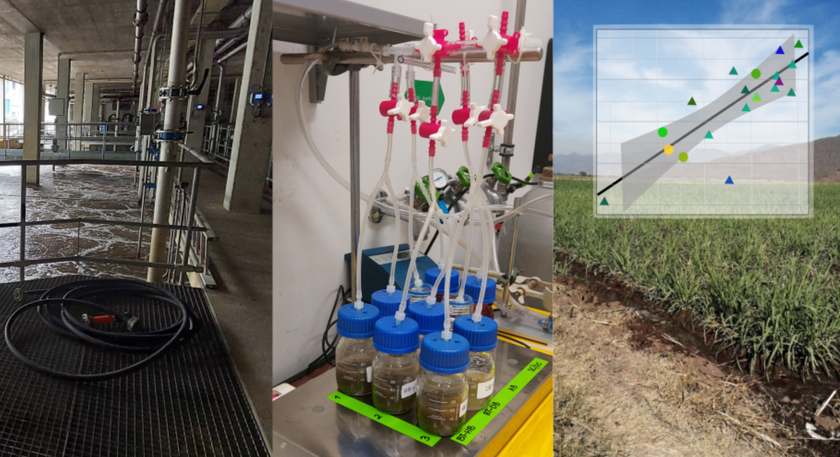

Agrochemical use is important to secure global food supply in our current society. In addition to improved crop production, new agrochemicals developed and released into the market should comply with environmental considerations, for example, regulatory frameworks for chemical risk assessment.  Degradation half-lives of chemicals are often required by regulation to assess environmental persistence and fate of chemicals, but the simulation tests recommended (such as OECD 307) are time- and resource-consuming. Simplified methods to predict degradation half-lives in the environment would facilitate persistence assessment in earlier stages of product development. 

In the project ReadAcross, funded by and in collaboration with our industrial partner Syngenta, we are investigating ways to read biotransformation half-lives of chemicals across different compartments. We are building regression models to test if degradation half-lives of agrochemicals obtained from laboratory tests in soil can be estimated through half-lives from well-designed biotransformation experiments in activated sludge, which are less time and resource intense than experiments in soil and could be implemented early in the research and development phase. Previous work has shown notable potential of this approach:

Fenner, K.; Screpanti, C.; Renold, P.; Rouchdi, M.; Vogler, B.; Rich, S., Comparison of Small Molecule Biotransformation Half-Lives between Activated Sludge and Soil: Opportunities for Read-Across? Environ Sci Technol 2020, 54, (6), 3148-3158. (DOI: 10.1021/acs.est.9b05104)

Further experiments to test the domain of applicability, the biotransformation mechanisms and transformation products generated within this project will contribute to an improved understanding of future applications for read-across in estimating biotransformation half-lives in environmental compartments.

Publications

Extbase Variable Dump
array(2 items)
   publications => '20524' (5 chars)
   libraryUrl => '' (0 chars)
Extbase Variable Dump
array(1 item)
   0 => Snowflake\Publications\Domain\Model\Publicationprototypepersistent entity (uid=20524, pid=124)
      originalId => protected20524 (integer)
      authors => protected'Fenner, K.; Screpanti, C.; Renold, P.; Rouchdi, M.; Vogl
         er, B.; Rich, S.
' (102 chars) title => protected'Comparison of small molecule biotransformation half-lives between activated
         sludge and soil: opportunities for read-across?
' (123 chars) journal => protected'Environmental Science and Technology' (36 chars) year => protected2020 (integer) volume => protected54 (integer) issue => protected'6' (1 chars) startpage => protected'3148' (4 chars) otherpage => protected'3158' (4 chars) categories => protected'' (0 chars) description => protected'Compartment-specific degradation half-lives are essential pieces of informat
         ion in the regulatory risk assessment of synthetic chemicals. However, their
          measurement according to regulatory testing guidelines is laborious and cos
         tly. Despite the obvious ecological and economic benefits of knowing environ
         mental degradability as early as possible, its consideration in the early ph
         ases of rational chemical design is therefore challenging. Here, we explore
         the possibility to use half-lives determined in highly time- and work-effici
         ent biotransformation experiments with activated sludge and mixtures of chem
         icals to predict soil half-lives from regulatory simulation studies. We expe
         rimentally determined half-lives for 52 structurally diverse agrochemical ac
         tive ingredients in batch reactors with three concentrations of the same act
         ivated sludge. We then developed bi- and multivariate models for predicting
         half-lives in soil by regressing the experimentally determined half-lives in
          activated sludge against average soil half-lives of the same chemicals extr
         acted from regulatory data. The models differed in how we accounted for sorp
         tion-related bioavailability differences in soil and activated sludge. The b
         est-performing models exhibited good coefficients of determination (<em>R</e
         m><sup>2</sup> of around 0.8) and low average errors (
' (1346 chars) serialnumber => protected'0013-936X' (9 chars) doi => protected'10.1021/acs.est.9b05104' (23 chars) uid => protected20524 (integer) _localizedUid => protected20524 (integer)modified _languageUid => protectedNULL _versionedUid => protected20524 (integer)modified pid => protected124 (integer)
Fenner, K.; Screpanti, C.; Renold, P.; Rouchdi, M.; Vogler, B.; Rich, S. (2020) Comparison of small molecule biotransformation half-lives between activated sludge and soil: opportunities for read-across?, Environmental Science and Technology, 54(6), 3148-3158, doi:10.1021/acs.est.9b05104, Institutional Repository