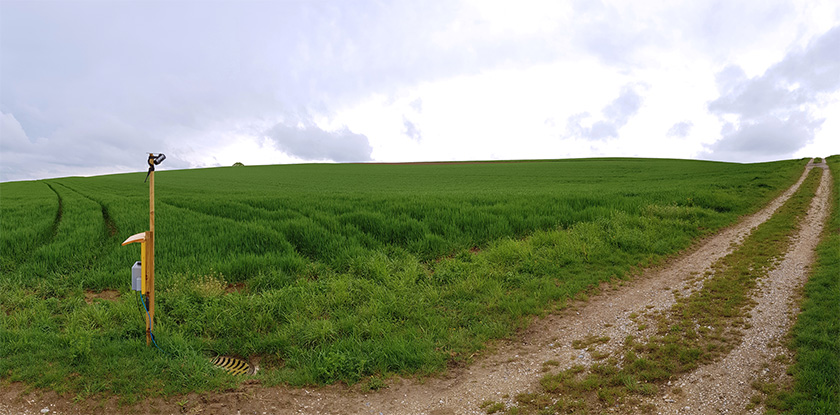
Pesticide transport from agriculture to surface waters: Hydraulic shortcuts are a major transport pathway, but have been largely overlooked in the past
Pesticides used in agriculture are transported to surface waters through various pathways, impairing water quality and posing a major threat to aquatic ecosystems. Previous research suggests that so-called hydraulic shortcuts may be an important pesticide transport pathway. The term hydraulic shortcuts refers to inlet or maintenance shafts of agricultural storm drainage systems, but also to roads, farm tracks, channel drains, and ditches. Their relevance for pesticide transport in agricultural catchments has only been studied in single cases and it remained unclear how important hydraulic shortcuts are compared to other transport pathways. This project therefore aimed on systematically assessing the relevance of hydraulic shortcuts for the pollution of Swiss surface waters for the first time.
The results of the project show that hydraulic shortcuts are a major transport pathway of pesticides to Swiss surface waters, and that road storm drainage inlets are the most important shortcut type. Pesticides can be transported to surface waters by three main processes:
Surface runoff via shortcuts (see Figure below): After a pesticide application, surface runoff formed on a crop area during a rain event is contaminated with pesticides. This surface runoff can flow into shortcuts and is then discharged to surface waters.
Drift via shortcuts (see Figure below): During pesticide application, some of the spray liquid is deposited on non-target areas (e.g. nearby roads or farm tracks) by spray drift (i.e. transport via wind). During subsequent rain events, the deposited spray liquid can be washed off the non-target areas into shortcuts and is then discharged to surface waters.
Improper handling: Due to improper pesticide handling (e.g. leaking spraying equipment, accidental spills, non-compliance with spraying buffers) spray liquid may be deposited on hard surfaces (e.g. roads or farm tracks). During subsequent rain events, the deposited spray liquid can be washed into shortcuts and is then discharged to surface waters.
Despite its importance for the pollution of Swiss surface waters, pesticide transport via hydraulic shortcuts has been largely overlooked in the past. Current regulations and mitigation measures are not addressing this pathway and – consequently – fall short in preventing pesticide losses through this pathway. Pesticide transport via shortcuts should therefore be considered in the pesticide registration process and when designing regulations and mitigation measures. Moreover, the awareness of farmers on this transport process should be built and further research should focus on closing remaining knowledge gaps on hydraulic shortcuts.
array(4 items)0 => Snowflake\Publications\Domain\Model\Publicationprototypepersistent entity (uid=24419, pid=124)originalId => protected24419 (integer)
authors => protected'Schönenberger, U. T.; Beck, B.; Dax, A.; Vogler, B .; Stamm, C.' (93 chars)
title => protected'Pesticide concentrations in agricultural storm drainage inlets of a small Sw iss catchment' (89 chars)
journal => protected'Environmental Science and Pollution Research' (44 chars)
year => protected2022 (integer)
volume => protected29 (integer)
issue => protected'' (0 chars)
startpage => protected'43966' (5 chars)
otherpage => protected'43983' (5 chars)
categories => protected'storm drainage inlets; hydraulic shortcuts; field study; agricultural runoff ; surface runoff; spray drift; pesticide concentrations; pesticide transport pathways' (161 chars)
description => protected'Agricultural pesticides transported to surface waters pose a major risk for aquatic ecosystems. Modelling studies indicate that the inlets of agricultur al storm drainage systems can considerably increase the connectivity of surf ace runoff and pesticides to surface waters. These model results have howeve r not yet been validated with field measurements. In this study, we measured discharge and concentrations of 51 pesticides in four out of 158 storm drai nage inlets of a small Swiss agricultural catchment (2.8 km<sup>2</sup>) an d in the receiving stream. For this, we performed an event-triggered samplin g during 19 rain events and collected plot-specific pesticide application da ta. Our results show that agricultural storm drainage inlets strongly influe nce surface runoff and pesticide transport in the study catchment. The conce ntrations of single pesticides in inlets amounted up to 62 µg/L. During so me rain events, transport through single inlets caused more than 10% of the stream load of certain pesticides. An extrapolation to the entire catchment suggests that during selected events on average 30 to 70% of the load in the stream was transported through inlets. Pesticide applications on fields wit h surface runoff or spray drift potential to inlets led to increased concent rations in the corresponding inlets. Overall, this study corroborates the re levance of such inlets for pesticide transport by establishing a connectivit y between fields and surface waters, and by their potential to deliver subst antial pesticide loads to surface waters.' (1561 chars)
serialnumber => protected'0944-1344' (9 chars)
doi => protected'10.1007/s11356-022-18933-5' (26 chars)
uid => protected24419 (integer)
_localizedUid => protected24419 (integer)modified_languageUid => protectedNULL
_versionedUid => protected24419 (integer)modifiedpid => protected124 (integer)1 => Snowflake\Publications\Domain\Model\Publicationprototypepersistent entity (uid=23874, pid=124)originalId => protected23874 (integer)
authors => protected'Schönenberger, U. T.; Simon, J.; Stamm, C.' (63 chars)
title => protected'Are spray drift losses to agricultural roads more important for surface wate r contamination than direct drift to surface waters?' (128 chars)
journal => protected'Science of the Total Environment' (32 chars)
year => protected2022 (integer)
volume => protected809 (integer)
issue => protected'' (0 chars)
startpage => protected'151102 (12 pp.)' (15 chars)
otherpage => protected'' (0 chars)
categories => protected'spray drift; surface waters; agriculture; shortcuts; pesticides; road storm drainage' (84 chars)
description => protected'Spray drift is considered a major pesticide transport pathway to surface wat ers. Current research and legislation usually only considers direct spray dr ift. However, also spray drift on roads and subsequent wash-off to surface w aters was identified as a possible transport pathway. Hydraulic shortcuts (s torm drainage inlets, channel drains, ditches) have been shown to connect ro ads to surface waters, thus increasing the risk of drift wash-off to surface waters. However, the importance of this pathway has never been assessed on larger scales. To address this knowledge gap, we studied 26 agricultural cat chments with a predominance of arable cropping (<em>n</em> = 17) and viney ards (<em>n</em> = 9). In these study sites, we assessed the occurrence of shortcuts by field mapping. Afterwards, we modelled the areas of roads drai ned to surface waters using a high-resolution digital elevation model (0.5 m resolution) and a multiple flow algorithm. Finally, we modelled drift depo sition to drained roads and surface waters using a spatially explicit, geore ferenced spray drift model. Our results show that for most sites, the drift to drained roads is much larger than the direct drift to surface waters. In arable land sites, drift to roads exceeds the direct drift by a factor of 4. 5 to 18, and in vineyard sites by 35 to 140. In arable land sites, drift to drained roads is rather small (0.0015% to 0.0049% of applied amount) compare d to typical total pesticide losses to surface waters. However, substantial drift to drained roads in vineyard sites was found (0.063% to 0.20% of appli ed amount). Current literature suggests that major fractions of the drift de posited on roads can be washed off during rain events, especially for pestic ides with low soil adsorption coefficients. For such pesticides and particul arly in vineyards, spray drift wash-off from drained roads is therefore expe cted to be a major transport pathway to surface waters.' (1955 chars)
serialnumber => protected'0048-9697' (9 chars)
doi => protected'10.1016/j.scitotenv.2021.151102' (31 chars)
uid => protected23874 (integer)
_localizedUid => protected23874 (integer)modified_languageUid => protectedNULL
_versionedUid => protected23874 (integer)modifiedpid => protected124 (integer)2 => Snowflake\Publications\Domain\Model\Publicationprototypepersistent entity (uid=22384, pid=124)originalId => protected22384 (integer)
authors => protected'Schönenberger, U.; Stamm, C.' (39 chars)
title => protected'Hydraulic shortcuts increase the connectivity of arable land areas to surfac e waters' (84 chars)
journal => protected'Hydrology and Earth System Sciences' (35 chars)
year => protected2021 (integer)
volume => protected25 (integer)
issue => protected'4' (1 chars)
startpage => protected'1727' (4 chars)
otherpage => protected'1746' (4 chars)
categories => protected'' (0 chars)
description => protected'Surface runoff represents a major pathway for pesticide transport from agric ultural areas to surface waters. The influence of artificial structures (e.g . roads, hedges, and ditches) on surface runoff connectivity has been shown in various studies. In Switzerland, so-called hydraulic shortcuts (e.g. inle t and maintenance shafts of road or field storm drainage systems) have been shown to influence surface runoff connectivity and related pesticide transpo rt. Their occurrence and their influence on surface runoff and pesticide con nectivity have, however, not been studied systematically.<br /> To address t hat deficit, we randomly selected 20 study areas (average size of 3.5 km< sup>2</sup>) throughout the Swiss plateau, representing arable cropping syst ems. We assessed shortcut occurrence in these study areas using three mappin g methods, namely field mapping, drainage plans, and high-resolution aerial images. Surface runoff connectivity in the study areas was analysed using a 2×2 m digital elevation model and a multiple-flow algorithm. Parameter un certainty affecting this analysis was addressed by a Monte Carlo simulation. With our approach, agricultural areas were divided into areas that are eith er directly, indirectly (i.e. via hydraulic shortcuts), or not at all connec ted to surface waters. Finally, the results of this connectivity analysis we re scaled up to the national level, using a regression model based on topogr aphic descriptors, and were then compared to an existing national connectivi ty model.<br /> Inlet shafts of the road storm drainage system were identifi ed as the main shortcuts. On average, we found 0.84 inlet shafts and a tota l of 2.0 shafts per hectare of agricultural land. In the study catchments, between 43 % and 74 % of the agricultural area is connected to surface w aters via hydraulic shortcuts. On the national level, this fraction is simil ar and lies between 47 % and 60 %. Considering our empirical observation s led to shifts in estim...' (2917 chars)
serialnumber => protected'1027-5606' (9 chars)
doi => protected'10.5194/hess-25-1727-2021' (25 chars)
uid => protected22384 (integer)
_localizedUid => protected22384 (integer)modified_languageUid => protectedNULL
_versionedUid => protected22384 (integer)modifiedpid => protected124 (integer)3 => Snowflake\Publications\Domain\Model\Publicationprototypepersistent entity (uid=21557, pid=124)originalId => protected21557 (integer)
authors => protected'Schönenberger, U.; Dax, A.; Singer, H.; Stamm, C.' (70 chars)
title => protected'Hydraulische Kurzschlüsse. Hohe Bedeutung für die Belastung der Gewässer mit Pflanzenschutzmitteln' (101 chars)
journal => protected'Aqua & Gas' (10 chars)
year => protected2020 (integer)
volume => protected100 (integer)
issue => protected'11' (2 chars)
startpage => protected'65' (2 chars)
otherpage => protected'71' (2 chars)
categories => protected'' (0 chars)
description => protected'Die schweizerische Agrarlandschaft weist ein dichtes Weg- und Strassennetz a uf, dessen Entwässerung oft direkt in Oberflächengewässer führt. Es wirk t damit als hydraulischer Kurzschluss und als Transportpfad für Pflanzensch utzmittel (PSM). Felduntersuchungen und Modellrechnungen zeigen, dass gleich viel Ackerfläche über Kurzschlüsse mit einem Gewässer verbunden ist wie direkt angeschlossen ist. Zusätzlich wurden bedeutende PSM-Konzentrationen in Kurzschlüssen gemessen. Das weist darauf hin, dass Kurzschlüsse erhebl ich zur Belastung der Schweizer Gewässer mit PSM beitragen.' (592 chars)
serialnumber => protected'2235-5197' (9 chars)
doi => protected'' (0 chars)
uid => protected21557 (integer)
_localizedUid => protected21557 (integer)modified_languageUid => protectedNULL
_versionedUid => protected21557 (integer)modifiedpid => protected124 (integer)
Pesticide concentrations in agricultural storm drainage inlets of a small Swiss catchment
Agricultural pesticides transported to surface waters pose a major risk for aquatic ecosystems. Modelling studies indicate that the inlets of agricultural storm drainage systems can considerably increase the connectivity of surface runoff and pesticides to surface waters. These model results have however not yet been validated with field measurements. In this study, we measured discharge and concentrations of 51 pesticides in four out of 158 storm drainage inlets of a small Swiss agricultural catchment (2.8 km2) and in the receiving stream. For this, we performed an event-triggered sampling during 19 rain events and collected plot-specific pesticide application data. Our results show that agricultural storm drainage inlets strongly influence surface runoff and pesticide transport in the study catchment. The concentrations of single pesticides in inlets amounted up to 62 µg/L. During some rain events, transport through single inlets caused more than 10% of the stream load of certain pesticides. An extrapolation to the entire catchment suggests that during selected events on average 30 to 70% of the load in the stream was transported through inlets. Pesticide applications on fields with surface runoff or spray drift potential to inlets led to increased concentrations in the corresponding inlets. Overall, this study corroborates the relevance of such inlets for pesticide transport by establishing a connectivity between fields and surface waters, and by their potential to deliver substantial pesticide loads to surface waters.
Schönenberger, U. T.; Beck, B.; Dax, A.; Vogler, B.; Stamm, C. (2022) Pesticide concentrations in agricultural storm drainage inlets of a small Swiss catchment, Environmental Science and Pollution Research, 29, 43966-43983, doi:10.1007/s11356-022-18933-5, Institutional Repository
Are spray drift losses to agricultural roads more important for surface water contamination than direct drift to surface waters?
Spray drift is considered a major pesticide transport pathway to surface waters. Current research and legislation usually only considers direct spray drift. However, also spray drift on roads and subsequent wash-off to surface waters was identified as a possible transport pathway. Hydraulic shortcuts (storm drainage inlets, channel drains, ditches) have been shown to connect roads to surface waters, thus increasing the risk of drift wash-off to surface waters. However, the importance of this pathway has never been assessed on larger scales. To address this knowledge gap, we studied 26 agricultural catchments with a predominance of arable cropping (n = 17) and vineyards (n = 9). In these study sites, we assessed the occurrence of shortcuts by field mapping. Afterwards, we modelled the areas of roads drained to surface waters using a high-resolution digital elevation model (0.5 m resolution) and a multiple flow algorithm. Finally, we modelled drift deposition to drained roads and surface waters using a spatially explicit, georeferenced spray drift model. Our results show that for most sites, the drift to drained roads is much larger than the direct drift to surface waters. In arable land sites, drift to roads exceeds the direct drift by a factor of 4.5 to 18, and in vineyard sites by 35 to 140. In arable land sites, drift to drained roads is rather small (0.0015% to 0.0049% of applied amount) compared to typical total pesticide losses to surface waters. However, substantial drift to drained roads in vineyard sites was found (0.063% to 0.20% of applied amount). Current literature suggests that major fractions of the drift deposited on roads can be washed off during rain events, especially for pesticides with low soil adsorption coefficients. For such pesticides and particularly in vineyards, spray drift wash-off from drained roads is therefore expected to be a major transport pathway to surface waters.
Schönenberger, U. T.; Simon, J.; Stamm, C. (2022) Are spray drift losses to agricultural roads more important for surface water contamination than direct drift to surface waters?, Science of the Total Environment, 809, 151102 (12 pp.), doi:10.1016/j.scitotenv.2021.151102, Institutional Repository
Hydraulic shortcuts increase the connectivity of arable land areas to surface waters
Surface runoff represents a major pathway for pesticide transport from agricultural areas to surface waters. The influence of artificial structures (e.g. roads, hedges, and ditches) on surface runoff connectivity has been shown in various studies. In Switzerland, so-called hydraulic shortcuts (e.g. inlet and maintenance shafts of road or field storm drainage systems) have been shown to influence surface runoff connectivity and related pesticide transport. Their occurrence and their influence on surface runoff and pesticide connectivity have, however, not been studied systematically. To address that deficit, we randomly selected 20 study areas (average size of 3.5 km2) throughout the Swiss plateau, representing arable cropping systems. We assessed shortcut occurrence in these study areas using three mapping methods, namely field mapping, drainage plans, and high-resolution aerial images. Surface runoff connectivity in the study areas was analysed using a 2×2 m digital elevation model and a multiple-flow algorithm. Parameter uncertainty affecting this analysis was addressed by a Monte Carlo simulation. With our approach, agricultural areas were divided into areas that are either directly, indirectly (i.e. via hydraulic shortcuts), or not at all connected to surface waters. Finally, the results of this connectivity analysis were scaled up to the national level, using a regression model based on topographic descriptors, and were then compared to an existing national connectivity model. Inlet shafts of the road storm drainage system were identified as the main shortcuts. On average, we found 0.84 inlet shafts and a total of 2.0 shafts per hectare of agricultural land. In the study catchments, between 43 % and 74 % of the agricultural area is connected to surface waters via hydraulic shortcuts. On the national level, this fraction is similar and lies between 47 % and 60 %. Considering our empirical observations led to shifts in estimated fractions of connected areas compared to the previous connectivity model. The differences were most pronounced in flat areas of river valleys. These numbers suggest that transport through hydraulic shortcuts is an important pesticide flow path in a landscape where many engineered structures exist to drain excess water from fields and roads. However, this transport process is currently not considered in Swiss pesticide legislation and authorization. Therefore, current regulations may fall short in addressing the full extent of the pesticide problem. However, independent measurements of water flow and pesticide transport to quantify the contribution of shortcuts and validating the model results are lacking. Overall, the findings highlight the relevance of better understanding the connectivity between fields and receiving waters and the underlying factors and physical structures in the landscape.
Schönenberger, U.; Stamm, C. (2021) Hydraulic shortcuts increase the connectivity of arable land areas to surface waters, Hydrology and Earth System Sciences, 25(4), 1727-1746, doi:10.5194/hess-25-1727-2021, Institutional Repository
Hydraulische Kurzschlüsse. Hohe Bedeutung für die Belastung der Gewässer mit Pflanzenschutzmitteln
Die schweizerische Agrarlandschaft weist ein dichtes Weg- und Strassennetz auf, dessen Entwässerung oft direkt in Oberflächengewässer führt. Es wirkt damit als hydraulischer Kurzschluss und als Transportpfad für Pflanzenschutzmittel (PSM). Felduntersuchungen und Modellrechnungen zeigen, dass gleich viel Ackerfläche über Kurzschlüsse mit einem Gewässer verbunden ist wie direkt angeschlossen ist. Zusätzlich wurden bedeutende PSM-Konzentrationen in Kurzschlüssen gemessen. Das weist darauf hin, dass Kurzschlüsse erheblich zur Belastung der Schweizer Gewässer mit PSM beitragen.
Schönenberger, U.; Dax, A.; Singer, H.; Stamm, C. (2020) Hydraulische Kurzschlüsse. Hohe Bedeutung für die Belastung der Gewässer mit Pflanzenschutzmitteln, Aqua & Gas, 100(11), 65-71, Institutional Repository