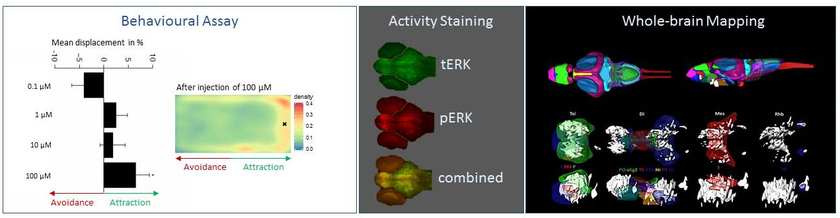
Insecticides are extensively used in Switzerland and all over the world to control pests and pathogens in medicine, households, and agriculture. Via spray drift, leaching or run-off they find their way into the aquatic environment where they pose a risk to non-target organisms, such as fish. Toxic effects from insecticides can occur at different organizational levels and may range from easily observable lethal to very subtle behavioral effects. As most insecticides are designed to interfere with neuronal signaling, they are able to adversely affect sensory processing and motor outputs in the fish with extensive ecological consequences.
We are investigating whether different classes of insecticides lead to attractive or aversive responses of zebrafish larvae, and are additionally interested in the neuronal mechanism underlying the observed behavioral response. We aim to better understand how insecticides change natural behavioral responses of fish in order to better predict their impact on the ecosystem.
Moreover, we are interested in how insecticides affect the fish’s developing nervous system. Therefore, we are assessing locomotor behavior of larval zebrafish which have been exposed to insecticides during different stages of their development. Using imaging and molecular methods we would not only like to understand the cause underlying the locomotion defects, but also whether there are critical periods during the development and to what extent adverse effects can be reversed.
array(3 items)0 => Snowflake\Publications\Domain\Model\Publicationprototypepersistent entity (uid=24965, pid=124)originalId => protected24965 (integer)
authors => protected'Könemann, S.; von Wyl, M.; vom Berg, C.' (55 chars)
title => protected'Zebrafish larvae rapidly recover from locomotor effects and neuromuscular al terations induced by cholinergic insecticides' (121 chars)
journal => protected'Environmental Science and Technology' (36 chars)
year => protected2022 (integer)
volume => protected56 (integer)
issue => protected'12' (2 chars)
startpage => protected'8449' (4 chars)
otherpage => protected'8462' (4 chars)
categories => protected'recovery; neuromuscular junction; immunohistochemistry; locomotion; axon gro wth; muscle development; birefringence' (114 chars)
description => protected'Owing to the importance of acetylcholine as a neurotransmitter, many insecti cides target the cholinergic system. Across phyla, cholinergic signaling is essential for many neuro-developmental processes including axonal pathfindin g and synaptogenesis. Consequently, early-life exposure to such insecticides can disturb these processes, resulting in an impaired nervous system. One t est frequently used to assess developmental neurotoxicity is the zebrafish l ight–dark transition test, which measures larval locomotion as a response to light changes. However, it is only poorly understood which structural alt erations cause insecticide-induced locomotion defects and how persistent the se alterations are. Therefore, this study aimed to link locomotion defects w ith effects on neuromuscular structures, including motorneurons, synapses, a nd muscles, and to investigate the longevity of the effects. The cholinergic insecticides diazinon and dimethoate (organophosphates), methomyl and pirim icarb (carbamates), and imidacloprid and thiacloprid (neonicotinoids) were u sed to induce hypoactivity. Our analyses revealed that some insecticides did not alter any of the structures assessed, while others affected axon branch ing (methomyl, imidacloprid) or muscle integrity (methomyl, thiacloprid). Th e majority of effects, even structural, were reversible within 24 to 72 h. O verall, we find that both neurodevelopmental and non-neurodevelopmental effe cts of different longevity can account for the reduced locomotion. These fin dings provide unprecedented insights into the underpinnings of insecticide-i nduced hypoactivity.' (1616 chars)
serialnumber => protected'0013-936X' (9 chars)
doi => protected'10.1021/acs.est.2c00161' (23 chars)
uid => protected24965 (integer)
_localizedUid => protected24965 (integer)modified_languageUid => protectedNULL
_versionedUid => protected24965 (integer)modifiedpid => protected124 (integer)1 => Snowflake\Publications\Domain\Model\Publicationprototypepersistent entity (uid=21778, pid=124)originalId => protected21778 (integer)
authors => protected'Fitzgerald, J. A.; Könemann, S.; Krümpelmann, L.; Žup anič, A.; vom Berg, C.' (109 chars)
title => protected'Approaches to test the neurotoxicity of environmental contaminants in the ze brafish model - from behavior to molecular mechanisms' (129 chars)
journal => protected'Environmental Toxicology and Chemistry' (38 chars)
year => protected2021 (integer)
volume => protected40 (integer)
issue => protected'4' (1 chars)
startpage => protected'989' (3 chars)
otherpage => protected'1006' (4 chars)
categories => protected'neurotoxicity; behavioral toxicology; ecotoxicology; toxicity mechanism; tel eost' (80 chars)
description => protected'The occurrence of neuroactive chemicals in the aquatic environment is on the rise and poses a potential threat to aquatic biota of currently unpredictab le outcome. In particular, subtle changes caused by these chemicals to an or ganism's sensation or behavior are difficult to tackle with current test sys tems that focus on rodents or with in vitro test systems omitting whole anim al responses. In recent years, zebrafish (<em>Danio rerio)</em> have become a popular model organism for toxicological studies and testing strategies, s uch as the standardized use of zebrafish early life stages in the OECD guide line 236. In terms of neurotoxicity, the zebrafish provides a powerful model to investigate changes to the nervous system from several different angles, offering the ability to tackle the mechanisms of action of chemicals in det ail. The mechanistic understanding gained through the analysis of this model species provides a good basic knowledge of how neuroactive chemicals might interact with a teleost nervous system. Such information can help infer pote ntial effects occurring to other species exposed to neuroactive chemicals in their aquatic environment and predicting potential risks of a chemical for the aquatic ecosystem. In the present article, we highlight approaches rangi ng from behavioral to structural, functional and molecular analysis of the l arval zebrafish nervous system, providing a holistic view of potential neuro toxic outcomes.' (1459 chars)
serialnumber => protected'0730-7268' (9 chars)
doi => protected'10.1002/etc.4951' (16 chars)
uid => protected21778 (integer)
_localizedUid => protected21778 (integer)modified_languageUid => protectedNULL
_versionedUid => protected21778 (integer)modifiedpid => protected124 (integer)2 => Snowflake\Publications\Domain\Model\Publicationprototypepersistent entity (uid=23455, pid=124)originalId => protected23455 (integer)
authors => protected'Könemann, S.; Meyer, S.; Betz, A.; Županič, A.; vom B erg, C.' (88 chars)
title => protected'Sub-lethal peak exposure to insecticides triggers olfaction-mediated avoidan ce in zebrafish larvae' (98 chars)
journal => protected'Environmental Science and Technology' (36 chars)
year => protected2021 (integer)
volume => protected55 (integer)
issue => protected'17' (2 chars)
startpage => protected'11835' (5 chars)
otherpage => protected'11847' (5 chars)
categories => protected'insecticide exposure; behavioral response; olfaction; neuronal activity; str ess response' (88 chars)
description => protected'In agricultural areas, insecticides inevitably reach water bodies via leachi ng or run-off. While designed to be neurotoxic to insects, insecticides have adverse effects on a multitude of organisms due to the high conservation of the nervous system among phyla. To estimate the ecological effects of insec ticides, it is important to investigate their impact on non-target organisms such as fish. Using zebrafish as the model, we investigated how different c lasses of insecticides influence fish behavior and uncovered neuronal underp innings of the associated behavioral changes, providing an unprecedented ins ight into the perception of these chemicals by fish. We observed that zebraf ish larvae avoid diazinon and imidacloprid while showing no response to othe r insecticides with the same mode of action. Moreover, ablation of olfaction abolished the aversive responses, indicating that fish smelled the insectic ides. Assessment of neuronal activity in 289 brain regions showed that hypot halamic areas involved in stress response were among the regions with the la rgest changes, indicating that the observed behavioral response resembles re actions to stimuli that threaten homeostasis, such as changes in water chemi stry. Our results contribute to the understanding of the environmental impac t of insecticide exposure and can help refine acute toxicity assessment.' (1364 chars)
serialnumber => protected'0013-936X' (9 chars)
doi => protected'10.1021/acs.est.1c01792' (23 chars)
uid => protected23455 (integer)
_localizedUid => protected23455 (integer)modified_languageUid => protectedNULL
_versionedUid => protected23455 (integer)modifiedpid => protected124 (integer)
Zebrafish larvae rapidly recover from locomotor effects and neuromuscular alterations induced by cholinergic insecticides
Owing to the importance of acetylcholine as a neurotransmitter, many insecticides target the cholinergic system. Across phyla, cholinergic signaling is essential for many neuro-developmental processes including axonal pathfinding and synaptogenesis. Consequently, early-life exposure to such insecticides can disturb these processes, resulting in an impaired nervous system. One test frequently used to assess developmental neurotoxicity is the zebrafish light–dark transition test, which measures larval locomotion as a response to light changes. However, it is only poorly understood which structural alterations cause insecticide-induced locomotion defects and how persistent these alterations are. Therefore, this study aimed to link locomotion defects with effects on neuromuscular structures, including motorneurons, synapses, and muscles, and to investigate the longevity of the effects. The cholinergic insecticides diazinon and dimethoate (organophosphates), methomyl and pirimicarb (carbamates), and imidacloprid and thiacloprid (neonicotinoids) were used to induce hypoactivity. Our analyses revealed that some insecticides did not alter any of the structures assessed, while others affected axon branching (methomyl, imidacloprid) or muscle integrity (methomyl, thiacloprid). The majority of effects, even structural, were reversible within 24 to 72 h. Overall, we find that both neurodevelopmental and non-neurodevelopmental effects of different longevity can account for the reduced locomotion. These findings provide unprecedented insights into the underpinnings of insecticide-induced hypoactivity.
Könemann, S.; von Wyl, M.; vom Berg, C. (2022) Zebrafish larvae rapidly recover from locomotor effects and neuromuscular alterations induced by cholinergic insecticides, Environmental Science and Technology, 56(12), 8449-8462, doi:10.1021/acs.est.2c00161, Institutional Repository
Approaches to test the neurotoxicity of environmental contaminants in the zebrafish model - from behavior to molecular mechanisms
The occurrence of neuroactive chemicals in the aquatic environment is on the rise and poses a potential threat to aquatic biota of currently unpredictable outcome. In particular, subtle changes caused by these chemicals to an organism's sensation or behavior are difficult to tackle with current test systems that focus on rodents or with in vitro test systems omitting whole animal responses. In recent years, zebrafish (Danio rerio) have become a popular model organism for toxicological studies and testing strategies, such as the standardized use of zebrafish early life stages in the OECD guideline 236. In terms of neurotoxicity, the zebrafish provides a powerful model to investigate changes to the nervous system from several different angles, offering the ability to tackle the mechanisms of action of chemicals in detail. The mechanistic understanding gained through the analysis of this model species provides a good basic knowledge of how neuroactive chemicals might interact with a teleost nervous system. Such information can help infer potential effects occurring to other species exposed to neuroactive chemicals in their aquatic environment and predicting potential risks of a chemical for the aquatic ecosystem. In the present article, we highlight approaches ranging from behavioral to structural, functional and molecular analysis of the larval zebrafish nervous system, providing a holistic view of potential neurotoxic outcomes.
Fitzgerald, J. A.; Könemann, S.; Krümpelmann, L.; Županič, A.; vom Berg, C. (2021) Approaches to test the neurotoxicity of environmental contaminants in the zebrafish model - from behavior to molecular mechanisms, Environmental Toxicology and Chemistry, 40(4), 989-1006, doi:10.1002/etc.4951, Institutional Repository
Sub-lethal peak exposure to insecticides triggers olfaction-mediated avoidance in zebrafish larvae
In agricultural areas, insecticides inevitably reach water bodies via leaching or run-off. While designed to be neurotoxic to insects, insecticides have adverse effects on a multitude of organisms due to the high conservation of the nervous system among phyla. To estimate the ecological effects of insecticides, it is important to investigate their impact on non-target organisms such as fish. Using zebrafish as the model, we investigated how different classes of insecticides influence fish behavior and uncovered neuronal underpinnings of the associated behavioral changes, providing an unprecedented insight into the perception of these chemicals by fish. We observed that zebrafish larvae avoid diazinon and imidacloprid while showing no response to other insecticides with the same mode of action. Moreover, ablation of olfaction abolished the aversive responses, indicating that fish smelled the insecticides. Assessment of neuronal activity in 289 brain regions showed that hypothalamic areas involved in stress response were among the regions with the largest changes, indicating that the observed behavioral response resembles reactions to stimuli that threaten homeostasis, such as changes in water chemistry. Our results contribute to the understanding of the environmental impact of insecticide exposure and can help refine acute toxicity assessment.
Könemann, S.; Meyer, S.; Betz, A.; Županič, A.; vom Berg, C. (2021) Sub-lethal peak exposure to insecticides triggers olfaction-mediated avoidance in zebrafish larvae, Environmental Science and Technology, 55(17), 11835-11847, doi:10.1021/acs.est.1c01792, Institutional Repository