
News Detail

Insecticides can affect fish behaviour

August 24, 2023 | Annette Ryser

The safety of insecticides is predominantly evaluated based on lethal effects on other animals. However, new findings from Eawag support the notion that also lower concentrations can be problematic, because they affect the nervous systems of fish and cause changes in their behaviour. This can indirectly affect the survival of fish populations and may be one of the reasons for the fish decline that we are observing in Switzerland. Researchers are uncovering the mechanisms of action and suggesting how these effects could be taken into account in the assessment and evaluation processes of insecticides.

Insecticides have a bad reputation. Most of them are designed to target the nervous system of fruit and crop pests (such as the aphid), but they often affect the nervous systems of other organisms as well. These include bees, aquatic insects – and vertebrates, such as fish or even humans. In some cases, this already occurs in very low concentrations. “Many fundamental aspects of the nervous system have changed very little over the course of evolution“, explains Ecotoxicologist Sarah Könemann, who researched the effects of insecticides in her doctoral thesis at the aquatic research institute Eawag and EPFL. For example, some insecticides target certain molecules in the nervous system of insects, but we have almost exactly the same molecules in our nervous system. This is why insecticides can have an effect on humans, too.

In most cases, the concentrations in which insecticides are found in the environment are not high enough to be acutely toxic, i.e. lethal, for vertebrates. ”However, there is a very wide range between a lethal effect and no effect“, explains Könemann. ”This is where I wanted to take a closer look.”

Fish can smell certain insecticides

For this reason, the researcher examined how six common insecticides affect the movement patterns and neuronal activity in the brains of zebrafish larvae. She discovered that these fish perceived the insecticides imidacloprid and diazinon as stress when they were exposed to a high concentration of them in a short time. And: Könemann was able to demonstrate that the fish larvae smelled these insecticides and subsequently avoided the substances. ”At first glance, this seems like a sensible reaction“, says the researcher. ”They flee from the insecticide and thus prevent chronic effects.”

Yet, such a change in behaviour can have negative consequences as well, e.g., if the fish avoid certain habitats as a result. This could lead to them no longer finding sufficient sexual partners or abandoning areas with a particularly rich food supply. “Such effects may therefore be another factor negatively impacting fish populations, which are already challenged by other stressors.”
 

Behavioural change at the push of a button

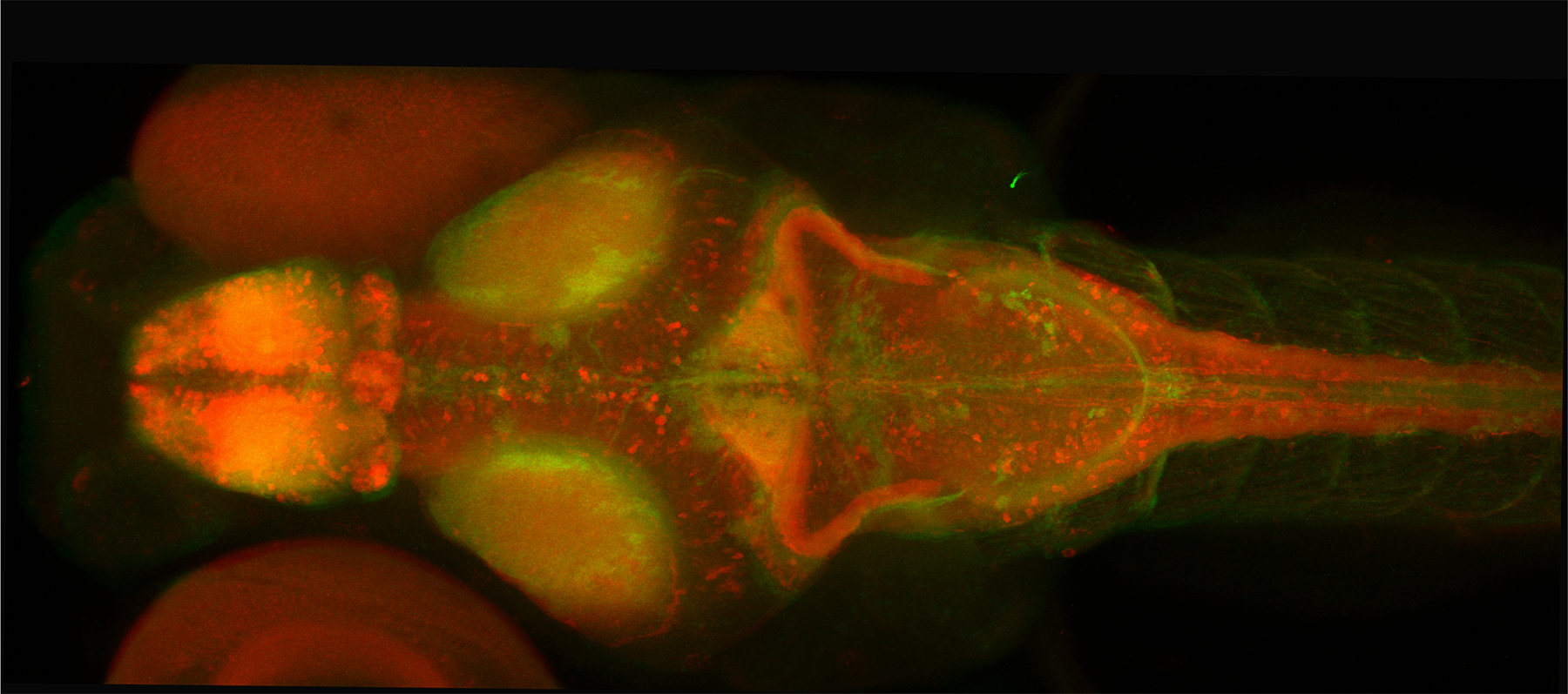
In her doctoral thesis, Sarah Könemann also looked at the developing nervous system of zebrafish embryos. “We anticipated that certain insecticides would have a particularly strong influence during the sensitive developmental phase, when the nervous system is forming”, explains the researcher. And indeed, for three quarters of the substances studied, she was able to demonstrate an effect on the behaviour of the fish: Larvae moved less than the control larvae.

Könemann was also able to identify structural changes in the muscle fibres and the peripheral nervous system that could explain the altered movement patterns. But there were also some surprises: Most of these effects (with the exception of those caused by pirimicarb) were reversible when the larvae were no longer exposed to the insecticides. In other words: “We were able to reverse most of the behavioural effects as well as the structural changes within 72 hours.”
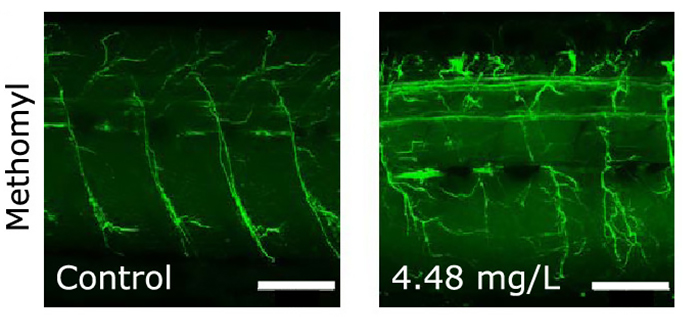
 

The insecticide methomyl, for example, led to structural changes in nerve cells of the peripheral nervous system of zebrafish larvae: Compared to control (left), more branches were formed in the nerve tracts on the right. This effect disappeared when the larvae were no longer exposed to the insecticide (Photo: Environ. Sci. Technol. 2022 56 12 8449 8462).

Significance for the approval of insecticides

Könemanns investigations also revealed that a group of newer insecticides, which were specifically developed to act on a certain organ that only insects have, did not have far-reaching influence on the behaviour of the fish studied. This is the case for pymetrozine and flonicamid. “This shows us that the impact on vertebrates in the environment can be reduced if the substances are developed in such a way that they more specifically act on the target-organisms”, says Könemann.

She advocates that when evaluating and approving insecticides, one should not only consider whether they will eventually lead to the death of the test animals, but also consider whether their use (even at much lower concentrations) results in behavioural changes. “There is a lot of research going on in the field of ecotoxicology at the moment, especially in the development of tests that can determine the effects of insecticides or other chemicals on the developing nervous system of vertebrates”, says Könemann.

However: “Simply investigating whether a substance affects the behaviour of animals is not enough, in my opinion, to be able to classify the significance of such an effect. I recommend also looking closely at the mechanisms that lead to the behavioural changes and the potential of the organism to recover.”

Award-winning research

It is worth thinking outside the box to gain new insights. In her doctoral thesis, Sarah Könemann applied methods from the neurosciences to an ecotoxicological context and was awarded the Rifcon Early Career Scientist Award from the globally active Society for Environmental Toxicology and Chemistry (SETAC) in 2022 for her detailed and interdisciplinary work.

 

Sarah Könemann (left) and former Eawag Director Janet Hering at the 2022 SETAC Europe meeting in Copenhagen
(Photo: Eawag, Barbara Jozef).

Why are problematic insecticides found in water bodies?

In Switzerland, insecticides are approved primarily to be used as plant protection products and biocides. They are mainly used in agriculture, but also in urban areas, the food and feed industry, as well as forestry. They generally enter water bodies through the air and via run-off during rainfall. Although the standards for approving insecticides have been made more stringent in recent years and many substances have been banned, they can still be found in the environment. This is surprising insofar as the most current insecticides degrade quickly in nature. «The fact that we can detect them in our environment in Switzerland (albeit in extremely small quantities of a few pico to nanograms per litre) nevertheless means that they are still being released, despite the bans», says Ecotoxicologist Sarah Könemann. This is made possible by emergency approvals or their use as biocides in stables, which is not explicitly prohibited, unlike the use of the same substance in a field.

Cover picture: Insecticides are designed to target the nervous system of fruit and crop pests (such as the Colorado potato beetle), however they often affect the nervous system of other organisms as well. (Photo: Shutterstock, Sidorov Ruslan)
 

Original publications

Extbase Variable Dump
array(3 items)
   publications => '23455,24965,30029' (17 chars)
   libraryUrl => '' (0 chars)
   layout => '0' (1 chars)
Extbase Variable Dump
array(3 items)
   0 => Snowflake\Publications\Domain\Model\Publicationprototypepersistent entity (uid=23455, pid=124)
      originalId => protected23455 (integer)
      authors => protected'Könemann, S.; Meyer, S.; Betz, A.; Županič, A.; vom B
         erg, C.
' (88 chars) title => protected'Sub-lethal peak exposure to insecticides triggers olfaction-mediated avoidan
         ce in zebrafish larvae
' (98 chars) journal => protected'Environmental Science and Technology' (36 chars) year => protected2021 (integer) volume => protected55 (integer) issue => protected'17' (2 chars) startpage => protected'11835' (5 chars) otherpage => protected'11847' (5 chars) categories => protected'insecticide exposure; behavioral response; olfaction; neuronal activity; str
         ess response
' (88 chars) description => protected'In agricultural areas, insecticides inevitably reach water bodies via leachi
         ng or run-off. While designed to be neurotoxic to insects, insecticides have
          adverse effects on a multitude of organisms due to the high conservation of
          the nervous system among phyla. To estimate the ecological effects of insec
         ticides, it is important to investigate their impact on non-target organisms
          such as fish. Using zebrafish as the model, we investigated how different c
         lasses of insecticides influence fish behavior and uncovered neuronal underp
         innings of the associated behavioral changes, providing an unprecedented ins
         ight into the perception of these chemicals by fish. We observed that zebraf
         ish larvae avoid diazinon and imidacloprid while showing no response to othe
         r insecticides with the same mode of action. Moreover, ablation of olfaction
          abolished the aversive responses, indicating that fish smelled the insectic
         ides. Assessment of neuronal activity in 289 brain regions showed that hypot
         halamic areas involved in stress response were among the regions with the la
         rgest changes, indicating that the observed behavioral response resembles re
         actions to stimuli that threaten homeostasis, such as changes in water chemi
         stry. Our results contribute to the understanding of the environmental impac
         t of insecticide exposure and can help refine acute toxicity assessment.
' (1364 chars) serialnumber => protected'0013-936X' (9 chars) doi => protected'10.1021/acs.est.1c01792' (23 chars) uid => protected23455 (integer) _localizedUid => protected23455 (integer)modified _languageUid => protectedNULL _versionedUid => protected23455 (integer)modified pid => protected124 (integer)
1 => Snowflake\Publications\Domain\Model\Publicationprototypepersistent entity (uid=24965, pid=124) originalId => protected24965 (integer) authors => protected'Könemann, S.; von Wyl, M.; vom Berg, C.' (55 chars) title => protected'Zebrafish larvae rapidly recover from locomotor effects and neuromuscular al
         terations induced by cholinergic insecticides
' (121 chars) journal => protected'Environmental Science and Technology' (36 chars) year => protected2022 (integer) volume => protected56 (integer) issue => protected'12' (2 chars) startpage => protected'8449' (4 chars) otherpage => protected'8462' (4 chars) categories => protected'recovery; neuromuscular junction; immunohistochemistry; locomotion; axon gro
         wth; muscle development; birefringence
' (114 chars) description => protected'Owing to the importance of acetylcholine as a neurotransmitter, many insecti
         cides target the cholinergic system. Across phyla, cholinergic signaling is
         essential for many neuro-developmental processes including axonal pathfindin
         g and synaptogenesis. Consequently, early-life exposure to such insecticides
          can disturb these processes, resulting in an impaired nervous system. One t
         est frequently used to assess developmental neurotoxicity is the zebrafish l
         ight–dark transition test, which measures larval locomotion as a response
         to light changes. However, it is only poorly understood which structural alt
         erations cause insecticide-induced locomotion defects and how persistent the
         se alterations are. Therefore, this study aimed to link locomotion defects w
         ith effects on neuromuscular structures, including motorneurons, synapses, a
         nd muscles, and to investigate the longevity of the effects. The cholinergic
          insecticides diazinon and dimethoate (organophosphates), methomyl and pirim
         icarb (carbamates), and imidacloprid and thiacloprid (neonicotinoids) were u
         sed to induce hypoactivity. Our analyses revealed that some insecticides did
          not alter any of the structures assessed, while others affected axon branch
         ing (methomyl, imidacloprid) or muscle integrity (methomyl, thiacloprid). Th
         e majority of effects, even structural, were reversible within 24 to 72 h. O
         verall, we find that both neurodevelopmental and non-neurodevelopmental effe
         cts of different longevity can account for the reduced locomotion. These fin
         dings provide unprecedented insights into the underpinnings of insecticide-i
         nduced hypoactivity.
' (1616 chars) serialnumber => protected'0013-936X' (9 chars) doi => protected'10.1021/acs.est.2c00161' (23 chars) uid => protected24965 (integer) _localizedUid => protected24965 (integer)modified _languageUid => protectedNULL _versionedUid => protected24965 (integer)modified pid => protected124 (integer)
2 => Snowflake\Publications\Domain\Model\Publicationprototypepersistent entity (uid=30029, pid=124) originalId => protected30029 (integer) authors => protected'von Wyl, M.; Könemann, S.; vom Berg, C.' (55 chars) title => protected'Different developmental insecticide exposure windows trigger distinct locomo
         tor phenotypes in the early life stages of zebrafish
' (128 chars) journal => protected'Chemosphere' (11 chars) year => protected2023 (integer) volume => protected317 (integer) issue => protected'' (0 chars) startpage => protected'137874 (10 pp.)' (15 chars) otherpage => protected'' (0 chars) categories => protected'spontaneous tail coiling; touch-evoked response; locomotion; recovery; criti
         cal window; insecticides; developmental neurotoxicity
' (129 chars) description => protected'Due to their extensive use and high biological activity, insecticides largel
         y contribute to loss of biodiversity and environmental pollution. The regula
         tion of insecticides by authorities is mainly focused on lethal concentratio
         ns. However, sub-lethal effects such as alterations in behavior and neurodev
         elopment can significantly affect the fitness of individual fish and their p
         opulation dynamics and therefore deserve consideration. Moreover, it is impo
         rtant to understand the impact of exposure timing during development, about
         which there is currently a lack of relevant knowledge. Here, we investigated
          whether there are periods during neurodevelopment of fish, which are partic
         ularly vulnerable to insecticide exposure. Therefore, we exposed zebrafish e
         
         
         t using an age-matched behavior assay. We used the organophosphates diazinon
          and dimethoate, the carbamates pirimicarb and methomyl as well as the neoni
         cotinoids thiacloprid and imidacloprid because they are abundant in the envi
         ronment and cholinergic signaling plays a major role during key processes of
          neurodevelopment. We found that early embryonic motor behaviors, as measure
         d by spontaneous tail coiling, increased upon exposure to most insecticides,
          while later movements, measured through touch-evoked response and a light-d
         ark transition assay, rather decreased for the same insecticides and exposur
         e duration. Moreover, the observed effects were more pronounced when exposur
         e windows were temporally closer to the performing of the respective behavio
         ral assay. However, the measured behavioral effects recovered after a short
         period, indicating that none of the exposure windows chosen here are particu
         larly critical, but rather that insecticides acutely interfere with neuronal
          function at all stages as long as they are present. Overall, our results co
         ntribute to a better und...
' (2165 chars) serialnumber => protected'0045-6535' (9 chars) doi => protected'10.1016/j.chemosphere.2023.137874' (33 chars) uid => protected30029 (integer) _localizedUid => protected30029 (integer)modified _languageUid => protectedNULL _versionedUid => protected30029 (integer)modified pid => protected124 (integer)
Könemann, S.; Meyer, S.; Betz, A.; Županič, A.; vom Berg, C. (2021) Sub-lethal peak exposure to insecticides triggers olfaction-mediated avoidance in zebrafish larvae, Environmental Science and Technology, 55(17), 11835-11847, doi:10.1021/acs.est.1c01792, Institutional Repository
Könemann, S.; von Wyl, M.; vom Berg, C. (2022) Zebrafish larvae rapidly recover from locomotor effects and neuromuscular alterations induced by cholinergic insecticides, Environmental Science and Technology, 56(12), 8449-8462, doi:10.1021/acs.est.2c00161, Institutional Repository
von Wyl, M.; Könemann, S.; vom Berg, C. (2023) Different developmental insecticide exposure windows trigger distinct locomotor phenotypes in the early life stages of zebrafish, Chemosphere, 317, 137874 (10 pp.), doi:10.1016/j.chemosphere.2023.137874, Institutional Repository

Funding / Partnerships

  • Eawag
  • EPFL
  • University of Zurich
  • Swiss National Science Foundation