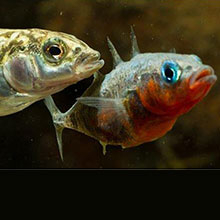
Wir sind Teil des Instituts für Integrative Biologie (IBZ) am Departement Umweltsystemwissenschaften (D-USYS) der ETH Zürich. Unsere Gruppe arbeitet an der Eawag in Kastanienbaum, wo unsere Büros und Labors sind. Unser Interesse gilt der Ökologie und Evolution aquatischer Ökosysteme. Nahrungsnetze zeigen bemerkenswerte strukturelle Vielfalt, aber wie wirkt sich das auf das Funktionieren von Ökosystemen aus? Um vorherzusagen, wie Ökosysteme auf globale Umweltveränderungen reagieren, müssen wir verstehen wie sich Variabilität von Nahrungsnetzen das Funktionieren von Ökosystemen verhalten. Dies erfordert eine vollständige Integration von Ökologie, Evolution und Ökosystem-Wissenschaft.
Den Fokus legen wir auf ökologische, evolutionäre und anthropogene Prozesse die zur Entstehung, Aufrechterhaltung und Veränderung von Biodiversität führen. Gleichzeitig interessiert uns wie Artenvielfalt die Funktion aquatischer Ökosysteme beeinflussen kann (z.B. Produktivität, Nährstoffkreislauf, organische Substanz-Fluss).
Wir nähern uns diesen Fragen in grossem experimentellem Massstab: wir verwenden Mesokosmos-Experimente (= 1000 L Aussen-Aquarien) und eine Kombination aus empirischen Feldstudien, Laborstudien und Modellierung.
Masterstudenten und Studierende im Grundstudium sind herzlich willkommen. Für weitere Informationen wenden Sie sich bitte an Blake Matthews.
array(7 items)0 => Snowflake\Publications\Domain\Model\Publicationprototypepersistent entity (uid=31310, pid=124)originalId => protected31310 (integer)
authors => protected'Hudson, C. M.; Cuenca Cambronero, M.; Moosmann, M.; Nar wani, A.; Spaak, P.; Seehausen, O.; Matthews, B.' (144 chars)
title => protected'Environmentally independent selection for hybrids between divergent freshwat er stickleback lineages in semi-natural ponds' (121 chars)
journal => protected'Journal of Evolutionary Biology' (31 chars)
year => protected2023 (integer)
volume => protected36 (integer)
issue => protected'8' (1 chars)
startpage => protected'1166' (4 chars)
otherpage => protected'1184' (4 chars)
categories => protected'adaptation; hybridization; invasive species; threespine stickleback' (67 chars)
description => protected'Hybridization following secondary contact of genetically divergent populatio ns can influence the range expansion of invasive species, though specific ou tcomes depend on the environmental dependence of hybrid fitness. Here, using two genetically and ecologically divergent threespine stickleback lineages that differ in their history of freshwater colonization, we estimate fitness variation of parental lineages and hybrids in semi-natural freshwater ponds with contrasting histories of nutrient loading. In our experiment, we found that fish from the older freshwater lineage (Lake Geneva) and hybrids outpe rformed fish from the younger freshwater lineage (Lake Constance) in terms o f both growth and survival, regardless of the environmental context of our p onds. Across all ponds, hybrids exhibited the highest survival. Although wil d-caught adult populations differed in their functional and defence morpholo gy, it is unclear which of these traits underlie the fitness differences obs erved among juveniles in our experiment. Overall, our work suggests that whe n hybrid fitness is insensitive to environmental conditions, as observed her e, introgression may promote population expansion into unoccupied habitats a nd accelerate invasion success.' (1247 chars)
serialnumber => protected'1010-061X' (9 chars)
doi => protected'10.1111/jeb.14194' (17 chars)
uid => protected31310 (integer)
_localizedUid => protected31310 (integer)modified_languageUid => protectedNULL
_versionedUid => protected31310 (integer)modifiedpid => protected124 (integer)1 => Snowflake\Publications\Domain\Model\Publicationprototypepersistent entity (uid=30183, pid=124)originalId => protected30183 (integer)
authors => protected'Moosmann, M.; Hudson, C. M.; Seehausen, O.; Matthews,&nb sp;B.' (81 chars)
title => protected'The phenotypic determinants of diet variation between divergent lineages of threespine stickleback' (98 chars)
journal => protected'Evolution, International Journal of Organic Evolution' (53 chars)
year => protected2023 (integer)
volume => protected77 (integer)
issue => protected'1' (1 chars)
startpage => protected'13' (2 chars)
otherpage => protected'25' (2 chars)
categories => protected'trait utility; dietary divergence; foraging; trait evolution' (60 chars)
description => protected'Lineages with independent evolutionary histories often differ in both their morphology and diet. Experimental work has improved our understanding of the links between the biomechanics of morphological traits and foraging perform ance (trait utility). However, because the expression of foraging-relevant t raits and their utility can be highly context-specific, it is often unclear how dietary divergence arises from evolved phenotypic differences. Here, we explore the phenotypic causes of dietary divergence between two genetically and phenotypically divergent lineages of threespine stickleback (Gasterosteu s aculeatus) with independent evolutionary histories of freshwater colonizat ion and adaptation. First, using individuals from a line-cross breeding desi gn, we conducted 150 common-garden foraging trials with a community of multi ple prey species and performed morphological and behavioral analyses to test for prey-specific trait utility. Second, we tested if the traits that expla in variation in foraging performance among all individuals could also explai n the dietary divergence between the lineages. Overall, we found evidence fo r the utility of several foraging traits, but these traits did not explain t he observed dietary divergence between the lineages in a common garden. This work suggests that evolved dietary divergence results not only from differe nces in morphology but also from divergence in behaviors that underlie prey capture success in species-rich prey communities.' (1493 chars)
serialnumber => protected'0014-3820' (9 chars)
doi => protected'10.1093/evolut/qpac021' (22 chars)
uid => protected30183 (integer)
_localizedUid => protected30183 (integer)modified_languageUid => protectedNULL
_versionedUid => protected30183 (integer)modifiedpid => protected124 (integer)2 => Snowflake\Publications\Domain\Model\Publicationprototypepersistent entity (uid=25163, pid=124)originalId => protected25163 (integer)
authors => protected'Twining, C. W.; Shipley, J. R.; Matthews, B.' (69 chars)
title => protected'Climate change creates nutritional phenological mismatches' (58 chars)
journal => protected'Trends in Ecology and Evolution' (31 chars)
year => protected2022 (integer)
volume => protected37 (integer)
issue => protected'9' (1 chars)
startpage => protected'736' (3 chars)
otherpage => protected'739' (3 chars)
categories => protected'animals; climate change; mismatch; nutrition; phenology' (55 chars)
description => protected'Climate change is creating phenological mismatches between consumers and the ir resources. However, while the importance of nutritional quality in ecolog ical interactions is widely appreciated, most studies of phenological mismat ch focus on energy content alone. We argue that mismatches in terms of pheno logy and nutrition will increase with climate change.' (357 chars)
serialnumber => protected'0169-5347' (9 chars)
doi => protected'10.1016/j.tree.2022.06.009' (26 chars)
uid => protected25163 (integer)
_localizedUid => protected25163 (integer)modified_languageUid => protectedNULL
_versionedUid => protected25163 (integer)modifiedpid => protected124 (integer)3 => Snowflake\Publications\Domain\Model\Publicationprototypepersistent entity (uid=24504, pid=124)originalId => protected24504 (integer)
authors => protected'Shipley, J. R.; Twining, C. W.; Mathieu-Resuge, M.; Parmar, T. P.; Kainz, M.; Martin-Creuzburg, D.; Weber,& nbsp;C.; Winkler, D. W.; Graham, C. H.; Matthews, B .' (229 chars)
title => protected'Climate change shifts the timing of nutritional flux from aquatic insects' (73 chars)
journal => protected'Current Biology' (15 chars)
year => protected2022 (integer)
volume => protected32 (integer)
issue => protected'6' (1 chars)
startpage => protected'1342' (4 chars)
otherpage => protected'1349' (4 chars)
categories => protected'' (0 chars)
description => protected'Climate change can decouple resource supply from consumer demand, with the p otential to create phenological mismatches driving negative consequences on fitness. However, the underlying ecological mechanisms of phenological misma tches between consumers and their resources have not been fully explored. He re, we use long-term records of aquatic and terrestrial insect biomass and e gg-hatching times of several co-occurring insectivorous species to investiga te temporal mismatches between the availability of and demand for nutrients that are essential for offspring development. We found that insects with aqu atic larvae reach peak biomass earlier in the season than those with terrest rial larvae and that the relative availability of omega-3 long-chain polyuns aturated fatty acids (n-3 LCPUFAs) to consumers is almost entirely dependent on the phenology of aquatic insect emergence. This is due to the 4- to 34-f old greater n-3 LCPUFA concentration difference in insects emerging from aqu atic as opposed to terrestrial habitats. From a long-sampled site (25 years) undergoing minimal land use conversion, we found that both aquatic and terr estrial insect phenologies have advanced substantially faster than those of insectivorous birds, shifting the timing of peak availability of n-3 LCPUFAs for birds during reproduction. For species that require n-3 LCPUFAs directl y from diet, highly nutritious aquatic insects cannot simply be replaced by terrestrial insects, creating nutritional phenological mismatches. Our resea rch findings reveal and highlight the increasing necessity of specifically i nvestigating how nutritional phenology, rather than only overall resource av ailability, is changing for consumers in response to climate change.' (1740 chars)
serialnumber => protected'0960-9822' (9 chars)
doi => protected'10.1016/j.cub.2022.01.057' (25 chars)
uid => protected24504 (integer)
_localizedUid => protected24504 (integer)modified_languageUid => protectedNULL
_versionedUid => protected24504 (integer)modifiedpid => protected124 (integer)4 => Snowflake\Publications\Domain\Model\Publicationprototypepersistent entity (uid=23870, pid=124)originalId => protected23870 (integer)
authors => protected'Chaparro Pedraza, P. C.; Matthews, B.; de Meester, L.; D akos, V.' (89 chars)
title => protected'Adaptive evolution can both prevent ecosystem collapse and delay ecosystem r ecovery' (83 chars)
journal => protected'American Naturalist' (19 chars)
year => protected2021 (integer)
volume => protected198 (integer)
issue => protected'6' (1 chars)
startpage => protected'E186' (4 chars)
otherpage => protected'E197' (4 chars)
categories => protected'ecosystem tipping points; ecosystem resilience; eco-evolutionary feedback; s hallow lakes; alternative stable states' (115 chars)
description => protected'There is growing concern about the dire socioeco-logical consequences of abr upt transitions between alternative ecosystem states in response to environm ental changes. At the same time, environmental change can trigger evolutiona ry responses that could stabilize or destabilize ecosystem dynamics. However , we know little about how coupled ecological and evolutionary processes aff ect the risk of transition between alternative ecosystem states. Using shall ow lakes as a model ecosystem, we investigate how trait evolution of a key s pecies affects ecosystem resilience under environmental stress. We find that adaptive evolution of macrophytes can increase ecosystem resilience by shif ting the critical threshold, which marks the transition from a clear-water s tate to a turbid-water state to a higher level of environmental stress. Howe ver, following the transition, adaptation to the turbid-water state can dela y the ecosystem recovery back to the clear-water state. This implies that re storation could be more effective when implemented early enough after a tran sition occurs and before organisms adapt to the alternative state. Our findi ngs provide new insights into how to prevent and mitigate the occurrence of regime shifts in ecosystems and highlight the need to understand ecosystem r esponses to environmental change in the context of coupled ecological and ev olutionary processes.' (1389 chars)
serialnumber => protected'0003-0147' (9 chars)
doi => protected'10.1086/716929' (14 chars)
uid => protected23870 (integer)
_localizedUid => protected23870 (integer)modified_languageUid => protectedNULL
_versionedUid => protected23870 (integer)modifiedpid => protected124 (integer)5 => Snowflake\Publications\Domain\Model\Publicationprototypepersistent entity (uid=23608, pid=124)originalId => protected23608 (integer)
authors => protected'Moosmann, M.; Cuenca-Cambronero, M.; De Lisle, S.; Greenway,& nbsp;R.; Hudson, C. M.; Lürig, M.; Matthews, B.' (144 chars)
title => protected'On the evolution of trophic position' (36 chars)
journal => protected'Ecology Letters' (15 chars)
year => protected2021 (integer)
volume => protected24 (integer)
issue => protected'12' (2 chars)
startpage => protected'2549' (4 chars)
otherpage => protected'2562' (4 chars)
categories => protected'food webs; intraspecific variation; natural selection; phenotypic plasticity ; trait evolution; trophic position' (111 chars)
description => protected'The trophic structure of food webs is primarily determined by the variation in trophic position among species and individuals. Temporal dynamics of food web structure are central to our understanding of energy and nutrient fluxe s in changing environments, but little is known about how evolutionary proce sses shape trophic position variation in natural populations. We propose tha t trophic position, whose expression depends on both environmental and genet ic determinants of the diet variation in individual consumers, is a quantita tive trait that can evolve via natural selection. Such evolution can occur e ither when trophic position is correlated with other heritable morphological and behavioural traits under selection, or when trophic position is a targe t of selection, which is possible if the fitness effects of prey items are h eterogeneously distributed along food chains. Recognising trophic position a s an evolving trait, whose expression depends on the food web context, provi des an important conceptual link between behavioural foraging theory and foo d web dynamics, and a useful starting point for the integration of ecologica l and evolutionary studies of trophic position.' (1187 chars)
serialnumber => protected'1461-023X' (9 chars)
doi => protected'10.1111/ele.13888' (17 chars)
uid => protected23608 (integer)
_localizedUid => protected23608 (integer)modified_languageUid => protectedNULL
_versionedUid => protected23608 (integer)modifiedpid => protected124 (integer)6 => Snowflake\Publications\Domain\Model\Publicationprototypepersistent entity (uid=22836, pid=124)originalId => protected22836 (integer)
authors => protected'Twining, C. W.; Bernhardt, J. R.; Derry, A. M. ; Hudson, C. M.; Ishikawa, A.; Kabeya, N.; Kainz, M . J.; Kitano, J.; Kowarik, C.; Ladd, S. N.; Leal,&n bsp;M. C.; Scharnweber, K.; Shipley, J. R.; Matthews,&nb sp;B.' (309 chars)
title => protected'The evolutionary ecology of fatty-acid variation: implications for consumer adaptation and diversification' (106 chars)
journal => protected'Ecology Letters' (15 chars)
year => protected2021 (integer)
volume => protected24 (integer)
issue => protected'8' (1 chars)
startpage => protected'1709' (4 chars)
otherpage => protected'1731' (4 chars)
categories => protected'adaptation; behavior; diversification; genetics; metabolic networks; nutriti onal landscapes; omega-3 polyunsaturated fatty acids; traits' (136 chars)
description => protected'The nutritional diversity of resources can affect the adaptive evolution of consumer metabolism and consumer diversification. The omega-3 long-chain pol yunsaturated fatty acids eicosapentaenoic acid (EPA; 20:5n-3) and docosahexa enoic acid (DHA; 22:6n-3) have a high potential to affect consumer fitness, through their widespread effects on reproduction, growth and survival. Howev er, few studies consider the evolution of fatty acid metabolism within an ec ological context. In this review, we first document the extensive diversity in both primary producer and consumer fatty acid distributions amongst major ecosystems, between habitats and amongst species within habitats. We highli ght some of the key nutritional contrasts that can shape behavioural and/or metabolic adaptation in consumers, discussing how consumers can evolve in re sponse to the spatial, seasonal and community-level variation of resource qu ality. We propose a hierarchical trait-based approach for studying the evolu tion of consumers' metabolic networks and review the evolutionary genetic me chanisms underpinning consumer adaptation to EPA and DHA distributions. In d oing so, we consider how the metabolic traits of consumers are hierarchicall y structured, from cell membrane function to maternal investment, and have s trongly environment-dependent expression. Finally, we conclude with an outlo ok on how studying the metabolic adaptation of consumers within the context of nutritional landscapes can open up new opportunities for understanding ev olutionary diversification.' (1547 chars)
serialnumber => protected'1461-023X' (9 chars)
doi => protected'10.1111/ele.13771' (17 chars)
uid => protected22836 (integer)
_localizedUid => protected22836 (integer)modified_languageUid => protectedNULL
_versionedUid => protected22836 (integer)modifiedpid => protected124 (integer)
Environmentally independent selection for hybrids between divergent freshwater stickleback lineages in semi-natural ponds
Hybridization following secondary contact of genetically divergent populations can influence the range expansion of invasive species, though specific outcomes depend on the environmental dependence of hybrid fitness. Here, using two genetically and ecologically divergent threespine stickleback lineages that differ in their history of freshwater colonization, we estimate fitness variation of parental lineages and hybrids in semi-natural freshwater ponds with contrasting histories of nutrient loading. In our experiment, we found that fish from the older freshwater lineage (Lake Geneva) and hybrids outperformed fish from the younger freshwater lineage (Lake Constance) in terms of both growth and survival, regardless of the environmental context of our ponds. Across all ponds, hybrids exhibited the highest survival. Although wild-caught adult populations differed in their functional and defence morphology, it is unclear which of these traits underlie the fitness differences observed among juveniles in our experiment. Overall, our work suggests that when hybrid fitness is insensitive to environmental conditions, as observed here, introgression may promote population expansion into unoccupied habitats and accelerate invasion success.
Hudson, C. M.; Cuenca Cambronero, M.; Moosmann, M.; Narwani, A.; Spaak, P.; Seehausen, O.; Matthews, B. (2023) Environmentally independent selection for hybrids between divergent freshwater stickleback lineages in semi-natural ponds, Journal of Evolutionary Biology, 36(8), 1166-1184, doi:10.1111/jeb.14194, Institutional Repository
The phenotypic determinants of diet variation between divergent lineages of threespine stickleback
Lineages with independent evolutionary histories often differ in both their morphology and diet. Experimental work has improved our understanding of the links between the biomechanics of morphological traits and foraging performance (trait utility). However, because the expression of foraging-relevant traits and their utility can be highly context-specific, it is often unclear how dietary divergence arises from evolved phenotypic differences. Here, we explore the phenotypic causes of dietary divergence between two genetically and phenotypically divergent lineages of threespine stickleback (Gasterosteus aculeatus) with independent evolutionary histories of freshwater colonization and adaptation. First, using individuals from a line-cross breeding design, we conducted 150 common-garden foraging trials with a community of multiple prey species and performed morphological and behavioral analyses to test for prey-specific trait utility. Second, we tested if the traits that explain variation in foraging performance among all individuals could also explain the dietary divergence between the lineages. Overall, we found evidence for the utility of several foraging traits, but these traits did not explain the observed dietary divergence between the lineages in a common garden. This work suggests that evolved dietary divergence results not only from differences in morphology but also from divergence in behaviors that underlie prey capture success in species-rich prey communities.
Moosmann, M.; Hudson, C. M.; Seehausen, O.; Matthews, B. (2023) The phenotypic determinants of diet variation between divergent lineages of threespine stickleback, Evolution, International Journal of Organic Evolution, 77(1), 13-25, doi:10.1093/evolut/qpac021, Institutional Repository
Climate change is creating phenological mismatches between consumers and their resources. However, while the importance of nutritional quality in ecological interactions is widely appreciated, most studies of phenological mismatch focus on energy content alone. We argue that mismatches in terms of phenology and nutrition will increase with climate change.
Twining, C. W.; Shipley, J. R.; Matthews, B. (2022) Climate change creates nutritional phenological mismatches, Trends in Ecology and Evolution, 37(9), 736-739, doi:10.1016/j.tree.2022.06.009, Institutional Repository
Climate change shifts the timing of nutritional flux from aquatic insects
Climate change can decouple resource supply from consumer demand, with the potential to create phenological mismatches driving negative consequences on fitness. However, the underlying ecological mechanisms of phenological mismatches between consumers and their resources have not been fully explored. Here, we use long-term records of aquatic and terrestrial insect biomass and egg-hatching times of several co-occurring insectivorous species to investigate temporal mismatches between the availability of and demand for nutrients that are essential for offspring development. We found that insects with aquatic larvae reach peak biomass earlier in the season than those with terrestrial larvae and that the relative availability of omega-3 long-chain polyunsaturated fatty acids (n-3 LCPUFAs) to consumers is almost entirely dependent on the phenology of aquatic insect emergence. This is due to the 4- to 34-fold greater n-3 LCPUFA concentration difference in insects emerging from aquatic as opposed to terrestrial habitats. From a long-sampled site (25 years) undergoing minimal land use conversion, we found that both aquatic and terrestrial insect phenologies have advanced substantially faster than those of insectivorous birds, shifting the timing of peak availability of n-3 LCPUFAs for birds during reproduction. For species that require n-3 LCPUFAs directly from diet, highly nutritious aquatic insects cannot simply be replaced by terrestrial insects, creating nutritional phenological mismatches. Our research findings reveal and highlight the increasing necessity of specifically investigating how nutritional phenology, rather than only overall resource availability, is changing for consumers in response to climate change.
Shipley, J. R.; Twining, C. W.; Mathieu-Resuge, M.; Parmar, T. P.; Kainz, M.; Martin-Creuzburg, D.; Weber, C.; Winkler, D. W.; Graham, C. H.; Matthews, B. (2022) Climate change shifts the timing of nutritional flux from aquatic insects, Current Biology, 32(6), 1342-1349, doi:10.1016/j.cub.2022.01.057, Institutional Repository
Adaptive evolution can both prevent ecosystem collapse and delay ecosystem recovery
There is growing concern about the dire socioeco-logical consequences of abrupt transitions between alternative ecosystem states in response to environmental changes. At the same time, environmental change can trigger evolutionary responses that could stabilize or destabilize ecosystem dynamics. However, we know little about how coupled ecological and evolutionary processes affect the risk of transition between alternative ecosystem states. Using shallow lakes as a model ecosystem, we investigate how trait evolution of a key species affects ecosystem resilience under environmental stress. We find that adaptive evolution of macrophytes can increase ecosystem resilience by shifting the critical threshold, which marks the transition from a clear-water state to a turbid-water state to a higher level of environmental stress. However, following the transition, adaptation to the turbid-water state can delay the ecosystem recovery back to the clear-water state. This implies that restoration could be more effective when implemented early enough after a transition occurs and before organisms adapt to the alternative state. Our findings provide new insights into how to prevent and mitigate the occurrence of regime shifts in ecosystems and highlight the need to understand ecosystem responses to environmental change in the context of coupled ecological and evolutionary processes.
Chaparro Pedraza, P. C.; Matthews, B.; de Meester, L.; Dakos, V. (2021) Adaptive evolution can both prevent ecosystem collapse and delay ecosystem recovery, American Naturalist, 198(6), E186-E197, doi:10.1086/716929, Institutional Repository
On the evolution of trophic position
The trophic structure of food webs is primarily determined by the variation in trophic position among species and individuals. Temporal dynamics of food web structure are central to our understanding of energy and nutrient fluxes in changing environments, but little is known about how evolutionary processes shape trophic position variation in natural populations. We propose that trophic position, whose expression depends on both environmental and genetic determinants of the diet variation in individual consumers, is a quantitative trait that can evolve via natural selection. Such evolution can occur either when trophic position is correlated with other heritable morphological and behavioural traits under selection, or when trophic position is a target of selection, which is possible if the fitness effects of prey items are heterogeneously distributed along food chains. Recognising trophic position as an evolving trait, whose expression depends on the food web context, provides an important conceptual link between behavioural foraging theory and food web dynamics, and a useful starting point for the integration of ecological and evolutionary studies of trophic position.
Moosmann, M.; Cuenca-Cambronero, M.; De Lisle, S.; Greenway, R.; Hudson, C. M.; Lürig, M.; Matthews, B. (2021) On the evolution of trophic position, Ecology Letters, 24(12), 2549-2562, doi:10.1111/ele.13888, Institutional Repository
The evolutionary ecology of fatty-acid variation: implications for consumer adaptation and diversification
The nutritional diversity of resources can affect the adaptive evolution of consumer metabolism and consumer diversification. The omega-3 long-chain polyunsaturated fatty acids eicosapentaenoic acid (EPA; 20:5n-3) and docosahexaenoic acid (DHA; 22:6n-3) have a high potential to affect consumer fitness, through their widespread effects on reproduction, growth and survival. However, few studies consider the evolution of fatty acid metabolism within an ecological context. In this review, we first document the extensive diversity in both primary producer and consumer fatty acid distributions amongst major ecosystems, between habitats and amongst species within habitats. We highlight some of the key nutritional contrasts that can shape behavioural and/or metabolic adaptation in consumers, discussing how consumers can evolve in response to the spatial, seasonal and community-level variation of resource quality. We propose a hierarchical trait-based approach for studying the evolution of consumers' metabolic networks and review the evolutionary genetic mechanisms underpinning consumer adaptation to EPA and DHA distributions. In doing so, we consider how the metabolic traits of consumers are hierarchically structured, from cell membrane function to maternal investment, and have strongly environment-dependent expression. Finally, we conclude with an outlook on how studying the metabolic adaptation of consumers within the context of nutritional landscapes can open up new opportunities for understanding evolutionary diversification.
Twining, C. W.; Bernhardt, J. R.; Derry, A. M.; Hudson, C. M.; Ishikawa, A.; Kabeya, N.; Kainz, M. J.; Kitano, J.; Kowarik, C.; Ladd, S. N.; Leal, M. C.; Scharnweber, K.; Shipley, J. R.; Matthews, B. (2021) The evolutionary ecology of fatty-acid variation: implications for consumer adaptation and diversification, Ecology Letters, 24(8), 1709-1731, doi:10.1111/ele.13771, Institutional Repository
Laufende Projekte
20,000 years of evolution and ecosystem dynamics in the world’s largest tropical lake reconstructed from sediment cores, fossils, and ancient DNA.
New tools to monitor changes in ecosystem conditions and to quantify genetic changes of populations in (semi-)natural environments to predict how human mediated environmental change will influence stability and resilience of ecosystems.