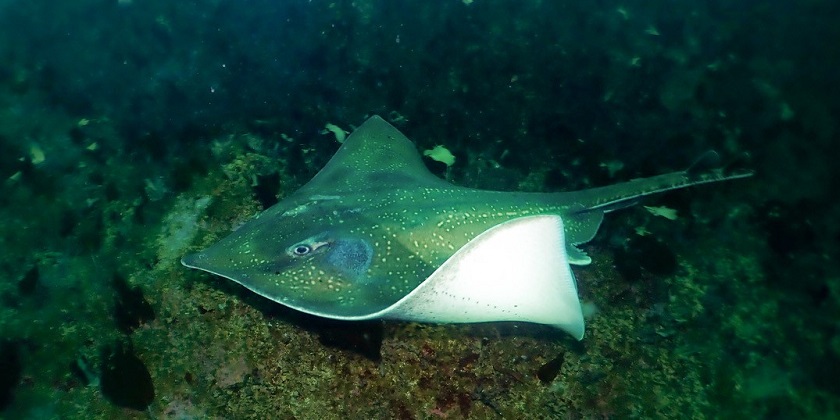
We develop methods to model passive acoustic telemetry data as part of research into species’ movement ecology and conservation, including the Critically Endangered flapper skate.
Photograph courtesy of S. Bradley.
Wir interessieren uns für die Analyse von Tierbewegungen in passiven akustischen Telemetriesystemen (PAT). PAT-Systeme bestehen aus Netzen von statischen akustischen Empfängern, die auf akustische Übertragungen von akustischen Pingern, die an markierten Tieren angebracht sind, "lauschen". Die Technologie wird in großem Umfang in Küsten- und Süßwasserökosystemen als Teil der Forschung zur Ökologie und Erhaltung mobiler aquatischer Arten eingesetzt. In der Schweiz wird von der Eawag-Fachgruppe Flussfischökologie das erste grossflächige Netz von akustischen Empfängern in Flüssen aufgebaut. In der Gruppe Ökologische Modellierung entwickeln wir modernste Partikel-Filter-Algorithmen für die Datenanalyse, die es ermöglichen, aus den Detektionen an den Empfängern feinräumige Bewegungspfade und Muster der Raumnutzung zu rekonstruieren. Neben der Methodenentwicklung schreiben wir effiziente Open-Source-Implementierungsroutinen, führen umfangreiche Simulationsstudien durch und analysieren reale Daten ausgewählter Arten, darunter auch des vom Aussterben bedrohten Grossen Glattrochens (Dipturus intermedius). Wir haben das R-Paket patter entwickelt, um diese Arbeit zu unterstützen. Bitte nehmen Sie Kontakt auf, wenn Sie an der Unterstützung von Beta-Tests oder potenziellen Anwendungen interessiert sind. Die Forschung hat mehrere Studentenprojekte in Zusammenarbeit mit Dr. Stanisław Biber an der Universität Bristol hervorgebracht und hat wichtige Auswirkungen auf die Erhaltung von mobilen Arten.
array(3 items)0 => Snowflake\Publications\Domain\Model\Publicationprototypepersistent entity (uid=34558, pid=124)originalId => protected34558 (integer)
authors => protected'Lavender, E.; Scheidegger, A.; Albert, C.; Biber, S.W.; Illian, J.; Thorburn, J.; Smout, S.; Moor, H.' (141 chars)
title => protected'Particle algorithms for animal movement modelling in receiver arrays' (69 chars)
journal => protected'Methods in Ecology and Evolution' (32 chars)
year => protected2025 (integer)
volume => protected16 (integer)
issue => protected'8' (1 chars)
startpage => protected'1808' (4 chars)
otherpage => protected'1819' (4 chars)
categories => protected'animal tracking; movement ecology; passive acoustic telemetry; patter; state -space model; utilisation distribution' (114 chars)
description => protected'1. Particle filters and smoothers are sequential Monte Carlo algorithms used to fit non-linear, non-Gaussian state-space models. These algorithms are we ll placed to fit process-oriented models to animal-tracking data, especially in receiver arrays, but to date they have received limited attention in the ecological literature.<br />2. We introduce a Bayesian filtering–smoothin g algorithm that reconstructs individual movements and patterns of space use from animal-tracking data, with a focus on passive acoustic telemetry syste ms. Within a sound probabilistic framework, the methodology integrates the m ovement process and the observation processes of disparate datasets, while c orrectly representing uncertainty. In a simulation-based analysis, we compar e the performance of our algorithm to the prevailing heuristic methods used to study movements and space use in passive acoustic telemetry systems and a nalyse algorithm sensitivity.<br />3. We find the particle smoothing methodo logy outperforms heuristic methods across the board. Particle-based maps rep resent simulated movements more accurately, even in dense receiver arrays, a nd are better suited to analyses of home ranges, residency and habitat prefe rences.<br />4. This study sets a new state-of-the-art for movement modellin g in receiver arrays. Particle algorithms provide a robust, flexible and int uitive modelling framework with potential applications in many ecological se ttings.' (1451 chars)
serialnumber => protected'2041-210X' (9 chars)
doi => protected'10.1111/2041-210X.70028' (23 chars)
uid => protected34558 (integer)
_localizedUid => protected34558 (integer)modified_languageUid => protectedNULL
_versionedUid => protected34558 (integer)modifiedpid => protected124 (integer)1 => Snowflake\Publications\Domain\Model\Publicationprototypepersistent entity (uid=34554, pid=124)originalId => protected34554 (integer)
authors => protected'Lavender, E.; Scheidegger, A.; Albert, C.; Biber, S.&nbs p;W.; Illian, J.; Thorburn, J.; Smout, S.; Moor, H.' (147 chars)
title => protected'patter: particle algorithms for animal tracking in R and Julia' (62 chars)
journal => protected'Methods in Ecology and Evolution' (32 chars)
year => protected2025 (integer)
volume => protected16 (integer)
issue => protected'8' (1 chars)
startpage => protected'1609' (4 chars)
otherpage => protected'1616' (4 chars)
categories => protected'Bayesian inference; movement ecology; package; particle filter; passive acou stic telemetry; state-space model' (109 chars)
description => protected'1. State-space models are a powerful modelling framework in movement ecology that represents individual movements and the processes connecting movements to observations. However, fitting state-space models to animal-tracking dat a can be difficult and computationally expensive.<br />2. Here, we introduce patter, a package that provides particle filtering and smoothing algorithms that fit Bayesian state-space models to tracking data, with a focus on data from aquatic animals in receiver arrays. patter is written in R, with a per formant Julia backend. Package functionality supports data simulation, prepa ration, filtering, smoothing and mapping.<br />3. In two examples, we demons trate how to implement patter to reconstruct the movements of a tagged anima l in an acoustic telemetry system from acoustic detections and ancillary obs ervations. With perfect information, the particle filter reconstructs the tr ue (unobserved) movement path (Example One). More generally, particle algori thms represent an individual's possible location probabilistically as a weig hted series of samples (‘particles’). In our illustration, we resolve an individual's (unobserved) location every 2 min during 1 month and use parti cles to visualise movements, map space use and quantify residency (Example T wo).<br />4. patter facilitates robust, flexible and efficient analyses of a nimal-tracking data. The methods are widely applicable and enable refined an alyses of space use, home ranges and residency.' (1491 chars)
serialnumber => protected'2041-210X' (9 chars)
doi => protected'10.1111/2041-210X.70029' (23 chars)
uid => protected34554 (integer)
_localizedUid => protected34554 (integer)modified_languageUid => protectedNULL
_versionedUid => protected34554 (integer)modifiedpid => protected124 (integer)2 => Snowflake\Publications\Domain\Model\Publicationprototypepersistent entity (uid=33717, pid=124)originalId => protected33717 (integer)
authors => protected'Cole, G.; Lavender, E.; Naylor, A.; Girling, S.; Aleynik , D.; Oppel, S.; Dodd, J.; Thorburn, J.' (135 chars)
title => protected'Physiological responses to capture, handling and tagging in the critically e ndangered flapper skate (Dipturus intermedius)' (122 chars)
journal => protected'Conservation Physiology' (23 chars)
year => protected2024 (integer)
volume => protected12 (integer)
issue => protected'1' (1 chars)
startpage => protected'coae077 (16 pp.)' (16 chars)
otherpage => protected'' (0 chars)
categories => protected'acidosis; angling; batoid; conservation; dipturus intermedius; elasmobranch; flapper skate; physiology; tagging' (111 chars)
description => protected'Catch-and-release angling is a popular recreational pastime and an essential component of many fish research programmes. Marked physiological disturbanc es have been documented in elasmobranchs in response to angling and handling , but skates and rays remain understudied. Here, we describe for the first t ime the physiological responses of the critically endangered flapper skate ( Dipturus intermedius) to angling, handling and tagging in Scotland. Sixty-on e skate were captured by angling as part of a tagging research programme. We assessed individual health, measured blood parameters at two time points (p ost-capture and prior to release) and recorded heart and respiratory rates d uring handling and the surgical insertion of acoustic tags. Injuries or infe ctions were identified in 10% of individuals and attributed to prior angling in two cases. Skate generally experienced a mild metabolic acidosis charact erized by decreases in blood pH and bicarbonate and increases in lactate and glucose. Respiratory acidosis characterized by limited increases in PCO<sub >2</sub> was also observed. The degree of acidosis was greater with warmer s ea temperatures and longer fight times, and worsened during the time that sk ate were handled on deck. Heart rates during handling were negatively associ ated with body size, positively associated with temperature and also linked to time on the line. Taken together, our results suggest that elevated fight times and temperatures increase the physiological stress experienced by rod and reel-caught flapper skate. Efforts to reduce fight times and minimize h eat exposure (including shading, irrigation and reduced handling time) shoul d be beneficial for skate.' (1698 chars)
serialnumber => protected'2051-1434' (9 chars)
doi => protected'10.1093/conphys/coae077' (23 chars)
uid => protected33717 (integer)
_localizedUid => protected33717 (integer)modified_languageUid => protectedNULL
_versionedUid => protected33717 (integer)modifiedpid => protected124 (integer)
Particle algorithms for animal movement modelling in receiver arrays
1. Particle filters and smoothers are sequential Monte Carlo algorithms used to fit non-linear, non-Gaussian state-space models. These algorithms are well placed to fit process-oriented models to animal-tracking data, especially in receiver arrays, but to date they have received limited attention in the ecological literature. 2. We introduce a Bayesian filtering–smoothing algorithm that reconstructs individual movements and patterns of space use from animal-tracking data, with a focus on passive acoustic telemetry systems. Within a sound probabilistic framework, the methodology integrates the movement process and the observation processes of disparate datasets, while correctly representing uncertainty. In a simulation-based analysis, we compare the performance of our algorithm to the prevailing heuristic methods used to study movements and space use in passive acoustic telemetry systems and analyse algorithm sensitivity. 3. We find the particle smoothing methodology outperforms heuristic methods across the board. Particle-based maps represent simulated movements more accurately, even in dense receiver arrays, and are better suited to analyses of home ranges, residency and habitat preferences. 4. This study sets a new state-of-the-art for movement modelling in receiver arrays. Particle algorithms provide a robust, flexible and intuitive modelling framework with potential applications in many ecological settings.
Lavender, E.; Scheidegger, A.; Albert, C.; Biber, S.W.; Illian, J.; Thorburn, J.; Smout, S.; Moor, H. (2025) Particle algorithms for animal movement modelling in receiver arrays, Methods in Ecology and Evolution, 16(8), 1808-1819, doi:10.1111/2041-210X.70028, Institutional Repository
patter: particle algorithms for animal tracking in R and Julia
1. State-space models are a powerful modelling framework in movement ecology that represents individual movements and the processes connecting movements to observations. However, fitting state-space models to animal-tracking data can be difficult and computationally expensive. 2. Here, we introduce patter, a package that provides particle filtering and smoothing algorithms that fit Bayesian state-space models to tracking data, with a focus on data from aquatic animals in receiver arrays. patter is written in R, with a performant Julia backend. Package functionality supports data simulation, preparation, filtering, smoothing and mapping. 3. In two examples, we demonstrate how to implement patter to reconstruct the movements of a tagged animal in an acoustic telemetry system from acoustic detections and ancillary observations. With perfect information, the particle filter reconstructs the true (unobserved) movement path (Example One). More generally, particle algorithms represent an individual's possible location probabilistically as a weighted series of samples (‘particles’). In our illustration, we resolve an individual's (unobserved) location every 2 min during 1 month and use particles to visualise movements, map space use and quantify residency (Example Two). 4. patter facilitates robust, flexible and efficient analyses of animal-tracking data. The methods are widely applicable and enable refined analyses of space use, home ranges and residency.
Lavender, E.; Scheidegger, A.; Albert, C.; Biber, S. W.; Illian, J.; Thorburn, J.; Smout, S.; Moor, H. (2025) patter: particle algorithms for animal tracking in R and Julia, Methods in Ecology and Evolution, 16(8), 1609-1616, doi:10.1111/2041-210X.70029, Institutional Repository
Physiological responses to capture, handling and tagging in the critically endangered flapper skate (Dipturus intermedius)
Catch-and-release angling is a popular recreational pastime and an essential component of many fish research programmes. Marked physiological disturbances have been documented in elasmobranchs in response to angling and handling, but skates and rays remain understudied. Here, we describe for the first time the physiological responses of the critically endangered flapper skate (Dipturus intermedius) to angling, handling and tagging in Scotland. Sixty-one skate were captured by angling as part of a tagging research programme. We assessed individual health, measured blood parameters at two time points (post-capture and prior to release) and recorded heart and respiratory rates during handling and the surgical insertion of acoustic tags. Injuries or infections were identified in 10% of individuals and attributed to prior angling in two cases. Skate generally experienced a mild metabolic acidosis characterized by decreases in blood pH and bicarbonate and increases in lactate and glucose. Respiratory acidosis characterized by limited increases in PCO2 was also observed. The degree of acidosis was greater with warmer sea temperatures and longer fight times, and worsened during the time that skate were handled on deck. Heart rates during handling were negatively associated with body size, positively associated with temperature and also linked to time on the line. Taken together, our results suggest that elevated fight times and temperatures increase the physiological stress experienced by rod and reel-caught flapper skate. Efforts to reduce fight times and minimize heat exposure (including shading, irrigation and reduced handling time) should be beneficial for skate.
Cole, G.; Lavender, E.; Naylor, A.; Girling, S.; Aleynik, D.; Oppel, S.; Dodd, J.; Thorburn, J. (2024) Physiological responses to capture, handling and tagging in the critically endangered flapper skate (Dipturus intermedius), Conservation Physiology, 12(1), coae077 (16 pp.), doi:10.1093/conphys/coae077, Institutional Repository