Abteilung Siedlungswasserwirtschaft

mikroMISCH
Projektbeschrieb

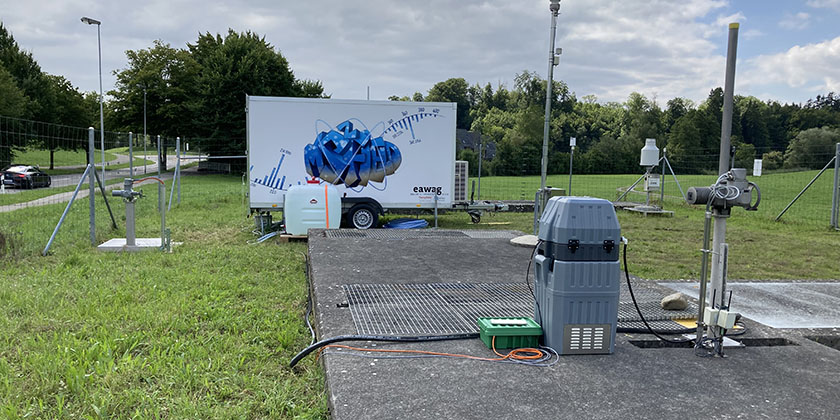
Im Projekt mikroMISCH untersuchen wir die Emissionen von Mikroverunreinigungen aus Mischwasserentlastungen in Oberflächengewässern. Das Ziel dieses Projekts ist es, einen tieferen Einblick in die Dynamik und das Substanzspektrum von Mikroverunreinigungen bei Entlastungsereignissen zu erhalten. Dazu kommt der MS2field zum Einsatz, eine an der Eawag entwickelte mobile Plattform mit einem hochauflösenden Massenspektrometer. Mit dem MS2field können wir eine beinahe unlimitierte Anzahl von verschiedenen organischen Substanzen bei einer zeitlichen Auflösung von 20 Minuten während mehreren Wochen bis Monaten mit verhältnismässig geringem Aufwand detektieren. Daraus erhoffen wir uns (1) realistischere Expositionsszenarien zu erhalten [z.B. Vergleich von Spitzenkonzentrationen mit akuten Qualitätskriterien], (2) verschiedene Eintragspfade von Mikroverunreinigungen ins Abwasser zu identifizieren [Ermittlung der Quellen mit Zeitreihenanalyse] und (3) ein grösseres Spektrum von verschiedenen Substanzen zu detektieren [Suspect- und Non-Target Screening].


 

Kontakt und Projektleitung

Heinz Singer Senior Scientist / Gruppenleiter Tel. +41 58 765 5577 Inviare e-mail

Publikationen

Extbase Variable Dump
array(2 items)
   publications => '32044,34117,34150' (17 chars)
   libraryUrl => '' (0 chars)
Extbase Variable Dump
array(3 items)
   0 => Snowflake\Publications\Domain\Model\Publicationprototypepersistent entity (uid=32044, pid=124)
      originalId => protected32044 (integer)
      authors => protected'Furrer, V.; Mutzner, L.; Ort, C.; Singer, H.' (64 chars)
      title => protected'Micropollutant concentration fluctuations in combined sewer overflows requir
         e short sampling intervals
' (102 chars) journal => protected'Water Research X' (16 chars) year => protected2023 (integer) volume => protected21 (integer) issue => protected'' (0 chars) startpage => protected'100202 (8 pp.)' (14 chars) otherpage => protected'' (0 chars) categories => protected'trace contaminants; combined sewer overflow; sampling; dynamics; polar organ
         ic pollutants; high temporal resolution measurements
' (128 chars) description => protected'Combined sewer overflows (CSOs) are an important pathway of organic micropol
         lutants from urban areas to open water bodies. Understanding the temporal dy
         namics of these micropollutants during overflow events is crucial for applyi
         ng appropriate sampling methods and implementing effective management strate
         gies. Yet, little is known about the dynamics of micropollutants in CSOs, be
         cause most studies report concentrations from single grab samples or event m
         ean concentrations (EMCs). With unique high temporal resolution measurements
          (3 min), we show the real dynamics of polar organic micropollutants in CSO
         s of one small (2,700 people: P) and one large (159,000 P) urban catchment,
         for two micropollutant categories: (i) 33 micropollutants in municipal waste
         water and (ii) 13 micropollutants from urban surface runoff. The concentrati
         on dynamics depend on the substance source and the catchment size. Indoor su
         bstances such as pharmaceuticals show high temporal dynamics with changes of
          1 to 2 orders of magnitude within 9 min in the CSO of the small catchment.
          In contrast, outdoor substances at the small catchment and all substances a
         t the large catchment display considerably lower variation. We tested variou
         s time-proportional sampling strategies to assess the range of error when es
         timating EMCs. We recommend an interval of 3 min to capture the dynamics of
          indoor substances in CSOs from small catchments. The results highlight that
          both future monitoring campaigns and the planning and management of urban w
         et-weather treatment systems will benefit from high temporal sampling resolu
         tions, not only to understand dynamics but also to minimize errors of estima
         ted EMCs.
' (1681 chars) serialnumber => protected'2589-9147' (9 chars) doi => protected'10.1016/j.wroa.2023.100202' (26 chars) uid => protected32044 (integer) _localizedUid => protected32044 (integer)modified _languageUid => protectedNULL _versionedUid => protected32044 (integer)modified pid => protected124 (integer)
1 => Snowflake\Publications\Domain\Model\Publicationprototypepersistent entity (uid=34117, pid=124) originalId => protected34117 (integer) authors => protected'Furrer, V.; Froemelt, A.; Singer, H.; Ort, C.' (65 chars) title => protected'Source-specific dynamics of organic micropollutants in combined sewer overfl
         ows
' (79 chars) journal => protected'Water Research' (14 chars) year => protected2025 (integer) volume => protected279 (integer) issue => protected'' (0 chars) startpage => protected'123416 (9 pp.)' (14 chars) otherpage => protected'' (0 chars) categories => protected'temporal dynamics; LC-HRMS; source allocation; urban drainage; nontarget ana
         lysis; classification
' (97 chars) description => protected'Combined sewer overflows (CSOs) discharge organic micropollutants (MPs) into
          open water bodies, posing potential environmental threats. Knowledge of the
          numbers, sources, and dynamics of MPs during CSOs is scarce but crucial for
          assessing their impact and developing mitigation strategies. To shed light
         on the dynamics of dissolved organic MPs in CSOs, we conducted high-temporal
         -resolution sampling (10 min composite samples) followed by liquid chromatog
         raphy high-resolution mass spectrometry analysis, both target (60 substances
         ) and nontarget, at two CSO sites in a small [17 hectares reduced (ha<sub>re
         d</sub>)] and a large (368 ha<sub>red</sub>) catchment for over 10 events ea
         ch. We observe similar patterns among indoor substances in the large catchme
         nt and among tire-associated compounds in both catchments, indicating source
         -specific behavior. Due to high and diverse concentration variability, no te
         mporal correlations were found among indoor substances in the small catchmen
         t or among pesticides in either catchment. A random forest classifier was ap
         plied to assign nontarget time series to indoor and road sources in the larg
         e catchment. The results indicate that CSOs discharge several thousand subst
         ances from indoor sources, followed by a few hundred from outdoor sources wi
         th continuous leaching. These high numbers substantially surpass the scope o
         f traditional target lists and underscore the importance of broad-spectrum s
         creening methods when assessing MP contamination.
' (1493 chars) serialnumber => protected'0043-1354' (9 chars) doi => protected'10.1016/j.watres.2025.123416' (28 chars) uid => protected34117 (integer) _localizedUid => protected34117 (integer)modified _languageUid => protectedNULL _versionedUid => protected34117 (integer)modified pid => protected124 (integer)
2 => Snowflake\Publications\Domain\Model\Publicationprototypepersistent entity (uid=34150, pid=124) originalId => protected34150 (integer) authors => protected'Furrer,&nbsp;V.; Junghans,&nbsp;M.; Singer,&nbsp;H.; Ort,&nbsp;C.' (65 chars) title => protected'Realistic exposure scenarios in combined sewer overflows: how temporal resol
         ution and selection of micropollutants impact risk assessment
' (137 chars) journal => protected'Water Research' (14 chars) year => protected2025 (integer) volume => protected278 (integer) issue => protected'' (0 chars) startpage => protected'123318 (9 pp.)' (14 chars) otherpage => protected'' (0 chars) categories => protected'chemical risk assessment; acute ecotoxicity; temporal dynamics; urban draina
         ge; aquatic ecosystems; real exposure scenarios
' (123 chars) description => protected'Organic micropollutants in combined sewer overflows (CSOs) pose a potential
         risk to aquatic ecosystems. Previous studies mainly reported event mean conc
         entrations (EMCs) and often focused on a small number of substances. This st
         udy presents realistic exposure scenarios using high-temporal resolution (10
         -minute) data from 24 events at two CSO sites. We analyzed 49 dissolved orga
         nic micropollutants for all events and 198 for four events, including pharma
         ceuticals, pesticides, and road-related compounds, of which we detected 83 s
         ubstances at least once. From these, we assessed the mixed chemical risk by
         applying acute quality criteria and evaluated how the risk assessment outcom
         e changes for two aspects: temporal resolution and selection of substances.
         Our results reveal that total risk quotients (RQ<sub>tot</sub>) can vary gre
         atly within CSO events, with 10-minute data capturing peak concentrations th
         at are missed with EMCs. Using EMCs underestimates the maximum RQ<sub>tot</s
         ub> of an event by a median factor of 4.9, up to a maximum factor of 6.9. Wh
         en comparing a selection of 20 substances from the Swiss Waters Protection O
         rdinance to a broader list of 49 substances commonly detected at CSOs and a
         comprehensive list of 198 substances, the estimated RQ<sub>tot</sub> increas
         es between 1.1 to 2.3-fold. RQ<sub>tot</sub> values exceed the threshold of
         1 in 75 % of the events, requiring further dilution in the receiving water b
         ody. All three pollutant classes (pharma, pesticide, road) drive the total r
         isk, and no specific phase during overflow events consistently poses higher
         risk than other phases, which challenges the design of effective mitigation
         measures. Furthermore, the exposure scenarios presented here offer essential
          input for future ecotoxicological research as they reveal high short-term f
         luctuations in RQ<sub>tot</sub> whose ecological significance is still large
         ly unknown.
' (1911 chars) serialnumber => protected'0043-1354' (9 chars) doi => protected'10.1016/j.watres.2025.123318' (28 chars) uid => protected34150 (integer) _localizedUid => protected34150 (integer)modified _languageUid => protectedNULL _versionedUid => protected34150 (integer)modified pid => protected124 (integer)
Furrer, V.; Mutzner, L.; Ort, C.; Singer, H. (2023) Micropollutant concentration fluctuations in combined sewer overflows require short sampling intervals, Water Research X, 21, 100202 (8 pp.), doi:10.1016/j.wroa.2023.100202, Institutional Repository
Furrer, V.; Froemelt, A.; Singer, H.; Ort, C. (2025) Source-specific dynamics of organic micropollutants in combined sewer overflows, Water Research, 279, 123416 (9 pp.), doi:10.1016/j.watres.2025.123416, Institutional Repository
Furrer, V.; Junghans, M.; Singer, H.; Ort, C. (2025) Realistic exposure scenarios in combined sewer overflows: how temporal resolution and selection of micropollutants impact risk assessment, Water Research, 278, 123318 (9 pp.), doi:10.1016/j.watres.2025.123318, Institutional Repository