Tintenstrich-Gemeinschaften in den Schweizer Alpen
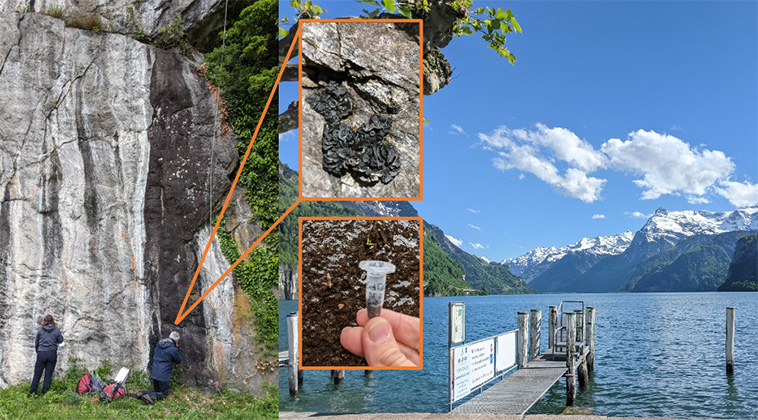
Dieses Projekt ist eine Zusammenarbeit mit Wissenschaftler*innen der WSL und Eawag. Gemeinsam untersuchen wir die genetische und metabolische Vielfalt von Cyanobakterien auf Gesteinsoberflächen in den Schweizer Alpen. Diese sogenannten Tintenstrich Gemeinschaften können als dunkel bis schwarze Streifen auf der Felsoberfläche wahrgenommen werden. Die Tintenstriche entwickeln sich auf grossen Felsflächen und besonders dort wo immer wieder Oberflächenwasser abfliesst. Tintenstrich Gemeinschaften bestehen nicht nur aus Cyanobakterien sondern auch aus Flechten wo sich Cyanobakterien oder Algen mit Pilzen vergesellschaften.
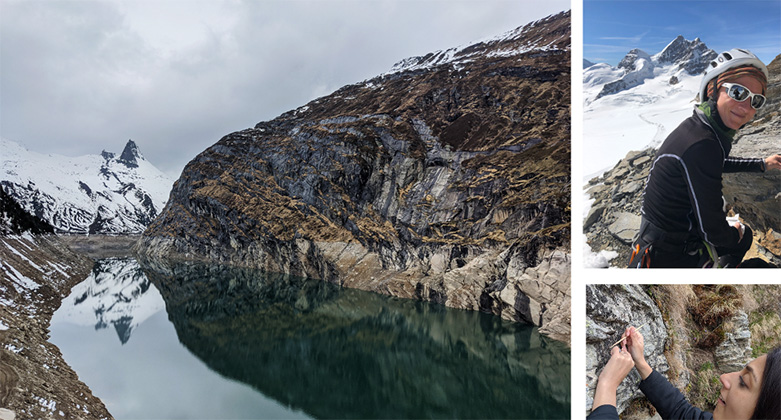
Probenahme von Flechten und Herbivoren auf Tintenstrichen in den Schweizer Alpen
In den 1940ger Jahren hat der Wissenschaftler Otto Jaag Pionierarbeit geleistet und Tintenstrich Gemeinschaften erstmals in den Schweizer Alpen mittels morphologischer Bestimmung beschrieben. Cyanobakterien können auch Griftstoffe produzieren, welche in Oberflächengewässern bereits umfangreich untersucht werden. Allerdings haben wir momentan keine Information über Giftstoffe der Cyanobakterien aus diesen Tintenstrich Gemeinschaften der Schweizer Alpen. In unserer Arbeit kehren wir zu den Probennahmestellen von Jaag zurück und erforschen die genetische und metabolische Vielfalt der Cyanobakterien mit modernsten analytischen Methoden, einschliesslich Illumina Sequenzierung und hochauflösender Massenspektrometrie. Über die Biodiversität hinaus, interessiert uns, ob Bakterien und Giftstoffe mit dem Wasser, das über die Tintenstriche abfliesst, mobilisiert werden und wie lokale Herbivore mit den Giftstoffen umgehen können.
array(3 items)0 => Snowflake\Publications\Domain\Model\Publicationprototypepersistent entity (uid=35323, pid=124)originalId => protected35323 (integer)
authors => protected'Oliveira, J.; Pittino, F.; Scheidegger, C.; Fink, S.; Ja nssen, E. M. -L.' (107 chars)
title => protected'Genetic and metabolic diversity of cyanobacteria on the rock–water interfa ce in mountainous ecosystems' (104 chars)
journal => protected'Environmental Science and Technology' (36 chars)
year => protected2025 (integer)
volume => protected59 (integer)
issue => protected'38' (2 chars)
startpage => protected'20595' (5 chars)
otherpage => protected'20607' (5 chars)
categories => protected'metabarcoding; toxin; anabaenopeptin; microcystin; cyanopeptolin; Tintenstri ch; lichen' (86 chars)
description => protected'<em>Tintenstrich</em> communities are specialized lithic biofilms dominated by free-living cyanobacteria, also occurring in lichen associations, forming a unique ecological interface between rock environments and aquatic habitat s in mountainous areas. To better understand their composition and genetic a nd metabolic potential, we analyzed 207 samples from the Swiss Alps and Jura Mountains. We determined how key environmental factors shaped cyanobacteria l abundance, assessed whether these communities harbor genes for toxin biosy nthesis, characterized their taxonomic composition at the family and genus l evel, and evaluated the actual occurrence of cyanotoxins and other bioactive metabolites. Cyanobacterial abundance proved to be influenced by factors su ch as elevation, exposure, and their interaction with siliceous rock substra ta. Targeted PCR and Sanger sequencing revealed the presence of toxin-encodi ng genes, particularly for <em>ndaF</em>/<em>mcyE</em> fragments, which may encode microcystin and/or nodularin biosynthesis, while specific genes for m icrocystins, anatoxins, and cylindrospermopsins were rather rare. Metabarcod ing analysis identified 11 cyanobacterial families, with Chroococcaceae, Nos tocaceae, and Leptolyngbyaceae being the most abundant. Complementary high-r esolution mass spectrometry confirmed the occasional presence of nodularins and microcystins, alongside more frequent detection of other bioactive pepti des such as anabaenopeptins and cyanopeptolins. Overall, these findings prov ide the most comprehensive insight to date into <em>Tintenstrich</em>-associ ated cyanobacteria, underscoring their environmental significance given thei r genetic and metabolic potential.' (1706 chars)
serialnumber => protected'0013-936X' (9 chars)
doi => protected'10.1021/acs.est.5c05763' (23 chars)
uid => protected35323 (integer)
_localizedUid => protected35323 (integer)modified_languageUid => protectedNULL
_versionedUid => protected35323 (integer)modifiedpid => protected124 (integer)1 => Snowflake\Publications\Domain\Model\Publicationprototypepersistent entity (uid=33751, pid=124)originalId => protected33751 (integer)
authors => protected'Pittino, F.; Fink, S.; Oliveira, J.; Janssen, E. M. L.; Scheidegger, C.' (106 chars)
title => protected'Lithic bacterial communities: ecological aspects focusing on <em>Tintenstric h</em> communities' (94 chars)
journal => protected'Frontiers in Microbiology' (25 chars)
year => protected2024 (integer)
volume => protected15 (integer)
issue => protected'' (0 chars)
startpage => protected'1430059 (12 pp.)' (16 chars)
otherpage => protected'' (0 chars)
categories => protected'cyanobacteria; Tintenstrich; lithic bacterial communities; extreme environme nts; lichens' (88 chars)
description => protected'<em>Tintenstrich</em> communities (TCs) mainly comprise Cyanobacteria develo ping on rock substrates and forming physical structures that are strictly co nnected to the rock itself. Endolithic and epilithic bacterial communities a re important because they contribute to nutrient release within run-off wate rs flowing on the rock surface. Despite TCs being ubiquitous, little informa tion about their ecology and main characteristics is available. In this stud y, we characterized the bacterial communities of rock surfaces of TCs in Swi tzerland through Illumina sequencing. We investigated their bacterial commun ity composition on two substrate types (siliceous rocks [SRs] and carbonate rocks [CRs]) through multivariate models. Our results show that Cyanobacteri a and Proteobacteria are the predominant phyla in this environment. Bacteria l <em>α</em>-diversity was higher on CRs than on SRs, and the <em>β</em>-d iversity of SRs varied with changes in rock surface structure. In this study , we provide novel insights into the bacterial community composition of TCs, their differences from other lithic communities, and the effects of the roc k substrate and structure.' (1166 chars)
serialnumber => protected'' (0 chars)
doi => protected'10.3389/fmicb.2024.1430059' (26 chars)
uid => protected33751 (integer)
_localizedUid => protected33751 (integer)modified_languageUid => protectedNULL
_versionedUid => protected33751 (integer)modifiedpid => protected124 (integer)2 => Snowflake\Publications\Domain\Model\Publicationprototypepersistent entity (uid=26097, pid=124)originalId => protected26097 (integer)
authors => protected'Pittino, F.; Oliveira, J.; De Almeida Torres, M.; Fink, S.; Janssen, E. M. L.; Scheidegger, C.' (134 chars)
title => protected'Cyanobacteria: extreme environments and toxic metabolites' (57 chars)
journal => protected'Chimia' (6 chars)
year => protected2022 (integer)
volume => protected76 (integer)
issue => protected'11' (2 chars)
startpage => protected'967' (3 chars)
otherpage => protected'969' (3 chars)
categories => protected'bioaccumulation; cyanobacteria; cyanotoxins; lichen; water quality' (66 chars)
description => protected'Cyanobacteria, also known as blue-green algae, are photosynthetic bacteria t hat can colonize different habitats, including extreme ones. They are of gre at interest to the scientific community, especially because of their ability to produce cyanotoxins: toxic secondary metabolites potentially harmful to organisms especially when released to surface waters.' (357 chars)
serialnumber => protected'0009-4293' (9 chars)
doi => protected'10.2533/chimia.2022.967' (23 chars)
uid => protected26097 (integer)
_localizedUid => protected26097 (integer)modified_languageUid => protectedNULL
_versionedUid => protected26097 (integer)modifiedpid => protected124 (integer)
Genetic and metabolic diversity of cyanobacteria on the rock–water interface in mountainous ecosystems
Tintenstrich communities are specialized lithic biofilms dominated by free-living cyanobacteria, also occurring in lichen associations, forming a unique ecological interface between rock environments and aquatic habitats in mountainous areas. To better understand their composition and genetic and metabolic potential, we analyzed 207 samples from the Swiss Alps and Jura Mountains. We determined how key environmental factors shaped cyanobacterial abundance, assessed whether these communities harbor genes for toxin biosynthesis, characterized their taxonomic composition at the family and genus level, and evaluated the actual occurrence of cyanotoxins and other bioactive metabolites. Cyanobacterial abundance proved to be influenced by factors such as elevation, exposure, and their interaction with siliceous rock substrata. Targeted PCR and Sanger sequencing revealed the presence of toxin-encoding genes, particularly for ndaF/mcyE fragments, which may encode microcystin and/or nodularin biosynthesis, while specific genes for microcystins, anatoxins, and cylindrospermopsins were rather rare. Metabarcoding analysis identified 11 cyanobacterial families, with Chroococcaceae, Nostocaceae, and Leptolyngbyaceae being the most abundant. Complementary high-resolution mass spectrometry confirmed the occasional presence of nodularins and microcystins, alongside more frequent detection of other bioactive peptides such as anabaenopeptins and cyanopeptolins. Overall, these findings provide the most comprehensive insight to date into Tintenstrich-associated cyanobacteria, underscoring their environmental significance given their genetic and metabolic potential.
Oliveira, J.; Pittino, F.; Scheidegger, C.; Fink, S.; Janssen, E. M. -L. (2025) Genetic and metabolic diversity of cyanobacteria on the rock–water interface in mountainous ecosystems, Environmental Science and Technology, 59(38), 20595-20607, doi:10.1021/acs.est.5c05763, Institutional Repository
Lithic bacterial communities: ecological aspects focusing on Tintenstrich communities
Tintenstrich communities (TCs) mainly comprise Cyanobacteria developing on rock substrates and forming physical structures that are strictly connected to the rock itself. Endolithic and epilithic bacterial communities are important because they contribute to nutrient release within run-off waters flowing on the rock surface. Despite TCs being ubiquitous, little information about their ecology and main characteristics is available. In this study, we characterized the bacterial communities of rock surfaces of TCs in Switzerland through Illumina sequencing. We investigated their bacterial community composition on two substrate types (siliceous rocks [SRs] and carbonate rocks [CRs]) through multivariate models. Our results show that Cyanobacteria and Proteobacteria are the predominant phyla in this environment. Bacterial α-diversity was higher on CRs than on SRs, and the β-diversity of SRs varied with changes in rock surface structure. In this study, we provide novel insights into the bacterial community composition of TCs, their differences from other lithic communities, and the effects of the rock substrate and structure.
Pittino, F.; Fink, S.; Oliveira, J.; Janssen, E. M. L.; Scheidegger, C. (2024) Lithic bacterial communities: ecological aspects focusing on Tintenstrich communities, Frontiers in Microbiology, 15, 1430059 (12 pp.), doi:10.3389/fmicb.2024.1430059, Institutional Repository
Cyanobacteria: extreme environments and toxic metabolites
Cyanobacteria, also known as blue-green algae, are photosynthetic bacteria that can colonize different habitats, including extreme ones. They are of great interest to the scientific community, especially because of their ability to produce cyanotoxins: toxic secondary metabolites potentially harmful to organisms especially when released to surface waters.
Pittino, F.; Oliveira, J.; De Almeida Torres, M.; Fink, S.; Janssen, E. M. L.; Scheidegger, C. (2022) Cyanobacteria: extreme environments and toxic metabolites, Chimia, 76(11), 967-969, doi:10.2533/chimia.2022.967, Institutional Repository