Vorhersage akuter Fischtoxizität mit in vitro Modellen
Der akute Fischtoxizitätstest ist einer der am häufigsten durchgeführten Versuche in der regulatorischen Ökotoxikologie um die Toxizität von Chemikalien und Abwässern zu bestimmen. Da man dabei das Überleben bzw. Sterben der Fische bestimmt, fällt dieser Test unter den höchsten Schweregrad bei Tierversuchen.
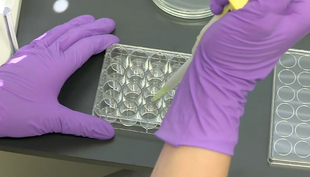
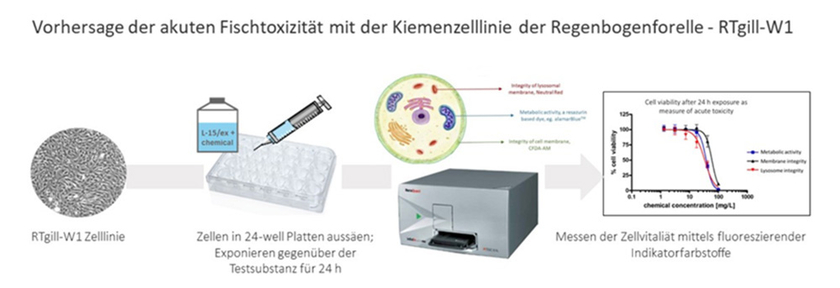
Vor diesem Hintergrund haben wir Alternativen zu diesem Test entwickelt. Zunächst standen dabei frühe Lebensstadien des Zebrafisches im Vordergrund – eine entsprechende OECD Richtlinie (OECD236) existiert seit einigen Jahren. Deshalb setzten wir verstärkt auf eine Alternative, die gar keine Fische mehr benötigt: Zelllinien. Ein von uns etablierter Test mit Kiemenzelllinien wurde im April 2019 von der ISO adoptiert (ISO21115). Im gleichen Jahr wurde unsere Arbeit mit dem Swiss 3Rs Award des 3R Kompetenzzentrum Schweiz (3RCC) ausgezeichnet. Seit dem konnten wir auch die Expertengremien und Ländervertreter der OECD von der Robustheit und Aussagekraft dieses Tests überzeugen: im April 2021 wurde er als erste in vitro Testrichtlinie im Ökotoxikologiebereich angenommen (OECD 249). Der Zelllinientest wird auch von unserem Spin-off aQuatox-Solutions GmbH als Service angeboten.
Die OECD gibt grünes Licht für den an der Eawag entwickelten Fischzelllinientest. Damit ist der Weg frei für Unternehmen und Behörden auf der ganzen Welt, die Umwelttoxizität von Chemikalien zu bestimmen, ohne dabei auf...
Die OECD gibt grünes Licht für den an der Eawag entwickelten Fischzelllinientest. Damit ist der Weg frei für Unternehmen und Behörden auf der ganzen Welt, die Umwelttoxizität von Chemikalien zu bestimmen, ohne dabei auf Tierversuche zurückgreifen zu müssen.
array(6 items)0 => Snowflake\Publications\Domain\Model\Publicationprototypepersistent entity (uid=18989, pid=124)originalId => protected18989 (integer)
authors => protected'Schug, H.; Maner, J.; Hülskamp, M.; Begnaud, F.; Debonn eville, C.; Berthaud, F.; Gimeno, S.; Schirmer, K.' (146 chars)
title => protected'Extending the concept of predicting fish acute toxicity <em>in vitro</em> to the intestinal cell line RTgutGC' (109 chars)
journal => protected'ALTEX: Alternatives to Animal Experimentation' (45 chars)
year => protected2019 (integer)
volume => protected0 (integer)
issue => protected'' (0 chars)
startpage => protected'(9 pp.)' (7 chars)
otherpage => protected'' (0 chars)
categories => protected'' (0 chars)
description => protected'Testing chemicals for fish acute toxicity is a legal requirement in many cou ntries as part of environmental risk assessment. To reduce the numbers of fi sh used, substantial efforts have been focussed on alternative approaches. P rominently, the cell viability assay with the rainbow trout (<em>Oncorhynchu s mykiss</em>) gill cell line, RTgill-W1, has been recognized, owing to its high predictive power and robustness. Like gills, the intestine is considere d a major site of chemical uptake and biotransformation but, in contrast to gills, is expected to be exposed to rather hydrophobic chemicals, which ente r the fish <em>via</em> food. In the present study, we therefore aimed to ex tend the cell bioassay to the rainbow trout epithelial cell line from intest ine, RTgutGC. Using 16 hydrophobic and volatile chemicals from the fragrance palette, we showed that also the RTgutGC cell line can be used to predict f ish acute toxicity of chemicals and yields intra-laboratory variability in l ine with other bioassays. By comparing the RTgutGC toxicity to a study emplo ying the RTgill-W1 assay on the same group of chemicals, a fragrance specifi c relationship was established which reflects an almost perfect 1:1 relation ship between <em>in vitro</em> and <em>in vivo</em> toxicity results. Thus, both cell lines can be used to predict fish acute toxicity, either by using the obtained <em>in vivo-in vitro</em> relationship or by taking the <em>in vitro</em> results at face value. We moreover demonstrate the derivation of non-toxic concentrations for downstream applications which rely on a healthy cell state, such as the assessment of biotransformation or chemical transfe r.' (1674 chars)
serialnumber => protected'1868-596X' (9 chars)
doi => protected'10.14573/altex.1905032' (22 chars)
uid => protected18989 (integer)
_localizedUid => protected18989 (integer)modified_languageUid => protectedNULL
_versionedUid => protected18989 (integer)modifiedpid => protected124 (integer)1 => Snowflake\Publications\Domain\Model\Publicationprototypepersistent entity (uid=7210, pid=124)originalId => protected7210 (integer)
authors => protected'Tanneberger, K.; Knöbel, M.; Busser, F. J. M.; Sin nige, T. L.; Hermens, J. L. M.; Schirmer, K.' (150 chars)
title => protected'Predicting fish acute toxicity using a fish gill cell line-based toxicity as say' (79 chars)
journal => protected'Environmental Science and Technology' (36 chars)
year => protected2013 (integer)
volume => protected47 (integer)
issue => protected'2' (1 chars)
startpage => protected'1110' (4 chars)
otherpage => protected'1119' (4 chars)
categories => protected'' (0 chars)
description => protected'The OECD test guideline 203 for determination of fish acute toxicity require s substantial numbers of fish and uses death as an apical end point. One pot ential alternative are fish cell lines; however, several studies indicated t hat these appear up to several orders of magnitude less sensitive than fish. We developed a fish gill cell line-based (RTgill-W1) assay, using several m easures to improve sensitivity. The optimized assay was applied to determine the toxicity of 35 organic chemicals, having a wide range of toxicity to fi sh, mode of action and physicochemical properties. We found a very good agre ement between in vivo and in vitro effective concentrations. For up to 73% o f the tested compounds, the difference between the two approaches was less t han 5-fold, covering baseline toxicants but as well compounds with presumed specific modes of action, including reactivity, inhibition of acetylcholine esterase or uncoupling of oxidative phosphorylation. Accounting for measured chemical concentrations eliminated two outliers, the hydrophobic 4-decylani line and the volatile 2,3-dimethyl-1,3-butadiene, with an outlier being oper ationally defined as a substance showing a more than 10-fold difference betw een in vivo/in vitro effect concentrations. Few outliers remained. The most striking were allyl alcohol (2700-fold), which likely needs to be metabolica lly activated, and permethrin (190-fold) and lindane (63-fold), compounds ac ting, respectively, on sodium and chloride channels in the brain of fish. We discuss further developments of this assay and suggest its use beyond predi cting acute toxicity to fish, for example, as part of adverse outcome pathwa ys to replace, reduce, or refine chronic fish tests.' (1724 chars)
serialnumber => protected'0013-936X' (9 chars)
doi => protected'10.1021/es303505z' (17 chars)
uid => protected7210 (integer)
_localizedUid => protected7210 (integer)modified_languageUid => protectedNULL
_versionedUid => protected7210 (integer)modifiedpid => protected124 (integer)2 => Snowflake\Publications\Domain\Model\Publicationprototypepersistent entity (uid=7153, pid=124)originalId => protected7153 (integer)
authors => protected'Knöbel, M.; Busser, F. J. M.; Rico-Rico, Á.; Kram er, N. I.; Hermens, J. L. M.; Hafner, C.; Tann eberger, K.; Schirmer, K.; Scholz, S.' (204 chars)
title => protected'Predicting adult fish acute lethality with the zebrafish embryo: relevance o f test duration, endpoints, compound properties, and exposure concentration analysis' (160 chars)
journal => protected'Environmental Science and Technology' (36 chars)
year => protected2012 (integer)
volume => protected46 (integer)
issue => protected'17' (2 chars)
startpage => protected'9690' (4 chars)
otherpage => protected'9700' (4 chars)
categories => protected'' (0 chars)
description => protected'The zebrafish embryo toxicity test has been proposed as an alternative for t he acute fish toxicity test, which is required by various regulations for en vironmental risk assessment of chemicals. We investigated the reliability of the embryo test by probing organic industrial chemicals with a wide range o f physicochemical properties, toxicities, and modes of toxic action. Moreove r, the relevance of using measured versus nominal (intended) exposure concen trations, inclusion of sublethal endpoints, and different exposure durations for the comparability with reported fish acute toxicity was explored. Our r esults confirm a very strong correlation of zebrafish embryo to fish acute t oxicity. When toxicity values were calculated based on measured exposure con centrations, the slope of the type II regression line was 1 and nearly passe d through the origin (1 to 1 correlation). Measured concentrations also expl ained several apparent outliers. Neither prolonged exposure (up to 120 h) no r consideration of sublethal effects led to a reduced number of outliers. Ye t, two types of compounds were less lethal to embryos than to adult fish: a neurotoxic compound acting via sodium channels (permethrin) and a compound r equiring metabolic activation (allyl alcohol).' (1262 chars)
serialnumber => protected'0013-936X' (9 chars)
doi => protected'10.1021/es301729q' (17 chars)
uid => protected7153 (integer)
_localizedUid => protected7153 (integer)modified_languageUid => protectedNULL
_versionedUid => protected7153 (integer)modifiedpid => protected124 (integer)3 => Snowflake\Publications\Domain\Model\Publicationprototypepersistent entity (uid=6387, pid=124)originalId => protected6387 (integer)
authors => protected'Tanneberger, K.; Rico-Rico, A.; Kramer, N. I.; Busser,&n bsp;F. J. M.; Hermens, J. L. M.; Schirmer, K.' (151 chars)
title => protected'Effects of solvents and dosing procedure on chemical toxicity in cell-based <I>in vitro</I> assays' (98 chars)
journal => protected'Environmental Science and Technology' (36 chars)
year => protected2010 (integer)
volume => protected44 (integer)
issue => protected'12' (2 chars)
startpage => protected'4775' (4 chars)
otherpage => protected'4781' (4 chars)
categories => protected'' (0 chars)
description => protected'Due to the implementation of new legislation, such as REACh, a dramatic incr ease of animal use for toxicity testing is expected and the search for alter natives is timely. Cell-based <I>in vitro</I> assays are promising alternati ves. However, the behavior of chemicals in these assays is still poorly unde rstood. We set out to quantify the exposure and associated toxicity of chemi cals with different physicochemical properties toward a fish gill cell line when different solvents and procedural steps are used to introduce test chem icals to cells. Three chemicals with a range of hydrophobicity and volatilit y were selected and delivered in three different solvents using two common d osing procedures. Toxicity tests were coupled with chemical analysis to quan tify the chemical concentrations within culture wells. The impact of solvent s and dosing procedure was greatest for the most volatile and hydrophobic te st chemical. We show that certain combinations of the test chemical, solvent , and procedural steps can lead to inhomogeneous distribution of the test ch emical and thus differing degrees of bioavailability, resulting in quantitat ive differences in apparent toxicity.' (1177 chars)
serialnumber => protected'0013-936X' (9 chars)
doi => protected'10.1021/es100045y' (17 chars)
uid => protected6387 (integer)
_localizedUid => protected6387 (integer)modified_languageUid => protectedNULL
_versionedUid => protected6387 (integer)modifiedpid => protected124 (integer)4 => Snowflake\Publications\Domain\Model\Publicationprototypepersistent entity (uid=6141, pid=124)originalId => protected6141 (integer)
authors => protected'Kramer, N. I.; Hermens, J. L. M.; Schirmer, K.' (76 chars)
title => protected'The influence of modes of action and physicochemical properties of chemicals on the correlation between <I>in vitro</I> and acute fish toxicity data' (148 chars)
journal => protected'Toxicology in Vitro' (19 chars)
year => protected2009 (integer)
volume => protected23 (integer)
issue => protected'7' (1 chars)
startpage => protected'1372' (4 chars)
otherpage => protected'1379' (4 chars)
categories => protected'acute fish toxicity; alternatives to animal testing; in vitro-in vivo extrap olation; cytotoxicity assays' (104 chars)
description => protected'New EU legislation is providing an impetus for research aimed at replacing a cute fish toxicity testing with <I>in vitro</I> alternatives. In line with s uch research, the objective of this study was to determine what factors infl uence the correlation between <I>in vitro</I> and fish toxicity data. Basal cytotoxicity (IC<SUB>50</SUB>) and acute toxicity data from fathead minnow ( LC<SUB>50</SUB>) of 82 industrial organic chemicals were obtained from the H alle Registry of Cytotoxicity and the US EPA Fathead Minnow Database. A good correlation between IC<SUB>50</SUB> with LC<SUB>50</SUB> data was found (<I >r</I> 0.84). Yet, IC<SUB>50</SUB> data were less sensitive than LC<SUB>50</ SUB> data by an order of magnitude. Using multiple regression analysis, the octanol–water partition coefficient (<I>K</I><I><SUB>OW</SUB></I>) and the Henry’s Law Constant (<I>H</I>) were found to significantly explain the l ow absolute sensitivity. The mode of action (MOA) of the chemical was found to significantly explain the general variation in the log IC<SUB>50</SUB>/lo g LC<SUB>50</SUB> regression line. These results support the notion that (a) the bioavailability of hydrophobic (high <I>K</I><I><SUB>OW</SUB></I>) and volatile (high <I>H</I>) chemicals is significantly lower in <I>in vitro</I> assays than in the fish bioassay and (b) multiple cell types and endpoints should be included to mimic the modes of action possible in the whole organi sm.' (1447 chars)
serialnumber => protected'0887-2333' (9 chars)
doi => protected'10.1016/j.tiv.2009.07.029' (25 chars)
uid => protected6141 (integer)
_localizedUid => protected6141 (integer)modified_languageUid => protectedNULL
_versionedUid => protected6141 (integer)modifiedpid => protected124 (integer)5 => Snowflake\Publications\Domain\Model\Publicationprototypepersistent entity (uid=5845, pid=124)originalId => protected5845 (integer)
authors => protected'Schirmer, K.; Tanneberger, K.; Kramer, N. I.; Völker,&n bsp;D.; Scholz, S.; Hafner, C.; Lee, L. E. J.; Bols , N. C.; Hermens, J. L. M.' (203 chars)
title => protected'Developing a list of reference chemicals for testing alternatives to whole f ish toxicity tests' (94 chars)
journal => protected'Aquatic Toxicology' (18 chars)
year => protected2008 (integer)
volume => protected90 (integer)
issue => protected'2' (1 chars)
startpage => protected'128' (3 chars)
otherpage => protected'137' (3 chars)
categories => protected'alternatives to animal testing; chemical database; cell lines; fish embryo; acute fish lethality test' (101 chars)
description => protected'This paper details the derivation of a list of 60 reference chemicals for th e development of alternatives to animal testing in ecotoxicology with a part icular focus on fish. The chemicals were selected as a prerequisite to gathe r mechanistic information on the performance of alternative testing systems, namely vertebrate cell lines and fish embryos, in comparison to the fish ac ute lethality test. To avoid the need for additional experiments with fish, the U.S. EPA fathead minnow database was consulted as reference for whole or ganism responses. This database was compared to the Halle Registry of Cytoto xicity and a collation of data by the German EPA (UBA) on acute toxicity dat a derived from zebrafish embryos. Chemicals that were present in the fathead minnow database and in at least one of the other two databases were subject to selection. Criteria included the coverage of a wide range of toxicity an d physico-chemical parameters as well as the determination of outliers of th e <I>in vivo</I>/<I>in vitro</I> correlations. While the reference list of c hemicals now guides our research for improving cell line and fish embryo ass ays to make them widely applicable, the list could be of benefit to search f or alternatives in ecotoxicology in general. One example would be the use of this list to validate structure–activity prediction models, which in turn would benefit from a continuous extension of this list with regard to physi co-chemical and toxicological data.' (1479 chars)
serialnumber => protected'0166-445X' (9 chars)
doi => protected'10.1016/j.aquatox.2008.08.005' (29 chars)
uid => protected5845 (integer)
_localizedUid => protected5845 (integer)modified_languageUid => protectedNULL
_versionedUid => protected5845 (integer)modifiedpid => protected124 (integer)
Extending the concept of predicting fish acute toxicity in vitro to the intestinal cell line RTgutGC
Testing chemicals for fish acute toxicity is a legal requirement in many countries as part of environmental risk assessment. To reduce the numbers of fish used, substantial efforts have been focussed on alternative approaches. Prominently, the cell viability assay with the rainbow trout (Oncorhynchus mykiss) gill cell line, RTgill-W1, has been recognized, owing to its high predictive power and robustness. Like gills, the intestine is considered a major site of chemical uptake and biotransformation but, in contrast to gills, is expected to be exposed to rather hydrophobic chemicals, which enter the fish via food. In the present study, we therefore aimed to extend the cell bioassay to the rainbow trout epithelial cell line from intestine, RTgutGC. Using 16 hydrophobic and volatile chemicals from the fragrance palette, we showed that also the RTgutGC cell line can be used to predict fish acute toxicity of chemicals and yields intra-laboratory variability in line with other bioassays. By comparing the RTgutGC toxicity to a study employing the RTgill-W1 assay on the same group of chemicals, a fragrance specific relationship was established which reflects an almost perfect 1:1 relationship between in vitro and in vivo toxicity results. Thus, both cell lines can be used to predict fish acute toxicity, either by using the obtained in vivo-in vitro relationship or by taking the in vitro results at face value. We moreover demonstrate the derivation of non-toxic concentrations for downstream applications which rely on a healthy cell state, such as the assessment of biotransformation or chemical transfer.
Schug, H.; Maner, J.; Hülskamp, M.; Begnaud, F.; Debonneville, C.; Berthaud, F.; Gimeno, S.; Schirmer, K. (2019) Extending the concept of predicting fish acute toxicity in vitro to the intestinal cell line RTgutGC, ALTEX: Alternatives to Animal Experimentation, (9 pp.), doi:10.14573/altex.1905032, Institutional Repository
Predicting fish acute toxicity using a fish gill cell line-based toxicity assay
The OECD test guideline 203 for determination of fish acute toxicity requires substantial numbers of fish and uses death as an apical end point. One potential alternative are fish cell lines; however, several studies indicated that these appear up to several orders of magnitude less sensitive than fish. We developed a fish gill cell line-based (RTgill-W1) assay, using several measures to improve sensitivity. The optimized assay was applied to determine the toxicity of 35 organic chemicals, having a wide range of toxicity to fish, mode of action and physicochemical properties. We found a very good agreement between in vivo and in vitro effective concentrations. For up to 73% of the tested compounds, the difference between the two approaches was less than 5-fold, covering baseline toxicants but as well compounds with presumed specific modes of action, including reactivity, inhibition of acetylcholine esterase or uncoupling of oxidative phosphorylation. Accounting for measured chemical concentrations eliminated two outliers, the hydrophobic 4-decylaniline and the volatile 2,3-dimethyl-1,3-butadiene, with an outlier being operationally defined as a substance showing a more than 10-fold difference between in vivo/in vitro effect concentrations. Few outliers remained. The most striking were allyl alcohol (2700-fold), which likely needs to be metabolically activated, and permethrin (190-fold) and lindane (63-fold), compounds acting, respectively, on sodium and chloride channels in the brain of fish. We discuss further developments of this assay and suggest its use beyond predicting acute toxicity to fish, for example, as part of adverse outcome pathways to replace, reduce, or refine chronic fish tests.
Tanneberger, K.; Knöbel, M.; Busser, F. J. M.; Sinnige, T. L.; Hermens, J. L. M.; Schirmer, K. (2013) Predicting fish acute toxicity using a fish gill cell line-based toxicity assay, Environmental Science and Technology, 47(2), 1110-1119, doi:10.1021/es303505z, Institutional Repository
Predicting adult fish acute lethality with the zebrafish embryo: relevance of test duration, endpoints, compound properties, and exposure concentration analysis
The zebrafish embryo toxicity test has been proposed as an alternative for the acute fish toxicity test, which is required by various regulations for environmental risk assessment of chemicals. We investigated the reliability of the embryo test by probing organic industrial chemicals with a wide range of physicochemical properties, toxicities, and modes of toxic action. Moreover, the relevance of using measured versus nominal (intended) exposure concentrations, inclusion of sublethal endpoints, and different exposure durations for the comparability with reported fish acute toxicity was explored. Our results confirm a very strong correlation of zebrafish embryo to fish acute toxicity. When toxicity values were calculated based on measured exposure concentrations, the slope of the type II regression line was 1 and nearly passed through the origin (1 to 1 correlation). Measured concentrations also explained several apparent outliers. Neither prolonged exposure (up to 120 h) nor consideration of sublethal effects led to a reduced number of outliers. Yet, two types of compounds were less lethal to embryos than to adult fish: a neurotoxic compound acting via sodium channels (permethrin) and a compound requiring metabolic activation (allyl alcohol).
Knöbel, M.; Busser, F. J. M.; Rico-Rico, Á.; Kramer, N. I.; Hermens, J. L. M.; Hafner, C.; Tanneberger, K.; Schirmer, K.; Scholz, S. (2012) Predicting adult fish acute lethality with the zebrafish embryo: relevance of test duration, endpoints, compound properties, and exposure concentration analysis, Environmental Science and Technology, 46(17), 9690-9700, doi:10.1021/es301729q, Institutional Repository
Effects of solvents and dosing procedure on chemical toxicity in cell-based in vitro assays
Due to the implementation of new legislation, such as REACh, a dramatic increase of animal use for toxicity testing is expected and the search for alternatives is timely. Cell-based in vitro assays are promising alternatives. However, the behavior of chemicals in these assays is still poorly understood. We set out to quantify the exposure and associated toxicity of chemicals with different physicochemical properties toward a fish gill cell line when different solvents and procedural steps are used to introduce test chemicals to cells. Three chemicals with a range of hydrophobicity and volatility were selected and delivered in three different solvents using two common dosing procedures. Toxicity tests were coupled with chemical analysis to quantify the chemical concentrations within culture wells. The impact of solvents and dosing procedure was greatest for the most volatile and hydrophobic test chemical. We show that certain combinations of the test chemical, solvent, and procedural steps can lead to inhomogeneous distribution of the test chemical and thus differing degrees of bioavailability, resulting in quantitative differences in apparent toxicity.
Tanneberger, K.; Rico-Rico, A.; Kramer, N. I.; Busser, F. J. M.; Hermens, J. L. M.; Schirmer, K. (2010) Effects of solvents and dosing procedure on chemical toxicity in cell-based in vitro assays, Environmental Science and Technology, 44(12), 4775-4781, doi:10.1021/es100045y, Institutional Repository
The influence of modes of action and physicochemical properties of chemicals on the correlation between in vitro and acute fish toxicity data
New EU legislation is providing an impetus for research aimed at replacing acute fish toxicity testing with in vitro alternatives. In line with such research, the objective of this study was to determine what factors influence the correlation between in vitro and fish toxicity data. Basal cytotoxicity (IC50) and acute toxicity data from fathead minnow (LC50) of 82 industrial organic chemicals were obtained from the Halle Registry of Cytotoxicity and the US EPA Fathead Minnow Database. A good correlation between IC50 with LC50 data was found (r 0.84). Yet, IC50 data were less sensitive than LC50 data by an order of magnitude. Using multiple regression analysis, the octanol–water partition coefficient (KOW) and the Henry’s Law Constant (H) were found to significantly explain the low absolute sensitivity. The mode of action (MOA) of the chemical was found to significantly explain the general variation in the log IC50/log LC50 regression line. These results support the notion that (a) the bioavailability of hydrophobic (high KOW) and volatile (high H) chemicals is significantly lower in in vitro assays than in the fish bioassay and (b) multiple cell types and endpoints should be included to mimic the modes of action possible in the whole organism.
Kramer, N. I.; Hermens, J. L. M.; Schirmer, K. (2009) The influence of modes of action and physicochemical properties of chemicals on the correlation between in vitro and acute fish toxicity data, Toxicology in Vitro, 23(7), 1372-1379, doi:10.1016/j.tiv.2009.07.029, Institutional Repository
Developing a list of reference chemicals for testing alternatives to whole fish toxicity tests
This paper details the derivation of a list of 60 reference chemicals for the development of alternatives to animal testing in ecotoxicology with a particular focus on fish. The chemicals were selected as a prerequisite to gather mechanistic information on the performance of alternative testing systems, namely vertebrate cell lines and fish embryos, in comparison to the fish acute lethality test. To avoid the need for additional experiments with fish, the U.S. EPA fathead minnow database was consulted as reference for whole organism responses. This database was compared to the Halle Registry of Cytotoxicity and a collation of data by the German EPA (UBA) on acute toxicity data derived from zebrafish embryos. Chemicals that were present in the fathead minnow database and in at least one of the other two databases were subject to selection. Criteria included the coverage of a wide range of toxicity and physico-chemical parameters as well as the determination of outliers of the in vivo/in vitro correlations. While the reference list of chemicals now guides our research for improving cell line and fish embryo assays to make them widely applicable, the list could be of benefit to search for alternatives in ecotoxicology in general. One example would be the use of this list to validate structure–activity prediction models, which in turn would benefit from a continuous extension of this list with regard to physico-chemical and toxicological data.
Schirmer, K.; Tanneberger, K.; Kramer, N. I.; Völker, D.; Scholz, S.; Hafner, C.; Lee, L. E. J.; Bols, N. C.; Hermens, J. L. M. (2008) Developing a list of reference chemicals for testing alternatives to whole fish toxicity tests, Aquatic Toxicology, 90(2), 128-137, doi:10.1016/j.aquatox.2008.08.005, Institutional Repository