Abteilung Systemanalyse, Integrated Assessment und Modellierung

Neurale ODEs
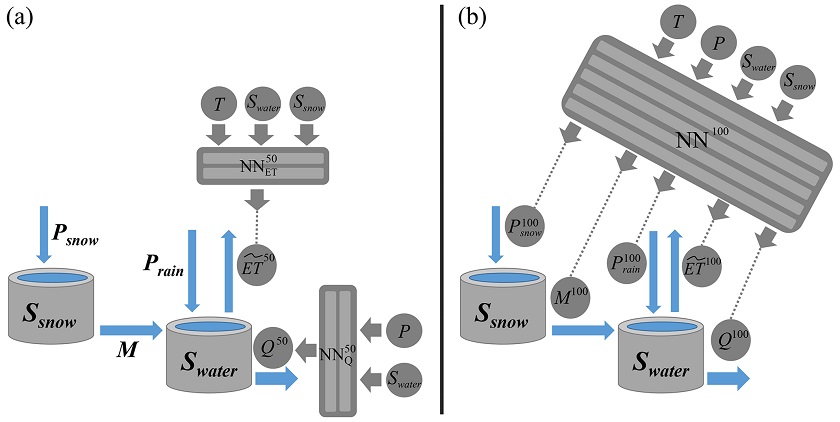
Deep-Learning-Methoden haben herkömmliche konzeptionelle Modelle bei der Modellierung von Niederschlägen und Abflüssen oft übertroffen, aber das Verständnis der internen Funktionsweise dieser Modelle bleibt eine Herausforderung. Während konzeptionelle Modelle klare Einblicke in hydrologische Prozesse bieten, fehlt bei Deep-Learning-Modellen diese Interpretierbarkeit. Um dieses Problem zu lösen, haben wir hydrologische neuronale Modelle mit gewöhnlichen Differentialgleichungen (ODEs) eingeführt, die die Vorhersagekraft von Deep Learning mit der Interpretierbarkeit von konzeptionellen Modellen kombinieren.
Bei neuronalen ODEs werden die internen Prozesse, die normalerweise durch Differentialgleichungen dargestellt werden, durch neuronale Netze ersetzt. Diese Verschmelzung ermöglicht es dem Deep Learning, mechanistische Modellierung zu integrieren, wodurch die interne Dynamik leichter zu interpretieren ist.


Publikationen

Extbase Variable Dump
array(2 items)
   publications => '25920' (5 chars)
   libraryUrl => '' (0 chars)
Extbase Variable Dump
array(1 item)
   0 => Snowflake\Publications\Domain\Model\Publicationprototypepersistent entity (uid=25920, pid=124)
      originalId => protected25920 (integer)
      authors => protected'Höge, M.; Scheidegger, A.; Baity-Jesi, M.; Albert, C.; 
         Fenicia, F.
' (92 chars) title => protected'Improving hydrologic models for predictions and process understanding using
         neural ODEs
' (87 chars) journal => protected'Hydrology and Earth System Sciences' (35 chars) year => protected2022 (integer) volume => protected26 (integer) issue => protected'19' (2 chars) startpage => protected'5085' (4 chars) otherpage => protected'5102' (4 chars) categories => protected'' (0 chars) description => protected'Deep learning methods have frequently outperformed conceptual hydrologic mod
         els in rainfall-runoff modelling. Attempts of investigating such deep learni
         ng models internally are being made, but the traceability of model states an
         d processes and their interrelations to model input and output is not yet fu
         lly understood. Direct interpretability of mechanistic processes has always
         been considered an asset of conceptual models that helps to gain system unde
         rstanding aside of predictability. We introduce hydrologic neural ordinary d
         ifferential equation (ODE) models that perform as well as state-of-the-art d
         eep learning methods in stream flow prediction while maintaining the ease of
          interpretability of conceptual hydrologic models. In neural ODEs, internal
         processes that are represented in differential equations, are substituted by
          neural networks. Therefore, neural ODE models enable the fusion of deep lea
         rning with mechanistic modelling. We demonstrate the basin-specific predicti
         ve performance for 569 catchments of the continental United States. For exe
         mplary basins, we analyse the dynamics of states and processes learned by th
         e model-internal neural networks. Finally, we discuss the potential of neura
         l ODE models in hydrology.
' (1242 chars) serialnumber => protected'1027-5606' (9 chars) doi => protected'10.5194/hess-26-5085-2022' (25 chars) uid => protected25920 (integer) _localizedUid => protected25920 (integer)modified _languageUid => protectedNULL _versionedUid => protected25920 (integer)modified pid => protected124 (integer)
Höge, M.; Scheidegger, A.; Baity-Jesi, M.; Albert, C.; Fenicia, F. (2022) Improving hydrologic models for predictions and process understanding using neural ODEs, Hydrology and Earth System Sciences, 26(19), 5085-5102, doi:10.5194/hess-26-5085-2022, Institutional Repository

Kontakt