Abteilung Umweltmikrobiologie

Ökologie Mikrobieller Systeme


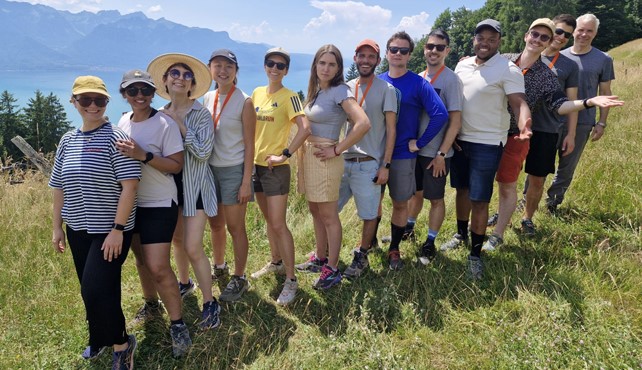
Die MSE-Gruppe wird von Dr. Olga Schubert und Prof. Martin Ackermann gemeinsam geleitet und ist der Eawag und der ETH Zürich angeschlossen.

Mikroben sind entscheidend für die Stabilität von Ökosystemen und können genutzt werden, um nachhaltige und skalierbare Lösungen gegen Klimawandel und Umweltzerstörung zu entwickeln. Unsere Forschung hat zum Ziel, ein besseres Verständnis dafür zu entwickeln, wie Mikroben und Mikrobiome funktionieren und wie wir diese gezielt nutzen können. Zum Beispiel untersuchen wir mikrobielle Prozesse, die dem marinen Kohlenstoffkreislauf zugrunde liegen, oder wir versuchen biotechnologische Prozesse zu entwickeln oder verbessern, von der Abwasserbehandlung über den Plastikabbau bis hin zur CO2-Speicherung im Boden. Oft versuchen wir zuerst grundlegende Prozesse auf der Ebene einzelner Zellen zu verstehen, und fragen dann, wie deren Verhalten und Interaktionen zur Funktion mikrobieller Gemeinschaften und ganzer mikrobieller Ökosysteme beitragen. In unseren Studien verwenden wir Mikrofluidik-basierte Lebendzellbildgebung und eine Vielzahl von Omics-Methoden, einschließlich Genomik, Transkriptomik, Proteomik und Metabolomik. Darüber hinaus nutzen wir bioinformatische Ansätze sowie mathematische und rechnergestützte Modellierungen, um weitere mechanistische Einblicke zu gewinnen und unsere Erkenntnisse zu konzeptualisieren. Um unsere Arbeit mit greifbaren Lösungen für konkrete Probleme zu verbinden, arbeiten wir mit Physikern, Chemikern und Ingenieuren zusammen. Unsere Forschung wird von SNSF, Innosuisse und Simons Foundation finanziert.

Weitere Informationen zu unseren laufenden Projekten finden Sie auf unserer Gruppenwebsite hier.

Für eine vollständige Liste unserer Veröffentlichungen besuchen Sie bitte die Google Scholar-Profile von Martin hier und Olga hier.
Gruppenleitende

Dr. Olga Schubert Gruppenleiterin Tel. +41 58 765 6487 E-Mail senden

Ausgewählte Publikationen

Extbase Variable Dump
array(2 items)
   publications => '34793,33966,33715,20388' (23 chars)
   libraryUrl => '' (0 chars)
Extbase Variable Dump
array(4 items)
   0 => Snowflake\Publications\Domain\Model\Publicationprototypepersistent entity (uid=34793, pid=124)
      originalId => protected34793 (integer)
      authors => protected'Stubbusch, A. K. M.; Peaudecerf, F. J.; Lee, K
         . S.; Paoli, L.; Schwartzman, J.; Stocker, R.; Basler,&n
         bsp;M.; Schubert, O. T.; Ackermann, M.; Magnabosco, C.;
         D’Souza, G. G.
' (254 chars) title => protected'Antagonism as a foraging strategy in microbial communities' (58 chars) journal => protected'Science' (7 chars) year => protected2025 (integer) volume => protected388 (integer) issue => protected'6752' (4 chars) startpage => protected'1214' (4 chars) otherpage => protected'1217' (4 chars) categories => protected'' (0 chars) description => protected'In natural habitats, nutrient availability limits bacterial growth. We disco
         vered that bacteria can overcome this limitation by acquiring nutrients by l
         ysing neighboring cells through contact-dependent antagonism. Using single-c
         ell live imaging and isotopic markers, we found that during starvation, the
         type VI secretion system (T6SS) lysed neighboring cells and thus provided nu
         trients from lysing cells for growth. Genomic adaptations in antagonists, ch
         aracterized by a reduced metabolic gene repertoire, and the previously unexp
         lored distribution of the T6SS across bacterial taxa in natural environments
          suggest that bacterial antagonism may contribute to nutrient transfer withi
         n microbial communities in many ecosystems.
' (727 chars) serialnumber => protected'0036-8075' (9 chars) doi => protected'10.1126/science.adr8286' (23 chars) uid => protected34793 (integer) _localizedUid => protected34793 (integer)modified _languageUid => protectedNULL _versionedUid => protected34793 (integer)modified pid => protected124 (integer)
1 => Snowflake\Publications\Domain\Model\Publicationprototypepersistent entity (uid=33966, pid=124) originalId => protected33966 (integer) authors => protected'Henderson, A.; Del Panta, A.; Schubert, O. T.; Mitri,&nb
         sp;S.; van Vliet, S.
' (101 chars) title => protected'Disentangling the feedback loops driving spatial patterning in microbial com
         munities
' (84 chars) journal => protected'npj Biofilms and Microbiomes' (28 chars) year => protected2025 (integer) volume => protected11 (integer) issue => protected'' (0 chars) startpage => protected'32 (14 pp.)' (11 chars) otherpage => protected'' (0 chars) categories => protected'' (0 chars) description => protected'The properties of multispecies biofilms are determined by how species are ar
         ranged in space. How these patterns emerge is a complex and largely unsolved
          problem. Here, we synthesize the known factors affecting pattern formation,
          identify the interdependencies and feedback loops coupling them, and discus
         s approaches to disentangle their effects. Finally, we propose an interdisci
         plinary research program that could create a predictive understanding of pat
         tern formation in microbial communities.
' (496 chars) serialnumber => protected'' (0 chars) doi => protected'10.1038/s41522-025-00666-1' (26 chars) uid => protected33966 (integer) _localizedUid => protected33966 (integer)modified _languageUid => protectedNULL _versionedUid => protected33966 (integer)modified pid => protected124 (integer)
2 => Snowflake\Publications\Domain\Model\Publicationprototypepersistent entity (uid=33715, pid=124) originalId => protected33715 (integer) authors => protected'Huelsmann, M.; Schubert, O. T.; Ackermann, M.' (65 chars) title => protected'A framework for understanding collective microbiome metabolism' (62 chars) journal => protected'Nature Microbiology' (19 chars) year => protected2024 (integer) volume => protected9 (integer) issue => protected'12' (2 chars) startpage => protected'3097' (4 chars) otherpage => protected'3109' (4 chars) categories => protected'' (0 chars) description => protected'Microbiome metabolism underlies numerous vital ecosystem functions. Individu
         al microbiome members often perform partial catabolism of substrates or do n
         ot express all of the metabolic functions required for growth. Microbiome me
         mbers can complement each other by exchanging metabolic intermediates and ce
         llular building blocks to achieve a collective metabolism. We currently lack
          a mechanistic framework to explain why microbiome members adopt partial met
         abolism and how metabolic functions are distributed among them. Here we argu
         e that natural selection for proteome efficiency—that is, performing essen
         tial metabolic fluxes at a minimal protein investment—explains partial met
         abolism of microbiome members, which underpins the collective metabolism of
         microbiomes. Using the carbon cycle as an example, we discuss motifs of coll
         ective metabolism, the conditions under which these motifs increase the prot
         eome efficiency of individuals and the metabolic interactions they result in
         . In summary, we propose a mechanistic framework for how collective metaboli
         c functions emerge from selection on individuals.
' (1113 chars) serialnumber => protected'2058-5276' (9 chars) doi => protected'10.1038/s41564-024-01850-3' (26 chars) uid => protected33715 (integer) _localizedUid => protected33715 (integer)modified _languageUid => protectedNULL _versionedUid => protected33715 (integer)modified pid => protected124 (integer)
3 => Snowflake\Publications\Domain\Model\Publicationprototypepersistent entity (uid=20388, pid=124) originalId => protected20388 (integer) authors => protected'Dal Co, A.; van Vliet, S.; Kiviet, D. J.; Schlegel,&nbsp
         ;S.; Ackermann, M.
' (99 chars) title => protected'Short-range interactions govern the dynamics and functions of microbial comm
         unities
' (83 chars) journal => protected'Nature Ecology & Evolution' (26 chars) year => protected2020 (integer) volume => protected4 (integer) issue => protected'' (0 chars) startpage => protected'366' (3 chars) otherpage => protected'375' (3 chars) categories => protected'' (0 chars) description => protected'Communities of interacting microorganisms play important roles across all ha
         bitats on Earth. These communities typically consist of a large number of sp
         ecies that perform different metabolic processes. The functions of microbial
          communities ultimately emerge from interactions between these different mic
         roorganisms. To understand the dynamics and functions of microbial communiti
         es, we thus need to know the nature and strength of these interactions. Here
         , we quantified the interaction strength between individual cells in microbi
         al communities. We worked with synthetic communities of <em>Escherichia coli
         </em> bacteria that exchange metabolites to grow. We combined single-cell gr
         owth rate measurements with mathematical modelling to quantify metabolic int
         eractions between individual cells and to map the spatial interaction networ
         k in these communities. We found that cells only interact with other cells i
         n their immediate neighbourhood. This short interaction range limits the cou
         pling between different species and reduces their ability to perform metabol
         ic processes collectively. Our experiments and models demonstrate that the s
         patial scale of biotic interaction plays a fundamental role in shaping the e
         cological dynamics of communities and the functioning of ecosystems.
' (1284 chars) serialnumber => protected'' (0 chars) doi => protected'10.1038/s41559-019-1080-2' (25 chars) uid => protected20388 (integer) _localizedUid => protected20388 (integer)modified _languageUid => protectedNULL _versionedUid => protected20388 (integer)modified pid => protected124 (integer)
Stubbusch, A. K. M.; Peaudecerf, F. J.; Lee, K. S.; Paoli, L.; Schwartzman, J.; Stocker, R.; Basler, M.; Schubert, O. T.; Ackermann, M.; Magnabosco, C.; D’Souza, G. G. (2025) Antagonism as a foraging strategy in microbial communities, Science, 388(6752), 1214-1217, doi:10.1126/science.adr8286, Institutional Repository
Henderson, A.; Del Panta, A.; Schubert, O. T.; Mitri, S.; van Vliet, S. (2025) Disentangling the feedback loops driving spatial patterning in microbial communities, npj Biofilms and Microbiomes, 11, 32 (14 pp.), doi:10.1038/s41522-025-00666-1, Institutional Repository
Huelsmann, M.; Schubert, O. T.; Ackermann, M. (2024) A framework for understanding collective microbiome metabolism, Nature Microbiology, 9(12), 3097-3109, doi:10.1038/s41564-024-01850-3, Institutional Repository
Dal Co, A.; van Vliet, S.; Kiviet, D. J.; Schlegel, S.; Ackermann, M. (2020) Short-range interactions govern the dynamics and functions of microbial communities, Nature Ecology & Evolution, 4, 366-375, doi:10.1038/s41559-019-1080-2, Institutional Repository

Projekte

Wie verändern Phagen – die Viren, die Bakterien infizieren – die Zusammensetzung und Aktivität mikrobieller Gemeinschaften?
Wir verbinden experimentelle, klinische und digitale Ansätze bei der Forschung an einem klareren Bild der Mikrobiome.
Es ist ein grosses Ziel, besser zu verstehen, wie mikrobielle Gemeinschaften funktionieren, wie Mikroben miteinander interagieren und wie diese Interaktionen die Funktionen der Gemeinschaft bestimmen.