News

Wie lokale Materialien und das Klima die optimale Gestaltung von Vermifiltern beeinflussen

Das Ziel 6 der Ziele für nachhaltige Entwicklung, Sanitärversorgung für alle, ist nicht auf Kurs und weit davon entfernt, bis 2030 erreicht zu werden. Die Vermifiltration könnte dazu beitragen, diese Lücke zu verkleinern: Das naturbasierte Abwassermanagementsystem erweist sich weltweit aufgrund seiner geringen Kosten als zunehmend vielversprechend. Forschende der Eawag-Abteilung Sandec besuchten Vermifilter-Anlagen in Indien und der Schweiz, um zu untersuchen, wie lokale Unterschiede deren optimale Gestaltung beeinflussen.

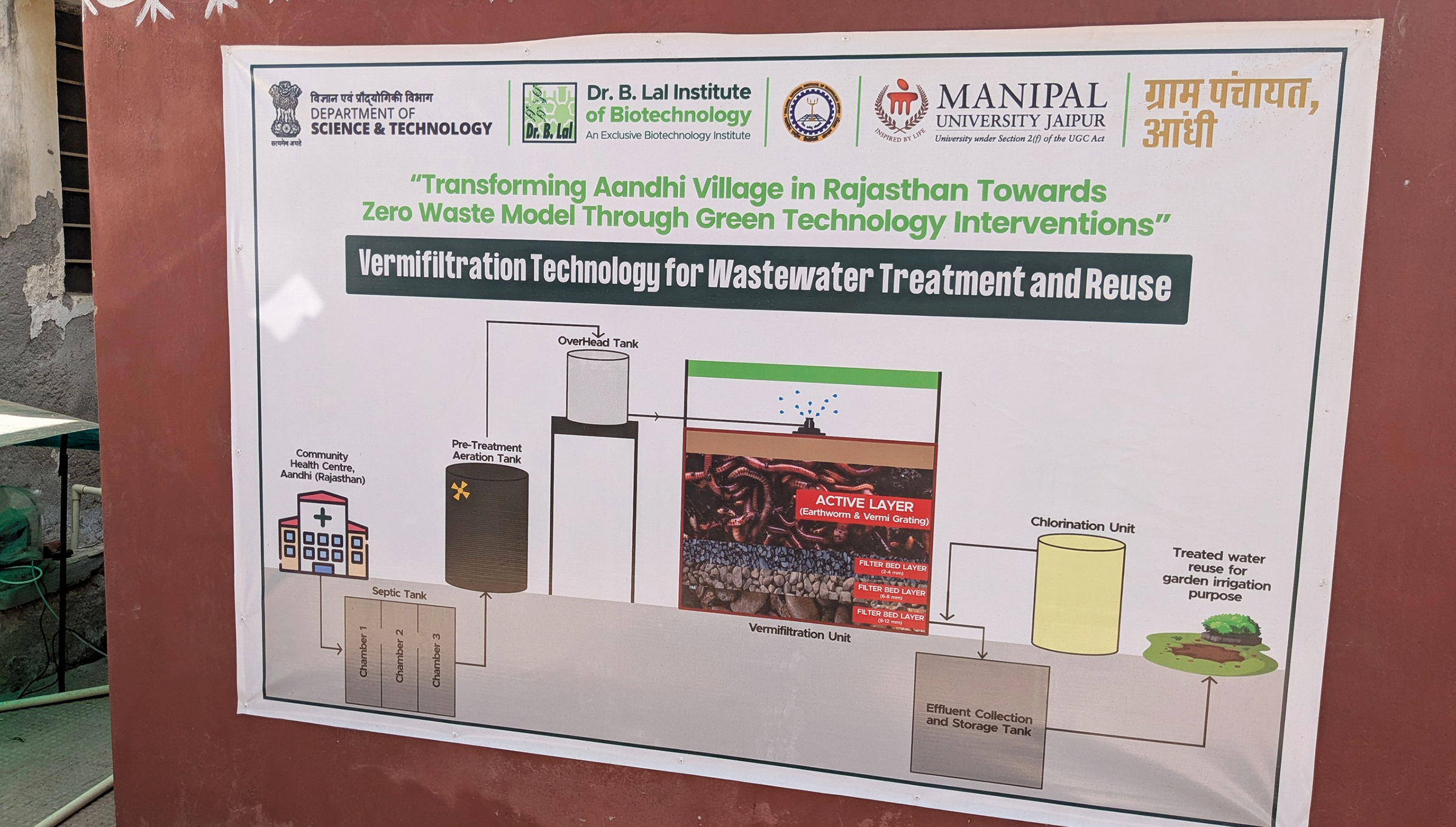
Vermifiltration ist eine Abwasseraufbereitungstechnologie, die ohne Kanalisation auskommt und die symbiotische Beziehung zwischen Regenwürmern, häufig Eisenia fetida, und Mikroorganismen nutzt, um Abwasser zu behandeln. Die Regenwürmer zersetzen nicht nur organisches Material, das dadurch für die Mikroorganismen leichter verfügbar wird, sondern belüften durch ihr Wühlen auch den Vermifilter, was die Produktivität der Bakterien stimuliert. Diese Technologie hat verschiedene Vorteile: Sie ist kostengünstig und robust, benötigt nur wenig bis gar keine Energie und kann mit lokalen, leicht verfügbaren Materialien (Kompost, Biokohle, Kies, Sand usw.) gebaut werden. Darüber hinaus kann das behandelte Abwasser genutzt werden, um Wasser- und Ressourcenkreisläufe zu schliessen.

Vergleich von Vermifiltern in Indien und der Schweiz

„Ich habe Vermifilteranlagen in Indien besucht, um zu verstehen, wie der lokale Kontext das Design von Vermifiltern beeinflusst und um die Ergebnisse mit denen aus der Schweiz zu vergleichen“, sagt Kayla Coppens, Doktorandin an der Eawag-Abteilung für Sanitation, Water and Solid Waste for Development (Sandec) und der Universität Genf.

Da Vermifiltersysteme lokal verfügbare Materialien nutzen, kommen in den Anlagen in Genf sowie in Jaipur und Pune (Indien) unterschiedliche Filtermedien zum Einsatz. Die Anlagen in Genf und Jaipur verwenden Wurmkompost als Einstreumaterial, während in Pune Kokosnussspäne als Einstreuschicht dienen. In Jaipur wurden auch Tests durchgeführt, bei denen Kokosnusskohle und Wurmkompost als Filtermedien kombiniert wurden.

Die drei Vermifilter unterschieden sich auch in ihren Vorbehandlungsansätzen. In Genf wurde der Vermifilter ohne zusätzliche Vorbehandlung installiert, während in Jaipur Absetzbecken zur Verringerung der Feststoffbelastung eingesetzt werden. In Pune kommen dafür Sandfänge zum Einsatz. Die unterschiedliche Feststoffbelastung beeinflusste die Wahl des Dispersionssystems. In Jaipur und Pune ermöglichte die geringe Feststoffbelastung den Einsatz von Sprinkleranlagen, während in Genf aufgrund der höheren Feststoffbelastung eine Zerkleinerungspumpe und 10-mm-Rohrleitungen erforderlich waren.

Die Unterschiede in Bezug auf Filtermaterialien, klimatische Bedingungen und Vorbehandlungsansätze erforderten Anpassungen der Betriebsparameter. So beeinflusste beispielsweise die im Vergleich zu Genf deutlich höhere Temperatur in Jaipur und Pune die Menge an Abwasser, die den Filtern zugeführt werden konnte. Trotz dieser Unterschiede erzielten alle drei Systeme eine vergleichbare Reinigungsleistung. Das zeigt, dass die Vermifiltration erfolgreich an unterschiedliche lokale Gegebenheiten angepasst werden kann.

Kein einheitliches Design für Vermifilter

„Meine wichtigste Erkenntnis ist, dass die Nutzung lokaler Ressourcen und Fachkenntnisse für die Entwicklung von Vermifiltern entscheidend ist und dass es keine universelle optimale Konfiguration gibt“, erklärt Coppens. Das Klima hat beispielsweise einen grossen Einfluss auf die Konstruktion von Vermifiltern. Bei den Anlagen in Indien müssen die hohen Temperaturen und die hohe Luftfeuchtigkeit des lokalen Klimas berücksichtigt werden, während in der Schweiz die Herausforderung darin besteht, die Kälte draussen zu halten. Zukünftige Forschungsarbeiten sollten wirksame Konstruktions- und Betriebskonfigurationen für verschiedene Kontexte ermitteln.
 

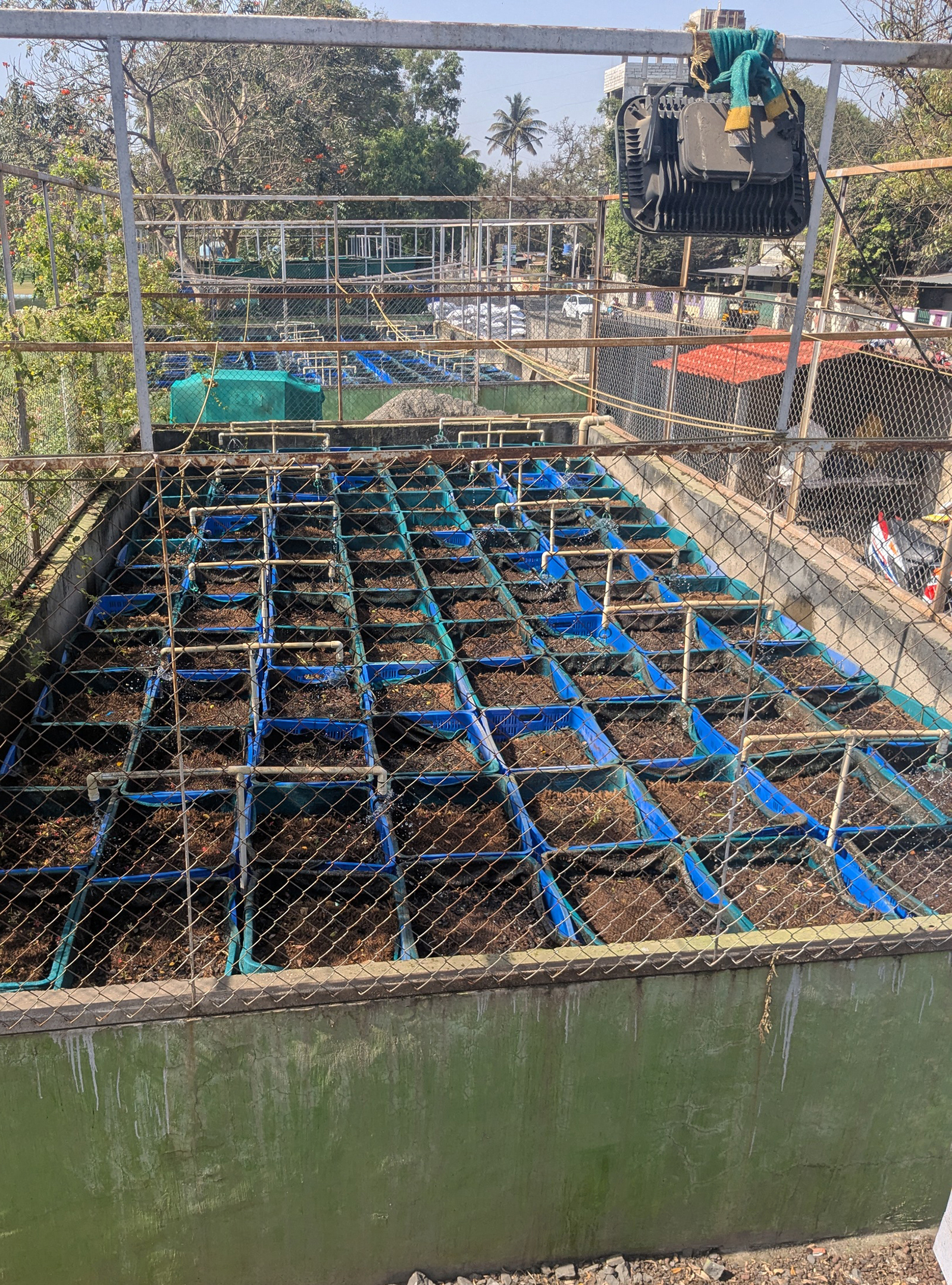
Vermifilter-installation in Pune, Indien (Foto: Kayla Coppens, Eawag).

Finanzierung / Kooperationen

Eawag (Diese Studie wurde auch von der UniGE und der SACAD (Société Académique de Genève) finanziert.).
 

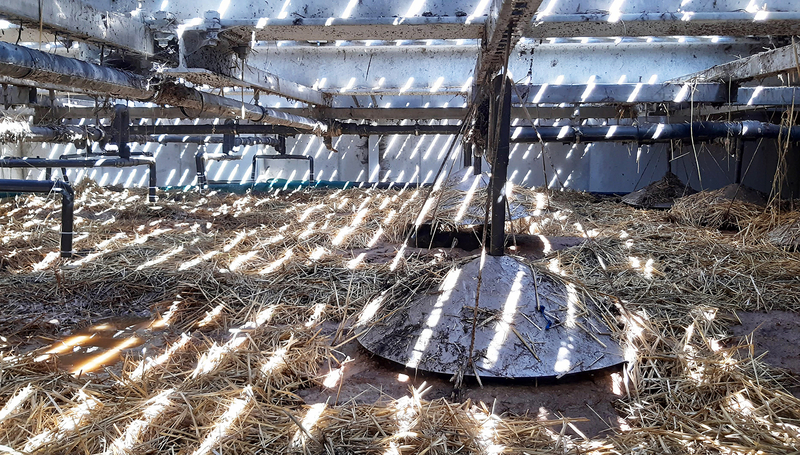
Titelbild: Vermifilter in Genf (Foto: Kayla Coppens, Eawag).
 

Originalpublikation

Extbase Variable Dump
array(3 items)
   publications => '35587' (5 chars)
   libraryUrl => '' (0 chars)
   layout => '0' (1 chars)
Extbase Variable Dump
array(1 item)
   0 => Snowflake\Publications\Domain\Model\Publicationprototypepersistent entity (uid=35587, pid=124)
      originalId => protected35587 (integer)
      authors => protected'' (0 chars)
      title => protected'Sandec News, 26' (15 chars)
      journal => protected'Sandec News' (11 chars)
      year => protected2025 (integer)
      volume => protected0 (integer)
      issue => protected'26' (2 chars)
      startpage => protected'' (0 chars)
      otherpage => protected'' (0 chars)
      categories => protected'' (0 chars)
      description => protected'' (0 chars)
      serialnumber => protected'1420-5572' (9 chars)
      doi => protected'10.55408/eawag:35587' (20 chars)
      uid => protected35587 (integer)
      _localizedUid => protected35587 (integer)modified
      _languageUid => protectedNULL
      _versionedUid => protected35587 (integer)modified
      pid => protected124 (integer)
(2025) Sandec News, 26, Sandec News, doi:10.55408/eawag:35587, Institutional Repository

Dokumente

Arora, S. and S. Saraswat, Vermifiltration as a natural, sustainable and green technology for environmental remediation: A new paradigm for wastewater treatment process. Current Research in Green and Sustainable Chemistry, 2021. 4.
https://doi.org/10.1016/j.crgsc.2021.100061

Coppens, K., Wackernagel, I., Stoll, S., & Strande, L. (2026). Worms in the city: can vermifiltration scale for treatment of domestic wastewater in urban contexts? [Manuscript submited for publication].

Coppens, K., & Strande, L. (2025). Optimal Vermifilter Design: Insights From Three Full-scale Installations. Sandec News, 26, 22.

Coppens, K., Stoll, S., & Strande, L. (2024). Nitrogen Removal in a Vermifilter Treating Urban Domestic Wastewater. Sandec News, 25, 26-27.

Extbase Variable Dump
array(3 items)
   publications => '34994,35076,36208' (17 chars)
   libraryUrl => '' (0 chars)
   layout => '0' (1 chars)
Extbase Variable Dump
array(3 items)
   0 => Snowflake\Publications\Domain\Model\Publicationprototypepersistent entity (uid=34994, pid=124)
      originalId => protected34994 (integer)
      authors => protected'Coppens, K.; Strande, L.; Stoll, S.' (50 chars)
      title => protected'Performance analysis and impact of operating conditions on the treatment cap
         acity of two full-scale vermifilters
' (112 chars) journal => protected'Journal of Environmental Management' (35 chars) year => protected2025 (integer) volume => protected391 (integer) issue => protected'' (0 chars) startpage => protected'126328 (11 pp.)' (15 chars) otherpage => protected'' (0 chars) categories => protected'full-scale vermifiltration; nature-based solution; domestic wastewater manag
         ement; seasonal impacts; optimal design for nitrogen removal; post-treatment
          requirements
' (165 chars) description => protected'Due to low investment and operational costs, chemical and energy independenc
         e, and a high potential to contribute to circular wastewater management prac
         tices, vermifiltration is a globally relevant wastewater treatment solution.
          Despite its potential, insufficient knowledge of the full-scale performance
          and the absence of guidelines for optimal design and operation impede vermi
         filtration from being widely implemented. This study analyzed the performanc
         e of two full-scale vermifilters treating domestic blackwater and greywater
         sediments in winter and summer in Switzerland. For the first time, the opera
         ting conditions of both vermifilters were determined empirically, where the
         blackwater vermifilter observed 4 times lower hydraulic loading rates, thoug
         h 10 times larger nitrogen loading rates than the greywater sediments vermif
         ilter. Both vermifilters demonstrated the ability to maintain high removal e
         fficiencies for organics and solids (&gt;75 % for BOD<sub>5</sub>, COD, and
         TSS), though nutrient removal was lacking (&lt;30 % for TN and TP). The desi
         gn and operation used in the full-scale vermifilters are, in general, recomm
         endable, as no clogging was observed, and the performance of the vermifilter
         s did not vary with season. In addition, with post-treatment, the effluent c
         omplied with discharge standards 100 % of the time. Insights into optimal de
         sign and operation include separate urine treatment, increased vermifilter d
         epth, and alternative and intermittent feeding regimes. Such modifications w
         ould likely decrease the post-treatment requirements, spatial footprint, and
          investment costs. Overall, the results of this study conclude that when emp
         loying favorable design and operation conditions, vermifiltration is a relev
         ant, reliable, and resilient wastewater treatment solution for both urban an
         d rural areas worldwide.
' (1848 chars) serialnumber => protected'0301-4797' (9 chars) doi => protected'10.1016/j.jenvman.2025.126328' (29 chars) uid => protected34994 (integer) _localizedUid => protected34994 (integer)modified _languageUid => protectedNULL _versionedUid => protected34994 (integer)modified pid => protected124 (integer)
1 => Snowflake\Publications\Domain\Model\Publicationprototypepersistent entity (uid=35076, pid=124) originalId => protected35076 (integer) authors => protected'Coppens,&nbsp;K.; Geyer,&nbsp;T.; Monod,&nbsp;A.; Strande,&nbsp;L.; Stoll,&n
         bsp;S.
' (82 chars) title => protected'Evaluation of vermifilter-treated domestic wastewater for irrigation and fer
         tigation: opportunities and challenges for implementation
' (133 chars) journal => protected'Journal of Water Process Engineering' (36 chars) year => protected2025 (integer) volume => protected77 (integer) issue => protected'' (0 chars) startpage => protected'108295 (11 pp.)' (15 chars) otherpage => protected'' (0 chars) categories => protected'nature-based solutions; organic micropollutants; metallic trace elements; mi
         croplastics; wastewater reclamation
' (111 chars) description => protected'Water reclamation can help meet agricultural irrigation and nutrient demands
         . Due to high nutrient loads, vermifiltration is often considered a suitable
          treatment solution for reclamation in agriculture. However, the ability of
         vermifiltration to meet irrigation standards is understudied. This study exp
         lores the feasibility of reclamation through irrigation and fertigation from
          two full-scale vermifilters treating black- and sedimented greywater in par
         allel and evaluates the removal efficiencies of metallic trace elements (MTE
         s), E. coli, and 15 organic micropollutants (OMPs). Microplastics in the eff
         luent were also quantified. The results show that, for reclamation in agricu
         lture, post-treatment of the vermifilter effluent is necessary to ensure rel
         iable and sufficient effluent quality. Despite an overall log removal of 3.6
         7, E. coli is the most restrictive parameter, conforming to irrigation stand
         ards only after the second post-treatment step. Various constraints, due to
         high nitrate concentrations and salinity, would also be necessary to avoid n
         egative environmental and agronomic impacts. For fertigation, careful planni
         ng is needed to overcome excessive and variable nitrogen loads. Despite low
         and variable MTE removal, the effluent quality meets irrigation standards. A
         verage removal of OMPs is 91 ± 15 %, and the coefficient of variation is &l
         t;10 % for two-thirds of the OMPs. Suggested optimizations to improve the us
         ability in agriculture include adding a disinfection step and urine separati
         on. Future studies should focus on the impacts of vermifilter reclamation in
          agriculture on soil and crops, as well as the potential for designations su
         ch as toilet flushing and street cleaning, which are likely more advantageou
         s in urban settings.
' (1768 chars) serialnumber => protected'2214-7144' (9 chars) doi => protected'10.1016/j.jwpe.2025.108295' (26 chars) uid => protected35076 (integer) _localizedUid => protected35076 (integer)modified _languageUid => protectedNULL _versionedUid => protected35076 (integer)modified pid => protected124 (integer)
2 => Snowflake\Publications\Domain\Model\Publicationprototypepersistent entity (uid=36208, pid=124) originalId => protected36208 (integer) authors => protected'Coppens,&nbsp;K.; Stoll,&nbsp;S.; Strande,&nbsp;L.' (50 chars) title => protected'Des lombrics en Ville' (21 chars) journal => protected'Aqua & Gas' (10 chars) year => protected2026 (integer) volume => protected106 (integer) issue => protected'2' (1 chars) startpage => protected'66' (2 chars) otherpage => protected'71' (2 chars) categories => protected'' (0 chars) description => protected'
         
         ain de Genève a été évaluée. En plus de l'abattement de la matière org
         anique, de l'azote, des pathogènes et des micropolluants, l'étude montre q
         
         
' (417 chars) serialnumber => protected'2235-5197' (9 chars) doi => protected'' (0 chars) uid => protected36208 (integer) _localizedUid => protected36208 (integer)modified _languageUid => protectedNULL _versionedUid => protected36208 (integer)modified pid => protected124 (integer)
Coppens, K.; Strande, L.; Stoll, S. (2025) Performance analysis and impact of operating conditions on the treatment capacity of two full-scale vermifilters, Journal of Environmental Management, 391, 126328 (11 pp.), doi:10.1016/j.jenvman.2025.126328, Institutional Repository
Coppens, K.; Geyer, T.; Monod, A.; Strande, L.; Stoll, S. (2025) Evaluation of vermifilter-treated domestic wastewater for irrigation and fertigation: opportunities and challenges for implementation, Journal of Water Process Engineering, 77, 108295 (11 pp.), doi:10.1016/j.jwpe.2025.108295, Institutional Repository
Coppens, K.; Stoll, S.; Strande, L. (2026) Des lombrics en Ville, Aqua & Gas, 106(2), 66-71, Institutional Repository