Archiv Detail

Neue Erkenntnisse dank effizienteren und interdisziplinären Testmethoden

9. August 2018 | Mirella Wepf

Um problematischen Mikroverunreinigungen im Wasser beizukommen, ist auch die Entwicklung neuer und kostengünstiger Analyseverfahren zentral. Dies gehörte zu den Hauptzielen von EDA-EMERGE, einem Programm der Europäischen Kommission, an dem auch die Eawag beteiligt war. 

Der fortlaufend wachsenden Menge an Chemikalien in Gewässern steht eine kleine Anzahl Substanzen gegenüber, die in der Schweiz und der EU routinemässig analysiert werden. Diese prioritären Schadstoffe wurden einst als besonders umweltrelevant definiert. Doch aktuelle Studien zeigen, dass häufig auch nicht-prioritäre oder gar unbekannte Chemikalien ein hohes Risiko für das aquatische Leben und die menschliche Gesundheit darstellen. Dies zeigte auch ein europäisches Forschungsprojekt, an dem die Eawag beteiligt war. Ziel des Programms EDA-Emerge war, die effekt-dirigierte Analyse (EDA) weiterzuentwickeln und in einem länderübergreifenden Demonstrationsprogramm zu erproben.

Chemische Analyse und Biotests kombiniert

EDA kombiniert Biotests mit chemischer Analytik – aus folgendem Grund: In Biotests, beispielsweise mit menschlichen Zellen oder Zebrafisch-Embryonen, lässt sich zwar die Toxizität einer Wasserprobe nachweisen, oft ist jedoch unklar, welche Substanzen diesen Effekt verursachen. Dazu braucht es die chemische Analytik.

Im Rahmen von EDA-Emerge wurde dieses Verfahren weiter optimiert und vereinfacht. Wichtige Bestandteile davon waren gezielt ausgewählte Biotests sowie ein neuentwickeltes Gerät, mit dem die Schadstoffe aus grossen Wassermengen angereichert werden können.

Negative Auswirkungen auf Lebewesen nicht erklärbar

Mit der neuen Methodik untersuchten 37 Forscherinnen und Forscher von 15 Instituten die Wasserqualität im Umfeld von Abwasserreinigungsanlagen in vier europäischen Flüssen. Dazu gehörte auch der Fluss Urtene im Berner Mittelland im Bereich der ARA Moossee-Urtenenbach.

Bei allen vier Flüssen konnten die Forschenden mit den Biotests toxische Wirkungen auf Algen und Fischembryonen sowie Effekte auf das Hormonsystem nachweisen, die sich nicht ausschliesslich mithilfe der gängigen Schadstofflisten erklären liessen. Diese Effekte traten insbesondere unterhalb der ARA-Ausflüsse auf.

Die chemischen Analysen machten deutlich, dass in den Proben auch zahlreiche Stoffe vorkommen, die nicht auf den Listen aufgeführt sind. Häufig nachgewiesen wurden beispielsweise der medizinische Wirkstoff Gabapentin, das Tensid TMDD oder Phthalimide, die unter anderem in Pflanzenschutzmitteln eingesetzt werden. (Mehr dazu in: Tousova Zouzana, et al, 2017 / https://doi.org/10.1016/j.scitotenv.2017.06.032 )
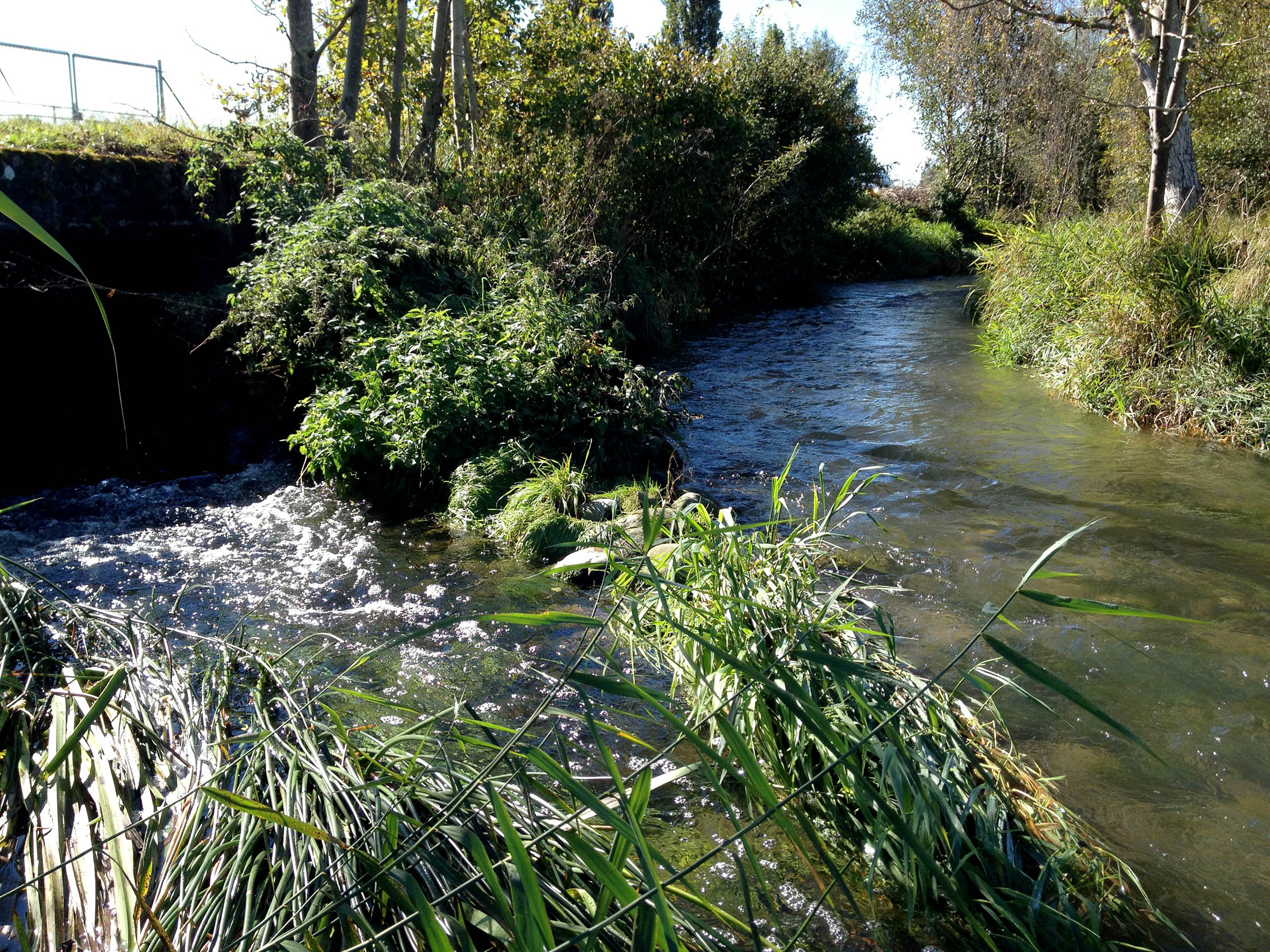
Ausfluss der ARA Moossee in die Urtene
(Foto: Jennifer Schollée, Eawag)

Urtenenbach unter der Lupe

Nach der ersten Versuchsphase hat eine kleinere, achtköpfige Gruppe die Urtene ein zweites Mal unter die Lupe genommen und die Untersuchungen intensiviert. Dieses Team bestand aus Forschenden der Eawag und dem französischen Forschungsinstitut INERIS. 

Marc Suter, Leiter der Gruppe Bioanalytik von der Eawag-Abteilung Umwelttoxikologie, erklärt die Hintergründe für dieses Vorhaben: «In der ersten Untersuchungsphase hat das Projektteam bei allen vier Flüssen mit bekannten Standardtests gearbeitet und die Proben in vier Fraktionen aufgeteilt.» In der zweiten Phase hätten sie unter anderem neue Biotests eingesetzt, um die Wirkmechanismen der Stoffe und Stoffgemische genauer zu studieren. «Zudem haben wir viel mehr Proben genommen und nach physikalisch-chemischen Eigenschaften in 40 Fraktionen aufgetrennt – eine extrem hohe Auflösung.» Je feiner eine Wasserprobe fraktioniert wird, desto klarer lässt sich die biologische Aktivität einzelnen Stoffen zuordnen.

Genauere Aussagen dank feiner Fraktionierung der Proben

Mit diesem Vorgehen wollten die Forschenden die Resultate der ersten Untersuchung validieren und ausschliessen, dass so genannte Antagonisten die Laborresultate verfälschen. Suter nennt ein Beispiel: «In der zweiten Testreihe konnte in 20 Fraktionen östrogene Wirkungen nachgewiesen werden. In der groben Aufteilung der ersten Testreihe wäre es möglich gewesen, dass in der gleichen Fraktion auftretende Anti-Östrogene die Wirkung der Östrogene unterdrücken. So hätte sich ein falsch negativer Befund ergeben.» Die hochaufgelöste Fraktionierung bilde die Realität besser ab.

Mehr Glucocorticoide entdeckt

Insgesamt hätten sich die Resultate der ersten und der zweiten Untersuchung allerdings weniger unterschieden als man ursprünglich erwartet hätte, sagt Suter. Einige Differenzen gebe es aber: «Mithilfe der feineren Fraktionierung konnten wir beispielsweise eine deutlich höhere glucocorticoid-artige Aktivität nachweisen.» Glucocorticoide können sich negativ auf das Immunsystem von Mensch und Tier auswirken. Die Eawag-Doktorandin Anita Hidasi hat dies im Rahmen von EDA-Emerge anhand von Zebrafischen gezeigt (Hidasi et al, 2017 / https://doi.org/10.1016/j.ecoenv.2016.11.024 ). Die zweite Projektphase war aufwendig, hat aber wertvolle Erkenntnisse gebracht: Durch die Kombination bereits gängiger EDA-Verfahren mit neuen Biotests habe man, so Suter, die Ursachen von diversen Negativeffekten, die im Labor zu beobachten waren, besser verstanden. Das sei ein wichtiger Schritt, um die Risikoanalyse der Schadstoffbelastung von Gewässern – insbesondere im Bereich von Kläranlagen – zu verbessern. In ihren Schlussforderungen halten die Forscherinnen und Forscher zudem fest, dass das Wissen über die Wirkung von glucocorticoid-artigen Stoffen ausgebaut werden müsse.

Finanzierung

EDA-EMERGE wurde von der Europäischen Kommission finanziert. Es handelt sich um ein vierjähriges Marie Curie ITN Projekt, das gezielt zur Förderung des wissenschaftlichen Nachwuchses dient. 

Publikationen

Extbase Variable Dump
array(2 items)
   publications => '16830,14458,14084' (17 chars)
   libraryUrl => '' (0 chars)
Extbase Variable Dump
array(3 items)
   0 => Snowflake\Publications\Domain\Model\Publicationprototypepersistent entity (uid=16830, pid=124)
      originalId => protected16830 (integer)
      authors => protected'Sonavane, M.; Schollée, J. E.; Hidasi, A. O.; Creu
         sot, N.; Brion, F.; Suter, M. J. -F.; Hollender,&nb
         sp;J.; Aït-Aïssa, S.
' (179 chars) title => protected'An integrative approach combining passive sampling, bioassays and effect-dir
         ected analysis to assess the impact of wastewater effluent
' (134 chars) journal => protected'Environmental Toxicology and Chemistry' (38 chars) year => protected2018 (integer) volume => protected37 (integer) issue => protected'8' (1 chars) startpage => protected'2079' (4 chars) otherpage => protected'2088' (4 chars) categories => protected'WWTP effluent; passive sampling; endocrine disrupting chemicals (EDCs); embr
         yo toxicity; effect-directed analysis (EDA); LC-MS/MS analysis
' (138 chars) description => protected'Wastewater treatment plant (WWTP) effluents are major sources of endocrine d
         isrupting chemicals (EDCs) and of other chemicals of toxicological concern f
         or the aquatic environment. In this study, we used an integrated strategy co
         mbining passive sampling (Chemcatcher<sup>®</sup>), developmental toxicity
         and mechanism‐based in vitro and in vivo bioassays to monitor the impacts
         of a WWTP on a river. In vitro screening revealed the WWTP effluent as a sou
         rce of estrogen (ER), glucocorticoid (GR), aryl hydrocarbon (AhR) receptor m
         ediated activities, impacting the downstream river site where significant ac
         tivities were also measured, albeit to a lesser extent than in the effluent.
          Effect‐directed analysis (EDA) of the effluent successfully identified th
         e presence of potent estrogens (estrone, 17α‐ethinylestradiol and 17β‐
         estradiol) and glucocorticoids (clobetasol propionate and fluticasone propio
         nate) as the major contributors to the observed in vitro activities, even th
         ough other unidentified active chemicals were likely present. The impact of
         the WWTP was also assessed using zebrafish embryo assays, highlighting its a
         bility to induce estrogenic response through up‐regulation of aromatase pr
         omoter‐dependent reporter gene in the transgenic (cyp19a1b–GFP) zebrafis
         h assay and to generate teratogenic effects at non‐lethal concentrations i
         n the zebrafish embryo toxicity test. This study argues for the use of such
         an integrated approach, combining passive sampling, bioassays and EDA, to co
         mprehensively identify endocrine active compounds and associated hazards of
         WTTP effluents.
' (1611 chars) serialnumber => protected'0730-7268' (9 chars) doi => protected'10.1002/etc.4155' (16 chars) uid => protected16830 (integer) _localizedUid => protected16830 (integer)modified _languageUid => protectedNULL _versionedUid => protected16830 (integer)modified pid => protected124 (integer)
1 => Snowflake\Publications\Domain\Model\Publicationprototypepersistent entity (uid=14458, pid=124) originalId => protected14458 (integer) authors => protected'Tousova,&nbsp;Z.; Oswald,&nbsp;P.; Slobodnik,&nbsp;J.; Blaha,&nbsp;L.; Muz,&
         nbsp;M.; Hu,&nbsp;M.; Brack,&nbsp;W.; Krauss,&nbsp;M.; Di Paolo,&nbsp;C.; Ta
         rcai,&nbsp;Z.; Seiler,&nbsp;T.-B.; Hollert,&nbsp;H.; Koprivica,&nbsp;S.; Ahe
         l,&nbsp;M.; Schollée,&nbsp;J.&nbsp;E.; Hollender,&nbsp;J.; Suter,&nbsp;M.&n
         bsp;J.&nbsp;-F.; Hidasi,&nbsp;A.&nbsp;O.; Schirmer,&nbsp;K.; Sonavane,&nbsp;
         M.; Ait-Aissa,&nbsp;S.; Creusot,&nbsp;N.; Brion,&nbsp;F.; Froment,&nbsp;J.;
         Almeida,&nbsp;A.&nbsp;C.; Thomas,&nbsp;K.; Tollefsen,&nbsp;K.&nbsp;E.; Tufi,
         &nbsp;S.; Ouyang,&nbsp;X.; Leonards,&nbsp;P.; Lamoree,&nbsp;M.; Torrens,&nbs
         p;V.&nbsp;O.; Kolkman,&nbsp;A.; Schriks,&nbsp;M.; Spirhanzlova,&nbsp;P.; Tin
         dall,&nbsp;A.; Schulze,&nbsp;T.
' (715 chars) title => protected'European demonstration program on the effect-based and chemical identificati
         on and monitoring of organic pollutants in European surface waters
' (142 chars) journal => protected'Science of the Total Environment' (32 chars) year => protected2017 (integer) volume => protected601 (integer) issue => protected'' (0 chars) startpage => protected'1849' (4 chars) otherpage => protected'1868' (4 chars) categories => protected'adverse effects; large volume solid phase extraction; EDA-EMERGE; simplified
          effect-directed analysis protocol; environmental health; human health
' (146 chars) description => protected'Growing concern about the adverse environmental and human health effects of
         a wide range of micropollutants requires the development of novel tools and
         approaches to enable holistic monitoring of their occurrence, fate and effec
         ts in the aquatic environment. A European-wide demonstration program (EDP) f
         or effect-based monitoring of micropollutants in surface waters was carried
         out within the Marie Curie Initial Training Network EDA-EMERGE. The main obj
         ectives of the EDP were to apply a simplified protocol for effect-directed a
         nalysis, to link biological effects to target compounds and to estimate thei
         r risk to aquatic biota. <i>Onsite</i> large volume solid phase extraction o
         f 50 L of surface water was performed at 18 sampling sites in four European
         river basins. Extracts were subjected to effect-based analysis (toxicity to
         algae, fish embryo toxicity, neurotoxicity, (anti-)estrogenicity, (anti-)and
         rogenicity, glucocorticoid activity and thyroid activity), to target analysi
         s (151 organic micropollutants) and to nontarget screening. The most pronoun
         ced effects were estrogenicity, toxicity to algae and fish embryo toxicity.
         In most bioassays, major portions of the observed effects could not be expla
         ined by target compounds, especially in case of androgenicity, glucocorticoi
         d activity and fish embryo toxicity. Estrone and nonylphenoxyacetic acid wer
         e identified as the strongest contributors to estrogenicity, while herbicide
         s, with a minor contribution from other micropollutants, were linked to the
         observed toxicity to algae. Fipronil and nonylphenol were partially responsi
         ble for the fish embryo toxicity. Within the EDP, 21 target compounds were p
         rioritized on the basis of their frequency and extent of exceedance of predi
         cted no effect concentrations. The EDP priority list included 6 compounds, w
         hich are already addressed by European legislation, and 15 micropollutants t
         hat may be important for future monitoring of surface waters. The study pres
         ents a novel simplified ...
' (2113 chars) serialnumber => protected'0048-9697' (9 chars) doi => protected'10.1016/j.scitotenv.2017.06.032' (31 chars) uid => protected14458 (integer) _localizedUid => protected14458 (integer)modified _languageUid => protectedNULL _versionedUid => protected14458 (integer)modified pid => protected124 (integer)
2 => Snowflake\Publications\Domain\Model\Publicationprototypepersistent entity (uid=14084, pid=124) originalId => protected14084 (integer) authors => protected'Hidasi,&nbsp;A.&nbsp;O.; Groh,&nbsp;K.&nbsp;J.; Suter,&nbsp;M.&nbsp;J.&nbsp;
         -F.; Schirmer,&nbsp;K.
' (98 chars) title => protected'Clobetasol propionate causes immunosuppression in zebrafish (Danio rerio) at
          environmentally relevant concentrations
' (116 chars) journal => protected'Ecotoxicology and Environmental Safety' (38 chars) year => protected2017 (integer) volume => protected138 (integer) issue => protected'' (0 chars) startpage => protected'16' (2 chars) otherpage => protected'24' (2 chars) categories => protected'endocrine disrupting chemicals; pharmaceuticals; inflammation; bacterial lip
         opolysaccharide
' (91 chars) description => protected'Synthetic glucocorticoids (GCs) are potential endocrine disrupting compounds
          that have been detected in the aquatic environment around the world in the
         low ng/L (nanomolar) range. GCs are used as immunosuppressants in medicine.
         It is of high interest whether clobetasol propionate (CP), a highly potent G
         C, suppresses the inflammatory response in fish after exposure to environmen
         tally relevant concentrations. Bacterial lipopolysaccharide (LPS) challenge
         was used to induce inflammation and thus mimic pathogen infection. Zebrafish
          embryos were exposed to ≤1000 nM CP from ~1 h post fertilization (hpf) to
          96 hpf, and CP uptake, survival after LPS challenge, and expression of infl
         ammation-related genes were examined. Our initial experiments were carried o
         ut using 0.001% DMSO as a solvent vehicle, but we observed that DMSO interfe
         red with the LPS challenge assay, and thus masked the effects of CP. Therefo
         re, DMSO was not used in the subsequent experiments. The internal CP concent
         ration was quantifiable after exposure to ≥10 nM CP for 96 h. The bioconce
         ntration factor (BCF) of CP was determined to be between 16 and 33 in zebraf
         ish embryos. CP-exposed embryos showed a significantly higher survival rate
         in the LPS challenge assay after exposure to ≥0.1 nM in a dose dependent m
         anner. This effect is an indication of immunosuppression. Furthermore, the r
         egulation pattern of several genes related to LPS challenge in mammals suppo
         rted our results, providing evidence that LPS-mediated inflammatory pathways
          are conserved from mammals to teleost fish. <I>Anxa1b</I>, a GC-action rela
         ted anti-inflammatory gene, was significantly down-regulated after exposure
         to ≥0.05 nM CP. Our results show for the first time that synthetic GCs can
          suppress the innate immune system of fish at environmentally relevant conce
         ntrations. This may reduce the chances of fish to survive in the environment
         , as their defense against pathogens is weakened.
' (1949 chars) serialnumber => protected'0147-6513' (9 chars) doi => protected'10.1016/j.ecoenv.2016.11.024' (28 chars) uid => protected14084 (integer) _localizedUid => protected14084 (integer)modified _languageUid => protectedNULL _versionedUid => protected14084 (integer)modified pid => protected124 (integer)
Sonavane, M.; Schollée, J. E.; Hidasi, A. O.; Creusot, N.; Brion, F.; Suter, M. J. -F.; Hollender, J.; Aït-Aïssa, S. (2018) An integrative approach combining passive sampling, bioassays and effect-directed analysis to assess the impact of wastewater effluent, Environmental Toxicology and Chemistry, 37(8), 2079-2088, doi:10.1002/etc.4155, Institutional Repository
Tousova, Z.; Oswald, P.; Slobodnik, J.; Blaha, L.; Muz, M.; Hu, M.; Brack, W.; Krauss, M.; Di Paolo, C.; Tarcai, Z.; Seiler, T.-B.; Hollert, H.; Koprivica, S.; Ahel, M.; Schollée, J. E.; Hollender, J.; Suter, M. J. -F.; Hidasi, A. O.; Schirmer, K.; Sonavane, M.; Ait-Aissa, S.; Creusot, N.; Brion, F.; Froment, J.; Almeida, A. C.; Thomas, K.; Tollefsen, K. E.; Tufi, S.; Ouyang, X.; Leonards, P.; Lamoree, M.; Torrens, V. O.; Kolkman, A.; Schriks, M.; Spirhanzlova, P.; Tindall, A.; Schulze, T. (2017) European demonstration program on the effect-based and chemical identification and monitoring of organic pollutants in European surface waters, Science of the Total Environment, 601, 1849-1868, doi:10.1016/j.scitotenv.2017.06.032, Institutional Repository
Hidasi, A. O.; Groh, K. J.; Suter, M. J. -F.; Schirmer, K. (2017) Clobetasol propionate causes immunosuppression in zebrafish (Danio rerio) at environmentally relevant concentrations, Ecotoxicology and Environmental Safety, 138, 16-24, doi:10.1016/j.ecoenv.2016.11.024, Institutional Repository

Fotos

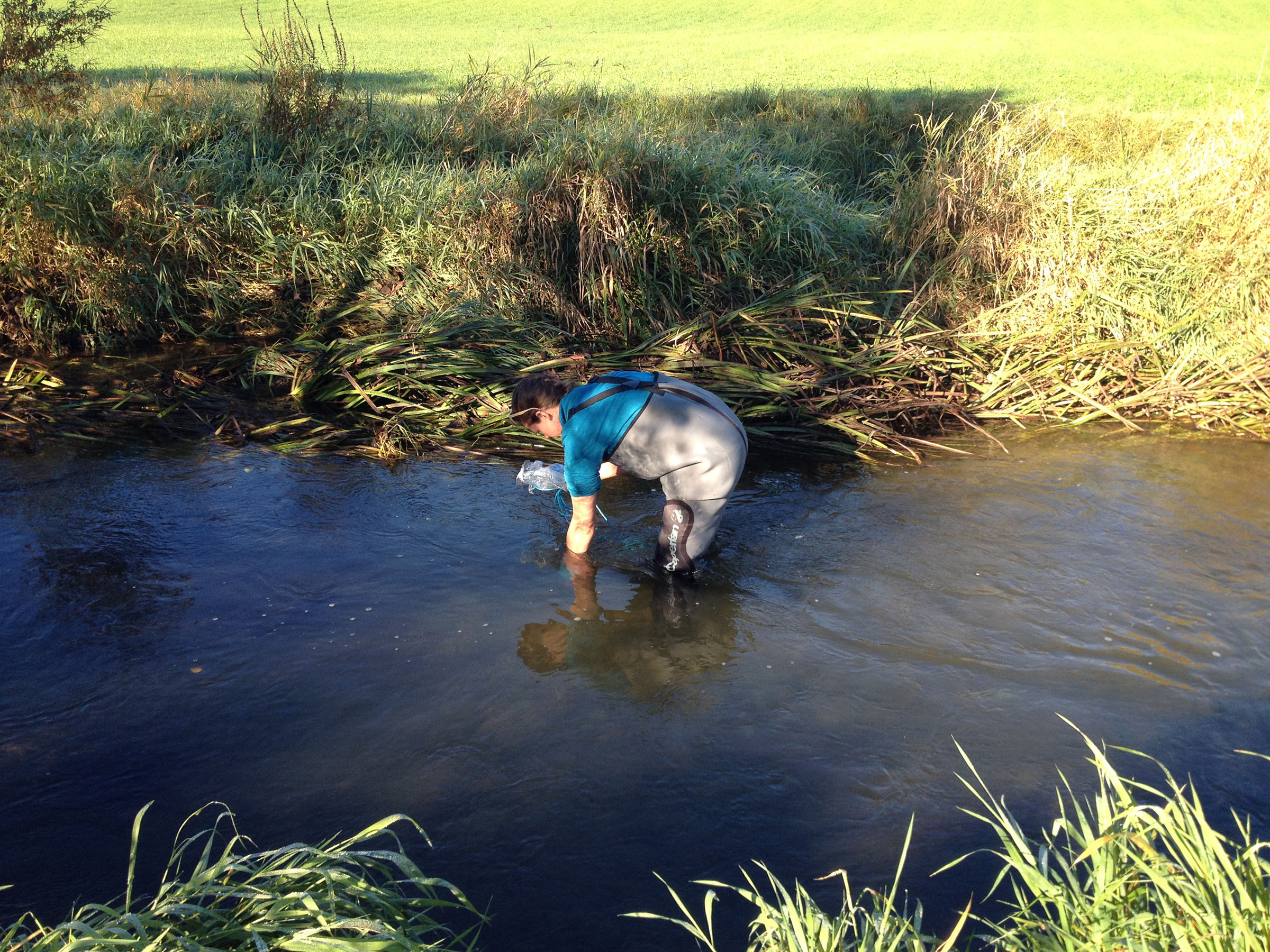
Jennifer Schollée beim Installieren des Chemcatchers beim Ausfluss der ARA Moossee in die Urtene. Schollée gehörte als Doktorandin zum siebenköpfigen Eawag-Team, das an EDA-EMERGE mitgearbeitet hat. Im Rahmen von EDA-EMERGE wurden gezielt auch junge Forscherinnen und Forscher gefördert. Jennifer Schollée und Anita Hidasi von der Eawag wurden in dieses Nachwuchsprogramm aufgenommen. (Foto: Anita Hidasi, Eawag)
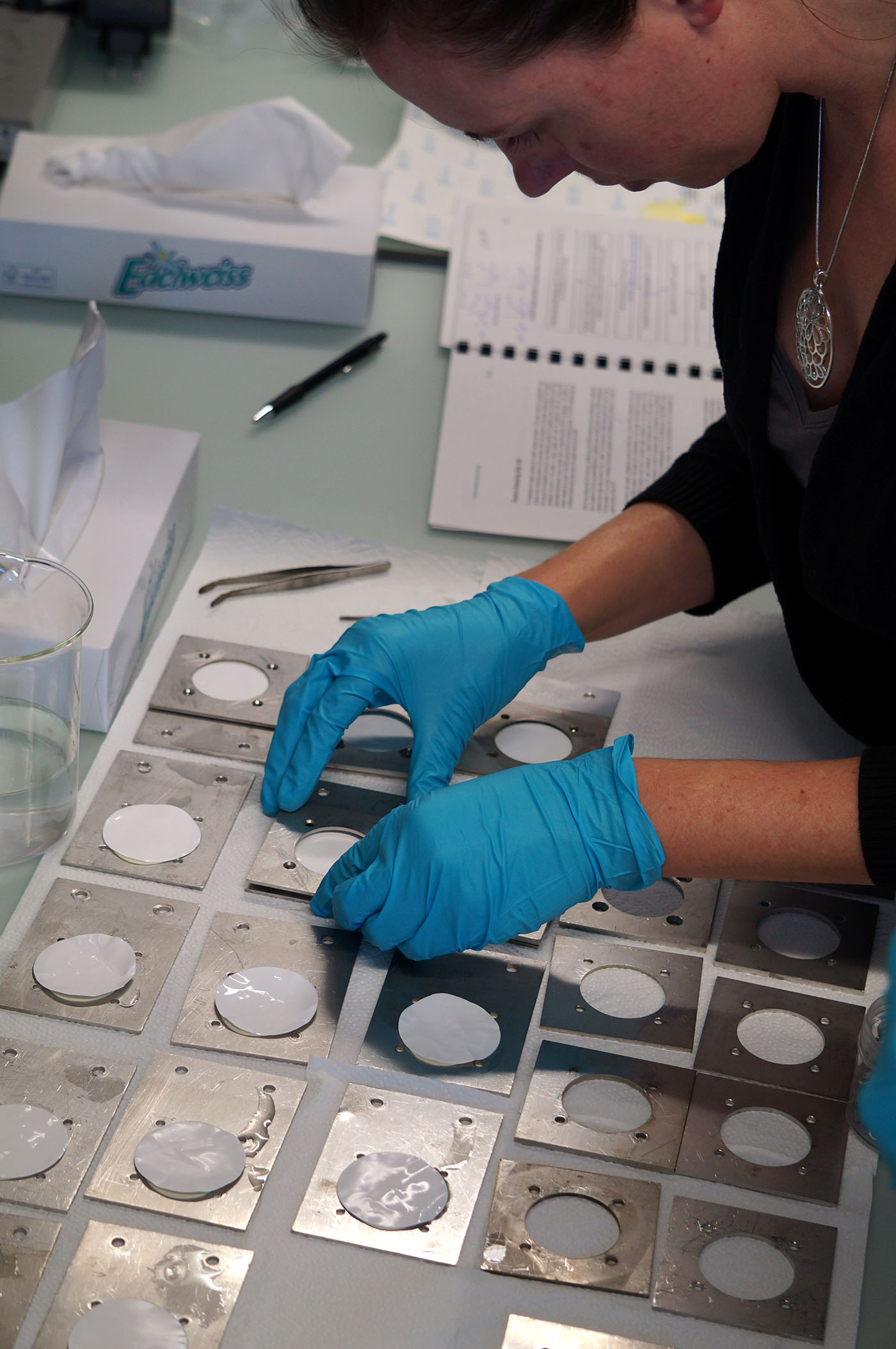
Eawag-Doktorandin Jennifer Schollée bereitet im Labor Passivsammler für die zweite Probenahme am Urtenenbach vor. Passivsammler dienen zur Ermittlung von Stoffen im Wasser.
(Foto: Birgit Beck, Eawag)