Department Fish Ecology and Evolution

Conservation biology
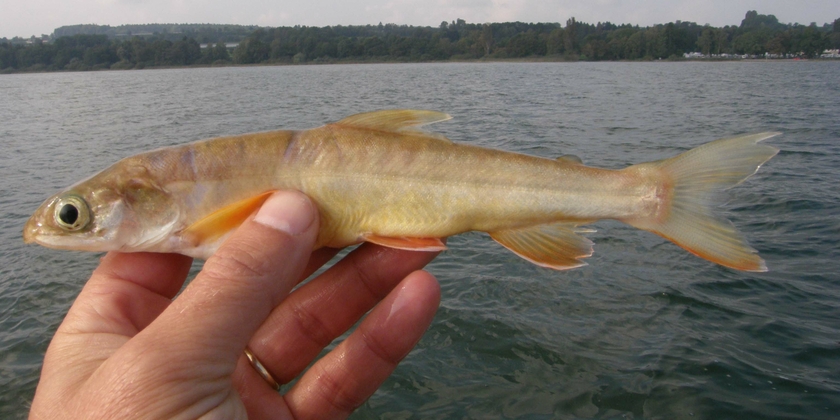
The state of conservation biology is most often defined in terms of what is known about terrestrial ecosystems. Contrary to what can sometimes be read in that literature, the largest stumbling block on the way to successful biodiversity management and conservation in aquatic ecosystems is the lack of quantitative baseline data, and the associated ignorance about diversity under the water surface. In the absence of data, goals are often set as qualitatively defined “reference conditions”, an approach that can be subjective, that risks broad brush generalisation and suffers from the shifting baseline syndrome. To combat these issues we launched several large integrated biodiversity mapping efforts for fish in Switzerland, Projet Lac in 2010, and more recently Progetto Fiumi.

Our second focus is on the population genetics and ecology of invasion and range expansion on the one hand, and decline and extinction on the other. Here we study Threespined stickleback at the invasion front north of the Alps and at the extinction front south of the Alps, and we study rheophilic fish species that are rapidly declining and approaching extinction in Switzerland.

Contact

Prof. Dr. Ole Seehausen Research Group Leader +41 58 765 2121 Send Mail

Current projects

Projet Lac

In Projet Lac  we collect and compile quantitative baseline data for most large lakes of Switzerland and neighboring countries. We designed methods for a full quantitative sampling design and applied them to twenty six medium to large and deep to very deep lakes. Our aim is to document and assess fish diversity at all its fundamental levels. This includes individual genetic and phenotypic diversity for key taxa, species diversity and abundance, community diversity by habitats and whole lake diversity. A large state-of-the-art collection of pre-alpine fish is being established at the Natural History Museum in Bern. We are now analyzing the species distribution and abundance data and are beginning to collect phenotypic and genetic data. Eventually we will use the data to try and explain some of the large changes in species diversity and distribution observed over the last decades, and we want to understand if these changes affect ecosystem functions. Progetto Fiumi is built to achieve the same for many streams and rivers in Switzerland.

Publications

Extbase Variable Dump
array(2 items)
   publications => '13954' (5 chars)
   libraryUrl => '' (0 chars)
Extbase Variable Dump
array(1 item)
   0 => Snowflake\Publications\Domain\Model\Publicationprototypepersistent entity (uid=13954, pid=124)
      originalId => protected13954 (integer)
      authors => protected'Alexander, T. J.; Vonlanthen, P.; Périat, G.; Degiorgi,
          F.; Raymond, J.-C.; Seehausen, O.
' (125 chars) title => protected'Evaluating gillnetting protocols to characterize lacustrine fish communities' (76 chars) journal => protected'Fisheries Research' (18 chars) year => protected2015 (integer) volume => protected161 (integer) issue => protected'' (0 chars) startpage => protected'320' (3 chars) otherpage => protected'329' (3 chars) categories => protected'multimesh gillnets; CEN standard; vertical net protocol; perch; coregonus' (73 chars) description => protected'Ecological research and monitoring of lacustrine ecosystems often requires a
          whole-lake assessment of fish communities. Gillnet sampling offers an effic
         ient means of estimating abundance, biomass and fish community composition.
         However the choice of gillnet sampling protocol may influence lake character
         ization via physical properties of the nets and allocation of sampling effor
         t between littoral, benthic and pelagic habitats. This paper compares two co
         mmonly used, whole-lake sampling protocols applied across 17 prealpine, suba
         lpine and alpine European lakes ranging widely in size, depth and altitude t
         o determine their relative strength for research and management applications
         . Effort-corrected estimates of abundance, biomass and species richness were
          correlated between the protocols and both distinguished the trout-dominated
          alpine communities from subalpine and prealpine lakes dominated by whitefis
         h and perch. A considerable amount of variance remained unexplained between
         the two protocols however, which seemed to correspond with differences in th
         e proportion of effort among benthic and pelagic habitats. We suggest that b
         oth the European standard (CEN) and vertical (VERT) netting protocols are su
         itable for assessing ecological status and monitoring changes in lake fish c
         ommunities through time. However the details of each protocol should be kept
          in mind when comparing fish communities between lakes. Mesh sizes used in C
         EN nets produce a more even size frequency distribution, suggesting that thi
         s protocol is most appropriate for assessing size structure of fish assembla
         ges. The high proportion of netting effort in benthic habitats shallower tha
         n 70 m depth under the CEN protocol means that, particularly in larger lakes
         , outcomes will be disproportionately influenced by the ecological condition
          of this habitat. The VERT protocol presumably provides a more accurate esti
         mate of whole-lake CPUE and community composition because effort, in terms o
         f net area, is more even...
' (2175 chars) serialnumber => protected'0165-7836' (9 chars) doi => protected'10.1016/j.fishres.2014.08.009' (29 chars) uid => protected13954 (integer) _localizedUid => protected13954 (integer)modified _languageUid => protectedNULL _versionedUid => protected13954 (integer)modified pid => protected124 (integer)
Alexander, T. J.; Vonlanthen, P.; Périat, G.; Degiorgi, F.; Raymond, J.-C.; Seehausen, O. (2015) Evaluating gillnetting protocols to characterize lacustrine fish communities, Fisheries Research, 161, 320-329, doi:10.1016/j.fishres.2014.08.009, Institutional Repository

Contact

Prof. Dr. Ole Seehausen Research Group Leader +41 58 765 2121 Send Mail

funding

Documenting endemic whitefish species and developing a management scheme
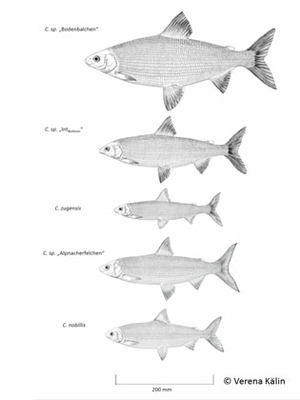
After a decade of research in our group on the distribution, origin and loss of endemic whitefish in the northern prealpine lakes of Switzerland we have now entered a phase, where we want to compile all we have learned into a compendium for fisheries managers. To make conservation-minded management effective, the species have to be recognized, defined and named. Our research had led to the realization that there are several yet undescribed and unnamed species of Coregonus in Switzerland. We are now in the process of describing these in the context of a systematic revision of the genus in Switzerland.

This is a Bafu/Eawag funded project that we do in collaboration with AquaBios.

Contact

Prof. Dr. Ole Seehausen Research Group Leader +41 58 765 2121 Send Mail

Publications

Extbase Variable Dump
array(2 items)
   publications => '6923,8961' (9 chars)
   libraryUrl => '' (0 chars)
Extbase Variable Dump
array(2 items)
   0 => Snowflake\Publications\Domain\Model\Publicationprototypepersistent entity (uid=6923, pid=124)
      originalId => protected6923 (integer)
      authors => protected'Vonlanthen, P.; Bittner, D.; Hudson, A. G.; Young, 
         K. A.; Müller, R.; Lundsgaard-Hansen, B.; Roy, D.; Di P
         iazza, S.; Largiader, C. R.; Seehausen, O.
' (214 chars) title => protected'Eutrophication causes speciation reversal in whitefish adaptive radiations' (74 chars) journal => protected'Nature' (6 chars) year => protected2012 (integer) volume => protected482 (integer) issue => protected'7385' (4 chars) startpage => protected'357' (3 chars) otherpage => protected'362' (3 chars) categories => protected'' (0 chars) description => protected'Species diversity can be lost through two different but potentially interact
         ing extinction processes: demographic decline and speciation reversal throug
         h introgressive hybridization. To investigate the relative contribution of t
         hese processes, we analysed historical and contemporary data of replicate wh
         itefish radiations from 17 pre-alpine European lakes and reconstructed chang
         es in genetic species differentiation through time using historical samples.
          Here we provide evidence that species diversity evolved in response to ecol
         ogical opportunity, and that eutrophication, by diminishing this opportunity
         , has driven extinctions through speciation reversal and demographic decline
         . Across the radiations, the magnitude of eutrophication explains the patter
         n of species loss and levels of genetic and functional distinctiveness among
          remaining species. We argue that extinction by speciation reversal may be m
         ore widespread than currently appreciated. Preventing such extinctions will
         require that conservation efforts not only target existing species but ident
         ify and protect the ecological and evolutionary processes that generate and
         maintain species.
' (1157 chars) serialnumber => protected'0028-0836' (9 chars) doi => protected'10.1038/nature10824' (19 chars) uid => protected6923 (integer) _localizedUid => protected6923 (integer)modified _languageUid => protectedNULL _versionedUid => protected6923 (integer)modified pid => protected124 (integer)
1 => Snowflake\Publications\Domain\Model\Publicationprototypepersistent entity (uid=8961, pid=124) originalId => protected8961 (integer) authors => protected'Hudson, A. G.; Vonlanthen, P.; Bezault, E.; Seehausen,&n
         bsp;O.
' (82 chars) title => protected'Genomic signatures of relaxed disruptive selection associated with speciatio
         n reversal in whitefish
' (99 chars) journal => protected'BMC Evolutionary Biology' (24 chars) year => protected2013 (integer) volume => protected13 (integer) issue => protected'' (0 chars) startpage => protected'108 (18 pp.)' (12 chars) otherpage => protected'' (0 chars) categories => protected'Coregonus; population genomics; adaptive radiation; speciation reversal; rel
         axed selection; heterogeneous genomic divergence; ecological speciation; spe
         ciation-with-gene-flow; eutrophication; divergence hitchhiking
' (214 chars) description => protected'Background: Speciation reversal: the erosion of species differentiation via
         an increase in introgressive hybridization due to the weakening of previousl
         y divergent selection regimes, is thought to be an important, yet poorly und
         erstood, driver of biodiversity loss. Our study system, the Alpine whitefish
          (<I>Coregonus</I> spp.) species complex is a classic example of a recent po
         stglacial adaptive radiation: forming an array of endemic lake flocks, with
         the independent origination of similar ecotypes among flocks. However, many
         of the lakes of the Alpine radiation have been seriously impacted by anthrop
         ogenic nutrient enrichment, resulting in a collapse in neutral genetic and p
         henotypic differentiation within the most polluted lakes. Here we investigat
         e the effects of eutrophication on the selective forces that have shaped thi
         s radiation, using population genomics. We studied eight sympatric species a
         ssemblages belonging to five independent parallel adaptive radiations, and o
         ne species pair in secondary contact. We used AFLP markers, and applied FST
         outlier (BAYESCAN, DFDIST) and logistic regression analyses (MATSAM), to ide
         ntify candidate regions for disruptive selection in the genome and their ass
         ociations with adaptive traits within each lake flock. The number of outlier
          and adaptive trait associated loci identified per lake were then regressed
         against two variables (historical phosphorus concentration and contemporary
         oxygen concentration) representing the strength of eutrophication.<BR/> Resu
         lts: Whilst we identify disruptive selection candidate regions in all lake f
         locks, we find similar trends, across analysis methods, towards fewer disrup
         tive selection candidate regions and fewer adaptive trait/candidate loci ass
         ociations in the more polluted lakes.<BR/> Conclusions: Weakened disruptive
         selection and a concomitant breakdown in reproductive isolating mechanisms i
         n more polluted lakes has lead to increased gene flow between coexisting Alp
         ine whitefish species. W...
' (2742 chars) serialnumber => protected'' (0 chars) doi => protected'10.1186/1471-2148-13-108' (24 chars) uid => protected8961 (integer) _localizedUid => protected8961 (integer)modified _languageUid => protectedNULL _versionedUid => protected8961 (integer)modified pid => protected124 (integer)
Vonlanthen, P.; Bittner, D.; Hudson, A. G.; Young, K. A.; Müller, R.; Lundsgaard-Hansen, B.; Roy, D.; Di Piazza, S.; Largiader, C. R.; Seehausen, O. (2012) Eutrophication causes speciation reversal in whitefish adaptive radiations, Nature, 482(7385), 357-362, doi:10.1038/nature10824, Institutional Repository
Hudson, A. G.; Vonlanthen, P.; Bezault, E.; Seehausen, O. (2013) Genomic signatures of relaxed disruptive selection associated with speciation reversal in whitefish, BMC Evolutionary Biology, 13, 108 (18 pp.), doi:10.1186/1471-2148-13-108, Institutional Repository

Hudson, AG, Vonlanthen, P, Seehausen, O 2011. Rapid parallel adaptive radiations from a single hybridogenic ancestral population. Proc Royal Society of London, Series B. 278, 58-66

Conservation genetics of rheophilic fish of alpine rivers

Several rheophilic fish species of the prealpine grayling and trout zones are experiencing dramatic population declines and rapid population extinction at a stage before quantitative assessment of genetic, functional and taxonomic diversity. Trying to provide such data, we have been studying four taxa. The first was the enigmatic Nase or Nose carp (Chondrostoma nasus), perhaps the most rapidly declining fish of Swiss rivers. We documented a deep genetic break between populations in the Lake Constance drainage and those in the rest of the Rhine catchment. We also demonstrated phenotypic variation, possibly associated with river size, and evidence of a genetic bottleneck in one population. Based on these findings we made recommendations for management.

Further, we are studying grayling populations in some parts of Switzerland in a similar framework, another species that declines for reasons that are not entirely clear. We are studying native trout of Mediterranean lineages, and the conditions of coexistence with or displacement by introduced Atlantic trout. Finally, we study bullhead (sculpins, Cottus gobio), a little benthic species that is of no commercial interest and supposedly has not been much affected by human translocation.

Contact

Prof. Dr. Ole Seehausen Research Group Leader +41 58 765 2121 Send Mail

Publications

Extbase Variable Dump
array(2 items)
   publications => '7625,6874' (9 chars)
   libraryUrl => '' (0 chars)
Extbase Variable Dump
array(2 items)
   0 => Snowflake\Publications\Domain\Model\Publicationprototypepersistent entity (uid=7625, pid=124)
      originalId => protected7625 (integer)
      authors => protected'Hudson,&nbsp;A.&nbsp;G.; Vonlanthen,&nbsp;P.; Seehausen,&nbsp;O.' (64 chars)
      title => protected'Population structure, inbreeding and local adaptation within an endangered r
         iverine specialist: the nase (<em>Chondrostoma nasus</em>)
' (134 chars) journal => protected'Conservation Genetics' (21 chars) year => protected2014 (integer) volume => protected15 (integer) issue => protected'4' (1 chars) startpage => protected'933' (3 chars) otherpage => protected'951' (3 chars) categories => protected'Chondrostoma nasus; conservation genomics; local adaptation; population geno
         mics; outlier scans; adaptive potential; conservation units (CUs)
' (141 chars) description => protected'<em>Chondrostoma nasus</em> is a cyprinid fish with highly specialized, ecol
         ogically and geographically distinct, ontogenetic trophic niches. Nase popul
         ation numbers across their Swiss range have shown massive declines and many
         localized extinctions. In this study, we integrate genetic data (AFLP, micro
         satellite, mtDNA sequence) with phenotypic and demographic analyses to surve
         y patterns of neutral and adaptive genetic diversity in all extant (and one
         extinct) Swiss nase populations, with the aim to delineate intraspecific con
         servation units (CUs) and to inform future population management strategies.
          We discovered two major genetically and geographically distinct population
         groupings. The first population grouping comprises nase inhabiting rivers fl
         owing into Lake Constance; the second comprises nase populations from Rhine
         drainages below Lake Constance. Within these clusters there is generally lim
         ited genetic differentiation among populations. Genomic outlier scans based
         on 256 to 377 polymorphic AFLP loci revealed little evidence of local adapta
         tion both within and among population clusters, with the exception of one ca
         ndidate locus identified in scans involving the low genetic diversity Schanz
         engraben population. However, significant phenotypic differentiation in body
          shape between certain populations suggests a need for more intensive future
          studies of local adaptation. Our data strongly suggests that the two major
         population groups should be treated as distinct CUs, with any supplemental s
         tocking and reintroductions sourced only from within the range of the CU con
         cerned.
' (1603 chars) serialnumber => protected'1566-0621' (9 chars) doi => protected'10.1007/s10592-014-0590-3' (25 chars) uid => protected7625 (integer) _localizedUid => protected7625 (integer)modified _languageUid => protectedNULL _versionedUid => protected7625 (integer)modified pid => protected124 (integer)
1 => Snowflake\Publications\Domain\Model\Publicationprototypepersistent entity (uid=6874, pid=124) originalId => protected6874 (integer) authors => protected'Junker,&nbsp;J.; Peter,&nbsp;A.; Wagner,&nbsp;C.&nbsp;E.; Mwaiko,&nbsp;S.; G
         ermann,&nbsp;B.; Seehausen,&nbsp;O.; Keller,&nbsp;I.
' (128 chars) title => protected'River fragmentation increases localized population genetic structure and enh
         ances asymmetry of dispersal in bullhead (<I>Cottus gobio</I>)
' (138 chars) journal => protected'Conservation Genetics' (21 chars) year => protected2012 (integer) volume => protected13 (integer) issue => protected'2' (1 chars) startpage => protected'545' (3 chars) otherpage => protected'556' (3 chars) categories => protected'fragmentation; microsatellites; bullhead; Cottus gobio; population genetic s
         tructure; conservation
' (98 chars) description => protected'Man-made habitat fragmentation is a major concern in river ecology and is ex
         pected to have particularly detrimental effects on aquatic species with limi
         ted dispersal abilities, like the bullhead (<I>Cottus gobio</I>). We used te
         n microsatellite markers to investigate small-scale patterns of gene flow,
         current dispersal and neutral genetic diversity in a morphologically diverse
          river where fragmented and unfragmented sections could be compared. We fou
         nd high genetic differentiation between sampling sites with a maximum <I>F</
         I><SUB>ST</SUB> of 0.32 between sites separated by only 35 km. A significant
          increase of genetic differentiation with geographical distance was observe
         d in the continuous river section as well as in the full dataset which inclu
         ded headwater populations isolated by anthropogenic barriers. Several lines
         of evidence are consistent with the hypothesis that such barriers completel
         y block upstream movement while downstream dispersal may be little affected.
          In the unfragmented habitat, dispersal rates were also higher in the direct
         ion of water flow than against it. The resulting asymmetry in gene flow like
         ly contributes to the decrease of genetic variation observed from the lower
         reaches towards the headwaters, which is particularly pronounced in physical
         ly isolated populations. Our findings suggest that headwater populations, du
         e to their isolation and low genetic variation, may be particularly vulnerab
         le to extinction.
' (1461 chars) serialnumber => protected'1566-0621' (9 chars) doi => protected'10.1007/s10592-011-0306-x' (25 chars) uid => protected6874 (integer) _localizedUid => protected6874 (integer)modified _languageUid => protectedNULL _versionedUid => protected6874 (integer)modified pid => protected124 (integer)
Hudson, A. G.; Vonlanthen, P.; Seehausen, O. (2014) Population structure, inbreeding and local adaptation within an endangered riverine specialist: the nase (Chondrostoma nasus), Conservation Genetics, 15(4), 933-951, doi:10.1007/s10592-014-0590-3, Institutional Repository
Junker, J.; Peter, A.; Wagner, C. E.; Mwaiko, S.; Germann, B.; Seehausen, O.; Keller, I. (2012) River fragmentation increases localized population genetic structure and enhances asymmetry of dispersal in bullhead (Cottus gobio), Conservation Genetics, 13(2), 545-556, doi:10.1007/s10592-011-0306-x, Institutional Repository

Genetics and ecology of invasion and range contraction

We have been working for several years now on the genetics and ecology of invasion of the Swiss midlands by Threespined stickleback. The invasion took place in the last 150 years and was associated with massive expansion of the ecological range of the species. In much of the Mediterranean region, stickleback were simultaneously declining rapidly to the extent that they are extinct or nearly extinct in many places and enjoy protected species status. We have more recently started to work on these isolated Mediterranean relict populations, hoping to make a little contribution to documenting diversity and adaptive potential.

Contact

Prof. Dr. Ole Seehausen Research Group Leader +41 58 765 2121 Send Mail

Publications

Extbase Variable Dump
array(2 items)
   publications => '9062,9079,7753,8986,8885,6555' (29 chars)
   libraryUrl => '' (0 chars)
Extbase Variable Dump
array(6 items)
   0 => Snowflake\Publications\Domain\Model\Publicationprototypepersistent entity (uid=9062, pid=124)
      originalId => protected9062 (integer)
      authors => protected'Lucek,&nbsp;K.; Sivasundar,&nbsp;A.; Seehausen,&nbsp;O.' (55 chars)
      title => protected'Disentangling the role of phenotypic plasticity and genetic divergence in co
         ntemporary ecotype formation during a biological invasion
' (133 chars) journal => protected'Evolution, International Journal of Organic Evolution' (53 chars) year => protected2014 (integer) volume => protected68 (integer) issue => protected'9' (1 chars) startpage => protected'2619' (4 chars) otherpage => protected'2632' (4 chars) categories => protected'adaptive divergence; ecotype formation; heritability; invasion biology; plas
         ticity
' (82 chars) description => protected'The occurrence of contemporary ecotype formation through adaptive divergence
          of populations within the range of an invasive species typically requires s
         tanding genetic variation but can be facilitated by phenotypic plasticity. T
         he relative contributions of both of these to adaptive trait differentiation
          have rarely been simultaneously quantified in recently diverging vertebrate
          populations. Here we study a case of intraspecific divergence into distinct
          lake and stream ecotypes of threespine stickleback that evolved in the past
          140 years within the invasive range in Switzerland. Using a controlled labo
         ratory experiment with full-sib crosses and treatments mimicking a key featu
         re of ecotypic niche divergence, we test if the phenotypic divergence that w
         e observe in the wild results from phenotypic plasticity or divergent geneti
         c predisposition. Our experimental groups show qualitatively similar phenoty
         pic divergence as those observed among wild adults. The relative contributio
         n of plasticity and divergent genetic predisposition differs among the trait
         s studied, with traits related to the biomechanics of feeding showing a stro
         nger genetic predisposition, whereas traits related to locomotion are mainly
          plastic. These results implicate that phenotypic plasticity and standing ge
         netic variation interacted during contemporary ecotype formation in this cas
         e.
' (1370 chars) serialnumber => protected'0014-3820' (9 chars) doi => protected'10.1111/evo.12443' (17 chars) uid => protected9062 (integer) _localizedUid => protected9062 (integer)modified _languageUid => protectedNULL _versionedUid => protected9062 (integer)modified pid => protected124 (integer)
1 => Snowflake\Publications\Domain\Model\Publicationprototypepersistent entity (uid=9079, pid=124) originalId => protected9079 (integer) authors => protected'Lucek,&nbsp;K.; Sivasundar,&nbsp;A.; Kristjánsson,&nbsp;B.&nbsp;K.; Skúlas
         on,&nbsp;S.; Seehausen,&nbsp;O.
' (107 chars) title => protected'Quick divergence but slow convergence during ecotype formation in lake and s
         tream stickleback pairs of variable age
' (115 chars) journal => protected'Journal of Evolutionary Biology' (31 chars) year => protected2014 (integer) volume => protected27 (integer) issue => protected'9' (1 chars) startpage => protected'1878' (4 chars) otherpage => protected'1892' (4 chars) categories => protected'line of least resistance; P matrix; parapatric evolution; phenotypic diversi
         fication
' (84 chars) description => protected'When genetic constraints restrict phenotypic evolution, diversification can
         be predicted to evolve along so-called lines of least resistance. To address
          the importance of such constraints and their resolution, studies of paralle
         l phenotypic divergence that differ in their age are valuable. Here, we inve
         stigate the parapatric evolution of six lake and stream threespine stickleba
         ck systems from Iceland and Switzerland, ranging in age from a few decades t
         o several millennia. Using phenotypic data, we test for parallelism in ecoty
         pic divergence between parapatric lake and stream populations and compare th
         e observed patterns to an ancestral-like marine population. We find strong a
         nd consistent phenotypic divergence, both among lake and stream populations
         and between our freshwater populations and the marine population. Interestin
         gly, ecotypic divergence in low-dimensional phenotype space (i.e. single tra
         its) is rapid and seems to be often completed within 100 years. Yet, the dim
         ensionality of ecotypic divergence was highest in our oldest systems and onl
         y there parallel evolution of unrelated ecotypes was strong enough to overwr
         ite phylogenetic contingency. Moreover, the dimensionality of divergence in
         different systems varies between trait complexes, suggesting different const
         raints and evolutionary pathways to their resolution among freshwater system
         s.
' (1370 chars) serialnumber => protected'1010-061X' (9 chars) doi => protected'10.1111/jeb.12439' (17 chars) uid => protected9079 (integer) _localizedUid => protected9079 (integer)modified _languageUid => protectedNULL _versionedUid => protected9079 (integer)modified pid => protected124 (integer)
2 => Snowflake\Publications\Domain\Model\Publicationprototypepersistent entity (uid=7753, pid=124) originalId => protected7753 (integer) authors => protected'Lucek,&nbsp;K.; Lemoine,&nbsp;M.; Seehausen,&nbsp;O.' (52 chars) title => protected'Contemporary ecotypic divergence during a recent range expansion was facilit
         ated by adaptive introgression
' (106 chars) journal => protected'Journal of Evolutionary Biology' (31 chars) year => protected2014 (integer) volume => protected27 (integer) issue => protected'10' (2 chars) startpage => protected'2233' (4 chars) otherpage => protected'2248' (4 chars) categories => protected'adaptive introgression; biological invasion; P matrix' (53 chars) description => protected'Although rapid phenotypic evolution during range expansion associated with c
         olonization of contrasting habitats has been documented in several taxa, the
          evolutionary mechanisms that underlie such phenotypic divergence have less
         often been investigated. A strong candidate for rapid ecotype formation with
         in an invaded range is the three-spine stickleback in the Lake Geneva region
          of central Europe. Since its introduction only about 140 years ago, it has
         undergone a significant expansion of its range and its niche, now forming ph
         enotypically differentiated parapatric ecotypes that occupy either the pelag
         ic zone of the large lake or small inlet streams, respectively. By comparing
          museum collections from different times with contemporary population sample
         s, we here reconstruct the evolution of parapatric phenotypic divergence thr
         ough time. Using genetic data from modern samples, we infer the underlying i
         nvasion history. We find that parapatric habitat-dependent phenotypic diverg
         ence between the lake and stream was already present in the first half of th
         e twentieth century, but the magnitude of differentiation increased through
         time, particularly in antipredator defence traits. This suggests that diverg
         ent selection between the habitats occurred and was stable through much of t
         he time since colonization. Recently, increased phenotypic differentiation i
         n antipredator defence traits likely results from habitat-dependent selectio
         n on alleles that arrived through introgression from a distantly related lin
         eage from outside the Lake Geneva region. This illustrates how hybridization
          can quickly promote phenotypic divergence in a system where adaptation from
          standing genetic variation was constrained.
' (1716 chars) serialnumber => protected'1010-061X' (9 chars) doi => protected'10.1111/jeb.12475' (17 chars) uid => protected7753 (integer) _localizedUid => protected7753 (integer)modified _languageUid => protectedNULL _versionedUid => protected7753 (integer)modified pid => protected124 (integer)
3 => Snowflake\Publications\Domain\Model\Publicationprototypepersistent entity (uid=8986, pid=124) originalId => protected8986 (integer) authors => protected'Lucek,&nbsp;K.; Sivasundar,&nbsp;A.; Roy,&nbsp;D.; Seehausen,&nbsp;O.' (69 chars) title => protected'Repeated and predictable patterns of ecotypic differentiation during a biolo
         gical invasion: lake–stream divergence in parapatric Swiss stickleback
' (148 chars) journal => protected'Journal of Evolutionary Biology' (31 chars) year => protected2013 (integer) volume => protected26 (integer) issue => protected'12' (2 chars) startpage => protected'2691' (4 chars) otherpage => protected'2709' (4 chars) categories => protected'divergent selection; ecological speciation; ecotype formation; local adaptat
         ion; parallel evolution
' (99 chars) description => protected'The relative importance of ecological selection and geographical isolation i
         n promoting and constraining genetic and phenotypic differentiation among po
         pulations is not always obvious. Interacting with divergent selection, restr
         icted opportunity for gene flow may in some cases be as much a cause as a co
         nsequence of adaptation, with the latter being a hallmark of ecological spec
         iation. Ecological speciation is well studied in parts of the native range o
         f the three-spined stickleback. Here, we study this process in a recently in
         vaded part of its range. Switzerland was colonized within the past 140 year
         s from at least three different colonization events involving different stic
         kleback lineages. They now occupy diverse habitats, ranging from small strea
         ms to the pelagic zone of large lakes. We use replicated systems of parapatr
         ic lake and stream populations, some of which trace their origins to differe
         nt invasive lineages, to ask (i) whether phenotypic divergence occurred amon
         g populations inhabiting distinct habitats, (ii) whether trajectories of phe
         notypic divergence follow predictable parallel patterns and (iii) whether ge
         ne flow constrains divergent adaptation or vice versa. We find consistent ph
         enotypic divergence between populations occupying distinct habitats. This in
         volves parallel evolution in several traits with known ecological relevance
         in independent evolutionary lineages. Adaptive divergence supersedes homogen
         izing gene flow even at a small spatial scale. We find evidence that adaptiv
         e phenotypic divergence places constraints on gene flow over and above that
         imposed by geographical distance, signalling the early onset of ecological s
         peciation.
' (1682 chars) serialnumber => protected'1010-061X' (9 chars) doi => protected'10.1111/jeb.12267' (17 chars) uid => protected8986 (integer) _localizedUid => protected8986 (integer)modified _languageUid => protectedNULL _versionedUid => protected8986 (integer)modified pid => protected124 (integer)
4 => Snowflake\Publications\Domain\Model\Publicationprototypepersistent entity (uid=8885, pid=124) originalId => protected8885 (integer) authors => protected'Lucek,&nbsp;K.; Sivasundar,&nbsp;A.; Seehausen,&nbsp;O.' (55 chars) title => protected'Evidence of adaptive evolutionary divergence during biological invasion' (71 chars) journal => protected'PLoS One' (8 chars) year => protected2012 (integer) volume => protected7 (integer) issue => protected'11' (2 chars) startpage => protected'e49377 (6 pp.)' (14 chars) otherpage => protected'' (0 chars) categories => protected'' (0 chars) description => protected'Rapid phenotypic diversification during biological invasions can either ari
         se by adaptation to alternative environments or by adaptive phenotypic plas
         ticity. Where experimental evidence for adaptive plasticity is common, supp
         ort for evolutionary diversification is rare. Here, we performed a controll
         ed laboratory experiment using full-sib crosses between ecologically diverg
         ent threespine stickleback populations to test for a genetic basis of adapt
         ation. Our populations are from two very different habitats, lake and strea
         m, of a recently invaded range in Switzerland and differ in ecologically re
         levant morphological traits. We found that in a lake-like food treatment la
         ke fish grow faster than stream fish, resembling the difference among wild
          type individuals. In contrast, in a stream-like food treatment individuals
          from both populations grow similarly. Our experimental data suggest that ge
         netically determined diversification has occurred within less than 140 years
          after the arrival of stickleback in our studied region.
' (1045 chars) serialnumber => protected'' (0 chars) doi => protected'10.1371/journal.pone.0049377' (28 chars) uid => protected8885 (integer) _localizedUid => protected8885 (integer)modified _languageUid => protectedNULL _versionedUid => protected8885 (integer)modified pid => protected124 (integer)
5 => Snowflake\Publications\Domain\Model\Publicationprototypepersistent entity (uid=6555, pid=124) originalId => protected6555 (integer) authors => protected'Lucek,&nbsp;K.; Roy,&nbsp;D.; Bezault,&nbsp;E.; Sivasundar,&nbsp;A.; Seehaus
         en,&nbsp;O.
' (87 chars) title => protected'Hybridization between distant lineages increases adaptive variation during a
          biological invasion: stickleback in Switzerland
' (124 chars) journal => protected'Molecular Ecology' (17 chars) year => protected2010 (integer) volume => protected19 (integer) issue => protected'18' (2 chars) startpage => protected'3995' (4 chars) otherpage => protected'4011' (4 chars) categories => protected'admixture; amplified fragment length polymorphism; invasion; phenotypic dive
         rgence
' (82 chars) description => protected'The three-spined stickleback is a widespread Holarctic species complex that
         radiated from the sea into freshwaters after the retreat of the Pleistocene
         ice sheets. In Switzerland, sticklebacks were absent with the exception of t
         he far northwest, but different introduced populations have expanded to occu
         py a wide range of habitats since the late 19th century. A well-studied adap
         tive phenotypic trait in sticklebacks is the number of lateral plates. With
         few exceptions, freshwater and marine populations in Europe are fixed for ei
         ther the low plated phenotype or the fully plated phenotype, respectively. S
         witzerland, in contrast, harbours in close proximity the full range of pheno
         typic variation known from across the continent. We addressed the phylogeogr
         aphic origins of Swiss sticklebacks using mitochondrial partial cytochrome <
         I>b</I> and control region sequences. We found only five different haplotype
         s but these originated from three distinct European regions, fixed for diffe
         rent plate phenotypes. These lineages occur largely in isolation at opposite
          ends of Switzerland, but co-occur in a large central part. Across the count
         ry, we found a strong correlation between a microsatellite linked to the hig
         h plate ectodysplasin allele and the mitochondrial haplotype from a region w
         here the fully plated phenotype is fixed. Phylogenomic and population genomi
         c analysis of 481 polymorphic amplified fragment length polymorphism loci in
         dicate genetic admixture in the central part of the country. The same part o
         f the country also carries elevated within-population phenotypic variation.
         We conclude that during the recent invasive range expansion of sticklebacks
         in Switzerland, adaptive and neutral between-population genetic variation wa
         s converted into within-population variation, raising the possibility that h
         ybridization between colonizing lineages contributed to the ecological succe
         ss of sticklebacks in Switzerland.
' (1934 chars) serialnumber => protected'0962-1083' (9 chars) doi => protected'10.1111/j.1365-294X.2010.04781.x' (32 chars) uid => protected6555 (integer) _localizedUid => protected6555 (integer)modified _languageUid => protectedNULL _versionedUid => protected6555 (integer)modified pid => protected124 (integer)
Lucek, K.; Sivasundar, A.; Seehausen, O. (2014) Disentangling the role of phenotypic plasticity and genetic divergence in contemporary ecotype formation during a biological invasion, Evolution, International Journal of Organic Evolution, 68(9), 2619-2632, doi:10.1111/evo.12443, Institutional Repository
Lucek, K.; Sivasundar, A.; Kristjánsson, B. K.; Skúlason, S.; Seehausen, O. (2014) Quick divergence but slow convergence during ecotype formation in lake and stream stickleback pairs of variable age, Journal of Evolutionary Biology, 27(9), 1878-1892, doi:10.1111/jeb.12439, Institutional Repository
Lucek, K.; Lemoine, M.; Seehausen, O. (2014) Contemporary ecotypic divergence during a recent range expansion was facilitated by adaptive introgression, Journal of Evolutionary Biology, 27(10), 2233-2248, doi:10.1111/jeb.12475, Institutional Repository
Lucek, K.; Sivasundar, A.; Roy, D.; Seehausen, O. (2013) Repeated and predictable patterns of ecotypic differentiation during a biological invasion: lake–stream divergence in parapatric Swiss stickleback, Journal of Evolutionary Biology, 26(12), 2691-2709, doi:10.1111/jeb.12267, Institutional Repository
Lucek, K.; Sivasundar, A.; Seehausen, O. (2012) Evidence of adaptive evolutionary divergence during biological invasion, PLoS One, 7(11), e49377 (6 pp.), doi:10.1371/journal.pone.0049377, Institutional Repository
Lucek, K.; Roy, D.; Bezault, E.; Sivasundar, A.; Seehausen, O. (2010) Hybridization between distant lineages increases adaptive variation during a biological invasion: stickleback in Switzerland, Molecular Ecology, 19(18), 3995-4011, doi:10.1111/j.1365-294X.2010.04781.x, Institutional Repository

Lucek, K, Seehausen, O (2015) Distinctive insular forms of threespine stickleback (Gasterosteus aculeatus) from western Mediterranean islands. Conserv Genet, DOI 10.1007/s10592-015-0742-0