Department Fish Ecology and Evolution

Progetto Fiumi
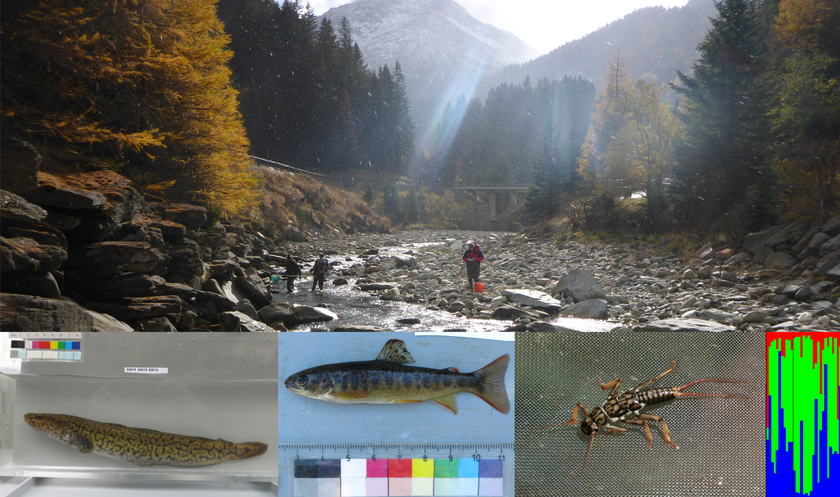
The rivers of Switzerland harbor a unique biodiversity due to its biogeographic location, which includes four of Europe’s major river drainage systems. Yet, as we are only learning about this rich diversity of genotypes, phenotypes and species, it is already being lost at an alarming rate due to anthropogenic impact on the fluvial ecosystems. To achieve effective conservation with finite resources, a large-scale assessment of the present fish biodiversity of rivers across the country is needed. With this project, we aim to assess biodiversity of fish in Swiss fluvial ecosystems at all levels from genes to communities.

In Progetto Fiumi, we have been sampling fish and lower trophic levels (e.g. invertebrates and periphyton) in hundreds of streams across Switzerland from small mountain streams to large lowland rivers. From each individual fish, we extracted data on weight, length and habitat, took pictures for morphological- and color analyses, took fin clips for genetics and tissue samples for isotope analyses. Finally, we preserved fish individually to enable laboratory studies of e.g. stomach content and detailed morphology. Additionally to our database, we have thereby established a reference collection of Swiss river fish from the years 2013-2018.

In the future, the data and the samples will support researchers and practitioners in understanding the underlying mechanisms of natural and anthropogenic influence of river fish biodiversity and ecological functioning. For example, the analyses of collected genetic material will help us to understand the current structure and spatial distribution of diffident significant evolutionary units, cryptic species and distinct populations. This will in turn create a baseline database to put future samples, e.g. from monitoring programs, into perspective.

Selected publications

Extbase Variable Dump
array(2 items)
   publications => '30020,9111,15447' (16 chars)
   libraryUrl => '' (0 chars)
Extbase Variable Dump
array(3 items)
   0 => Snowflake\Publications\Domain\Model\Publicationprototypepersistent entity (uid=30020, pid=124)
      originalId => protected30020 (integer)
      authors => protected'Brodersen, J.; Hellmann, J.; Seehausen, O.' (57 chars)
      title => protected'Erhebung der Fischbiodiversität in Schweizer Fliessgewässern. "Progetto Fi
         umi" Schlussbericht
' (95 chars) journal => protected'' (0 chars) year => protected2023 (integer) volume => protected0 (integer) issue => protected'' (0 chars) startpage => protected'356&nbsp;p' (10 chars) otherpage => protected'' (0 chars) categories => protected'' (0 chars) description => protected'<em>Die einzigartige Fischvielfalt in Fliessgewässer-Ökosystemen in und um
          die Schweiz</em><br />Aufgrund der geografischen Lage in vier der wichtigst
         en Wassereinzugsgebieten Europas und der grossen Vielfalt an Lebensräumen w
         eisen die aquatischen Ökosysteme der Schweiz eine aussergewöhnlich hohe Fi
         schvielfalt auf. Diese Vielfalt ist hauptsächlich durch zwei verschiedene P
         rozesse entstanden, einerseits durch die Zusammenführung bereits vorhandene
         r Vielfalt, und andererseits durch postglaziale Evolutionsprozesse. Der letz
         
         
         elen verschiedenen Ebenen zu finden. Neben der Artenvielfalt beherbergen die
          verschiedenen Flüsse und Bäche auch eine Vielfalt an diversen Fischgemein
         schaften, wobei sowohl die Unterschiede in der Artenzahl als auch in der Art
         enzusammensetzung zu unterschiedlichen Nahrungsnetzen und Ökosystemprozesse
         n zwischen den Flüssen führen. Viele Fischarten weisen auch ein hohes Mass
          an intraspezifischer Vielfalt auf, z. B. in Bezug auf Morphologie, Physiolo
         gie, Ökologie, Lebensgeschichte und Genom. Diese intraspezifische Vielfalt
         ist insofern von Bedeutung, dass verschiedene Populationen möglicherweise a
         n unterschiedliche Lebensräume angepasst sind und eine hohe genetische Viel
         falt aufweisen. Letzteres ermöglicht es den einzelnen Individuen innerhalb
         einer Population, verschiedene Nischen zu besetzen, und es ermöglicht den P
         opulationen, sich besser an veränderte Umweltbedingungen anzupassen. [...]<
         br /><br /><em>The unique fish diversity in riverine ecosystems in and aroun
         d Switzerland</em><br />As a consequence of its geographic location within f
         our of Europe’s major watersheds and a large amount of habitat diversity,
         aquatic ecosystems in Switzerland harbor an exceptionally high amount of fis
         h diversity. This diversity has mainly been formed by two different processe
         s, i.e. assembly of prev...
' (3027 chars) serialnumber => protected'' (0 chars) doi => protected'10.55408/eawag:30020' (20 chars) uid => protected30020 (integer) _localizedUid => protected30020 (integer)modified _languageUid => protectedNULL _versionedUid => protected30020 (integer)modified pid => protected124 (integer)
1 => Snowflake\Publications\Domain\Model\Publicationprototypepersistent entity (uid=9111, pid=124) originalId => protected9111 (integer) authors => protected'Brodersen,&nbsp;J.; Seehausen,&nbsp;O.' (38 chars) title => protected'Why evolutionary biologists should get seriously involved in ecological moni
         toring and applied biodiversity assessment programs
' (127 chars) journal => protected'Evolutionary Applications' (25 chars) year => protected2014 (integer) volume => protected7 (integer) issue => protected'9' (1 chars) startpage => protected'968' (3 chars) otherpage => protected'983' (3 chars) categories => protected'conservation; ecosystem monitoring; evolutionary biology; genotypes; managem
         ent; phenotypes
' (91 chars) description => protected'While ecological monitoring and biodiversity assessment programs are widely
         implemented and relatively well developed to survey and monitor the structur
         e and dynamics of populations and communities in many ecosystems, quantitati
         ve assessment and monitoring of genetic and phenotypic diversity that is imp
         ortant to understand evolutionary dynamics is only rarely integrated. As a c
         onsequence, monitoring programs often fail to detect changes in these key co
         mponents of biodiversity until after major loss of diversity has occurred. T
         he extensive efforts in ecological monitoring have generated large data sets
          of unique value to macro-scale and long-term ecological research, but the i
         nsights gained from such data sets could be multiplied by the inclusion of e
         volutionary biological approaches. We argue that the lack of process-based e
         volutionary thinking in ecological monitoring means a significant loss of op
         portunity for research and conservation. Assessment of genetic and phenotypi
         c variation within and between species needs to be fully integrated to safeg
         uard biodiversity and the ecological and evolutionary dynamics in natural ec
         osystems. We illustrate our case with examples from fishes and conclude with
          examples of ongoing monitoring programs and provide suggestions on how to i
         mprove future quantitative diversity surveys.
' (1337 chars) serialnumber => protected'1752-4571' (9 chars) doi => protected'10.1111/eva.12215' (17 chars) uid => protected9111 (integer) _localizedUid => protected9111 (integer)modified _languageUid => protectedNULL _versionedUid => protected9111 (integer)modified pid => protected124 (integer)
2 => Snowflake\Publications\Domain\Model\Publicationprototypepersistent entity (uid=15447, pid=124) originalId => protected15447 (integer) authors => protected'Dermond,&nbsp;P.; Thomas,&nbsp;S.&nbsp;M.; Brodersen,&nbsp;J.' (61 chars) title => protected'Environmental stability increases relative individual specialisation across
         populations of an aquatic top predator
' (114 chars) journal => protected'Oikos' (5 chars) year => protected2018 (integer) volume => protected127 (integer) issue => protected'2' (1 chars) startpage => protected'297' (3 chars) otherpage => protected'305' (3 chars) categories => protected'' (0 chars) description => protected'The concept of the niche has long been a central pillar in ecological theory
         , with a traditional focus on quantifying niches at the species or populatio
         n level. However, the importance of individual-level niche variation is incr
         easingly being recognised, with a strong focus on individual specialisation.
          While examples illustrating the contribution of the individual niche to who
         le population niche structure are accumulating rapidly, surprisingly little
         is known about the conditions that shape the differences between these two p
         otentially divergent components. Though theory predicts that stability shoul
         d influence the extent of such intra-specific specialisation, we know of no
         previous study that has investigated its role in individual specialisation,
         and the differentiation between individual- and population niches. Here, we
         studied the diet of individuals from multiple populations of an aquatic top-
         predator, <i>Salmo trutta</i>, inhabiting contrasting stable, groundwater fe
         d and unstable, surface water fed pre-alpine streams. Based on stomach conte
         nt analysis, we found that individuals living in stable environments display
         ed a higher degree of specialisation than those in unstable environments, wi
         th the between individual component of niche width being approximately twice
          as high in the former. We subsequently validated these results by evidence
         gained from stable isotope analysis of muscle tissue. As such, we reveal tha
         t environmental stability can signifi cantly infl uence individual niches wi
         thin populations, leading to increased specialisation.
' (1574 chars) serialnumber => protected'0030-1299' (9 chars) doi => protected'10.1111/oik.04578' (17 chars) uid => protected15447 (integer) _localizedUid => protected15447 (integer)modified _languageUid => protectedNULL _versionedUid => protected15447 (integer)modified pid => protected124 (integer)
Brodersen, J.; Hellmann, J.; Seehausen, O. (2023) Erhebung der Fischbiodiversität in Schweizer Fliessgewässern. "Progetto Fiumi" Schlussbericht, 356 p, doi:10.55408/eawag:30020, Institutional Repository
Brodersen, J.; Seehausen, O. (2014) Why evolutionary biologists should get seriously involved in ecological monitoring and applied biodiversity assessment programs, Evolutionary Applications, 7(9), 968-983, doi:10.1111/eva.12215, Institutional Repository
Dermond, P.; Thomas, S. M.; Brodersen, J. (2018) Environmental stability increases relative individual specialisation across populations of an aquatic top predator, Oikos, 127(2), 297-305, doi:10.1111/oik.04578, Institutional Repository

Contact

Funding and Duration

Funding:    BAFU

Duration:   2013 - 2015