Department Fish Ecology and Evolution

Community Ecology of Lake Fish
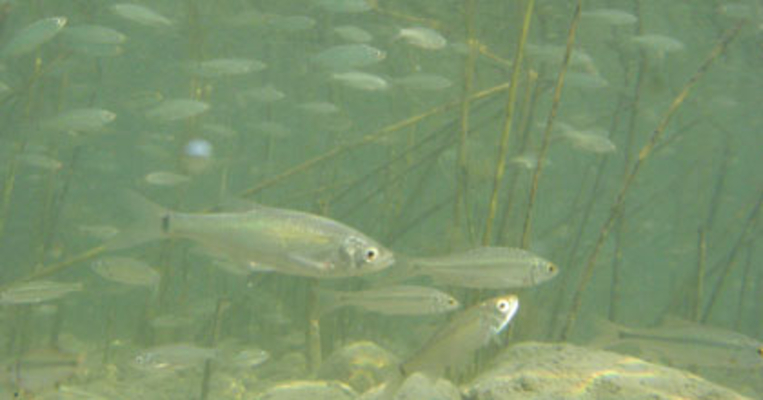
Fish communities in large deep lakes are of major ecological, evolutionary, commercial, conservation and recreational value. They are exposed to many anthropogenic stressors and change rapidly. We are studying environmental predictors of species richness and endemism using large data sets that we have compiled over many years. We work with a large data set for cichlid fish diversity of all major and many small lakes of Africa and with a large data set for all fish of most of the larger lakes north and south of the Alps. We are also working on fish in lakes of Greenland. In all these systems we wish to understand causes of variation in species diversity and functional ecological diversity. Eventually we wish to understand how variation in diversity affects the lacustrine ecosystems.

Contact

To identify the forces behind variation and change, quantitative fish community data is crucially needed. Surprisingly, such baseline data needed for studying lake fish community changes was lacking for most lakes in Switzerland. In 2010 we launched Projet Lac to collect and compile quantitative baseline data for most large lakes of Switzerland and neighboring countries. We designed methods for a full quantitative sampling design and applied them to twenty six medium to large and very deep lakes. We apply a fully nested biodiversity sampling and assessment, whereby the aim is to document and assess diversity at all its fundamental levels. These include individual genetic and phenotypic diversity within populations for several key taxa, species diversity and abundance, community diversity by habitats and whole lake diversity. A large state-of-the-art collection of pre-alpine fish is being established at the Natural History Museum in Bern. We are now analyzing the species distribution and abundance data and are beginning to collect phenotypic and genetic data. Eventually we want to explain the massive changes in species diversity and distribution observed over the last years, and we want to understand if these changes affect ecosystem functions.

Fish communities in most larger lakes, both in the tropics and the Alps and polar regions are a mixture of species that arrived by immigration and others that evolved locally through radiation of one colonizing species into several species. We would like to understand whether both processes are distinct in their effects on patterns in resource utilization and ecosystem function.

Major funding

AquaDiverse

AquaDiverse was funded by Eawag over several years and contributed importantly to our early work on the whitefish in the deep lakes of the Alps. This work led to the discovery of the mechanisms behind rapid collapse of whitefish species diversity in many lakes. It also started a series of ecosystem experiments in outdoor mesocosm tanks where we investigated effects on lower tropic levels and on the ecosystem of phenotypic and genetic differentiation among sympatric whitefish species. This work is in collaboration with Dr Blake Matthews. These experiments are since being continued with stickleback.

Contact

Dr. Blake Matthews Group Leader Tel. +41 58 765 2120 Send Mail

Projet Lac

Projet Lac was launched in 2010. It built on what we had learned in AquaDiverse but wants to extent the scope of this work from whitefish to the entire fish communities in the Archipelago of subalpine deep lakes. Funding has come from FOEHN (BAFU), Eawag, many Swiss kantons and our collaborating authorities in Italy, Germany and France.

Publications

Extbase Variable Dump
array(2 items)
   publications => '13969,13954,7785,9049,6923' (26 chars)
   libraryUrl => '' (0 chars)
Extbase Variable Dump
array(5 items)
   0 => Snowflake\Publications\Domain\Model\Publicationprototypepersistent entity (uid=13969, pid=124)
      originalId => protected13969 (integer)
      authors => protected'Alexander, T. J.; Vonlanthen, P.; Périat, G.; Degiorgi,
          F.; Raymond, J. C.; Seehausen, O.
' (130 chars) title => protected'Estimating whole-lake fish catch per unit effort' (48 chars) journal => protected'Fisheries Research' (18 chars) year => protected2015 (integer) volume => protected172 (integer) issue => protected'' (0 chars) startpage => protected'287' (3 chars) otherpage => protected'303' (3 chars) categories => protected'lake fish; multimesh gillnet; volume-weighting; whole-lake CPUE; CEN standar
         d; vertical gill net; perch; coregonus; roach
' (121 chars) description => protected'The European standard for gillnet sampling to characterize lake fish communi
         ties stratifies sampling effort (<I>i.e.</I>, number of nets) within depth s
         trata. Nets to sample benthic habitats are randomly distributed throughout t
         he lake within each depth strata. Pelagic nets are also stratified by depth,
          but are set only at the deepest point of the lake. Multiple authors have su
         ggested that this design under-represents pelagic habitats, resulting in est
         imates of whole-lake CPUE and community composition which are disproportiona
         tely influenced by ecological conditions of littoral and benthic habitats. T
         o address this issue, researchers have proposed estimating whole-lake CPUE b
         y weighting the catch rate in each depth-compartment by the proportion of th
         e volume of the lake contributed by the compartment. Our study aimed to asse
         ss the effectiveness of volume-weighting by applying it to fish communities
         sampled according to the European standard (CEN), and by a second whole-lake
          gillnetting protocol (VERT), which prescribes additional fishing effort in
         pelagic habitats. We assume that convergence between the protocols indicates
          that volume-weighting provides a more accurate estimate of whole-lake catch
          rate and community composition. Our results indicate that volume-weighting
         improves agreement between the protocols for whole-lake total CPUE, estimate
         d proportion of perch and roach and the overall fish community composition.
         Discrepancies between the protocols remaining after volume-weighting may be
         because sampling under the CEN protocol overlooks horizontal variation in pe
         lagic fish communities. Analyses based on multiple pelagic-set VERT nets ide
         ntified gradients in the density and biomass of pelagic fish communities in
         almost half the lakes that corresponded with the depth of water at net-setti
         ng location and distance along the length of a lake. Additional CEN pelagic
         sampling effort allocated across water depths and distributed throughout the
          lake would therefore he...
' (2170 chars) serialnumber => protected'0165-7836' (9 chars) doi => protected'10.1016/j.fishres.2015.07.024' (29 chars) uid => protected13969 (integer) _localizedUid => protected13969 (integer)modified _languageUid => protectedNULL _versionedUid => protected13969 (integer)modified pid => protected124 (integer)
1 => Snowflake\Publications\Domain\Model\Publicationprototypepersistent entity (uid=13954, pid=124) originalId => protected13954 (integer) authors => protected'Alexander,&nbsp;T.&nbsp;J.; Vonlanthen,&nbsp;P.; Périat,&nbsp;G.; Degiorgi,
         &nbsp;F.; Raymond,&nbsp;J.-C.; Seehausen,&nbsp;O.
' (125 chars) title => protected'Evaluating gillnetting protocols to characterize lacustrine fish communities' (76 chars) journal => protected'Fisheries Research' (18 chars) year => protected2015 (integer) volume => protected161 (integer) issue => protected'' (0 chars) startpage => protected'320' (3 chars) otherpage => protected'329' (3 chars) categories => protected'multimesh gillnets; CEN standard; vertical net protocol; perch; coregonus' (73 chars) description => protected'Ecological research and monitoring of lacustrine ecosystems often requires a
          whole-lake assessment of fish communities. Gillnet sampling offers an effic
         ient means of estimating abundance, biomass and fish community composition.
         However the choice of gillnet sampling protocol may influence lake character
         ization via physical properties of the nets and allocation of sampling effor
         t between littoral, benthic and pelagic habitats. This paper compares two co
         mmonly used, whole-lake sampling protocols applied across 17 prealpine, suba
         lpine and alpine European lakes ranging widely in size, depth and altitude t
         o determine their relative strength for research and management applications
         . Effort-corrected estimates of abundance, biomass and species richness were
          correlated between the protocols and both distinguished the trout-dominated
          alpine communities from subalpine and prealpine lakes dominated by whitefis
         h and perch. A considerable amount of variance remained unexplained between
         the two protocols however, which seemed to correspond with differences in th
         e proportion of effort among benthic and pelagic habitats. We suggest that b
         oth the European standard (CEN) and vertical (VERT) netting protocols are su
         itable for assessing ecological status and monitoring changes in lake fish c
         ommunities through time. However the details of each protocol should be kept
          in mind when comparing fish communities between lakes. Mesh sizes used in C
         EN nets produce a more even size frequency distribution, suggesting that thi
         s protocol is most appropriate for assessing size structure of fish assembla
         ges. The high proportion of netting effort in benthic habitats shallower tha
         n 70 m depth under the CEN protocol means that, particularly in larger lakes
         , outcomes will be disproportionately influenced by the ecological condition
          of this habitat. The VERT protocol presumably provides a more accurate esti
         mate of whole-lake CPUE and community composition because effort, in terms o
         f net area, is more even...
' (2175 chars) serialnumber => protected'0165-7836' (9 chars) doi => protected'10.1016/j.fishres.2014.08.009' (29 chars) uid => protected13954 (integer) _localizedUid => protected13954 (integer)modified _languageUid => protectedNULL _versionedUid => protected13954 (integer)modified pid => protected124 (integer)
2 => Snowflake\Publications\Domain\Model\Publicationprototypepersistent entity (uid=7785, pid=124) originalId => protected7785 (integer) authors => protected'Lundsgaard-Hansen,&nbsp;B.; Matthews,&nbsp;B.; Seehausen,&nbsp;O.' (65 chars) title => protected'Ecological speciation and phenotypic plasticity affect ecosystems' (65 chars) journal => protected'Ecology' (7 chars) year => protected2014 (integer) volume => protected95 (integer) issue => protected'10' (2 chars) startpage => protected'2723' (4 chars) otherpage => protected'2735' (4 chars) categories => protected'adaptive radiation; common gardening experiment; Coregonus; direct trophic e
         ffects; eco-evolutionary dynamics; ecological speciation; indirect effects
' (150 chars) description => protected'Phenotypic differences among closely related populations and species can cau
         se contrasting effects on ecosystems; however, it is unknown whether such ef
         fects result from genetic divergence, phenotypic plasticity, or both. To tes
         t this, we reared sympatric limnetic and benthic species of whitefish from a
          young adaptive radiation in a common garden, where the benthic species was
         raised on two distinct food types. We then used these fish in a mesocosm exp
         eriment to test for contrasting ecosystem effects of closely related species
          and of plastically induced differences within a species. We found that stro
         ng contrasting ecosystem effects resulted more frequently from genetic diver
         gence, although they were not stronger overall than those resulting from phe
         notypic plasticity. Overall, our results provide evidence that genetically b
         ased differences among closely related species that evolved during a young a
         daptive radiation can affect ecosystems, and that phenotypic plasticity can
         modify the ecosystem effects of such species.
' (1033 chars) serialnumber => protected'0012-9658' (9 chars) doi => protected'10.1890/13-2338.1' (17 chars) uid => protected7785 (integer) _localizedUid => protected7785 (integer)modified _languageUid => protectedNULL _versionedUid => protected7785 (integer)modified pid => protected124 (integer)
3 => Snowflake\Publications\Domain\Model\Publicationprototypepersistent entity (uid=9049, pid=124) originalId => protected9049 (integer) authors => protected'Wagner,&nbsp;C.&nbsp;E.; Harmon,&nbsp;L.&nbsp;J.; Seehausen,&nbsp;O.' (68 chars) title => protected'Cichlid species-area relationships are shaped by adaptive radiations that sc
         ale with area
' (89 chars) journal => protected'Ecology Letters' (15 chars) year => protected2014 (integer) volume => protected17 (integer) issue => protected'1' (1 chars) startpage => protected'583' (3 chars) otherpage => protected'592' (3 chars) categories => protected'adaptive radiation; cichlid; diversity-dependent diversification; ecological
          limits; island biogeography; species-area relationship
' (131 chars) description => protected'A positive relationship between species richness and island size is thought
         to emerge from an equilibrium between immigration and extinction rates, but
         the influence of species diversification on the form of this relationship is
          poorly understood. Here, we show that within-lake adaptive radiation strong
         ly modifies the species-area relationship for African cichlid fishes. The to
         tal number of species derived from <I>in situ</I> speciation increases with
         lake size, resulting in faunas orders of magnitude higher in species richnes
         s than faunas assembled by immigration alone. Multivariate models provide ev
         idence for added influence of lake depth on the species-area relationship. D
         iversity of clades representing within-lake radiations show responses to lak
         e area, depth and energy consistent with limitation by these factors, sugges
         ting that ecological factors influence the species richness of radiating cla
         des within these ecosystems. Together, these processes produce lake fish fau
         nas with highly variable composition, but with diversities that are well pre
         dicted by environmental variables.
' (1098 chars) serialnumber => protected'1461-023X' (9 chars) doi => protected'10.1111/ele.12260' (17 chars) uid => protected9049 (integer) _localizedUid => protected9049 (integer)modified _languageUid => protectedNULL _versionedUid => protected9049 (integer)modified pid => protected124 (integer)
4 => Snowflake\Publications\Domain\Model\Publicationprototypepersistent entity (uid=6923, pid=124) originalId => protected6923 (integer) authors => protected'Vonlanthen,&nbsp;P.; Bittner,&nbsp;D.; Hudson,&nbsp;A.&nbsp;G.; Young,&nbsp;
         K.&nbsp;A.; Müller,&nbsp;R.; Lundsgaard-Hansen,&nbsp;B.; Roy,&nbsp;D.; Di P
         iazza,&nbsp;S.; Largiader,&nbsp;C.&nbsp;R.; Seehausen,&nbsp;O.
' (214 chars) title => protected'Eutrophication causes speciation reversal in whitefish adaptive radiations' (74 chars) journal => protected'Nature' (6 chars) year => protected2012 (integer) volume => protected482 (integer) issue => protected'7385' (4 chars) startpage => protected'357' (3 chars) otherpage => protected'362' (3 chars) categories => protected'' (0 chars) description => protected'Species diversity can be lost through two different but potentially interact
         ing extinction processes: demographic decline and speciation reversal throug
         h introgressive hybridization. To investigate the relative contribution of t
         hese processes, we analysed historical and contemporary data of replicate wh
         itefish radiations from 17 pre-alpine European lakes and reconstructed chang
         es in genetic species differentiation through time using historical samples.
          Here we provide evidence that species diversity evolved in response to ecol
         ogical opportunity, and that eutrophication, by diminishing this opportunity
         , has driven extinctions through speciation reversal and demographic decline
         . Across the radiations, the magnitude of eutrophication explains the patter
         n of species loss and levels of genetic and functional distinctiveness among
          remaining species. We argue that extinction by speciation reversal may be m
         ore widespread than currently appreciated. Preventing such extinctions will
         require that conservation efforts not only target existing species but ident
         ify and protect the ecological and evolutionary processes that generate and
         maintain species.
' (1157 chars) serialnumber => protected'0028-0836' (9 chars) doi => protected'10.1038/nature10824' (19 chars) uid => protected6923 (integer) _localizedUid => protected6923 (integer)modified _languageUid => protectedNULL _versionedUid => protected6923 (integer)modified pid => protected124 (integer)
Alexander, T. J.; Vonlanthen, P.; Périat, G.; Degiorgi, F.; Raymond, J. C.; Seehausen, O. (2015) Estimating whole-lake fish catch per unit effort, Fisheries Research, 172, 287-303, doi:10.1016/j.fishres.2015.07.024, Institutional Repository
Alexander, T. J.; Vonlanthen, P.; Périat, G.; Degiorgi, F.; Raymond, J.-C.; Seehausen, O. (2015) Evaluating gillnetting protocols to characterize lacustrine fish communities, Fisheries Research, 161, 320-329, doi:10.1016/j.fishres.2014.08.009, Institutional Repository
Lundsgaard-Hansen, B.; Matthews, B.; Seehausen, O. (2014) Ecological speciation and phenotypic plasticity affect ecosystems, Ecology, 95(10), 2723-2735, doi:10.1890/13-2338.1, Institutional Repository
Wagner, C. E.; Harmon, L. J.; Seehausen, O. (2014) Cichlid species-area relationships are shaped by adaptive radiations that scale with area, Ecology Letters, 17(1), 583-592, doi:10.1111/ele.12260, Institutional Repository
Vonlanthen, P.; Bittner, D.; Hudson, A. G.; Young, K. A.; Müller, R.; Lundsgaard-Hansen, B.; Roy, D.; Di Piazza, S.; Largiader, C. R.; Seehausen, O. (2012) Eutrophication causes speciation reversal in whitefish adaptive radiations, Nature, 482(7385), 357-362, doi:10.1038/nature10824, Institutional Repository

Seehausen, O., (2009. Speciation affects ecosystems. Nature 458, 1122-1123