Department Fish Ecology and Evolution

Trout migration
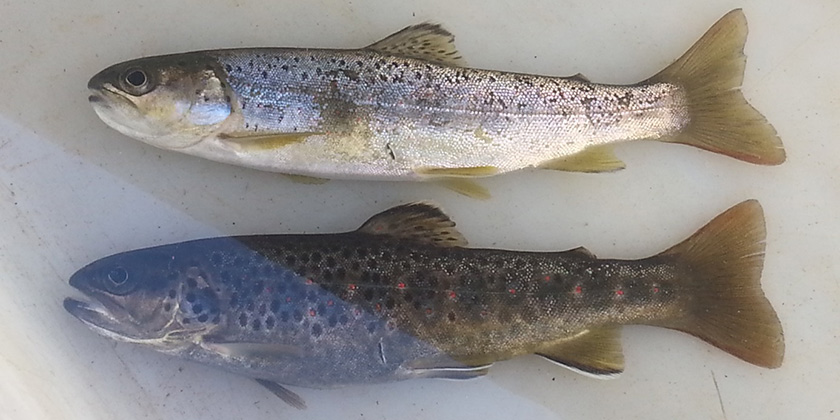
Animal migration is one of the great spectacles of nature that has long intrigued curious scientists. Migrants benefit from temporally changing relative benefits of alternative habitats. Individuals experience selection pressures for adaptation to at least two different environments often under intra- and interspecific competition. Current knowledge on adaptation to a migratory life history is limited to the migratory travel per se. However further research is needed to understand the interaction between migration and adaptation to alternative macrohabitats. Specifically, divergent local adaptation in natal habitats may very well determine niche divergence in a second habitat that is shared between multiple migratory populations. This may also cause non-neutral gene-flow between populations.

Migration of trout (Salmo trutta) between afferent streams and Lake Lucerne presents an ideal study system. Here individual migration can be accurately monitored with replication on an individual and population level. Stream-specific migration patterns are detected by PIT-tag antennas in the mouth of 12 tributaries to the lake. With its integrative approach, the study is significantly contributing to our understanding of the interplay between migration, local adaptation and ecological diversification. We are specifically monitoring out-migration of juvenile trout in spring and return migration of adult lake trout in autumn. Here, we see large within- and between stream variation in migration patterns, which we aim to explain through analyses of individual trait variables and external environmental variables.

We additionally study the interaction of trout with avian predators, by monitoring the abundance of piscivorous birds at the streams and detecting individual predation events through tracking of PIT-tags in the streams and underneath heron colonies. Lastly, we are studying migration patterns and fitness of hatchery-raised trout, which are stocked by cantonal authorities and fishing organizations to improve lake trout harvest in the lake.

Selected publication

Extbase Variable Dump
array(2 items)
   publications => '15447' (5 chars)
   libraryUrl => '' (0 chars)
Extbase Variable Dump
array(1 item)
   0 => Snowflake\Publications\Domain\Model\Publicationprototypepersistent entity (uid=15447, pid=124)
      originalId => protected15447 (integer)
      authors => protected'Dermond, P.; Thomas, S. M.; Brodersen, J.' (61 chars)
      title => protected'Environmental stability increases relative individual specialisation across 
         populations of an aquatic top predator
' (114 chars) journal => protected'Oikos' (5 chars) year => protected2018 (integer) volume => protected127 (integer) issue => protected'2' (1 chars) startpage => protected'297' (3 chars) otherpage => protected'305' (3 chars) categories => protected'' (0 chars) description => protected'The concept of the niche has long been a central pillar in ecological theory
         , with a traditional focus on quantifying niches at the species or populatio
         n level. However, the importance of individual-level niche variation is incr
         easingly being recognised, with a strong focus on individual specialisation.
          While examples illustrating the contribution of the individual niche to who
         le population niche structure are accumulating rapidly, surprisingly little
         is known about the conditions that shape the differences between these two p
         otentially divergent components. Though theory predicts that stability shoul
         d influence the extent of such intra-specific specialisation, we know of no
         previous study that has investigated its role in individual specialisation,
         and the differentiation between individual- and population niches. Here, we
         studied the diet of individuals from multiple populations of an aquatic top-
         predator, <i>Salmo trutta</i>, inhabiting contrasting stable, groundwater fe
         d and unstable, surface water fed pre-alpine streams. Based on stomach conte
         nt analysis, we found that individuals living in stable environments display
         ed a higher degree of specialisation than those in unstable environments, wi
         th the between individual component of niche width being approximately twice
          as high in the former. We subsequently validated these results by evidence
         gained from stable isotope analysis of muscle tissue. As such, we reveal tha
         t environmental stability can signifi cantly infl uence individual niches wi
         thin populations, leading to increased specialisation.
' (1574 chars) serialnumber => protected'0030-1299' (9 chars) doi => protected'10.1111/oik.04578' (17 chars) uid => protected15447 (integer) _localizedUid => protected15447 (integer)modified _languageUid => protectedNULL _versionedUid => protected15447 (integer)modified pid => protected124 (integer)
Dermond, P.; Thomas, S. M.; Brodersen, J. (2018) Environmental stability increases relative individual specialisation across populations of an aquatic top predator, Oikos, 127(2), 297-305, doi:10.1111/oik.04578, Institutional Repository

Conctact

Funding and Duration

Funding:    SNSF

Duration:   2015 - ongoing