Department Systems Analysis, Integrated Assessment and Modelling

Dynamical modelling of water related energy
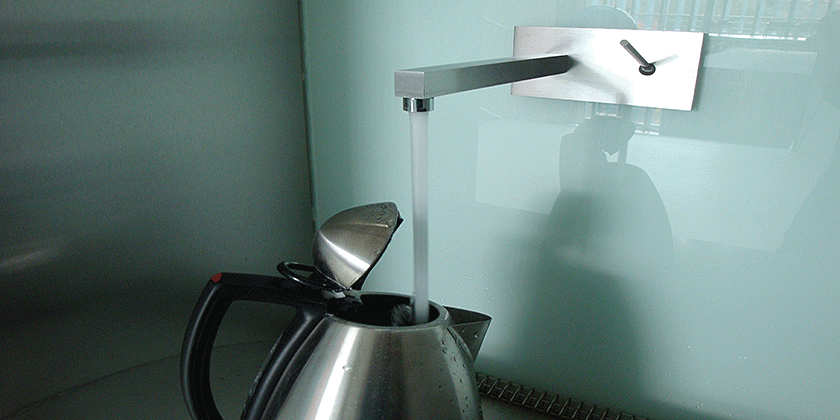
Water use and water related energy use is one of the most important energy consumptions in private households.

The contributions are: shower, bath, cloth washing, taps, dish washer, toilets and others.

In 2010 Steven Kenway from University of Queensland, Brisbane, Australia started a collaboration with Eawag with the focus to develop a stationary model to simulate water use and water related energy use in private households and cities.

Extbase Variable Dump
array(2 items)
   publications => '7255' (4 chars)
   libraryUrl => '' (0 chars)
Extbase Variable Dump
array(1 item)
   0 => Snowflake\Publications\Domain\Model\Publicationprototypepersistent entity (uid=7255, pid=124)
      originalId => protected7255 (integer)
      authors => protected'Kenway, S. J.; Scheidegger, R.; Larsen, T. A.; Lant
         , P.; Bader, H.-P.
' (104 chars) title => protected'Water-related energy in households: a model designed to understand the curre
         nt state and simulate possible measures
' (115 chars) journal => protected'Energy and Buildings' (20 chars) year => protected2013 (integer) volume => protected58 (integer) issue => protected'' (0 chars) startpage => protected'378' (3 chars) otherpage => protected'389' (3 chars) categories => protected'water; energy; greenhouse gas emissions; material flow analysis; modelling' (74 chars) description => protected'Energy use in households, including private transport, accounts for about 30
         % of primary energy use in industrialised countries. Therefore, households a
         re important key drivers of energy use and related greenhouse gas emissions.
          In order to understand energy use related to water in households a detailed
          mathematical flow analysis of materials, energy, CO<sub>2</sub> emissions a
         nd costs (MMFA) for household water use was set up and tested for a specific
          family household in Brisbane, Australia. The simulation results for the cur
         rent state of this household were well within 20% of the monitored data. Aft
         er calibration, a detailed scenario investigation determined the impact of (
         i) potential and (ii) realistic reduction values for all relevant (a) behavi
         oural and (b) technical parameters, including a shift from gas to a solar ho
         t-water system. The reduction potentials for water use, greenhouse gas emiss
         ions, water-related energy consumption, water costs and water-related energy
          costs were 4–77%, 14–85%, 15–93%, 1–31% and 13–90% respectively.
         The study showed that for this household, technical improvements alone, with
         out changing to a solar hot-water system, result in less than a 15% change i
         n terms of energy and greenhouse gas emissions. In contrast, combined behavi
         oural and technical changes have a much higher reduction potential.
' (1359 chars) serialnumber => protected'0378-7788' (9 chars) doi => protected'10.1016/j.enbuild.2012.08.035' (29 chars) uid => protected7255 (integer) _localizedUid => protected7255 (integer)modified _languageUid => protectedNULL _versionedUid => protected7255 (integer)modified pid => protected124 (integer)
Kenway, S. J.; Scheidegger, R.; Larsen, T. A.; Lant, P.; Bader, H.-P. (2013) Water-related energy in households: a model designed to understand the current state and simulate possible measures, Energy and Buildings, 58, 378-389, doi:10.1016/j.enbuild.2012.08.035, Institutional Repository

This model gave insight into the yearly water and water related energy consumptions. However for the suppliers the peak flows are crucial. Therefore a dynamical model to simulate the water and water related energy flows in function of time is being developed.