Department Surface Waters - Research and Management

Antibiotic resistance in post-ozonation biological treatment
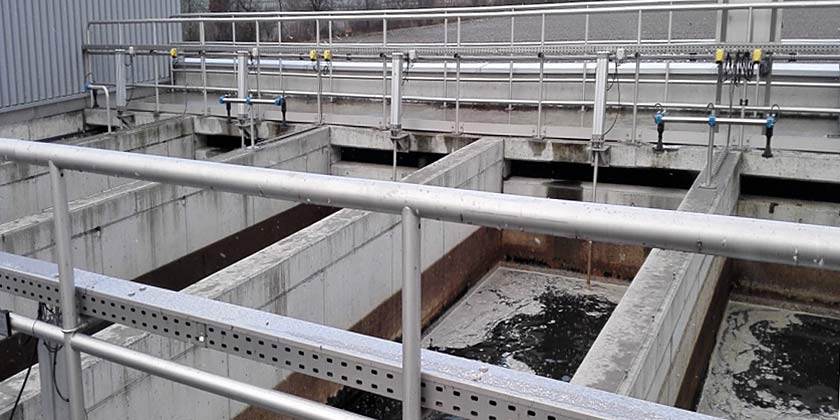

Switzerland decided in 2014 to upgrade major wastewater treatment plants with an additional purification stage to reduce the discharge of micropollutants into the environment. To reach this goal, Technologies based on oxidation (ozonation) and/or adsorption (activated carbon or sand filter) are available. However, data about the release of antibiotic resistance after the advanced treatments is still lacking. Therefore, we need to investigate the distribution of antibiotic resistance in different advanced treatments to know whether they would be effective to eliminate or reduce antibiotic resistant bacteria and associated resistance genes.
This project is focused on the fate of antibiotic resistance in advanced treatment, with a focus on the effects of the biological post-ozonation treatment. We will take samples from at least 5 installations that represent different situations regarding the type of filter material (sandfilter and granulated active carbon) and the age/history of filter material. Metagenomics and Q-PCR will be used to research the shift of bacterial populations and antibiotic resistance genes. Flow cytometry and bacterial cultivation will be used to enumerate microbial cell numbers, and the prevalence of cultivable antibiotic resistant bacteria. Our data will assess the removal of antibiotic resistance by advanced treatment the potential for regrowth in biological post-treatment and will provide proper recommendations for maximizing a positive effect of the new purification levels on the release of resistant bacteria.

Publication

Extbase Variable Dump
array(2 items)
   publications => '14002' (5 chars)
   libraryUrl => '' (0 chars)
Extbase Variable Dump
array(1 item)
   0 => Snowflake\Publications\Domain\Model\Publicationprototypepersistent entity (uid=14002, pid=124)
      originalId => protected14002 (integer)
      authors => protected'Czekalski, N.; Imminger, S.; Salhi, E.; Veljkovic, M.; K
         leffel, K.; Drissner, D.; Hammes, F.; Bürgmann, H.; Von
          Gunten, U.
' (168 chars) title => protected'Inactivation of antibiotic resistant bacteria and resistance genes by ozone:
          from laboratory experiments to full-scale wastewater treatment
' (139 chars) journal => protected'Environmental Science and Technology' (36 chars) year => protected2016 (integer) volume => protected50 (integer) issue => protected'21' (2 chars) startpage => protected'11862' (5 chars) otherpage => protected'11871' (5 chars) categories => protected'' (0 chars) description => protected'Ozone, a strong oxidant and disinfectant, seems ideal to cope with future ch
         allenges of water treatment, such as micropollutants, multiresistant bacteri
         a (MRB) and even intracellular antibiotic resistance genes (ARG), but inform
         ation on the latter is scarce. In ozonation experiments we simultaneously de
         termined kinetics and dose-dependent inactivation of <I>Escherichia coli</I>
          and its plasmid-encoded sulfonamide resistance gene <I>sul1</I> in differen
         t water matrixes. Effects in <I>E. coli</I> were compared to an autochthonou
         s wastewater community. Furthermore, resistance elimination by ozonation and
          post-treatment were studied in full-scale at a wastewater treatment plant (
         WWTP). Bacterial inactivation (cultivability, membrane damage) and degradati
         on of <I>sul1</I> were investigated using plate counts, flow cytometry and q
         uantitative real-time PCR. In experiments with <I>E. coli</I> and the more o
         zone tolerant wastewater community disruption of intracellular genes was obs
         erved at specific ozone doses feasible for full-scale application, but flocs
          seemed to interfere with this effect. At the WWTP, regrowth during postozon
         ation treatment partly compensated inactivation of MRB, and intracellular <I
         >sul1</I> seemed unaffected by ozonation. Our findings indicate that ozone d
         oses relevant for micropollutant abatement from wastewater do not eliminate
         intracellular ARG.
' (1386 chars) serialnumber => protected'0013-936X' (9 chars) doi => protected'10.1021/acs.est.6b02640' (23 chars) uid => protected14002 (integer) _localizedUid => protected14002 (integer)modified _languageUid => protectedNULL _versionedUid => protected14002 (integer)modified pid => protected124 (integer)
Czekalski, N.; Imminger, S.; Salhi, E.; Veljkovic, M.; Kleffel, K.; Drissner, D.; Hammes, F.; Bürgmann, H.; Von Gunten, U. (2016) Inactivation of antibiotic resistant bacteria and resistance genes by ozone: from laboratory experiments to full-scale wastewater treatment, Environmental Science and Technology, 50(21), 11862-11871, doi:10.1021/acs.est.6b02640, Institutional Repository