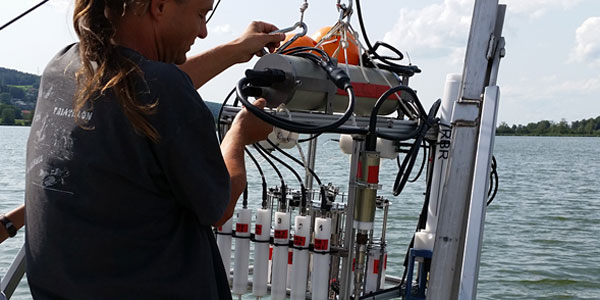
Recent improvements in the design of ion selective electrodes improved signal stability and selectivity. Detection limits can reach the nanomolar ranges. The development of solid-state sensors facilitates the application for in-situ profiling and precision-sampling of lake water.
Applications
Potentiometric electrodes for nitrate, ammonia, pH and CO2 as well as oxygen optodes were adapted for use in a custom-made profiling system with integrated syringe sampler for high-resolution analyses of stratified lakes.
array(4 items)0 => Snowflake\Publications\Domain\Model\Publicationprototypepersistent entity (uid=17755, pid=124)originalId => protected17755 (integer)
authors => protected'Athavale, R.; Pankratova, N.; Dinkel, C.; Bakker, E.; We hrli, B.; Brand, A.' (105 chars)
title => protected'Fast potentiometric CO<sub>2</sub> sensor for high-resolution in situ measur ements in fresh water systems' (105 chars)
journal => protected'Environmental Science and Technology' (36 chars)
year => protected2018 (integer)
volume => protected52 (integer)
issue => protected'19' (2 chars)
startpage => protected'11259' (5 chars)
otherpage => protected'11266' (5 chars)
categories => protected'' (0 chars)
description => protected'We present a new potentiometric sensor principle and a calibration protocol for in situ profiling of dissolved CO<sub>2</sub> with high temporal and spa tial resolution in fresh water lakes. The sensor system is based on the meas urement of EMF between two solid-contact ion selective electrodes (SC-ISEs), a hydrogen ion selective and a carbonate selective sensor. Since it relies on SC-ISEs, it is insensitive to changes in pressure, thus suitable for in s itu studies. Also, as it offers a response time (<i>t</i><sub>95%</sub>) of <10 s, it allows for profiling applications at high spatial resolution. The proposed optimum in situ protocol accounts for the continuous drift and chan ge in offset that remains a challenge during profiling in natural waters. Th e fast response resolves features that are usually missed by standard method s like the classical Severinghaus CO<sub>2</sub> probe. In addition, the ins ensitivity of the presented setup to dissolved sulfide allows also for measu rements in anoxic zones of eutrophic systems. Highly resolved CO<sub>2</sub> concentration profiles obtained by the novel and robust SC-ISE setup along with the developed optimum in situ protocol allow investigating hotspots of biogeochemical processes, such as mineralization and primary production in t he water column and help improving estimates for CO<sub>2</sub> turnover in freshwater systems.' (1387 chars)
serialnumber => protected'0013-936X' (9 chars)
doi => protected'10.1021/acs.est.8b02969' (23 chars)
uid => protected17755 (integer)
_localizedUid => protected17755 (integer)modified_languageUid => protectedNULL
_versionedUid => protected17755 (integer)modifiedpid => protected124 (integer)1 => Snowflake\Publications\Domain\Model\Publicationprototypepersistent entity (uid=15068, pid=124)originalId => protected15068 (integer)
authors => protected'Athavale, R.; Dinkel, C.; Wehrli, B.; Bakker, E.; Crespo , G. A.; Brand, A.' (109 chars)
title => protected'Robust solid-contact ion selective electrodes for high-resolution <i>in situ </i> measurements in fresh water systems' (116 chars)
journal => protected'Environmental Science and Technology Letters' (44 chars)
year => protected2017 (integer)
volume => protected4 (integer)
issue => protected'7' (1 chars)
startpage => protected'286' (3 chars)
otherpage => protected'291' (3 chars)
categories => protected'' (0 chars)
description => protected'Biogeochemical processes are often confined to very narrow zones in aquatic systems. Therefore, highly resolved <i>in situ</i> measurements are required to study these processes. Potentiometric solid-contact ion selective electr odes (SC-ISEs) are promising tools for such measurements. SC-ISEs show good performance in analyses under controlled experimental conditions. Very few s ensor designs, however, can sustain the challenges of natural water matrices and external environmental conditions during <i>in situ</i> applications. W e fabricated ammonium and pH selective SC-ISEs with functionalized multiwall ed carbon nanotubes (f-MWCNT) as a solid contact. Their functionality was te sted in the laboratory and applied in situ for vertical profiling in a eutro phic lake. Sensors were insensitive to strong redox changes, high sulfide co ncentrations, and bright daylight conditions during the application in the l ake. In addition, sensors are easily fabricated and exhibit short response t imes (<10 s). The proposed design of SC-ISEs based on f-MWCNTs is quite suit able for high-resolution in situ profiling of ionic species in fresh water l akes.' (1145 chars)
serialnumber => protected'' (0 chars)
doi => protected'10.1021/acs.estlett.7b00130' (27 chars)
uid => protected15068 (integer)
_localizedUid => protected15068 (integer)modified_languageUid => protectedNULL
_versionedUid => protected15068 (integer)modifiedpid => protected124 (integer)2 => Snowflake\Publications\Domain\Model\Publicationprototypepersistent entity (uid=10482, pid=124)originalId => protected10482 (integer)
authors => protected'Brand, A.; Bruderer, H.; Oswald, K.; Guggenheim, C.; Sch ubert, C. J.; Wehrli, B.' (115 chars)
title => protected'Oxygenic primary production below the oxycline and its importance for redox dynamics' (84 chars)
journal => protected'Aquatic Sciences' (16 chars)
year => protected2016 (integer)
volume => protected78 (integer)
issue => protected'4' (1 chars)
startpage => protected'727' (3 chars)
otherpage => protected'741' (3 chars)
categories => protected'primary production; anoxic zone; redox cycling; oxygen' (54 chars)
description => protected'We present evidence that oxygenic primary production occurs in the virtually anoxic regions (i.e. regions where no oxygen was detected) of the eutrophic , pre-alpine Lake Rot (Switzerland). Chlorophyll-a measurements in combinati on with phytoplankton densities indicated the presence of oxygenic primary p roducers throughout the water column. While Chlorophyceae were present as th e main class of oxygenic phototrophs above the oxycline, which extended from 8 down to 9.2 m, the phototrophic community in and below the oxycline was d ominated by cyanobacteria. In-situ incubation experiments with H<SUP>14</SUP >CO<SUB>3</SUB><SUP>-</SUP> conducted in August 2013 revealed an oxygenic pr imary production rate of 1.0 and 0.5 mg C m<SUP>-3</SUP> h<SUP>-1</SUP> in 9 and 10 m depth, respectively. However, measurements with optical trace oxyg en sensors showed that oxygen concentrations were below the detection limit (20 nmol l<SUP>-1</SUP>) during the incubation period below 9.2 m. Potentia l oxygen consumption rates, which were 10–20 times higher than oxygen prod uction rates, explain this absence of free oxygen. Our data show that oxygen production in the virtually anoxic zone corresponded to approximately 8 % o f the oxygen flux driven by the concentration gradient in the oxycline. This provided an important source of electron acceptors for biogeochemical proce sses beyond the conventional redox boundary and in the apparently oxygen dep leted zone of Lake Rot. This oxygenic primary production in the virtually an oxic zone could allow growth and activity of aerobic microorganisms adapted to low oxygen supply.' (1617 chars)
serialnumber => protected'1015-1621' (9 chars)
doi => protected'10.1007/s00027-016-0465-4' (25 chars)
uid => protected10482 (integer)
_localizedUid => protected10482 (integer)modified_languageUid => protectedNULL
_versionedUid => protected10482 (integer)modifiedpid => protected124 (integer)3 => Snowflake\Publications\Domain\Model\Publicationprototypepersistent entity (uid=8423, pid=124)originalId => protected8423 (integer)
authors => protected'Athavale, R.; Kokorite, I.; Dinkel, C.; Bakker, E.; Wehr li, B.; Crespo, G. A.; Brand, A.' (128 chars)
title => protected'<I>In situ</I> ammonium profiling using solid-contact ion-selective electrod es in eutrophic lakes' (97 chars)
journal => protected'Analytical Chemistry' (20 chars)
year => protected2015 (integer)
volume => protected87 (integer)
issue => protected'24' (2 chars)
startpage => protected'11990' (5 chars)
otherpage => protected'11997' (5 chars)
categories => protected'' (0 chars)
description => protected'A promising profiling setup for <I>in situ</I> measurements in lakes with po tentiometric solid-contact ion-selective electrodes (SC-ISEs) and a data pro cessing method for sensor calibration and drift correction are presented. Th e profiling setup consists of a logging system, which is equipped with a syr inge sampler and sensors for the measurement of standard parameters includin g temperature, conductivity, oxygen and photosynthetically active radiation (PAR). The setup was expanded with SC-ISEs in galvanically separated amplifi ers. The potential for high-resolution profiling is investigated by deployin g the setup in the eutrophic Lake Rotsee (Lucerne, Switzerland), using two d ifferent designs of ammonium sensing SC-ISEs. Ammonium was chosen as a targe t analyte, since it is the most common reduced inorganic nitrogen species in volved in various pathways of the nitrogen cycle and is therefore indicative of numerous biogeochemical processes that occur in lakes such as denitrific ation and primary production. One of the designs, which uses a composite car bon-nanotube–PVC-based membrane, suffered from sulfide poisoning in the de eper, sulfidic regions of the lake. In contrast, electrodes containing a pla sticizer-free methacrylate copolymer-based sensing layer on top of a conduct ing polymer layer as a transducer did not show this poisoning effect. The sy ringe samples drawn during continuous profiling were utilized to calibrate t he electrode response. Reaction hotspots and steep gradients of ammonium con centrations were identified on-site by monitoring the electrode potential on line. Upon conversion to high-resolution concentration profiles, fine scale features between the calibration points were displayed, which would have bee n missed by conventional limnological sampling and subsequent laboratory ana lyses. Thus, the presented setup with SC-ISEs tuned to analytes of interest can facilitate the study of biogeochemical processes that occur at the centi meter scale.' (1988 chars)
serialnumber => protected'0003-2700' (9 chars)
doi => protected'10.1021/acs.analchem.5b02424' (28 chars)
uid => protected8423 (integer)
_localizedUid => protected8423 (integer)modified_languageUid => protectedNULL
_versionedUid => protected8423 (integer)modifiedpid => protected124 (integer)
Fast potentiometric CO2 sensor for high-resolution in situ measurements in fresh water systems
We present a new potentiometric sensor principle and a calibration protocol for in situ profiling of dissolved CO2 with high temporal and spatial resolution in fresh water lakes. The sensor system is based on the measurement of EMF between two solid-contact ion selective electrodes (SC-ISEs), a hydrogen ion selective and a carbonate selective sensor. Since it relies on SC-ISEs, it is insensitive to changes in pressure, thus suitable for in situ studies. Also, as it offers a response time (t95%) of <10 s, it allows for profiling applications at high spatial resolution. The proposed optimum in situ protocol accounts for the continuous drift and change in offset that remains a challenge during profiling in natural waters. The fast response resolves features that are usually missed by standard methods like the classical Severinghaus CO2 probe. In addition, the insensitivity of the presented setup to dissolved sulfide allows also for measurements in anoxic zones of eutrophic systems. Highly resolved CO2 concentration profiles obtained by the novel and robust SC-ISE setup along with the developed optimum in situ protocol allow investigating hotspots of biogeochemical processes, such as mineralization and primary production in the water column and help improving estimates for CO2 turnover in freshwater systems.
Athavale, R.; Pankratova, N.; Dinkel, C.; Bakker, E.; Wehrli, B.; Brand, A. (2018) Fast potentiometric CO2 sensor for high-resolution in situ measurements in fresh water systems, Environmental Science and Technology, 52(19), 11259-11266, doi:10.1021/acs.est.8b02969, Institutional Repository
Robust solid-contact ion selective electrodes for high-resolution in situ measurements in fresh water systems
Biogeochemical processes are often confined to very narrow zones in aquatic systems. Therefore, highly resolved in situ measurements are required to study these processes. Potentiometric solid-contact ion selective electrodes (SC-ISEs) are promising tools for such measurements. SC-ISEs show good performance in analyses under controlled experimental conditions. Very few sensor designs, however, can sustain the challenges of natural water matrices and external environmental conditions during in situ applications. We fabricated ammonium and pH selective SC-ISEs with functionalized multiwalled carbon nanotubes (f-MWCNT) as a solid contact. Their functionality was tested in the laboratory and applied in situ for vertical profiling in a eutrophic lake. Sensors were insensitive to strong redox changes, high sulfide concentrations, and bright daylight conditions during the application in the lake. In addition, sensors are easily fabricated and exhibit short response times (<10 s). The proposed design of SC-ISEs based on f-MWCNTs is quite suitable for high-resolution in situ profiling of ionic species in fresh water lakes.
Athavale, R.; Dinkel, C.; Wehrli, B.; Bakker, E.; Crespo, G. A.; Brand, A. (2017) Robust solid-contact ion selective electrodes for high-resolution in situ measurements in fresh water systems, Environmental Science and Technology Letters, 4(7), 286-291, doi:10.1021/acs.estlett.7b00130, Institutional Repository
Oxygenic primary production below the oxycline and its importance for redox dynamics
We present evidence that oxygenic primary production occurs in the virtually anoxic regions (i.e. regions where no oxygen was detected) of the eutrophic, pre-alpine Lake Rot (Switzerland). Chlorophyll-a measurements in combination with phytoplankton densities indicated the presence of oxygenic primary producers throughout the water column. While Chlorophyceae were present as the main class of oxygenic phototrophs above the oxycline, which extended from 8 down to 9.2 m, the phototrophic community in and below the oxycline was dominated by cyanobacteria. In-situ incubation experiments with H14CO3- conducted in August 2013 revealed an oxygenic primary production rate of 1.0 and 0.5 mg C m-3 h-1 in 9 and 10 m depth, respectively. However, measurements with optical trace oxygen sensors showed that oxygen concentrations were below the detection limit (20 nmol l-1) during the incubation period below 9.2 m. Potential oxygen consumption rates, which were 10–20 times higher than oxygen production rates, explain this absence of free oxygen. Our data show that oxygen production in the virtually anoxic zone corresponded to approximately 8 % of the oxygen flux driven by the concentration gradient in the oxycline. This provided an important source of electron acceptors for biogeochemical processes beyond the conventional redox boundary and in the apparently oxygen depleted zone of Lake Rot. This oxygenic primary production in the virtually anoxic zone could allow growth and activity of aerobic microorganisms adapted to low oxygen supply.
Brand, A.; Bruderer, H.; Oswald, K.; Guggenheim, C.; Schubert, C. J.; Wehrli, B. (2016) Oxygenic primary production below the oxycline and its importance for redox dynamics, Aquatic Sciences, 78(4), 727-741, doi:10.1007/s00027-016-0465-4, Institutional Repository
In situ ammonium profiling using solid-contact ion-selective electrodes in eutrophic lakes
A promising profiling setup for in situ measurements in lakes with potentiometric solid-contact ion-selective electrodes (SC-ISEs) and a data processing method for sensor calibration and drift correction are presented. The profiling setup consists of a logging system, which is equipped with a syringe sampler and sensors for the measurement of standard parameters including temperature, conductivity, oxygen and photosynthetically active radiation (PAR). The setup was expanded with SC-ISEs in galvanically separated amplifiers. The potential for high-resolution profiling is investigated by deploying the setup in the eutrophic Lake Rotsee (Lucerne, Switzerland), using two different designs of ammonium sensing SC-ISEs. Ammonium was chosen as a target analyte, since it is the most common reduced inorganic nitrogen species involved in various pathways of the nitrogen cycle and is therefore indicative of numerous biogeochemical processes that occur in lakes such as denitrification and primary production. One of the designs, which uses a composite carbon-nanotube–PVC-based membrane, suffered from sulfide poisoning in the deeper, sulfidic regions of the lake. In contrast, electrodes containing a plasticizer-free methacrylate copolymer-based sensing layer on top of a conducting polymer layer as a transducer did not show this poisoning effect. The syringe samples drawn during continuous profiling were utilized to calibrate the electrode response. Reaction hotspots and steep gradients of ammonium concentrations were identified on-site by monitoring the electrode potential online. Upon conversion to high-resolution concentration profiles, fine scale features between the calibration points were displayed, which would have been missed by conventional limnological sampling and subsequent laboratory analyses. Thus, the presented setup with SC-ISEs tuned to analytes of interest can facilitate the study of biogeochemical processes that occur at the centimeter scale.
Athavale, R.; Kokorite, I.; Dinkel, C.; Bakker, E.; Wehrli, B.; Crespo, G. A.; Brand, A. (2015) In situ ammonium profiling using solid-contact ion-selective electrodes in eutrophic lakes, Analytical Chemistry, 87(24), 11990-11997, doi:10.1021/acs.analchem.5b02424, Institutional Repository