Motivation. Our surface water is impacted by a wide variety of contaminants released through human activities. One contaminant group of concern is micropollutants, which can have eco-toxicological effects in trace concentrations. Micropollutants, for example, include plant protection products and biocides, which are specifically designed to harm organisms. An important input pathway of micropollutants to surface water can be untreated sewer overflows (combined sewer overflows and stormwater outlets). However, the understanding of factors influencing the occurrence and levels of micropollutants is limited and challenged by: i) high spatial differences among sites, ii) a large number of discharge sites and iii) high temporal fluctuating discharge events.
Research objective. This thesis intends to enhance our understanding of micropollutants in sewer overflows. It aims to investigate efficient methods to prioritize sewer overflow sites, which can be potentially harmful for receiving waters. The presented work focuses on the development of model prediction and efficient monitoring approaches and includes the following: i) a Swiss-wide model to assess how many discharge sites may be critical (Chapter 2), ii) fundamentals to develop passive sampling as an alternative monitoring method for short duration sewer overflows (Chapter 3 and 4) and iii) an extended monitoring study covering 20 combined sewer overflows (CSOs) to explore spatial differences among sites (Chapter 5). The main findings of this thesis are presented in the following.
Model-based screening. A dynamic substance flow modeling approach was applied to 2,500 Swiss municipalities, considering micropollutant accumulation and wash-off on urban surfaces. The approach is based on the simplification, that there is one CSO and one stormwater outlet per municipality. The model allows for an estimation of the micropollutant concentration fluctuations in sewer overflows in 10-min resolution. The results show the importance of untreated discharges from sewer overflows as emission into receiving waters. The load contribution to sewer overflows of micropollutants in stormwater (e.g. plant protection products and biocides) is estimated to be considerably higher than of micropollutants in municipal wastewater (e.g. pharmaceuticals and other household chemicals). In addition, the results indicate that up to 83% of all urban catchments have sewer overflows that need to rely on upstream dilution in order to not exceed substance-specific environmental quality standards (EQS). Thus, this nationwide screening approach clearly highlights the need for a more detailed assessment of micropollutants in sewer overflows, and especially, the need for more measured data to allow the development of validated micropollutant prediction models.
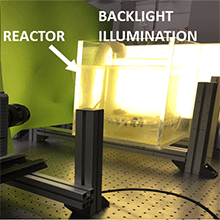
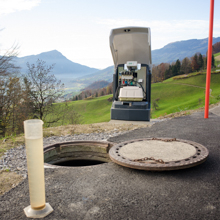
Measuring. Difficulties of monitoring sewer overflows with traditional methods are i) high concentration fluctuations with unknown event durations which require a high temporal sampling resolution, ii) many discharge sites and iii) placement, operation, and maintenance of equipment. Hence, passive samplers for polar organic micropollutants are analyzed systematically as a viable alternative to monitor short duration sewer overflows. The main advantage of passive samplers is the continuous accumulation of contaminants from the water phase, with no need for external energy sources nor for immense water sample storage volume. In a first step, the impact of fluctuating concentrations on deviations from true time-weighted average (TWA) concentrations was studied. The results highlight that the deviations induced by fluctuating concentrations are similar or smaller than uncertainties arising from chemical analysis and environmental factors. Understanding the uptake mechanism of micropollutants is one of the most important issues that needs to be resolved to reduce uncertainties in passive sampling data. The uptake experiments in sewer conditions for short duration events (<36h) indicate that the mass transfer is either dominated by the sorbent, or, by a multi-step mechanism. Therefore, a new semi-empirical mixed rate control model is proposed, which can be directly used for future studies under similar conditions. A field validation (3 locations, 10 events) shows that TWA concentration estimates measured by passive samplers are within a factor of 0.4 to 3.1 compared to composite water samples. Hence, the use of upper limit TWA concentration estimates is recommended for compliance checking with EQS. The findings clearly show that passive samplers are suitable to estimate TWA concentration ranges in sewer overflows and, thus facilitate identification of potentially critical discharge sites.
Occurrence of micropollutants. Unique monitoring data from 20 CSO sites was collected with passive samplers. In total 13 polar organic micropollutants were analysed in 95 events (2-7 events per site). The results highlight indicator micropollutants, which were often found in the monitored CSOs and could be used in future monitoring studies: diclofenac, benzotriazole, carbamazepine, diazinon, diuron, carbendazim, mecoprop, metolachlor and terbutryn. Further, our results reveal that the spatial differences among CSO sites are bigger than the inter-event differences within a site for all studied micropollutants. Nevertheless, no significant correlation with land use data could be identified. The results, therefore, suggest that additional factors, most likely the contaminant usage pattern, have a considerable influence on the observed spatial differences. Both municipal wastewater and stormwater contributed to concentrations above the EQS in CSOs (not in the receiving water). In addition, the monitoring with passive samplers indicates that at least 13 out of 20 CSOs show concentrations above EQS in CSOs, and would rely on dilution by receiving waters to not exceed EQS.
Outlook. Overall, the thesis shows the relevance of sewer overflows as a source of micropollutants entering receiving water bodies. The findings can serve as a basis for the development of a systematic and stepwise approach to efficiently identify critical sites. The development of such an approach would require joint efforts by eco-toxicologists, analytical chemists, regulators and wastewater engineers. This approach could be based on a simplified modeling approach as a first indicator, followed by passive sampling to assess micropollutant levels. To enable the widespread application of passive samplers in monitoring programs, regulators’ and operators’ confidence in passive sampling needs to be strengthened with more field validation studies and common guidelines.