Department Urban Water Management

DIMES II - Diffuse micropollutant emissions from urban areas

A first Swiss-wide assessment of micropollutants in wet-weather discharges indicated that many combined and separate sewer overflows can be critical at a local assessment level.

Extbase Variable Dump
array(2 items)
   publications => '10668' (5 chars)
   libraryUrl => '' (0 chars)
Extbase Variable Dump
array(1 item)
   0 => Snowflake\Publications\Domain\Model\Publicationprototypepersistent entity (uid=10668, pid=124)
      originalId => protected10668 (integer)
      authors => protected'Mutzner, L.; Staufer, P.; Ort, C.' (48 chars)
      title => protected'Model-based screening for critical wet-weather discharges related to micropo
         llutants from urban areas
' (101 chars) journal => protected'Water Research' (14 chars) year => protected2016 (integer) volume => protected104 (integer) issue => protected'' (0 chars) startpage => protected'547' (3 chars) otherpage => protected'557' (3 chars) categories => protected'combined system; effect assessment; runoff quality modelling; separate syste
         m; toxic Units; urban catchment
' (107 chars) description => protected'Wet-weather discharges contribute to anthropogenic micropollutant loads ente
         ring the aquatic environment. Thousands of wet-weather discharges exist in S
         wiss sewer systems, and we do not have the capacity to monitor them all. We
         consequently propose a model-based approach designed to identify critical di
         scharge points in order to support effective monitoring.<BR/>We applied a dy
         namic substance flow model to four substances representing different entry r
         outes: indoor (Triclosan, Mecoprop, Copper) as well as rainfall-mobilized (G
         lyphosate, Mecoprop, Copper) inputs. The accumulation on different urban lan
         d-use surfaces in dry weather and subsequent substance-specific wash-off is
         taken into account. For evaluation, we use a conservative screening approach
          to detect critical discharge points. This approach considers only local dil
         ution generated onsite from natural, unpolluted areas, i.e. excluding upstre
         am dilution.<BR/> Despite our conservative assumptions, we find that the env
         ironmental quality standards for Glyphosate and Mecoprop are not exceeded du
         ring any 10-min time interval over a representative one-year simulation peri
         od for all 2500 Swiss municipalities. In contrast, the environmental quality
          standard is exceeded during at least 20% of the discharge time at 83% of al
         l modelled discharge points for Copper and at 71% for Triclosan. For Copper,
          this corresponds to a total median duration of approximately 19 days per ye
         ar. For Triclosan, discharged only via combined sewer overflows, this means
         a median duration of approximately 10 days per year. In general, stormwater
         outlets contribute more to the calculated effect than combined sewer overflo
         ws for rainfall-mobilized substances. We further evaluate the Urban Index (A
         <SUB>urban,impervious</SUB>/A<SUB>natural</SUB>) as a proxy for critical dis
         charge points: catchments where Triclosan and Copper exceed the correspondin
         g environmental quality standard often have an Urban Index >0.03.<BR/>A dyna
         mic substance flow analy...
' (2183 chars) serialnumber => protected'0043-1354' (9 chars) doi => protected'10.1016/j.watres.2016.08.003' (28 chars) uid => protected10668 (integer) _localizedUid => protected10668 (integer)modified _languageUid => protectedNULL _versionedUid => protected10668 (integer)modified pid => protected124 (integer)
Mutzner, L.; Staufer, P.; Ort, C. (2016) Model-based screening for critical wet-weather discharges related to micropollutants from urban areas, Water Research, 104, 547-557, doi:10.1016/j.watres.2016.08.003, Institutional Repository

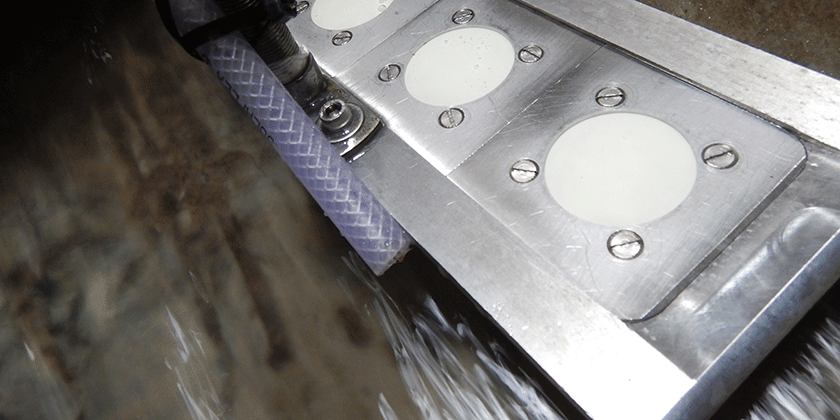
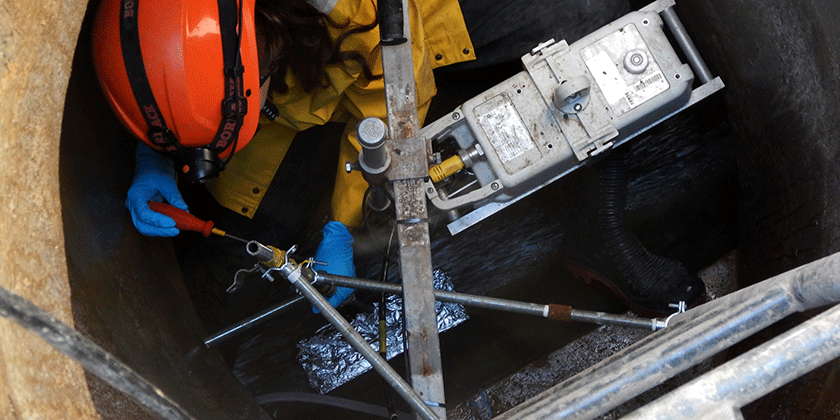
Data for micropollutants in wet-weather discharges is still scarce. Therefore, we aim to monitor and understand the occurrence of micropollutants (e.g. pharmaceuticals, biocides, pesticides) from urban areas by studying selected catchments with defined land uses. We surveyed two sites in the urban water observatory with conventional active water sampling and passive samplers to assess the applicability of passive samplers for rain-event based sampling in sewers.


Extbase Variable Dump
array(2 items)
   publications => '18823,17705' (11 chars)
   libraryUrl => '' (0 chars)
Extbase Variable Dump
array(2 items)
   0 => Snowflake\Publications\Domain\Model\Publicationprototypepersistent entity (uid=18823, pid=124)
      originalId => protected18823 (integer)
      authors => protected'Mutzner,&nbsp;L.; Vermeirssen,&nbsp;E.&nbsp;L.&nbsp;M.; Mangold,&nbsp;S.; Ma
         urer,&nbsp;M.; Scheidegger,&nbsp;A.; Singer,&nbsp;H.; Booij,&nbsp;K.; Ort,&n
         bsp;C.
' (158 chars) title => protected'Passive samplers to quantify micropollutants in sewer overflows: accumulatio
         n behaviour and field validation for short pollution events
' (135 chars) journal => protected'Water Research' (14 chars) year => protected2019 (integer) volume => protected160 (integer) issue => protected'' (0 chars) startpage => protected'350' (3 chars) otherpage => protected'360' (3 chars) categories => protected'polar organic pollutant; Chemcatcher; monitoring; pesticide; pharmaceutical' (75 chars) description => protected'Contaminants in sewer overflows can contribute to exceedances of environment
         al quality standards, thus the quantification of contaminants during rainfal
         l events is of relevance. However, monitoring is challenged by i) high spati
         otemporal variability of contaminants in events of hard-to-predict durations
         , and ii) a large number of remote sites, which would imply enormous efforts
          with traditional sampling equipment. Therefore, we evaluate the applicabili
         ty of passive samplers (Empore styrene-divinylbenzene reverse phase sulfonat
         ed (SDB-RPS)) to monitor a set of 13 polar organic contaminants. We present
         calibration experiments at high temporal resolution to assess the rate limit
         ing accumulation mechanisms for short events (&lt;36 h), report parameters
          for typical sewer conditions and compare passive samplers with composite wa
         ter samples in a field study (three locations, total 10 events). With sampli
         ng rates of 0.35–3.5 L/d for 1 h reference time, our calibration resul
         ts indicate a high sensitivity of passive samplers to sample short, highly v
         ariable sewer overflows. The contaminant uptake kinetic shows a fast initial
          accumulation, which is not well represented with the typical first-order mo
         del. Our results indicate that mass transfer to passive samplers is either c
         ontrolled by the water boundary layer and the sorbent, or by the sorbent alo
         ne. Overall, passive sampler concentration estimates are within a factor 0.4
          to 3.1 in comparison to composite water samples in the field study. We conc
         lude that passive samplers are a promising approach to monitor a large numbe
         r of discharge sites although it cannot replace traditional stormwater quali
         ty sampling in some cases (e.g. exact load estimates, high temporal resoluti
         on). Passive samplers facilitate identifying and prioritizing locations that
          may require more detailed investigations.
' (1866 chars) serialnumber => protected'0043-1354' (9 chars) doi => protected'10.1016/j.watres.2019.04.012' (28 chars) uid => protected18823 (integer) _localizedUid => protected18823 (integer)modified _languageUid => protectedNULL _versionedUid => protected18823 (integer)modified pid => protected124 (integer)
1 => Snowflake\Publications\Domain\Model\Publicationprototypepersistent entity (uid=17705, pid=124) originalId => protected17705 (integer) authors => protected'Mutzner,&nbsp;L.; Vermeirssen,&nbsp;E.&nbsp;L.&nbsp;M.; Ort,&nbsp;C.' (68 chars) title => protected'Passive samplers in sewers and rivers with highly fluctuating micropollutant
          concentrations – Better than we thought
' (118 chars) journal => protected'Journal of Hazardous Materials' (30 chars) year => protected2019 (integer) volume => protected361 (integer) issue => protected'' (0 chars) startpage => protected'312' (3 chars) otherpage => protected'320' (3 chars) categories => protected'polar organic pollutant; chemcatcher; sampling uncertainty; pesticide; pharm
         aceutical
' (85 chars) description => protected'Considerable pollutant loads can enter surface waters during rain events. Th
         ree factors challenge quantification of these pollutant fluxes using traditi
         onal sampling methods: (i) concentration fluctuations; (ii) unknown event du
         ration; and (iii) placement, operation, and maintenance of equipment. Passiv
         e samplers offer the advantage of sampling in a continuous mode without powe
         r supply. However, variable uptake rates due to environmental factors and de
         sorption in the case of fluctuating concentrations can affect the accuracy o
         f time-weighted average (TWA) concentration estimates. While uncertainties r
         elated to environmental factors could be accounted for with additional effor
         t, we can neither control nor quantify the concentration variability. We pre
         sent measured and modelled concentration profiles at high temporal resolutio
         n and provide a systematic approach to assessing deviations from true TWA co
         ncentration due to fluctuating concentration profiles. We evaluate sampling
         of sewer overflows (0.3–14 h) with Chemcatcher and 1-week sampling in rive
         rs. The uncertainty due to fluctuating concentrations is small, and other fa
         ctors such as chemical analyses and sampler calibration have a similar or hi
         gher impact. The uncertainty due to fluctuations clearly increases with the
         sampling duration, particularly when exceeding the half-life of equilibrium.
          We conclude that passive sampling can also be used in wastewater systems wi
         th potentially high concentration variations.
' (1489 chars) serialnumber => protected'0304-3894' (9 chars) doi => protected'10.1016/j.jhazmat.2018.07.040' (29 chars) uid => protected17705 (integer) _localizedUid => protected17705 (integer)modified _languageUid => protectedNULL _versionedUid => protected17705 (integer)modified pid => protected124 (integer)
Mutzner, L.; Vermeirssen, E. L. M.; Mangold, S.; Maurer, M.; Scheidegger, A.; Singer, H.; Booij, K.; Ort, C. (2019) Passive samplers to quantify micropollutants in sewer overflows: accumulation behaviour and field validation for short pollution events, Water Research, 160, 350-360, doi:10.1016/j.watres.2019.04.012, Institutional Repository
Mutzner, L.; Vermeirssen, E. L. M.; Ort, C. (2019) Passive samplers in sewers and rivers with highly fluctuating micropollutant concentrations – Better than we thought, Journal of Hazardous Materials, 361, 312-320, doi:10.1016/j.jhazmat.2018.07.040, Institutional Repository

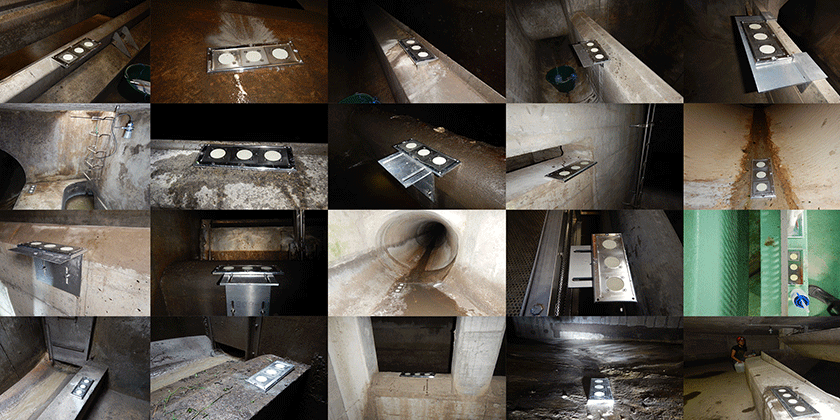
In 2017, we monitored 20 wet-weather discharge sites across Switzerland with the efficient passive sampler approach. With the collected monitoring data we aim to identify differences between urban catchments and find correlation between land use and micropollutant discharge.