Department Environmental Chemistry

Enzyme Mechanisms and Kinetics of Organic Contaminant Oxygenation
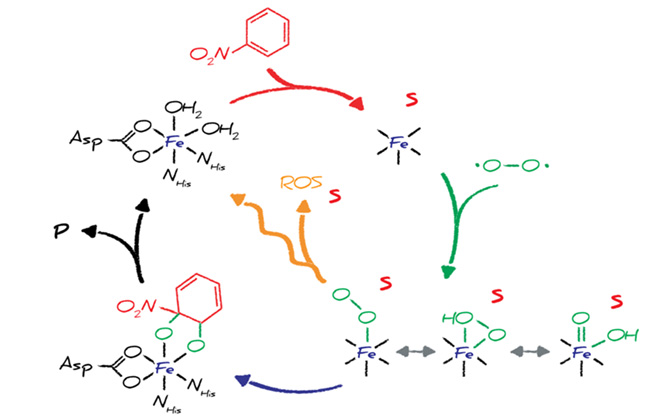
Rieske non-heme ferrous iron oxygenases are the main enzymes capable of hydroxylating persistent (poly)cyclic chlorinated and nitrated hydrocarbons. This class of enzymes therefore plays a critical role in the biodegradation of many recalcitrant organic contaminants in natural environments including soils, groundwaters, and surface waters or in engineered systems such as sewage treatment plants. While the general mechanisms of molecular O2 activation (and formation of reactive electrophilic oxygen species) are well known, essential factors of the catalytic activity of Rieske oxygenases with relevance for biotransformation of complex mixtures of contaminant remain elusive.

In this research, we explore the substrate- and enzyme-specificity of selected Rieske oxygenases with regard to path of molecular O2 activation as well as the efficiency of substrate hydroxylation vs. formation of problematic reactive oxygen species from the unproductive O2 uncoupling. Through the combination of experimental, analytical, and computational approaches, we aim at elucidating the reactivity of this class of enzymes towards the large number possible substrates and provide a mechanistic basis for hypothesis that link O2 uncoupling to the evolution of catalytically more proficient Rieske oxygenases.

Publikations

Extbase Variable Dump
array(2 items)
   publications => '32852,32987,32926,20557,15551' (29 chars)
   libraryUrl => '' (0 chars)
Extbase Variable Dump
array(5 items)
   0 => Snowflake\Publications\Domain\Model\Publicationprototypepersistent entity (uid=32852, pid=124)
      originalId => protected32852 (integer)
      authors => protected'Bernet, N. M.; Hofstetter, T. B.' (52 chars)
      title => protected'Advances in oxygen isotope analysis of phosphate by electrospray orbitrap ma
         ss spectrometry for studying the microbial metabolism of microorganisms
' (147 chars) journal => protected'Chimia' (6 chars) year => protected2024 (integer) volume => protected78 (integer) issue => protected'4' (1 chars) startpage => protected'256' (3 chars) otherpage => protected'260' (3 chars) categories => protected'microbial metabolism · orbitrap mass spectrometry · oxygen isotope ratios
         · phosphate · phosphoryl transfer reactions
' (121 chars) description => protected'Understanding the impact of human activities on the metabolic state of soil
         and aquatic environments is of paramount importance to implement measures fo
         r maintaining ecosystem services. Variations of natural abundance <sup>18</s
         up>O/<sup>16</sup>O ratios in phosphate have been proposed as proxies for th
         e holistic assessment of metabolic activity given the crucial importance of
         phosphoryl transfer reactions in fundamental biological processes. However,
         instrumental and procedural limitations inherent to oxygen isotope analysis
         in phosphate and organophosphorus compounds have so far limited the stable i
         sotope-based evaluation of metabolic processes. Here, we discuss how recent
         developments in Orbitrap high resolution mass spectrometry enable measuremen
         ts of <sup>18</sup>O/<sup>16</sup>O ratios in phosphate and outline the crit
         ical mass spectrometry parameters for accurate and precise analysis. Subsequ
         ently, we evaluate the types of <sup>18</sup>O kinetic isotope effects of ph
         osphoryl transfer reactions and illustrate how novel analytical approaches w
         ill give rise to an improved understanding of <sup>18</sup>O/<sup>16</sup>O
         ratio variations from biochemical processes affecting the microbial phosphor
         us metabolism.
' (1230 chars) serialnumber => protected'0009-4293' (9 chars) doi => protected'10.2533/chimia.2024.256' (23 chars) uid => protected32852 (integer) _localizedUid => protected32852 (integer)modified _languageUid => protectedNULL _versionedUid => protected32852 (integer)modified pid => protected124 (integer)
1 => Snowflake\Publications\Domain\Model\Publicationprototypepersistent entity (uid=32987, pid=124) originalId => protected32987 (integer) authors => protected'Bopp,&nbsp;C.&nbsp;E.; Bernet,&nbsp;N.&nbsp;M.; Pati,&nbsp;S.&nbsp;G.; Hofst
         etter,&nbsp;T.&nbsp;B.
' (98 chars) title => protected'Characterization of O<sub>2</sub> uncoupling in biodegradation reactions of
         nitroaromatic contaminants catalyzed by rieske oxygenases
' (133 chars) journal => protected'In: Bridwell-Rabb,&nbsp;J. (Eds.), Mononuclear non-heme iron-dependent enzym
         es
' (78 chars) year => protected2024 (integer) volume => protected0 (integer) issue => protected'' (0 chars) startpage => protected'3' (1 chars) otherpage => protected'28' (2 chars) categories => protected'' (0 chars) description => protected'Rieske oxygenases are known as catalysts that enable the cleavage of aromati
         c and aliphatic C–H bonds in structurally diverse biomolecules and recalci
         trant organic environmental pollutants through substrate oxygenations and ox
         idative heteroatom dealkylations. Yet, the unproductive O<sub>2</sub> activa
         tion, which is concomitant with the release of reactive oxygen species (ROS)
         , is typically not taken into account when characterizing Rieske oxygenase f
         unction. Even if considered an undesired side reaction, this O<sub>2</sub> u
         ncoupling allows for studying active site perturbations, enzyme mechanisms,
         and how enzymes evolve as environmental microorganisms adapt their substrate
         s to alternative carbon and energy sources. Here, we report on complementary
          methods for quantifying O<sub>2</sub> uncoupling based on mass balance or k
         inetic approaches that relate successful oxygenations to total O<sub>2</sub>
          activation and ROS formation. These approaches are exemplified with data fo
         r two nitroarene dioxygenases (nitrobenzene and 2-nitrotoluene dioxygenase)
         which have been shown to mono- and dioxygenate substituted nitroaromatic com
         pounds to substituted nitrobenzylalcohols and catechols, respectively.
' (1210 chars) serialnumber => protected'' (0 chars) doi => protected'10.1016/bs.mie.2024.05.010' (26 chars) uid => protected32987 (integer) _localizedUid => protected32987 (integer)modified _languageUid => protectedNULL _versionedUid => protected32987 (integer)modified pid => protected124 (integer)
2 => Snowflake\Publications\Domain\Model\Publicationprototypepersistent entity (uid=32926, pid=124) originalId => protected32926 (integer) authors => protected'Bopp,&nbsp;C.&nbsp;E.; Bernet,&nbsp;N.&nbsp;M.; Meyer,&nbsp;F.; Khan,&nbsp;R
         .; Robinson,&nbsp;S.&nbsp;L.; Kohler,&nbsp;H.&nbsp;P.&nbsp;E.; Buller,&nbsp;
         R.; Hofstetter,&nbsp;T.&nbsp;B.
' (183 chars) title => protected'Elucidating the role of O<sub>2</sub> uncoupling for the adaptation of bacte
         rial biodegradation reactions catalyzed by Rieske oxygenases
' (136 chars) journal => protected'ACS Environmental Au' (20 chars) year => protected2024 (integer) volume => protected4 (integer) issue => protected'4' (1 chars) startpage => protected'204' (3 chars) otherpage => protected'218' (3 chars) categories => protected'Rieske non-heme ferrous iron oxygenases; biocatalysis; O2 activation and unc
         oupling; reactive oxygen species; biodegradation; evolutionary adaptation
' (149 chars) description => protected'Oxygenation of aromatic and aliphatic hydrocarbons by Rieske oxygenases is t
         he initial step of various biodegradation pathways for environmental organic
          contaminants. Microorganisms carrying Rieske oxygenases are able to quickly
          adapt their substrate spectra to alternative carbon and energy sources that
          are structurally related to the original target substrate, yet the molecula
         r events responsible for this rapid adaptation are not well understood. Here
         , we evaluated the hypothesis that reactive oxygen species (ROS) generated b
         y unproductive activation of O<sub>2</sub>, the so-called O<sub>2</sub> unco
         upling, in the presence of the alternative substrate exert a selective press
         ure on the bacterium for increasing the oxygenation efficiency of Rieske oxy
         genases. To that end, we studied wild-type 2-nitrotoluene dioxygenase from A
         cidovorax sp. strain JS42 and five enzyme variants that have evolved from ad
         aptive laboratory evolution experiments with 3- and 4-nitrotoluene as altern
         ative growth substrates. The enzyme variants showed a substantially increase
         d oxygenation efficiency toward the new target substrates concomitant with a
          reduction of ROS production, while mechanisms and kinetics of enzymatic O<s
         ub>2</sub> activation remained unchanged. Structural analyses and docking st
         udies suggest that amino acid substitutions in enzyme variants occurred at r
         esidues lining both substrate and O<sub>2</sub> transport tunnels, enabling
         tighter binding of the target substrates in the active site. Increased oxyge
         nation efficiencies measured in vitro for the various enzyme (variant)-subst
         rate combinations correlated linearly with in vivo changes in growth rates f
         or evolved Acidovorax strains expressing the variants. Our data suggest that
          the selective pressure from oxidative stress toward more efficient oxygenat
         ion by Rieske oxygenases was most notable when O<sub>2</sub> uncoupling exce
         eded 60%.
' (1909 chars) serialnumber => protected'' (0 chars) doi => protected'10.1021/acsenvironau.4c00016' (28 chars) uid => protected32926 (integer) _localizedUid => protected32926 (integer)modified _languageUid => protectedNULL _versionedUid => protected32926 (integer)modified pid => protected124 (integer)
3 => Snowflake\Publications\Domain\Model\Publicationprototypepersistent entity (uid=20557, pid=124) originalId => protected20557 (integer) authors => protected'Bopp,&nbsp;C.&nbsp;E.; Kohler,&nbsp;H.&nbsp;P.&nbsp;E.; Hofstetter,&nbsp;T.&
         nbsp;B.
' (83 chars) title => protected'Enzyme kinetics of organic contaminant oxygenations' (51 chars) journal => protected'Chimia' (6 chars) year => protected2020 (integer) volume => protected74 (integer) issue => protected'3' (1 chars) startpage => protected'108' (3 chars) otherpage => protected'114' (3 chars) categories => protected'biodegradation; catalytic cycles; non-heme FeII oxygenases; O2 uncoupling' (73 chars) description => protected'Enzymatic oxygenations initiate biodegradation processes of many organic soi
         l and water contaminants. Even though many biochemical aspects of oxygenatio
         n reactions are well-known, quantifying rates of oxidative contaminant remov
         al as well as the extent of oxygenation remains a major challenge. Because e
         nzymes use different strategies to activate O<sub>2</sub>, reactions leading
          to substrate oxygenation are not necessarily limiting the rate of contamina
         nt removal. Moreover, oxygenases react along unproductive pathways without s
         ubstrate metabolism leading to O<sub>2</sub> uncoupling. Here, we identify t
         he critical features of the catalytic cycles of selected oxygenases that det
         ermine rates and extents of biodegradation. We focus most specifically on Ri
         eske dioxygenases, a subfamily of mononuclear non-heme ferrous iron oxygenas
         es, because of their ability to hydroxylate unactivated aromatic structures
         and thus initiate the transformation of the most persistent organic contamin
         ants. We illustrate that the rate-determining steps in their catalytic cycle
         s range from O<sub>2</sub> activation to substrate hydroxylation, depending
         on the extent of O-O cleavage that is required for generating the reactive F
         e-oxygen species. The extent of O<sub>2</sub> uncoupling, on the other hand,
          is highly substrate-specific and potentially modulated by adaptive response
         s to oxidative stress. Understanding the kinetic mechanisms of oxygenases wi
         ll be key to assess organic contaminant biotransformation quantitatively.
' (1517 chars) serialnumber => protected'0009-4293' (9 chars) doi => protected'10.2533/chimia.2020.108' (23 chars) uid => protected20557 (integer) _localizedUid => protected20557 (integer)modified _languageUid => protectedNULL _versionedUid => protected20557 (integer)modified pid => protected124 (integer)
4 => Snowflake\Publications\Domain\Model\Publicationprototypepersistent entity (uid=15551, pid=124) originalId => protected15551 (integer) authors => protected'Pati,&nbsp;S.&nbsp;G.; Kohler,&nbsp;H.-P.&nbsp;E.; Hofstetter,&nbsp;T.&nbsp;
         B.
' (78 chars) title => protected'Characterization of substrate, cosubstrate, and product isotope effects asso
         ciated with enzymatic oxygenations of organic compounds based on compound-sp
         ecific isotope analysis
' (175 chars) journal => protected'In: Harris,&nbsp;M.&nbsp;E.; Anderson,&nbsp;V.&nbsp;E. (Eds.), Measurement a
         nd analysis of kinetic isotope effects
' (114 chars) year => protected2017 (integer) volume => protected0 (integer) issue => protected'' (0 chars) startpage => protected'291' (3 chars) otherpage => protected'329' (3 chars) categories => protected'' (0 chars) description => protected'Enzymatic oxygenations are among the most important biodegradation and detox
         ification reactions of organic pollutants. In the environment, however, such
          natural attenuation processes are extremely difficult to monitor. Changes o
         f stable isotope ratios of aromatic pollutants at natural isotopic abundance
         s serve as proxies for isotope effects associated with oxygenation reactions
         . Such isotope fractionations offer new avenues for revealing the pathway an
         d extent of pollutant transformation and provide new insights into the mecha
         nisms of catalysis by Rieske non-heme ferrous iron oxygenases. Based on comp
         ound-specific C, H, N, and O isotope analysis, we present a comprehensive me
         thodology with which isotope effects can be derived from the isotope fractio
         nation measured in substrates, the cosubstrate O<sub>2</sub>, and organic ox
         ygenation products. We use dioxygenation of nitrobenzene and 2-nitrotoluene
         by nitrobenzene dioxygenase as illustrative examples to introduce different
         mathematical procedures for deriving apparent substrate and product isotope
         effects. We present two experimental approaches to control reactant and prod
         uct turnover for isotope fractionation analysis in experimental systems cont
         aining purified enzymes, <em>E. coli</em> clones, and pure strains of enviro
         nmental microorganisms. Finally, we present instrumental procedures and samp
         le treatment instructions for analysis of C, H, and N isotope analysis in or
         ganic compounds and O isotope analysis in aqueous O<sub>2</sub> by gas and l
         iquid chromatography coupled to isotope ratio mass spectrometry.
' (1584 chars) serialnumber => protected'' (0 chars) doi => protected'10.1016/bs.mie.2017.06.044' (26 chars) uid => protected15551 (integer) _localizedUid => protected15551 (integer)modified _languageUid => protectedNULL _versionedUid => protected15551 (integer)modified pid => protected124 (integer)
Bernet, N. M.; Hofstetter, T. B. (2024) Advances in oxygen isotope analysis of phosphate by electrospray orbitrap mass spectrometry for studying the microbial metabolism of microorganisms, Chimia, 78(4), 256-260, doi:10.2533/chimia.2024.256, Institutional Repository
Bopp, C. E.; Bernet, N. M.; Pati, S. G.; Hofstetter, T. B. (2024) Characterization of O2 uncoupling in biodegradation reactions of nitroaromatic contaminants catalyzed by rieske oxygenases, In: Bridwell-Rabb, J. (Eds.), Mononuclear non-heme iron-dependent enzymes, 3-28, doi:10.1016/bs.mie.2024.05.010, Institutional Repository
Bopp, C. E.; Bernet, N. M.; Meyer, F.; Khan, R.; Robinson, S. L.; Kohler, H. P. E.; Buller, R.; Hofstetter, T. B. (2024) Elucidating the role of O2 uncoupling for the adaptation of bacterial biodegradation reactions catalyzed by Rieske oxygenases, ACS Environmental Au, 4(4), 204-218, doi:10.1021/acsenvironau.4c00016, Institutional Repository
Bopp, C. E.; Kohler, H. P. E.; Hofstetter, T. B. (2020) Enzyme kinetics of organic contaminant oxygenations, Chimia, 74(3), 108-114, doi:10.2533/chimia.2020.108, Institutional Repository
Pati, S. G.; Kohler, H.-P. E.; Hofstetter, T. B. (2017) Characterization of substrate, cosubstrate, and product isotope effects associated with enzymatic oxygenations of organic compounds based on compound-specific isotope analysis, In: Harris, M. E.; Anderson, V. E. (Eds.), Measurement and analysis of kinetic isotope effects, 291-329, doi:10.1016/bs.mie.2017.06.044, Institutional Repository

Project collaborators

Markus Reiher, Theoretische Chemie ETH Zürich
Hanspeter Kohler