Department Environmental Chemistry

Occurrence of PFASs in Swiss Wastewater Treatment Plants
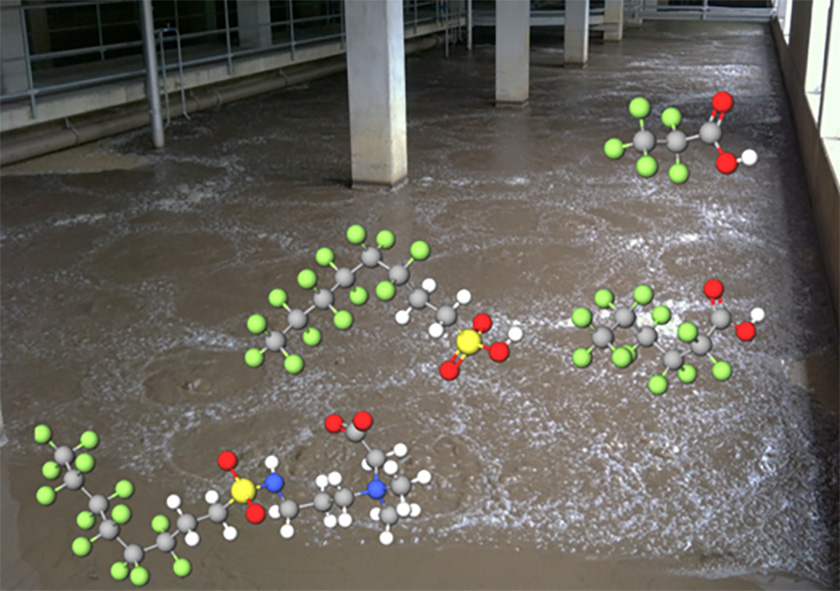
Per- and polyfluoroalkyl substances (PFASs) are a wide-ranging group of persistent organic pollutants characterized by the presence of high strength carbon-fluorine bonds with widespread use in industry and consumer products. Some PFASs have the potential to bioaccumulate and many have demonstrated toxicological effects. Low PFAS threshold values have been set in the EU drinking water directive, and freshwater quality standards are under consideration. When PFASs enter the water cycle, they often remain stable and are unable to be removed by natural or conventional water treatment processes. Wastewater treatment plants are an important point source for PFASs into aquatic systems, and they provide a representative indication of the types and amounts of different PFASs sourced from industry and municipalities within a defined catchment.

The aims of the project are to determine the occurrence of PFASs in Swiss wastewater treatment plants and to compare the concentrations today to historical measurements from the previous decade. A wide range of target substances will be assessed, and additional suspect and non-target screening is envisaged. Samples from wastewater influent, effluent, and sewage sludge will be analyzed to gain an understanding of contaminant occurrence and fate throughout the wastewater treatment process. These results will aid efforts to identify important PFASs present in wastewater streams and their potential sources, and they will provide crucial data to guide national use and discharge limits.

Publications

Extbase Variable Dump
array(2 items)
   publications => '13952' (5 chars)
   libraryUrl => '' (0 chars)
Extbase Variable Dump
array(1 item)
   0 => Snowflake\Publications\Domain\Model\Publicationprototypepersistent entity (uid=13952, pid=124)
      originalId => protected13952 (integer)
      authors => protected'Alder, A. C.; van der Voet, J.' (45 chars)
      title => protected'Occurrence and point source characterization of perfluoroalkyl acids in sewa
         ge sludge
' (85 chars) journal => protected'Chemosphere' (11 chars) year => protected2015 (integer) volume => protected129 (integer) issue => protected'' (0 chars) startpage => protected'62' (2 chars) otherpage => protected'73' (2 chars) categories => protected'PFAA; PFOS; PFOA; metal plating; AFFF; landfill leachate' (56 chars) description => protected'The occurrence and levels of perfluoroalkyl acids (PFAAs) emitted from speci
         fic pollution sources into the aquatic environment in Switzerland were studi
         ed using digested sewage sludges from 45 wastewater treatment plants in catc
         hments containing a wide range of potential industrial emitters. Concentrati
         ons of individual PFAAs show a high spatial and temporal variability, which
         infers different contributions from industrial technologies and activities.
         Perfluorooctane sulfonic acid (PFOS) was generally the predominant PFAA with
          concentrations varying between 4 and 2440 μg kg<SUP>−1</SUP> (median 75
         μg kg<SUP>−1</SUP>). Elevated emissions were especially observed in catch
         ments capturing discharges from metal plating industries (median 82 μg kg<S
         UP>−1</SUP>), aqueous firefighting foams (median 215 μg kg<SUP>−1</SUP>
         ) and landfill leachates (median 107 μg kg<SUP>−1</SUP>). Some elevated p
         erfluoroalkyl carboxylic acids (PFCAs) levels could be attributed to emissio
         ns from textile finishing industries with concentrations up to 233 μg kg<SU
         P>−1</SUP> in sewage sludge. Assuming sorption to sludge for PFOS and PFCA
         s of 15% and 2%, respectively, concentrations in wastewater effluents up to
         the low μg L<SUP>−1</SUP> level were estimated. Even if wastewater may be
          expected to be diluted between 10 and 100 times by the receiving waters, el
         evated concentrations may be reached at specific locations. Although sewage
         sludge is a minor compartment for PFAAs in WWTPs, these investigations are h
         elpful for the identification of hot-spots from industrial emitters as well
         as to estimate monthly average concentrations in wastewater.
' (1656 chars) serialnumber => protected'0045-6535' (9 chars) doi => protected'10.1016/j.chemosphere.2014.07.045' (33 chars) uid => protected13952 (integer) _localizedUid => protected13952 (integer)modified _languageUid => protectedNULL _versionedUid => protected13952 (integer)modified pid => protected124 (integer)
Alder, A. C.; van der Voet, J. (2015) Occurrence and point source characterization of perfluoroalkyl acids in sewage sludge, Chemosphere, 129, 62-73, doi:10.1016/j.chemosphere.2014.07.045, Institutional Repository