Pharmaceuticals in human excreta derived fertilizers and mitigation options
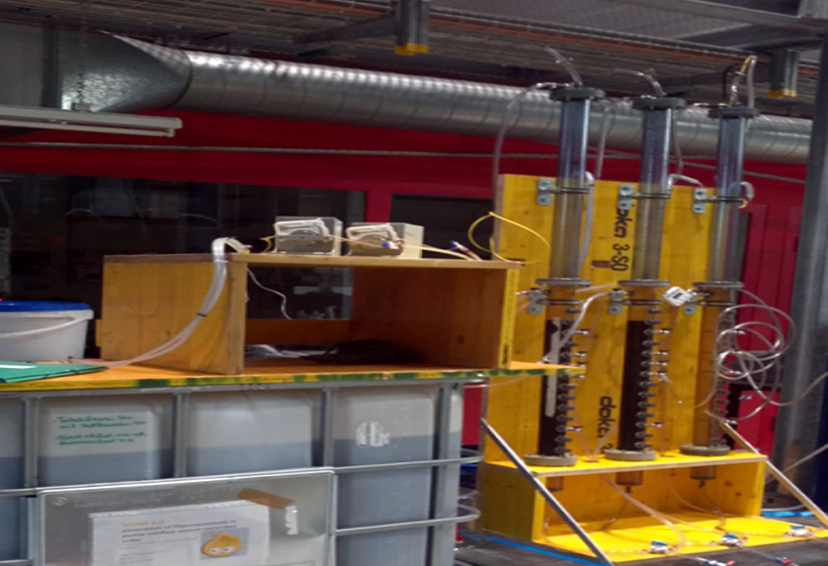
GAC columns treating urine
Separate collection and treatment of urine has been developed as an approach for preventing eutrophication, producing a valuable fertilizer and promoting sanitation in areas where no sewer-based sanitation is available. Nitrification and distillation of urine allow for the recovery of all nutrients in a highly concentrated fertilizer solution. However, separation of pharmaceuticals from nutrients in urine is relevant to produce a safe fertilizer, as more than 50% of pharmaceuticals are excreted with urine. We found that an adsorption column with granular activated carbon (GAC) included in the treatment train can successfully remove the pharmaceuticals, and our studies have led to the production of a urine fertilizer named Aurin that is authorized for use on vegetables and flowers in Switzerland. In follow-up projects, we investigate whether activated carbon adsorption can also be placed directly after anaerobic storage of urine, or after a simple aerobic organics degradation step.
Further studies aim at investigating the pharmaceutical contamination of biosolids derived from human fecal compost.
array(5 items)0 => Snowflake\Publications\Domain\Model\Publicationprototypepersistent entity (uid=33969, pid=124)originalId => protected33969 (integer)
authors => protected'Schinkel, L.; Eberhard, Y.; Maccagnan, A.; Berg, M.; McA rdell, C. S.' (98 chars)
title => protected'Antibiotics and other micropollutants in Swiss sewage sludge and fecal compo st' (78 chars)
journal => protected'Chemosphere' (11 chars)
year => protected2025 (integer)
volume => protected375 (integer)
issue => protected'' (0 chars)
startpage => protected'144216 (13 pp.)' (15 chars)
otherpage => protected'' (0 chars)
categories => protected'pharmaceuticals; preservatives; wastewater; fertilizer; dry toilet; mass flo w analysis' (86 chars)
description => protected'Antibiotics are of environmental concern. Their concentrations in the aquati c environment are frequently studied, while their occurrence in human excret a-derived fertilizers is less investigated. Therefore, levels of antibiotics , preservatives with antimicrobial properties, and various other micropollut ants were determined in sewage sludge and in human fecal compost. Digested s ludge of 29 Swiss wastewater treatment plants was analyzed, representing abo ut 2.6 Mio people (30% of the Swiss population). This was compared with resi dues found in compost with dry toilet content after thermophilic composting, representing about 10 000 people. Fluoroquinolones and preservatives domin ate in Swiss sewage sludge with weighted mean concentrations of 6500 μg k g<sup>−1</sup> and 2300 μg kg<sup>−1</sup>. Levels of macrolides (240 μg kg<sup>−1</sup>), β-lactam transformation products (35 μg kg<su p>−1</sup>) and sulfonamides (15 μg kg<sup>−1</sup>) were lower. Poll ution patterns in digested sewage sludge were relatively constant throughout Switzerland. Levels of contamination in fecal compost were approximately 30 times lower than in sewage sludge. Pollution patterns differed between comp ost and sludge. Chemicals used in down-the-drain-applications (e.g., preserv atives from personal care products or corrosion inhibitors) are less relevan t in compost. Based on the Swiss consumption and excretion data, a mass flow analysis was carried out for antibiotics and pharmaceuticals in sludge and compost. The mass flow analysis in sludge showed a good agreement of predict ed and measured concentrations for compounds that tend to sorb to organic ma tter (e.g., fluoroquinolones). Currently, there is no specific legislation t hat regulates the use of fecal compost from dry toilets as fertilizer. Howev er, the one to two order of magnitude lower levels of contaminants in fecal compost compared to sludge and manure indicate a lower environmental risk wh en applying it as fertil...' (2005 chars)
serialnumber => protected'0045-6535' (9 chars)
doi => protected'10.1016/j.chemosphere.2025.144216' (33 chars)
uid => protected33969 (integer)
_localizedUid => protected33969 (integer)modified_languageUid => protectedNULL
_versionedUid => protected33969 (integer)modifiedpid => protected124 (integer)1 => Snowflake\Publications\Domain\Model\Publicationprototypepersistent entity (uid=32848, pid=124)originalId => protected32848 (integer)
authors => protected'Heusser, A.; Dax, A.; McArdell, C. S.; Udert, K.&nb sp;M.' (81 chars)
title => protected'Comparing the adsorption of micropollutants on activated carbon from anaerob ically stored, organics-depleted, and nitrified urine' (129 chars)
journal => protected'Water Research' (14 chars)
year => protected2024 (integer)
volume => protected257 (integer)
issue => protected'' (0 chars)
startpage => protected'121615 (12 pp.)' (15 chars)
otherpage => protected'' (0 chars)
categories => protected'pharmaceuticals; PAC; GAC; pH effect; nutrient recovery; fertilizer' (67 chars)
description => protected'Separate collection and treatment of urine optimizes nutrient recovery and e nhances micropollutant removal from municipal wastewater. One typical urine treatment train includes nutrient recovery in three biological processes: an aerobic storage, followed by aerobic organics degradation concurrently with nitrification. These are usually followed by activated carbon adsorption to remove micropollutants. However, removing micropollutants prior to nitrifica tion would protect nitrifiers from potential inhibition by pharmaceuticals. In addition, combining simplified biological treatment with activated carbon adsorption could offer a cheap and robust process for removing micropolluta nts where nutrient recovery is not the first priority, as a partial loss of ammonia occurs without nitrification. In this study, we investigated whether activated carbon adsorption could also take place between the three biologi cal treatment steps. We tested the effectiveness of micropollutant removal w ith activated carbon after each biological treatment step by conducting expe riments with anaerobically stored urine, organics-depleted urine, and nitrif ied urine. The urine solutions were spiked with 19 pharmaceuticals: amisulpr ide, atenolol, atenolol acid, candesartan, carbamazepine, citalopram, clarit hromycin, darunavir, diclofenac, emtricitabine, fexofenadine, hydrochlorothi azide, irbesartan, lidocaine, metoprolol, N<sub>4</sub>-acetylsulfamethoxazo le, sulfamethoxazole, trimethoprim, venlafaxine, and two artificial sweetene rs, acesulfame and sucralose. Batch experiments were conducted with powdered activated carbon (PAC) to determine how much activated carbon achieve which degree of micropollutant removal and how organics, pH, and speciation chang e from ammonium to nitrate influence adsorption. Micropollutant removal was also tested in granular activated carbon (GAC) columns, which is the preferr ed technology for micropollutant removal from urine. The carbon usage rates (CUR) per person were lo...' (2962 chars)
serialnumber => protected'0043-1354' (9 chars)
doi => protected'10.1016/j.watres.2024.121615' (28 chars)
uid => protected32848 (integer)
_localizedUid => protected32848 (integer)modified_languageUid => protectedNULL
_versionedUid => protected32848 (integer)modifiedpid => protected124 (integer)2 => Snowflake\Publications\Domain\Model\Publicationprototypepersistent entity (uid=31924, pid=124)originalId => protected31924 (integer)
authors => protected'Heusser, A.; Dax, A.; McArdell, C. S.; Udert, K.&nb sp;M.' (81 chars)
title => protected'High content of low molecular weight organics does not always affect pharmac eutical adsorption on activated carbon: the case of acetate, propionate and ethanol in source-separated urine' (185 chars)
journal => protected'Water Research X' (16 chars)
year => protected2023 (integer)
volume => protected21 (integer)
issue => protected'' (0 chars)
startpage => protected'100199 (10 pp.)' (15 chars)
otherpage => protected'' (0 chars)
categories => protected'carbon usage rate; pharmaceutical removal; micropollutants; competing adsorp tion' (80 chars)
description => protected'Adsorption on activated carbon is a common process to remove pharmaceuticals in wastewater treatment. Activated carbon adsorption is usually applied to wastewater with a low content of biological degradable organics, i.e. after biological treatment. Especially low molecular weight (LMW) compounds are kn own to compete with pharmaceuticals for adsorption sites. The goal of this s tudy was to test the hypothesis that biological treatment is necessary for e fficient pharmaceutical removal. Source-separated urine after anaerobic stor age (anaerobically stored urine) and after aerobic biological removal of org anics without nitrification (organics-depleted urine) were used in this stud y. In anaerobically stored urine 60% of the organic compounds were LMW organ ics, of which about 40% were acetate and propionate. 74% of the DOC and 100% of acetate and propionate were removed during aerobic biological treatment. To investigate the effect of the organic compounds on pharmaceutical remova l, sorption experiments with 19 spiked pharmaceuticals and one artificial sw eetener were conducted with powdered activated carbon. Ethanol, another LMW organic, was included in the study, as it is regularly used for pharmaceutic al spiking thereby strongly increasing the DOC content. The experiments show ed that the adsorption of the pharmaceuticals and the sweetener were hardly affected by the easily biodegradable LMW organics or ethanol. Therefore, it was concluded that biological pre-treatment is not necessary for efficient p harmaceutical adsorption. Since acetate, propionate and ethanol contribute s ubstantially to the DOC content but do not absorb UV light, the latter is re commended as indicator for pharmaceutical removal in solutions with high con tents of biodegradable LMW organics.' (1784 chars)
serialnumber => protected'2589-9147' (9 chars)
doi => protected'10.1016/j.wroa.2023.100199' (26 chars)
uid => protected31924 (integer)
_localizedUid => protected31924 (integer)modified_languageUid => protectedNULL
_versionedUid => protected31924 (integer)modifiedpid => protected124 (integer)3 => Snowflake\Publications\Domain\Model\Publicationprototypepersistent entity (uid=21901, pid=124)originalId => protected21901 (integer)
authors => protected'Özel Duygan, B. D.; Udert, K. M.; Remmele, A.; McA rdell, C. S.' (98 chars)
title => protected'Removal of pharmaceuticals from human urine during storage, aerobic biologic al treatment, and activated carbon adsorption to produce a safe fertilizer' (150 chars)
journal => protected'Resources, Conservation and Recycling' (37 chars)
year => protected2021 (integer)
volume => protected166 (integer)
issue => protected'' (0 chars)
startpage => protected'105341 (10 pp.)' (15 chars)
otherpage => protected'' (0 chars)
categories => protected'biotransformation; ecotoxicity assessment; moving bed biofilm reactor; nitri fication; powdered activated carbon; source separation' (130 chars)
description => protected'Urine has great potential to be an effective fertilizer due to its high nutr ient content, however, it can contain potentially worrying pharmaceuticals. Our objective was to study whether urine storage and aerobic biological trea tment, i.e. nitrification, was sufficient to remove pharmaceuticals or an ad ditional treatment with activated carbon was necessary to produce a fertiliz er from urine. We investigated the abatement of twelve pharmaceuticals, incl uding antibiotics and antivirals, in laboratory experiments representing the treatment steps of anaerobic storage of source-separated human urine, stabi lization using partial and full nitrification under acclimatized and non-acc limatized conditions, and treatment of nitrified urine using powdered activa ted carbon (PAC). Two-month-long-term storage of urine was insufficient to s ubstantially degrade the pharmaceuticals, except for hydrochlorothiazide (&g t;90%). In the partial and full nitrification fed-batch reactors, atazanavir , ritonavir, and clarithromycin were rapidly removed, with biotransformation rate constants greater than 10 L g<sub>SS</sub><sup>−1</sup>d<sup>−1< /sup>. Darunavir, emtricitabine, trimethoprim, N4-acetylsulfamethoxazole, su lfamethoxazole, atenolol, diclofenac, and hydrochlorothiazide were degraded slowly, with biotransformation rate constants of < 1 L g<sub>SS</sub>< sup>−1</sup>d<sup>−1</sup>. With 200 mg PAC L<sup>−1</sup>, at leas t 90% of each investigated pharmaceutical was removed. Yeast estrogen screen tests and bioluminescence inhibition tests revealed efficient removal of es trogenicity (99%) and toxicity (56%) using nitrification, and a reduction of 89% and 64%, respectively, using 200 mg PAC L<sup>−1</sup>. With our s tudy, we provide biotransformation rate constants of compounds never previou sly investigated. We also show that a combination of nitrification and PAC a dsorption enables the production of a safe fertilizer with sufficiently low pharmaceutical concentra...' (2045 chars)
serialnumber => protected'0921-3449' (9 chars)
doi => protected'10.1016/j.resconrec.2020.105341' (31 chars)
uid => protected21901 (integer)
_localizedUid => protected21901 (integer)modified_languageUid => protectedNULL
_versionedUid => protected21901 (integer)modifiedpid => protected124 (integer)4 => Snowflake\Publications\Domain\Model\Publicationprototypepersistent entity (uid=21029, pid=124)originalId => protected21029 (integer)
authors => protected'Köpping, I.; McArdell, C. S.; Borowska, E.; Böhler,&nb sp;M. A.; Udert, K. M.' (113 chars)
title => protected'Removal of pharmaceuticals from nitrified urine by adsorption on granular ac tivated carbon' (90 chars)
journal => protected'Water Research X' (16 chars)
year => protected2020 (integer)
volume => protected9 (integer)
issue => protected'' (0 chars)
startpage => protected'100057 (10 pp.)' (15 chars)
otherpage => protected'' (0 chars)
categories => protected'source separation; organic micropollutants; resource recovery; recycling fer tilizer; carbon usage rate' (102 chars)
description => protected'Nitrification and distillation of urine allow for the recovery of all nutrie nts in a highly concentrated fertilizer solution. However, pharmaceuticals e xcreted with urine are only partially removed during these two process steps . For a sustainable and safe application, more extensive removal of pharmace uticals is necessary. To enhance the pharmaceutical removal, which is alread y occurring during urine storage, nitrification and distillation, an adsorpt ion column with granular activated carbon (GAC) can be included in the treat ment train. We executed a pilot-scale study to investigate the adsorption of eleven indicator pharmaceuticals on GAC. During 74 days, we treated roughly 1000 L of pre-filtered and nitrified urine spiked with pharmaceuticals in t wo flow-through GAC columns filled with different grain sizes. We compared t he performance of these columns by calculating the number of treated bed vol umes until breakthrough and carbon usage rates. The eleven spiked pharmaceut icals were candesartan, carbamazepine, clarithromycin, diclofenac, emtricita bine, hydrochlorothiazide, irbesartan, metoprolol, N<sub>4</sub>-acetylsulfa methoxazole, sulfamethoxazole and trimethoprim. At the shortest empty bed co ntact time (EBCT) of 25 min, immediate breakthrough was observed in both col umns shortly after the start of the experiments. Strong competition by natur al organic material (NOM) could have caused the low pharmaceutical removal a t the EBCT of 25 min. At EBCTs of 70, 92 and 115 min, more than 660 bed volu mes could be treated until breakthrough in the column with fine GAC. The ear liest breakthrough was observed for candesartan and clarithromycin. On coars e GAC, only half the number of bed volumes could be treated until breakthrou gh compared to fine GAC. The probable reason for the later breakthrough with fine GAC is the smaller intraparticle diffusive path length. DOC and UV abs orbance measurements at 265 nm indicated that both parameters can be used as indicators for the brea...' (2462 chars)
serialnumber => protected'2589-9147' (9 chars)
doi => protected'10.1016/j.wroa.2020.100057' (26 chars)
uid => protected21029 (integer)
_localizedUid => protected21029 (integer)modified_languageUid => protectedNULL
_versionedUid => protected21029 (integer)modifiedpid => protected124 (integer)
Antibiotics and other micropollutants in Swiss sewage sludge and fecal compost
Antibiotics are of environmental concern. Their concentrations in the aquatic environment are frequently studied, while their occurrence in human excreta-derived fertilizers is less investigated. Therefore, levels of antibiotics, preservatives with antimicrobial properties, and various other micropollutants were determined in sewage sludge and in human fecal compost. Digested sludge of 29 Swiss wastewater treatment plants was analyzed, representing about 2.6 Mio people (30% of the Swiss population). This was compared with residues found in compost with dry toilet content after thermophilic composting, representing about 10 000 people. Fluoroquinolones and preservatives dominate in Swiss sewage sludge with weighted mean concentrations of 6500 μg kg−1 and 2300 μg kg−1. Levels of macrolides (240 μg kg−1), β-lactam transformation products (35 μg kg−1) and sulfonamides (15 μg kg−1) were lower. Pollution patterns in digested sewage sludge were relatively constant throughout Switzerland. Levels of contamination in fecal compost were approximately 30 times lower than in sewage sludge. Pollution patterns differed between compost and sludge. Chemicals used in down-the-drain-applications (e.g., preservatives from personal care products or corrosion inhibitors) are less relevant in compost. Based on the Swiss consumption and excretion data, a mass flow analysis was carried out for antibiotics and pharmaceuticals in sludge and compost. The mass flow analysis in sludge showed a good agreement of predicted and measured concentrations for compounds that tend to sorb to organic matter (e.g., fluoroquinolones). Currently, there is no specific legislation that regulates the use of fecal compost from dry toilets as fertilizer. However, the one to two order of magnitude lower levels of contaminants in fecal compost compared to sludge and manure indicate a lower environmental risk when applying it as fertilizer.
Schinkel, L.; Eberhard, Y.; Maccagnan, A.; Berg, M.; McArdell, C. S. (2025) Antibiotics and other micropollutants in Swiss sewage sludge and fecal compost, Chemosphere, 375, 144216 (13 pp.), doi:10.1016/j.chemosphere.2025.144216, Institutional Repository
Comparing the adsorption of micropollutants on activated carbon from anaerobically stored, organics-depleted, and nitrified urine
Separate collection and treatment of urine optimizes nutrient recovery and enhances micropollutant removal from municipal wastewater. One typical urine treatment train includes nutrient recovery in three biological processes: anaerobic storage, followed by aerobic organics degradation concurrently with nitrification. These are usually followed by activated carbon adsorption to remove micropollutants. However, removing micropollutants prior to nitrification would protect nitrifiers from potential inhibition by pharmaceuticals. In addition, combining simplified biological treatment with activated carbon adsorption could offer a cheap and robust process for removing micropollutants where nutrient recovery is not the first priority, as a partial loss of ammonia occurs without nitrification. In this study, we investigated whether activated carbon adsorption could also take place between the three biological treatment steps. We tested the effectiveness of micropollutant removal with activated carbon after each biological treatment step by conducting experiments with anaerobically stored urine, organics-depleted urine, and nitrified urine. The urine solutions were spiked with 19 pharmaceuticals: amisulpride, atenolol, atenolol acid, candesartan, carbamazepine, citalopram, clarithromycin, darunavir, diclofenac, emtricitabine, fexofenadine, hydrochlorothiazide, irbesartan, lidocaine, metoprolol, N4-acetylsulfamethoxazole, sulfamethoxazole, trimethoprim, venlafaxine, and two artificial sweeteners, acesulfame and sucralose. Batch experiments were conducted with powdered activated carbon (PAC) to determine how much activated carbon achieve which degree of micropollutant removal and how organics, pH, and speciation change from ammonium to nitrate influence adsorption. Micropollutant removal was also tested in granular activated carbon (GAC) columns, which is the preferred technology for micropollutant removal from urine. The carbon usage rates (CUR) per person were lower for all urine solutions than for municipal wastewater. The results showed that organics depletion would be needed when micropollutant removal was the sole aim of urine treatment, as the degradation of easily biodegradable organics prevented clogging of GAC columns. However, CUR did hardly improve with organics-depleted urine compared to stored urine. The lowest CUR was achieved with nitrified urine. This resulted from the additional organics removal during nitrification and not the lower pH or the partial conversion of ammonium to nitrate. In addition, we showed that the relative pharmaceutical removal in all solutions was independent of the initial pharmaceutical concentration unless the background organics matrix changed considerably. We conclude that removal of micropollutants in GAC columns from organics-depleted urine can be performed without clogging, but with the drawback of a higher carbon usage compared to removal from nitrified urine.
Heusser, A.; Dax, A.; McArdell, C. S.; Udert, K. M. (2024) Comparing the adsorption of micropollutants on activated carbon from anaerobically stored, organics-depleted, and nitrified urine, Water Research, 257, 121615 (12 pp.), doi:10.1016/j.watres.2024.121615, Institutional Repository
High content of low molecular weight organics does not always affect pharmaceutical adsorption on activated carbon: the case of acetate, propionate and ethanol in source-separated urine
Adsorption on activated carbon is a common process to remove pharmaceuticals in wastewater treatment. Activated carbon adsorption is usually applied to wastewater with a low content of biological degradable organics, i.e. after biological treatment. Especially low molecular weight (LMW) compounds are known to compete with pharmaceuticals for adsorption sites. The goal of this study was to test the hypothesis that biological treatment is necessary for efficient pharmaceutical removal. Source-separated urine after anaerobic storage (anaerobically stored urine) and after aerobic biological removal of organics without nitrification (organics-depleted urine) were used in this study. In anaerobically stored urine 60% of the organic compounds were LMW organics, of which about 40% were acetate and propionate. 74% of the DOC and 100% of acetate and propionate were removed during aerobic biological treatment. To investigate the effect of the organic compounds on pharmaceutical removal, sorption experiments with 19 spiked pharmaceuticals and one artificial sweetener were conducted with powdered activated carbon. Ethanol, another LMW organic, was included in the study, as it is regularly used for pharmaceutical spiking thereby strongly increasing the DOC content. The experiments showed that the adsorption of the pharmaceuticals and the sweetener were hardly affected by the easily biodegradable LMW organics or ethanol. Therefore, it was concluded that biological pre-treatment is not necessary for efficient pharmaceutical adsorption. Since acetate, propionate and ethanol contribute substantially to the DOC content but do not absorb UV light, the latter is recommended as indicator for pharmaceutical removal in solutions with high contents of biodegradable LMW organics.
Heusser, A.; Dax, A.; McArdell, C. S.; Udert, K. M. (2023) High content of low molecular weight organics does not always affect pharmaceutical adsorption on activated carbon: the case of acetate, propionate and ethanol in source-separated urine, Water Research X, 21, 100199 (10 pp.), doi:10.1016/j.wroa.2023.100199, Institutional Repository
Removal of pharmaceuticals from human urine during storage, aerobic biological treatment, and activated carbon adsorption to produce a safe fertilizer
Urine has great potential to be an effective fertilizer due to its high nutrient content, however, it can contain potentially worrying pharmaceuticals. Our objective was to study whether urine storage and aerobic biological treatment, i.e. nitrification, was sufficient to remove pharmaceuticals or an additional treatment with activated carbon was necessary to produce a fertilizer from urine. We investigated the abatement of twelve pharmaceuticals, including antibiotics and antivirals, in laboratory experiments representing the treatment steps of anaerobic storage of source-separated human urine, stabilization using partial and full nitrification under acclimatized and non-acclimatized conditions, and treatment of nitrified urine using powdered activated carbon (PAC). Two-month-long-term storage of urine was insufficient to substantially degrade the pharmaceuticals, except for hydrochlorothiazide (>90%). In the partial and full nitrification fed-batch reactors, atazanavir, ritonavir, and clarithromycin were rapidly removed, with biotransformation rate constants greater than 10 L gSS−1d−1. Darunavir, emtricitabine, trimethoprim, N4-acetylsulfamethoxazole, sulfamethoxazole, atenolol, diclofenac, and hydrochlorothiazide were degraded slowly, with biotransformation rate constants of < 1 L gSS−1d−1. With 200 mg PAC L−1, at least 90% of each investigated pharmaceutical was removed. Yeast estrogen screen tests and bioluminescence inhibition tests revealed efficient removal of estrogenicity (99%) and toxicity (56%) using nitrification, and a reduction of 89% and 64%, respectively, using 200 mg PAC L−1. With our study, we provide biotransformation rate constants of compounds never previously investigated. We also show that a combination of nitrification and PAC adsorption enables the production of a safe fertilizer with sufficiently low pharmaceutical concentrations and no removal of beneficial nutrients.
Özel Duygan, B. D.; Udert, K. M.; Remmele, A.; McArdell, C. S. (2021) Removal of pharmaceuticals from human urine during storage, aerobic biological treatment, and activated carbon adsorption to produce a safe fertilizer, Resources, Conservation and Recycling, 166, 105341 (10 pp.), doi:10.1016/j.resconrec.2020.105341, Institutional Repository
Removal of pharmaceuticals from nitrified urine by adsorption on granular activated carbon
Nitrification and distillation of urine allow for the recovery of all nutrients in a highly concentrated fertilizer solution. However, pharmaceuticals excreted with urine are only partially removed during these two process steps. For a sustainable and safe application, more extensive removal of pharmaceuticals is necessary. To enhance the pharmaceutical removal, which is already occurring during urine storage, nitrification and distillation, an adsorption column with granular activated carbon (GAC) can be included in the treatment train. We executed a pilot-scale study to investigate the adsorption of eleven indicator pharmaceuticals on GAC. During 74 days, we treated roughly 1000 L of pre-filtered and nitrified urine spiked with pharmaceuticals in two flow-through GAC columns filled with different grain sizes. We compared the performance of these columns by calculating the number of treated bed volumes until breakthrough and carbon usage rates. The eleven spiked pharmaceuticals were candesartan, carbamazepine, clarithromycin, diclofenac, emtricitabine, hydrochlorothiazide, irbesartan, metoprolol, N4-acetylsulfamethoxazole, sulfamethoxazole and trimethoprim. At the shortest empty bed contact time (EBCT) of 25 min, immediate breakthrough was observed in both columns shortly after the start of the experiments. Strong competition by natural organic material (NOM) could have caused the low pharmaceutical removal at the EBCT of 25 min. At EBCTs of 70, 92 and 115 min, more than 660 bed volumes could be treated until breakthrough in the column with fine GAC. The earliest breakthrough was observed for candesartan and clarithromycin. On coarse GAC, only half the number of bed volumes could be treated until breakthrough compared to fine GAC. The probable reason for the later breakthrough with fine GAC is the smaller intraparticle diffusive path length. DOC and UV absorbance measurements at 265 nm indicated that both parameters can be used as indicators for the breakthrough of pharmaceuticals. In contrast to pharmaceuticals and DOC, the nutrient compounds ammonium, nitrate, phosphate, potassium and sulfate were not removed significantly. A comparison with literature values suggests that the amount of GAC needed to remove pharmaceuticals from human excreta could be reduced by nearly two orders of magnitude, if urine were treated on site instead of being discharged and treated in a centralized wastewater treatment plant.
Köpping, I.; McArdell, C. S.; Borowska, E.; Böhler, M. A.; Udert, K. M. (2020) Removal of pharmaceuticals from nitrified urine by adsorption on granular activated carbon, Water Research X, 9, 100057 (10 pp.), doi:10.1016/j.wroa.2020.100057, Institutional Repository