Department Environmental Chemistry

LRI ECO18

Biodegradation simulation tests are an essential element of environmental risk assessment in most chemical regulations. The OECD guideline 308 defines how transformation in aquatic sediment systems should be tested, but has been heavily criticized on various practical and theoretical grounds.
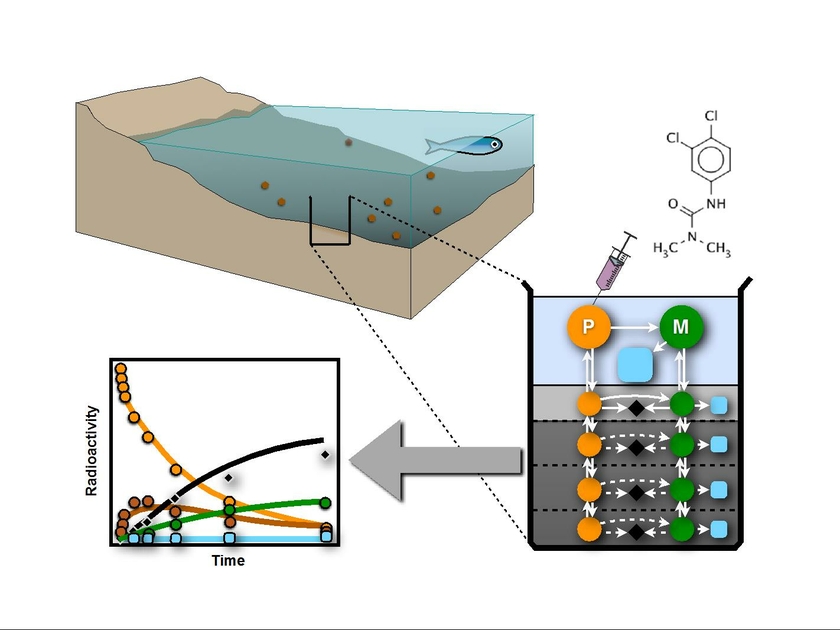
In this project sponsored by Cefic-LRI, the goal is to systematically investigate the suitability of studies carried out according to OECD 308 guidelines to deliver robust information on degradation at the sediment-water interface that is useful for exposure modeling and persistence assessment. For this purpose, different test design variants have been tested for a suite of substances that characteristically differ in their sorption and biotransformation behavior. Also, suites of existing OECD 308 data have been analyzed with kinetic models of increasing complexity and Bayesian data analysis to evaluate the suitability of these data to derive system-independent and meaningful indicators of persistence.

Publications

Extbase Variable Dump
array(2 items)
   publications => '10640,10639,8159' (16 chars)
   libraryUrl => '' (0 chars)
Extbase Variable Dump
array(3 items)
   0 => Snowflake\Publications\Domain\Model\Publicationprototypepersistent entity (uid=10640, pid=124)
      originalId => protected10640 (integer)
      authors => protected'Honti, M.; Hahn, S.; Hennecke, D.; Junker, T.; Shrestha,
          P.; Fenner, K.
' (101 chars) title => protected'Bridging across OECD 308 and 309 data in search of a robust biotransformatio
         n indicator
' (87 chars) journal => protected'Environmental Science and Technology' (36 chars) year => protected2016 (integer) volume => protected50 (integer) issue => protected'13' (2 chars) startpage => protected'6865' (4 chars) otherpage => protected'6872' (4 chars) categories => protected'' (0 chars) description => protected'The OECD guidelines 308 and 309 define simulation tests aimed at assessing b
         iotransformation of chemicals in water-sediment systems. They should serve t
         he estimation of persistence indicators for hazard assessment and half-lives
          for exposure modeling. Although dissipation half-lives of the parent compou
         nd are directly extractable from OECD 308 data, they are system-specific and
          mix up phase transfer with biotransformation. In contrast, aerobic biotrans
         formation half-lives should be easier to extract from OECD 309 experiments w
         ith suspended sediments. Therefore, there is scope for OECD 309 tests with s
         uspended sediment to serve as a proxy for degradation in the aerobic phase o
         f the more complicated OECD 308 test, but that correspondence has remained u
         ntested so far. Our aim was to find a way to extract biotransformation rate
         constants that are universally valid across variants of water-sediment syste
         ms and, hence, provide a more general description of the compound’s behavi
         or in the environment. We developed a unified model that was able to simulat
         e four experimental types (two variants of OECD 308 and two variants of OECD
          309) for three compounds by using a biomass-corrected, generalized aerobic
         biotransformation parameter (<I>k</I>′<SUB>bio</SUB>). We used Bayesian ca
         libration and uncertainty assessment to calibrate the models for individual
         experimental types separately and for combinations of experimental types. Th
         e results suggested that <I>k</I>′<SUB>bio</SUB> was a generally valid par
         ameter for quantifying biotransformation across systems. However, its uncert
         ainty remained significant when calibrated on individual systems alone. Usin
         
         
         from the phase-transfer processes taking place in the individual systems. Ov
         erall, <I>k</I>′<SUB>bio</SUB> has the potential to serve as a system-inde
         pendent descriptor of ae...
' (2156 chars) serialnumber => protected'0013-936X' (9 chars) doi => protected'10.1021/acs.est.6b01097' (23 chars) uid => protected10640 (integer) _localizedUid => protected10640 (integer)modified _languageUid => protectedNULL _versionedUid => protected10640 (integer)modified pid => protected124 (integer)
1 => Snowflake\Publications\Domain\Model\Publicationprototypepersistent entity (uid=10639, pid=124) originalId => protected10639 (integer) authors => protected'Shrestha,&nbsp;P.; Junker,&nbsp;T.; Fenner,&nbsp;K.; Hahn,&nbsp;S.; Honti,&n
         bsp;M.; Bakkour,&nbsp;R.; Diaz,&nbsp;C.; Hennecke,&nbsp;D.
' (134 chars) title => protected'Simulation studies to explore biodegradation in water-sediment systems: from
          OECD 308 to OECD 309
' (97 chars) journal => protected'Environmental Science and Technology' (36 chars) year => protected2016 (integer) volume => protected50 (integer) issue => protected'13' (2 chars) startpage => protected'6856' (4 chars) otherpage => protected'6864' (4 chars) categories => protected'' (0 chars) description => protected'Studies according to OECD 308 and OECD 309 are performed to simulate the bio
         degradation of chemicals in water–sediment systems in support of persisten
         ce assessment and exposure modeling. However, several shortcomings of OECD 3
         08 have been identified that hamper data evaluation and interpretation, and
         its relation to OECD 309 is still unclear. The present study systematically
         compares OECD 308 and OECD 309 and two variants thereof to derive recommenda
         tions on how to experimentally address any shortcomings and improve data for
          persistence and risk assessment. To this end, four <SUP>14</SUP>C-labeled c
         ompounds with different biodegradation and sorption behavior were tested acr
         oss standard OECD 308 and 309 test systems and two modified versions thereof
         . The well-degradable compounds showed slow equilibration and the least mine
         ralization in OECD 308, whereas the modified systems provided the highest de
         gree of mineralization. Different lines of evidence suggest that this was du
         e to increased oxygenation of the sediment in the modified systems. Particul
         arly for rapidly degrading compounds, non-extractable residue formation was
         in line with degradation and did not follow the sediment–water ratio. For
         the two more slowly degrading compounds, sorption in OECD 309 (standard and
         modified) increased with time beyond levels proposed by equilibrium partitio
         ning, which could be attributed to the grinding of the sediment through the
         stirring of the sediment suspension. Overall, the large differences in degra
         dation observed across the four test systems suggest that refined specificat
         ions in test guidelines are required to reduce variability in test outcomes.
          At the same time, the amount of sediment and its degree of oxygenation emer
         ged as drivers across all test systems. This suggests that a unified descrip
         tion of the systems was possible and would pave the way toward a more consis
         tent consideration of degradation in the water–sediment systems across dif
         ferent exposure situatio...
' (2029 chars) serialnumber => protected'0013-936X' (9 chars) doi => protected'10.1021/acs.est.6b01095' (23 chars) uid => protected10639 (integer) _localizedUid => protected10639 (integer)modified _languageUid => protectedNULL _versionedUid => protected10639 (integer)modified pid => protected124 (integer)
2 => Snowflake\Publications\Domain\Model\Publicationprototypepersistent entity (uid=8159, pid=124) originalId => protected8159 (integer) authors => protected'Honti,&nbsp;M.; Fenner,&nbsp;K.' (31 chars) title => protected'Deriving persistence indicators from regulatory water-sediment studies - opp
         ortunities and limitations in OECD 308 data
' (119 chars) journal => protected'Environmental Science and Technology' (36 chars) year => protected2015 (integer) volume => protected49 (integer) issue => protected'10' (2 chars) startpage => protected'5879' (4 chars) otherpage => protected'5886' (4 chars) categories => protected'' (0 chars) description => protected'The OECD guideline 308 describes a laboratory test method to assess aerobic
         and anaerobic transformation of organic chemicals in aquatic sediment system
         s and is an integral part of tiered testing strategies in different legislat
         ive frameworks for the environmental risk assessment of chemicals. The resul
         ts from experiments carried out according to OECD 308 are generally used to
         derive persistence indicators for hazard assessment or half-lives for exposu
         re assessment. We used Bayesian parameter estimation and system representati
         ons of various complexities to systematically assess opportunities and limit
         ations for estimating these indicators from existing data generated accordin
         g to OECD 308 for 23 pesticides and pharmaceuticals. We found that there is
         a disparity between the uncertainty and the conceptual robustness of persist
         ence indicators. Disappearance half-lives are directly extractable with limi
         ted uncertainty, but they lump degradation and phase transfer information an
         d are not robust against changes in system geometry. Transformation half-liv
         es are less system-specific but require inverse modeling to extract, resulti
         ng in considerable uncertainty. Available data were thus insufficient to der
         ive indicators that had both acceptable robustness and uncertainty, which fu
         rther supports previously voiced concerns about the usability and efficiency
          of these costly experiments. Despite the limitations of existing data, we s
         uggest the time until 50% of the parent compound has been transformed in the
          entire system (DegT<SUB>50,system</SUB>) could still be a useful indicator
         of persistence in the upper, partially aerobic sediment layer in the context
          of PBT assessment. This should, however, be accompanied by a mandatory repo
         rting or full standardization of the geometry of the experimental system. We
          recommend transformation half-lives determined by inverse modeling to be us
         ed as input parameters into fate models for exposure assessment, if due cons
         ideration is given to th...
' (2016 chars) serialnumber => protected'0013-936X' (9 chars) doi => protected'10.1021/acs.est.5b00788' (23 chars) uid => protected8159 (integer) _localizedUid => protected8159 (integer)modified _languageUid => protectedNULL _versionedUid => protected8159 (integer)modified pid => protected124 (integer)
Honti, M.; Hahn, S.; Hennecke, D.; Junker, T.; Shrestha, P.; Fenner, K. (2016) Bridging across OECD 308 and 309 data in search of a robust biotransformation indicator, Environmental Science and Technology, 50(13), 6865-6872, doi:10.1021/acs.est.6b01097, Institutional Repository
Shrestha, P.; Junker, T.; Fenner, K.; Hahn, S.; Honti, M.; Bakkour, R.; Diaz, C.; Hennecke, D. (2016) Simulation studies to explore biodegradation in water-sediment systems: from OECD 308 to OECD 309, Environmental Science and Technology, 50(13), 6856-6864, doi:10.1021/acs.est.6b01095, Institutional Repository
Honti, M.; Fenner, K. (2015) Deriving persistence indicators from regulatory water-sediment studies - opportunities and limitations in OECD 308 data, Environmental Science and Technology, 49(10), 5879-5886, doi:10.1021/acs.est.5b00788, Institutional Repository