Department Environmental Chemistry

AProWa - Water-friendly agriculture for the future
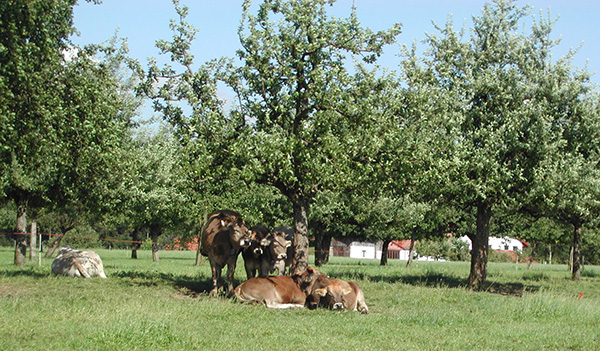
According the Swiss constitution, the Swiss agriculture has to fulfill several, partially conflicting goals such as agricultural production on the one hand and the conservation of natural environments on the other hand. In the context of this project, the relationships between the production aspect and the conservation of aquatic ecosystems was analysed from a broad perspective. The results shall serve as a basis for a future strategic research planning in this field. The following topics could be identified where a collaboration between FOAG, Agroscope and Eawag could be very beneficial: the status of small water bodies (ponds), mitigation options against pollution with pesticides and reducing the hydrological connectivity between fields and open water courses. The entire analysis can be found in the final report.


Last update: 3 December 2015

Final report

Extbase Variable Dump
array(2 items)
   publications => '14812' (5 chars)
   libraryUrl => '' (0 chars)
Extbase Variable Dump
array(1 item)
   0 => Snowflake\Publications\Domain\Model\Publicationprototypepersistent entity (uid=14812, pid=124)
      originalId => protected14812 (integer)
      authors => protected'Dietzel, A.; Zaffarano, P.; Stamm, C.' (52 chars)
      title => protected'Zukunftsfähige gewässerschonende landwirtschaftliche Produktion in der Sch
         weiz. Schlussbericht zum Projekt AProWa
' (115 chars) journal => protected'' (0 chars) year => protected2015 (integer) volume => protected0 (integer) issue => protected'' (0 chars) startpage => protected'75 p' (9 chars) otherpage => protected'' (0 chars) categories => protected'' (0 chars) description => protected'Im Spannungsfeld der landwirtschaftlichen Produktion und des Schutzes der Ge
         wässer in der Schweiz, hatte das Projekt AProWa zum Ziel, Entscheidungshilf
         en zu generieren, aber auch Forschungslücken für die zukünftige Zusammena
         rbeit zwischen landwirtschaftlicher Verwaltung und Wasserforschung zu identi
         fizieren. Um dieses komplexe Themenfeld zu bearbeiten und dabei Forschungser
         gebnisse sowie Wertvorstellungen zu berücksichtigen, wurde eine Methode ang
         ewendet, die auf der multi-kriteriellen Entscheidungsanalyse basiert und der
         en Produkte über das Projekt hinaus von Nutzen sein können.<br />Eine syst
         ematische Aufstellung und Gliederung von Produktions- und Schutzzielen und e
         in Vorschlag an messbaren Indikatoren diente als Bewertungssystem für einen
          umfassenden Katalog an landwirtschaftlichen und gewässerschützerischen Ha
         ndlungsoptionen. Aus der Experteneinschätzung zu den Effekten dieser Handlu
         ngsoptionen, konnten konfliktfreie und konfliktreiche Optionen, sowie inhalt
         liche Forschungslücken identifiziert werden.<br />Die für eine gewässersc
         honende Landwirtschaft konfliktfreien Optionen fielen grösstenteils in den
         Themenbereich des Weidemanagements. [...]
' (1181 chars) serialnumber => protected'' (0 chars) doi => protected'' (0 chars) uid => protected14812 (integer) _localizedUid => protected14812 (integer)modified _languageUid => protectedNULL _versionedUid => protected14812 (integer)modified pid => protected124 (integer)
Dietzel, A.; Zaffarano, P.; Stamm, C. (2015) Zukunftsfähige gewässerschonende landwirtschaftliche Produktion in der Schweiz. Schlussbericht zum Projekt AProWa, 75 p, Institutional Repository