Department Environmental Toxicology

Researchers awarded prize for promotion of alternatives to animal experiments

September 4, 2019 | Stephanie Engeli

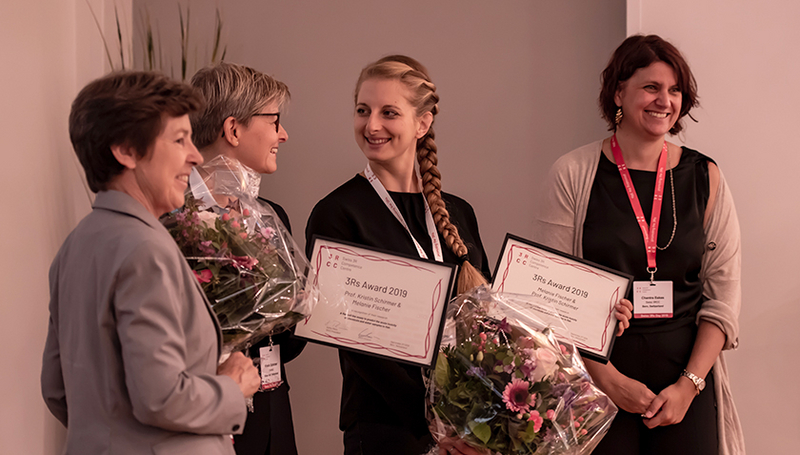
The 3RCC award has been conferred on two Eawag researchers by the 3R Swiss Competence Centre (3RCC) for their outstanding research work. For the first time ever, the researchers managed to obtain ISO certification for a toxicity test using cultured fish gill cells, thanks to their project work in this area. This represents a milestone in the promotion of alternatives to animal experiments. The prize was awarded on September 2nd in Bern.

Eawag has been researching for many years to find alternatives to animal experiments so as to reduce and replace tests on live fish. One such alternative involves the use of cell lines from rainbow trout gills. The cells cultured in the laboratory can be used to reliably determine acute toxicity levels for fish of water samples and chemicals. In the spring of 2019, we reported that this toxicity test had been ISO certified.
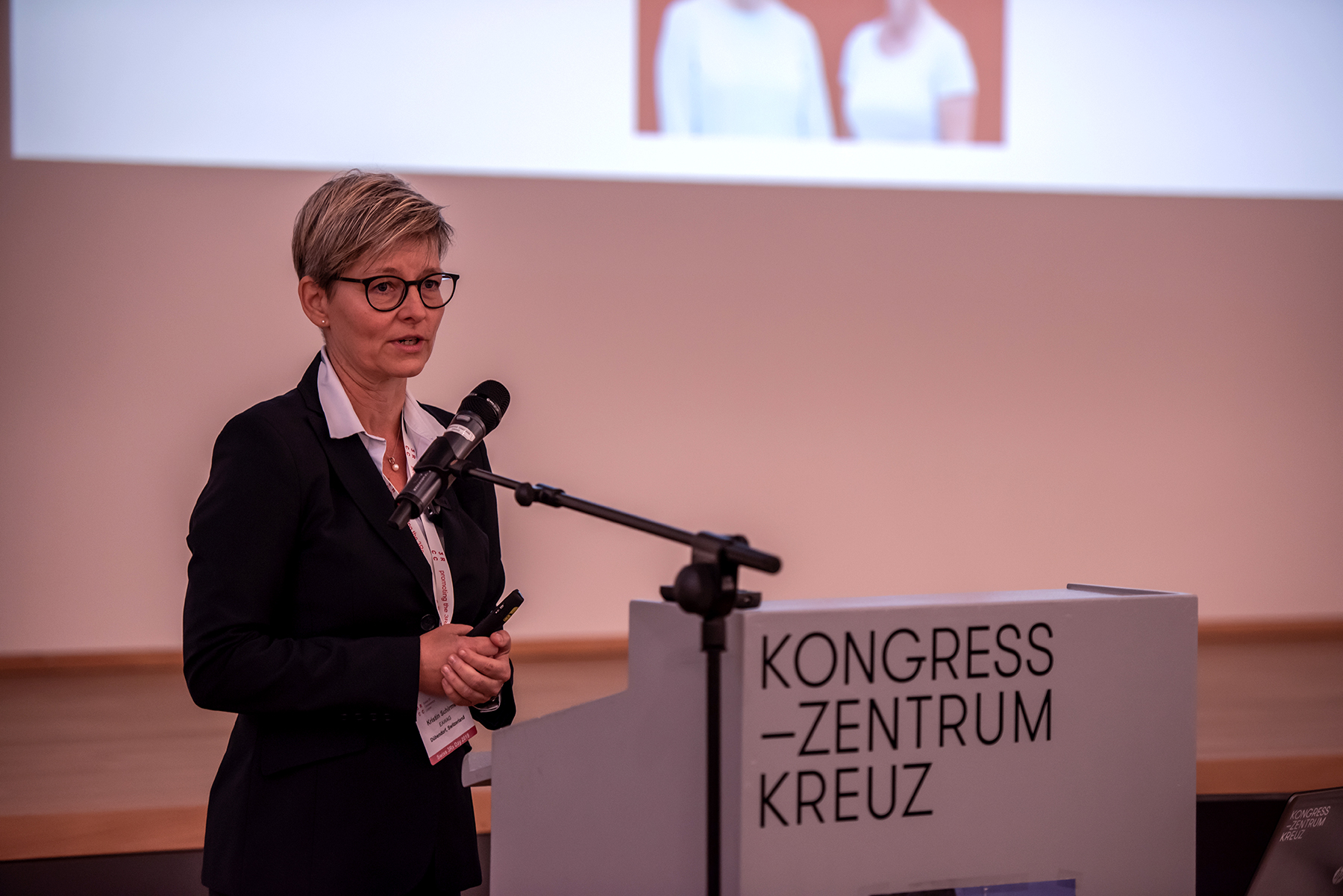
The women responsible for this pioneering work on the use of alternatives to animal experiments are Kristin Schirmer, Head of the Environmental Toxicology Department, and Melanie Fischer, a Laboratory Technician in the same department. The two researchers have now been recognised for their outstanding work by 3RCC. The Competence Centre promotes the “3R” principles of replacing, reducing and refining when it comes to animal experiments in Switzerland, and supports the implementation of these in the biological sciences. The award is designed to honour researchers who have made an important contribution to promoting the 3R principles.

Original publication

Extbase Variable Dump
array(2 items)
   publications => '18765' (5 chars)
   libraryUrl => '' (0 chars)
Extbase Variable Dump
array(1 item)
   0 => Snowflake\Publications\Domain\Model\Publicationprototypepersistent entity (uid=18765, pid=124)
      originalId => protected18765 (integer)
      authors => protected'Fischer, M.; Belanger, S. E.; Berckmans, P.; Bernhard,&n
         bsp;M. J.; Bláha, L.; Coman Schmid, D. E.; Dyer, S
         . D.; Haupt, T.; Hermens, J. L. M.; Hultman, M
         . T.; Laue, H.; Lillicrap, A.; Mlnaříková, M.; Natsch
         , A.; Novák, J.; Sinnige, T. L.; Tollefsen, K.&nbs
         p;E.; von Niederhäusern, V.; Witters, H.; Županič, A.; Sch
         irmer, K.
' (470 chars) title => protected'Repeatability and reproducibility of the RTgill-W1 cell line assay for predi
         cting fish acute toxicity
' (101 chars) journal => protected'Toxicological Sciences' (22 chars) year => protected2019 (integer) volume => protected169 (integer) issue => protected'2' (1 chars) startpage => protected'353' (3 chars) otherpage => protected'364' (3 chars) categories => protected'in vitro alternatives; round-robin study; validation' (52 chars) description => protected'Predicting fish acute toxicity of chemicals <i>in vitro</i> is an attractive
          alternative method to the conventional approach using juvenile and adult fi
         sh. The rainbow trout (<i>Oncorhynchus mykiss</i>) cell line assay with RTgi
         ll-W1 cells has been designed for this purpose. It quantifies cell viability
          using fluorescent measurements for metabolic activity, cell- and lysosomal-
         membrane integrity on the same set of cells. Results from over 70 organic ch
         emicals attest to the high predictive capacity of this test. We here report
         on the repeatability (intralaboratory variability) and reproducibility (inte
         rlaboratory variability) of the RTgill-W1 cell line assay in a round-robin s
         tudy focusing on 6 test chemicals involving 6 laboratories from the industri
         al and academic sector. All participating laboratories were able to establis
         h the assay according to preset quality criteria even though, apart from the
          lead laboratory, none had previously worked with the RTgill-W1 cell line. C
         oncentration-response modeling, based on either nominal or geometric mean-de
         rived measured concentrations, yielded effect concentrations (EC50) that spa
         nned approximately 4 orders of magnitude over the chemical range, covering a
         ll fish acute toxicity categories. Coefficients of variation for intralabora
         tory and interlaboratory variability for the average of the 3 fluorescent ce
         ll viability measurements were 15.5% and 30.8%, respectively, which is compa
         rable to other fish-derived, small-scale bioassays. This study therefore und
         erlines the robustness of the RTgill-W1 cell line assay and its accurate per
         formance when carried out by operators in different laboratory settings.
' (1668 chars) serialnumber => protected'1096-6080' (9 chars) doi => protected'10.1093/toxsci/kfz057' (21 chars) uid => protected18765 (integer) _localizedUid => protected18765 (integer)modified _languageUid => protectedNULL _versionedUid => protected18765 (integer)modified pid => protected124 (integer)
Fischer, M.; Belanger, S. E.; Berckmans, P.; Bernhard, M. J.; Bláha, L.; Coman Schmid, D. E.; Dyer, S. D.; Haupt, T.; Hermens, J. L. M.; Hultman, M. T.; Laue, H.; Lillicrap, A.; Mlnaříková, M.; Natsch, A.; Novák, J.; Sinnige, T. L.; Tollefsen, K. E.; von Niederhäusern, V.; Witters, H.; Županič, A.; Schirmer, K. (2019) Repeatability and reproducibility of the RTgill-W1 cell line assay for predicting fish acute toxicity, Toxicological Sciences, 169(2), 353-364, doi:10.1093/toxsci/kfz057, Institutional Repository