Archive detail

Autarky water module proves itself as a handwashing station

April 12, 2021 | Karin Stäheli

A mobile handwashing station that hygienically recycles its own water without water mains or sewage connection not only has great potential for deployment in countries lacking in infrastructure. The water wall also has great potential in public transport or at events.

The Autarky water module, which treats and recycles grey water in situ, was developed by Eawag researchers with funding from the Bill and Melinda Gates Foundation’s Reinvent the Toilet Challenge. Their aim with the Blue Diversion Autarky Toilet was to create a completely standalone (“autarchical”) toilet that would function without the need for a water mains or sewage connection. In designing their system, they wanted to ensure that the three modules for treating the water, urine and faeces would also function and have the ability to be deployed independently of each other. As well as putting the toilet through field testing, the researchers therefore also tested out the water recycling module as a mobile handwashing station.

Recycling rather than downcycling

Most other systems that treat wastewater on site do "downcycling" and use the treated water for applications with lower water quality requirements than the initial use. However, the water wall has been successfully designed by Eawag to circulate even large volumes of water safely and with the appropriate quality for the same purpose, thus achieving genuine recycling.

The process by which the water is recycled takes several steps: First of all, organic contaminants are broken down in an aerated bioreactor. Then the grey water flows through an ultra-filtration membrane that blocks the passage of pathogens before an activated charcoal filter binds to the remaining organic substances and removes them from the water. An electrolysis cell produces chlorine from the dissolved salts, thus disinfecting the water long term.
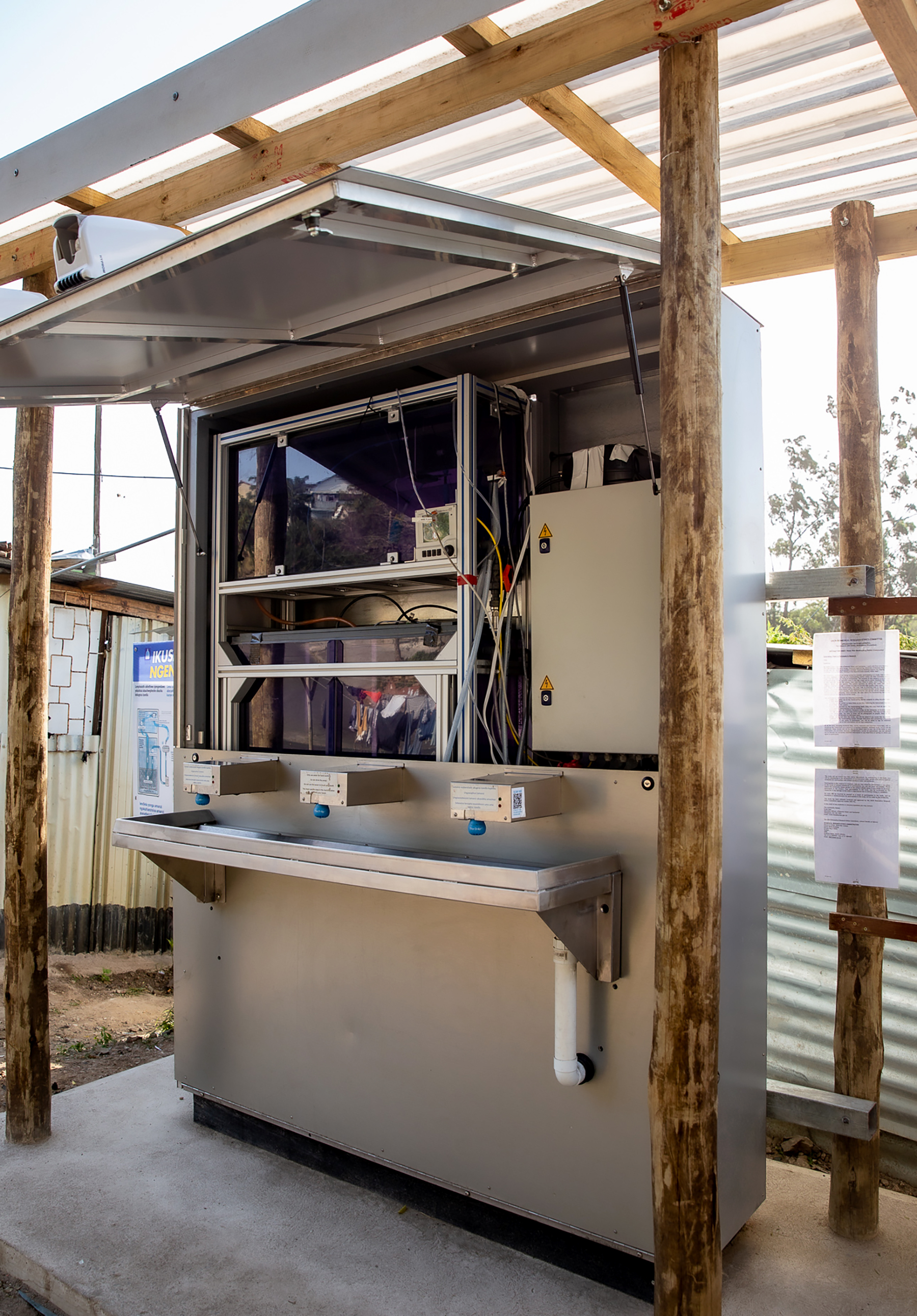
 

The central part of the mobile handwashing station is the water module from the Blue Diversion Autarky Project.
(Photo: Autarky, Eawag)

Practice tests prove successful

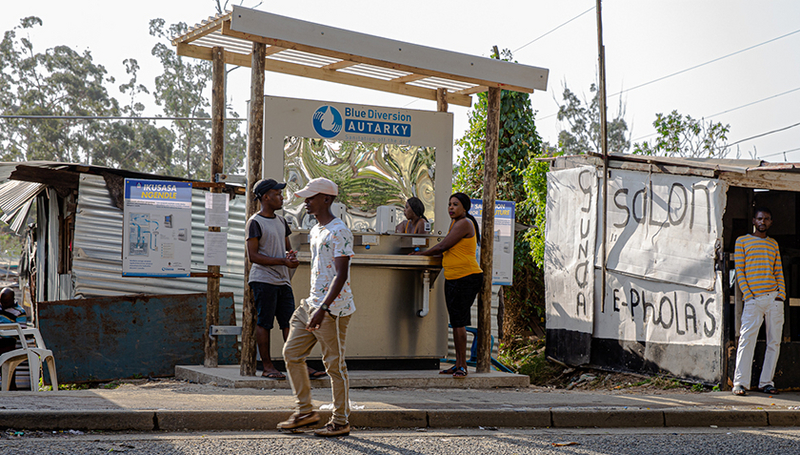
In South Africa, the water module has now proven itself as a standalone unit that can recycle even large volumes of water for handwashing. The water wall was able to treat and recycle around 2,000 litres of water in a roadside location in Durban. The recycled water was clarified and had no cloudiness or colouration, and a slight smell of chlorine lets the users know that the water is hygienic and safe. The handwashing station and its large mirror was well used by the passers-by. The users also referred to the water wall as the “ATM” because of the similarity of its design to modern cash machines.

In 2018, the water wall was also deployed for two months in the City of Zurich: In a public green space where the Hardturm Stadium previously stood, up to two hundred people a day were washing their hands during the trial period. The module stood up to the usage, providing sufficient amounts of recycled and safe water around the clock.

“The water wall passed the tests in Zurich and Durban with flying colours, and so the technology is now ready to be further developed and commercialised by industry partners”, says Eva Reynaert, who was in charge of the field tests. The Blue Diversion Autarky research project will soon be completed, but the development will continue: “We already have several interested parties who would like to further develop the technology with us. We will be contributing our expertise on how the system functions, and with their fresh pairs of eyes, industry partners often bring ideas to the table that can open up new directions. Both sides thereby benefit”, continues Reynaert. And the solutions for some important questions still need to be found: In her dissertation, Reynaert will be focussing on monitoring the water quality in real time, as this is still a significant challenge for all modern water treatment technologies.
 

Cover picture: Autarky, Eawag

Original publication

Extbase Variable Dump
array(2 items)
   publications => '20895' (5 chars)
   libraryUrl => '' (0 chars)
Extbase Variable Dump
array(1 item)
   0 => Snowflake\Publications\Domain\Model\Publicationprototypepersistent entity (uid=20895, pid=124)
      originalId => protected20895 (integer)
      authors => protected'Reynaert, E.; Greenwood, E. E.; Ndwandwe, B.; Riechmann,
          M. E.; Sindall, R. C.; Udert, K. M.; Morgenro
         th, E.
' (163 chars) title => protected'Practical implementation of true on-site water recycling systems for hand wa
         shing and toilet flushing
' (101 chars) journal => protected'Water Research X' (16 chars) year => protected2020 (integer) volume => protected7 (integer) issue => protected'' (0 chars) startpage => protected'100051 (13 pp.)' (15 chars) otherpage => protected'' (0 chars) categories => protected'field test; water recycling; hand washing; toilet flushing; wastewater reuse
         ; biologically activated membrane bioreactor (BAMBI)
' (128 chars) description => protected'On-site wastewater reuse can improve global access to clean water, sanitatio
         n and hygiene. We developed a treatment system (aerated bioreactor, ultrafil
         tration membrane, granular activated carbon and electrolysis for chlorine di
         sinfection) that recycles hand washing and toilet flush water.<br /> Three p
         rototypes were field-tested in non-sewered areas, one in Switzerland (hand w
         ashing) and two in South Africa (hand washing, toilet flushing), over period
         s of 63, 74 and 94 days, respectively.<br /> We demonstrated that the system
          is able to recycle sufficient quantities of safe and appealing hand washing
          and toilet flush water for domestic or public use in real-life applications
         . Chemical contaminants were effectively removed from the used water in all
         prototypes. Removal efficiencies were 99.7% for the chemical oxygen demand (
         COD), 98.5% for total nitrogen (TN) and 99.9% for phosphate in a prototype t
         reating hand washing water, and 99.8% for COD, 95.7% for TN and 89.6% for ph
         osphate in a prototype treating toilet flush water. While this system allowe
         d for true recycling for the same application, most on-site wastewater reuse
          systems downcycle the treated water, i.e., reuse it for an application requ
         iring lower water quality. An analysis of 18 selected wastewater reuse speci
         fications revealed that at best these guidelines are only partially applicab
         le to innovative recycling systems as they are focused on the downcycling of
          water to the environment (e.g., use for irrigation). We believe that a para
         digm shift is necessary and advocate for the implementation of risk-based (a
         nd thus end-use dependent) system performance targets to evaluate water trea
         tment systems, which recycle and not only downcycle water.
' (1730 chars) serialnumber => protected'2589-9147' (9 chars) doi => protected'10.1016/j.wroa.2020.100051' (26 chars) uid => protected20895 (integer) _localizedUid => protected20895 (integer)modified _languageUid => protectedNULL _versionedUid => protected20895 (integer)modified pid => protected124 (integer)
Reynaert, E.; Greenwood, E. E.; Ndwandwe, B.; Riechmann, M. E.; Sindall, R. C.; Udert, K. M.; Morgenroth, E. (2020) Practical implementation of true on-site water recycling systems for hand washing and toilet flushing, Water Research X, 7, 100051 (13 pp.), doi:10.1016/j.wroa.2020.100051, Institutional Repository