Archive detail

Fly larvae make biowaste disposal more climate friendly

February 19, 2019 | Stephanie Schnydrig

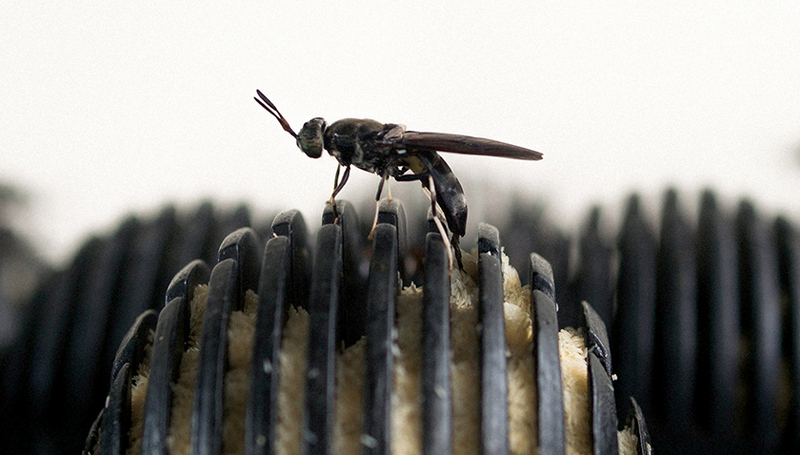
The larvae of black soldier flies feed on organic waste matter. This has the potential not only to alleviate the waste problem in many countries, but also cut greenhouse gas emissions from waste disposal by around half.

As the world’s population continues to grow, the piles of biowaste also tower higher and higher. “In developing countries especially, there often isn’t enough money for proper waste disposal”, says Eawag researcher Christian Zurbrügg, “So, biowaste often ends up on primitive dumps.” Large quantities of greenhouse gases, especially methane, are emitted from such dumps, as well as even from typical composting facilities.

A group of researchers at Eawag working with Christian Zurbrügg are therefore investigating options for treating this kind of waste in the most efficient ways possible. They are focussing on the breeding of black soldier flies, the larvae of which feed on biowaste and break it down. These protein-rich larvae can then be used as animal feed afterwards.

“Emissions balance a mystery until now”

Thanks to these hungry larvae, smaller amounts of greenhouse gases end up in the atmosphere when they are deployed in comparison to a composting facility. However, emissions are given rise to elsewhere in a black soldier fly facility: electricity is needed to shred the waste and sieve the larvae. The residues that remain after the larvae have fed on the waste also need to be treated and disposed of. “The extent to which a black soldier fly facility is more climate friendly than a composting facility has always been a bit of a mystery up to now”, says Zurbrügg.

Together with his team, Zurbrügg therefore conducted a life-cycle analysis to total up all of the energy expenditure and emissions of a process. The team ascertained the levels of greenhouse gases emitted from a black soldier fly facility at a pilot facility in Surabaya, Indonesia. Research carried out at this facility has been supported financially for several years by the Swiss State Secretariat for Economic Affairs (SECO). The researchers obtained the figures for composting facilities from a review of the literature.

The results show that the global warming potential (GWP) is around half as high when biowaste is decomposed by larvae: just under 50 kilogrammes of CO2 equivalent per tonne of treated biowaste is produced with the larvae, in contrast to over 100 kg otherwise.
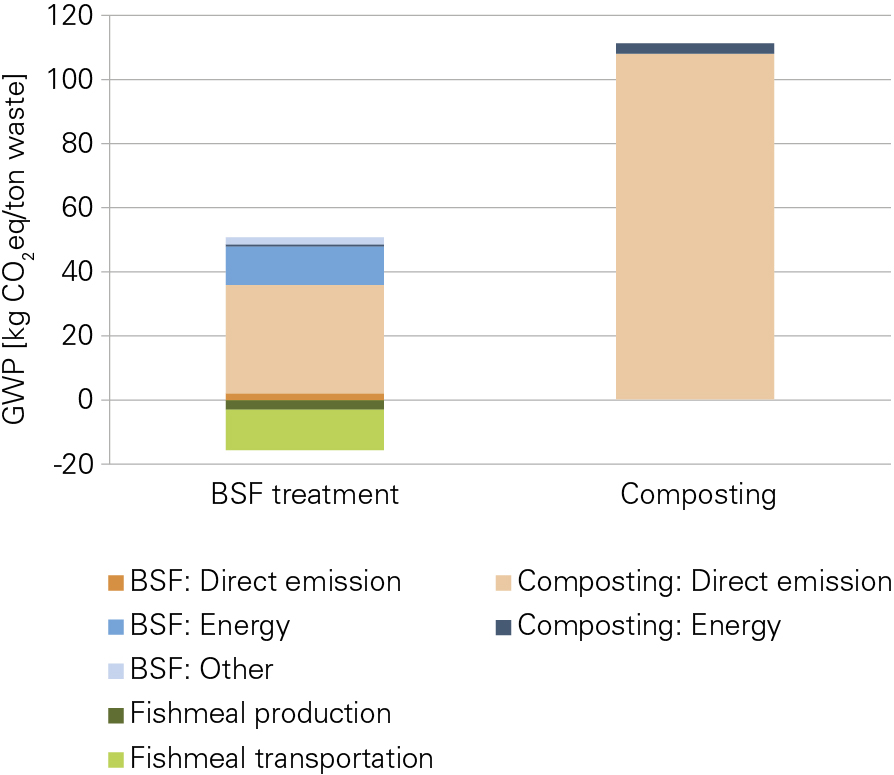
When biowaste is decomposed with the help of soldier-fly larvae, this cuts greenhouse gas emissions by around half compared to conventional composting.
(Source: Mertenant et al., 2019)

Substitute for fish meal

In their life-cycle analysis, the researchers went one step further: “Because the larvae are rich in protein and fat, they can be used as a substitute for fish meal”, says Christian Zurbrügg. In their analysis, they therefore included a calculation of the negative emissions that the larvae meal generates in contrast to fish meal. “This makes a facility like the one in Surabaya even more climate friendly, and reduces the global warming potential of greenhouse gases by 20 percent”, says Zurbrügg.

Original publication

Extbase Variable Dump
array(2 items)
   publications => '18044' (5 chars)
   libraryUrl => '' (0 chars)
Extbase Variable Dump
array(1 item)
   0 => Snowflake\Publications\Domain\Model\Publicationprototypepersistent entity (uid=18044, pid=124)
      originalId => protected18044 (integer)
      authors => protected'Mertenat, A.; Diener, S.; Zurbrügg, C.' (54 chars)
      title => protected'Black Soldier Fly biowaste treatment – assessment of global warming potent
         ial
' (79 chars) journal => protected'Waste Management' (16 chars) year => protected2019 (integer) volume => protected84 (integer) issue => protected'' (0 chars) startpage => protected'173' (3 chars) otherpage => protected'181' (3 chars) categories => protected'municipal solid waste; organic waste; greenhouse gas emissions; global warmi
         ng potential; life cycle assessment; Hermetia illucens
' (130 chars) description => protected'Cities of low and middle-income countries face severe challenges in managing
          the increasing amount of waste produced, especially the organic fraction. B
         lack Soldier Fly (BSF) biowaste treatment is an attractive treatment option
         as it offers a solution for waste management while also providing a protein
         source to help alleviate the rising global demand for animal feed. However,
         to-date very little information is available on how this technology performs
          with regard to direct greenhouse gas (GHG) emissions and global warming pot
         ential (GWP). <br/> This paper presents a study that uses a life cycle asses
         sment (LCA) approach to assess the GWP of a BSF waste treatment facility in
         the case of Indonesia and compares it with respective values for an open win
         drow composting facility. Direct CH<sub>4</sub> and N<sub>2</sub>O samples w
         ere extracted from BSF treatment units and analyzed by gas chromatography. R
         esults show that direct CO<sub>2</sub>eq emissions are 47 times lower the em
         issions from composting. Regarding the overall GWP, the LCA shows that compo
         sting has double the GWP of BSF treatment facility based on the functional u
         nit of 1 ton of biowaste (wet weight). The main GWP contribution from a BSF
         facility are from: (1) residue post-composting (69%) and (2) electricity nee
         ds and source (up to 55%). Fishmeal production substitution by BSF larvae me
         al can reduce significantly the GWP (up to 30%). Based on this study, we con
         clude that BSF biowaste treatment offers an environmentally relevant alterna
         tive with very low direct GHG emissions and potentially high GWP reduction.
         Further research should improve residue post-treatment.
' (1651 chars) serialnumber => protected'0956-053X' (9 chars) doi => protected'10.1016/j.wasman.2018.11.040' (28 chars) uid => protected18044 (integer) _localizedUid => protected18044 (integer)modified _languageUid => protectedNULL _versionedUid => protected18044 (integer)modified pid => protected124 (integer)
Mertenat, A.; Diener, S.; Zurbrügg, C. (2019) Black Soldier Fly biowaste treatment – assessment of global warming potential, Waste Management, 84, 173-181, doi:10.1016/j.wasman.2018.11.040, Institutional Repository