Archive detail

India’s excess fluoride in groundwater

August 16, 2018 | Stephanie Schnydrig

Fluoride occurs naturally in groundwater. In small amounts, this is usually not a problem, but in India the concentration in many places exceeds the threshold at which is starts to present a health hazard. According to estimates by Eawag researchers, based on new computer models, more than a hundred million people are affected.

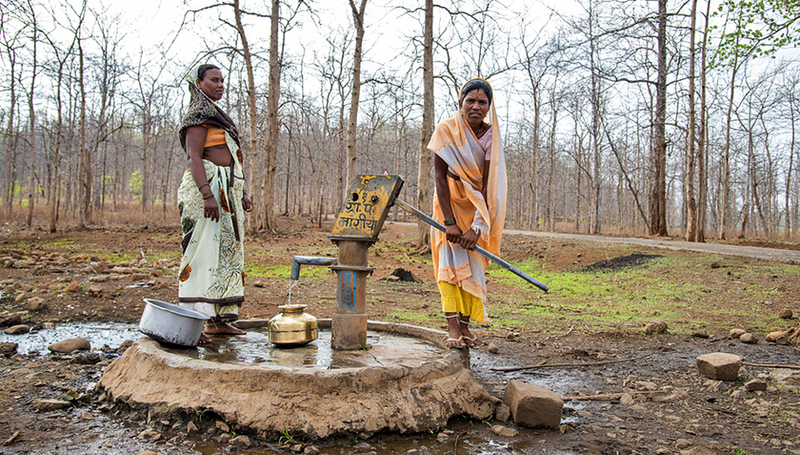
Many Indian lakes and rivers are polluted, and drinking from them is a health hazard. For this reason, more and more people in India are pumping ever-greater quantities of water - assumed to be clean groundwater – from underground wells. But in many places, this is also contaminated – with fluoride. Excess quantities of fluoride present a threat to health and lead to growth disorders, damage to teeth and bone deformation in those affected. Most of the fluoride collects underground as a result of natural weathering and ends up in the groundwater. The World Health Organisation WHO regards a concentration of more than 1.5 milligrams per litre as the threshold level. Eawag researchers working with the geophysicist Joel Podgorski, in collaboration with Indian experts, have shown that in India around 120 million people live in areas in which the groundwater exceeds this limit. The study appeared this week in the professional journal “Environmental Science and Technology”. It was financed partly by the Swiss Agency for Development and Cooperation SDC.

More than 13,000 fluoride measurements as the starting point

In order to determine the extent of fluoride-contaminated groundwater, the researchers developed a computer model based on 13,000 fluoride measurements. The data was collected all over the country by employees of the Indian Central Ground Water Board between 2013 and 2015. Additional information about the geology, topography, temperature and precipitation values also fed into the model. A geostatistical prediction model was thereby created that shows the locations on the Asian subcontinent where there is a high risk of the threshold concentration of fluoride in groundwater being exceeded.

According to this model, there are many areas in the western and southern parts of the country in particular that are thought likely to contain fluoride-contaminated water. Combining this result with current population counts, the researchers calculated that nearly one in ten people in India could be affected by excessive fluoride concentrations. Geophysicist Podgorski stresses that the map cannot be used directly to determine which wells are safe and which unsafe; the resolution is not high enough. But the hazard map allows local officials to carry out specific analyses in high-risk areas.

Not only fluoride, but geologically enriched arsenic, also, is a significant problem in India’s groundwater. The researchers are therefore planning to compile a hazard map for this substance as well. “A hazard map doesn’t help anyone, of course, but it provides the authorities with an extremely good basis for targeted investigations and the development of future water strategies,” says Podgorski. 
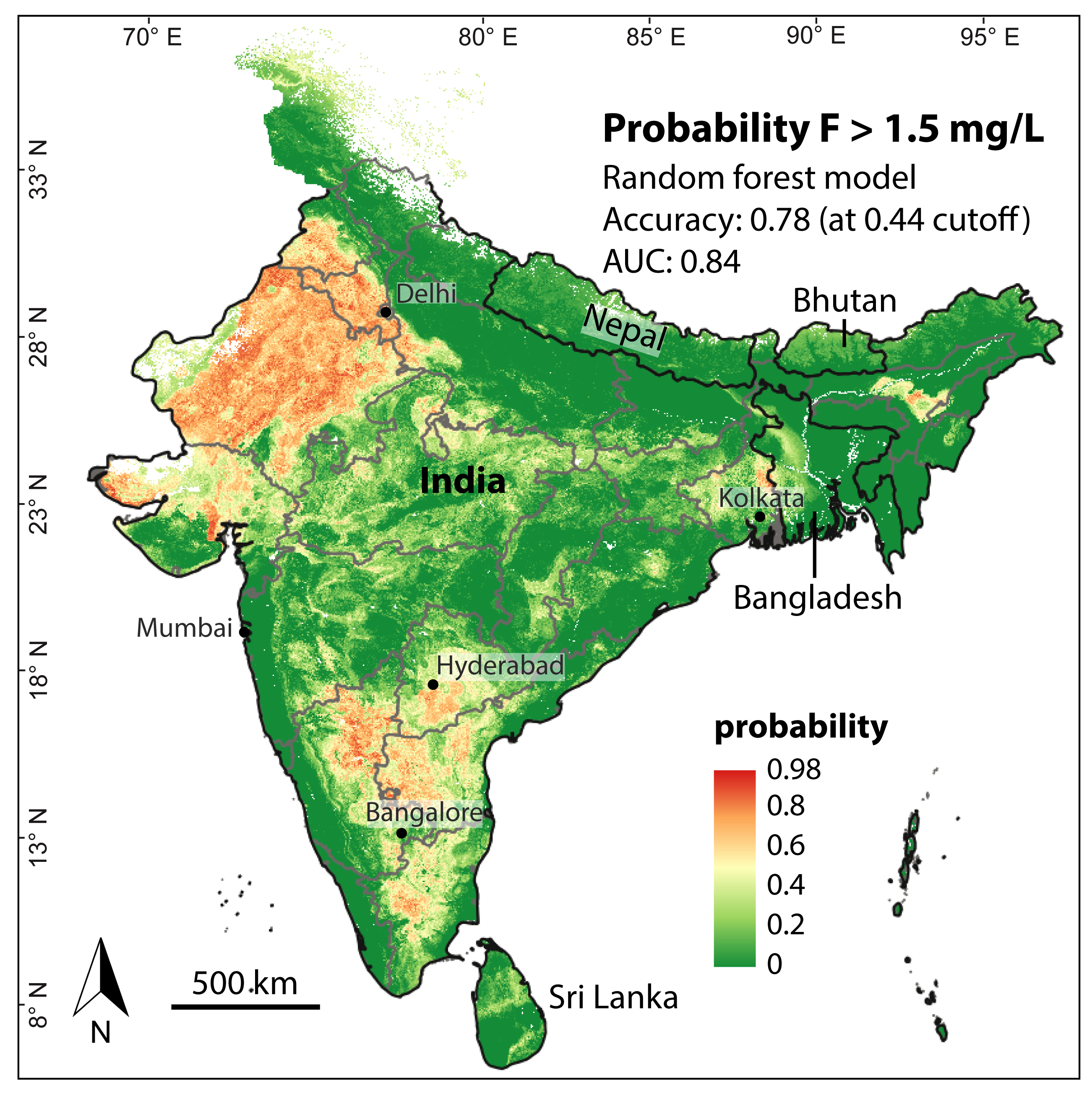
The new computer model created by Eawag researchers generates a map that shows which regions in India have a high likelihood of fluoride in groundwater exceeding the threshold of 1.5 milligrams per litre.
(Image: Podgorski et al., 2018)

Original article

Extbase Variable Dump
array(2 items)
   publications => '17318' (5 chars)
   libraryUrl => '' (0 chars)
Extbase Variable Dump
array(1 item)
   0 => Snowflake\Publications\Domain\Model\Publicationprototypepersistent entity (uid=17318, pid=124)
      originalId => protected17318 (integer)
      authors => protected'Podgorski, J. E.; Labhasetwar, P.; Saha, D.; Berg, 
         M.
' (78 chars) title => protected'Prediction modeling and mapping of groundwater fluoride contamination throug
         hout India
' (86 chars) journal => protected'Environmental Science and Technology' (36 chars) year => protected2018 (integer) volume => protected52 (integer) issue => protected'17' (2 chars) startpage => protected'9889' (4 chars) otherpage => protected'9898' (4 chars) categories => protected'' (0 chars) description => protected'For about the past eight decades, high concentrations of naturally occurring
          fluoride have been detected in groundwater in different parts of India. The
          chronic consumption of fluoride in high concentrations is recognized to cau
         se dental and skeletal fluorosis. We have used the random forest machine-lea
         rning algorithm to model a data set of 12 600 groundwater fluoride concentra
         tions from throughout India along with spatially continuous predictor variab
         les of predominantly geology, climate, and soil parameters. Despite only sur
         face parameters being available to describe a subsurface phenomenon, this ha
         s produced a highly accurate prediction map of fluoride concentrations excee
         ding 1.5 mg/L at 1 km resolution throughout the country. The most affected a
         reas are the northwestern states/territories of Delhi, Gujarat, Haryana, Pun
         jab, and Rajasthan and the southern states of Andhra Pradesh, Karnataka, Tam
         il Nadu, and Telangana. The total number of people at risk of fluorosis due
         to fluoride in groundwater is predicted to be around 120 million, or 9% of t
         he population. This number is based on rural populations and accounts for av
         erage rates of groundwater consumption from nonmanaged sources. The new fluo
         ride hazard and risk maps can be used by authorities in conjunction with det
         ailed groundwater utilization information to prioritize areas in need of mit
         igation measures.
' (1385 chars) serialnumber => protected'0013-936X' (9 chars) doi => protected'10.1021/acs.est.8b01679' (23 chars) uid => protected17318 (integer) _localizedUid => protected17318 (integer)modified _languageUid => protectedNULL _versionedUid => protected17318 (integer)modified pid => protected124 (integer)
Podgorski, J. E.; Labhasetwar, P.; Saha, D.; Berg, M. (2018) Prediction modeling and mapping of groundwater fluoride contamination throughout India, Environmental Science and Technology, 52(17), 9889-9898, doi:10.1021/acs.est.8b01679, Institutional Repository

Video GAP