Archive detail

Otto Jaag Water Protection Prize 2023 and ETH Medal for Charlotte Bopp

November 21, 2023 | Claudia Carle

Environmental scientist Charlotte Bopp has been honoured twice for her dissertation. She received the Otto Jaag Water Protection Prize on ETH Day on 18 November. In January, she will also accept the ETH Medal. Her work makes an important contribution to understanding the biodegradation of organic pollutants in the environment.

The Otto Jaag Water Protection Prize is awarded by ETH Zurich in recognition of outstanding master and doctoral theses in the field of water protection and hydrology. Charlotte Bopp received this award on ETH Day on 18 November for her dissertation on the following topic: “The role of oxygen uncoupling by Rieske non-heme iron dioxygenases in the biodegradation of aromatic contaminants.” In January, she will also be conferred the ETH Medal, which ETH Zurich awards for outstanding master and doctoral theses.

Inefficient oxidation of pollutants

As a doctoral student in the Environmental Chemistry department of the aquatic research institute Eawag, Charlotte Bopp examined the biodegradation of persistent organic pollutants. If such aromatic compounds, which are found in pesticides, medicines and explosives, for example, get into soil and water, microorganisms can oxidise them thanks to a groups of enzymes called “Rieske oxygenases” and thus break them down. Bopp focused on the sub-group of explosive-degrading enzymes and wanted to know how efficiently they worked. Her results do not give the enzymes much support. Instead of transferring the oxygen directly to the pollutants, the enzymes first form a particularly reactive form of oxygen. Only around half of this oxygen subsequently reacts with the pollutants, the other half of the reactive oxygen oxidises all kinds of other substances. This can be detrimental to the microorganisms and damage them.

New enzymes are more efficient

But this process can also have benefits, as Bopp was able to show. If the existing enzyme spectrum of the microorganisms is not suitable for breaking down new pollutants they come in contact with, they can adapt. The reactive oxygen leads to selective mutations in the enzymes, whereby individual amino acids within the enzyme change and new enzymes are created as a result. Some of them work even more efficiently than the original ones. Thanks to this evolutionary process, the microorganisms are able to metabolise the new pollutants after some time.

“With her research, Charlotte Bopp has uncovered connections in the biodegradation of pollutants that were previously unknown,” says Thomas Hofstetter, head of the Environmental Chemistry department at Eawag, who supervised her dissertation. Previously, the capacity to break down pollutants was based purely on the quantity of enzymes present in the environment. “Charlotte Bopp’s results show that we need to take a closer look here and take into account the varying efficiency of the organisms and their enzymes.”

Charlotte Bopp is delighted that her work has been recognised: “We decided to look where enzymes seem to fail.” It is precisely this deficiency that allows microorganisms to deal with a wide range of pollutants on a long-term basis. “We were only able to solve this mystery thanks to Eawag’s interdisciplinary organisation and a team that has earned these awards as a whole,” explains Bopp. Since completing her dissertation, she has been working in industry and is involved in the further development of ozonation processes in drinking and wastewater treatment.
 

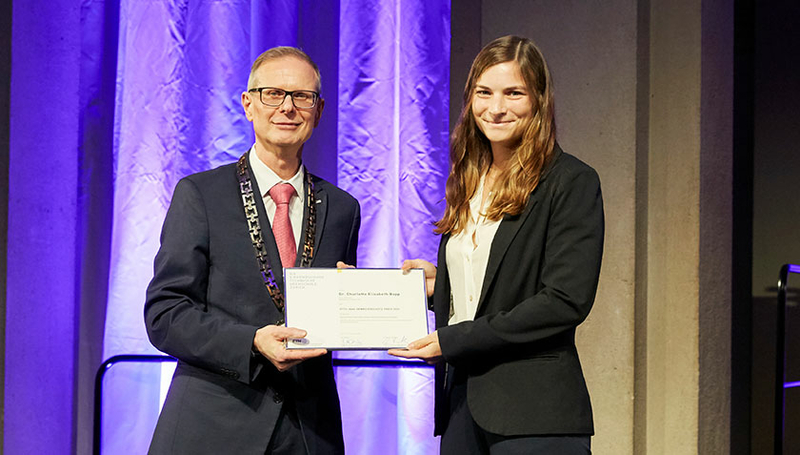
Cover picture: ETH Rector Günther Dissertori presents Charlotte Bopp with the Otto Jaag Water Protection Prize 2023 (photo: ETH, Giulia Marthaler)
 

Original publications

Extbase Variable Dump
array(3 items)
   publications => '25093,24911' (11 chars)
   libraryUrl => '' (0 chars)
   layout => '0' (1 chars)
Extbase Variable Dump
array(2 items)
   0 => Snowflake\Publications\Domain\Model\Publicationprototypepersistent entity (uid=25093, pid=124)
      originalId => protected25093 (integer)
      authors => protected'Bopp, C. E.; Bernet, N. M.; Kohler, H.-P. E.; 
         Hofstetter, T. B.
' (103 chars) title => protected'Elucidating the role of O<sub>2</sub> uncoupling in the oxidative biodegrada
         tion of organic contaminants by Rieske non-heme iron dioxygenases
' (141 chars) journal => protected'ACS Environmental Au' (20 chars) year => protected2022 (integer) volume => protected2 (integer) issue => protected'5' (1 chars) startpage => protected'428' (3 chars) otherpage => protected'440' (3 chars) categories => protected'non-heme ferrous iron oxygenases; Rieske oxygenases; biocatalysis; O2 uncoup
         ling; O2 activation; kinetic isotope effect; biodegradation
' (135 chars) description => protected'Oxygenations of aromatic soil and water contaminants with molecular O<sub>2<
         /sub> catalyzed by Rieske dioxygenases are frequent initial steps of biodegr
         adation in natural and engineered environments. Many of these non-heme ferro
         us iron enzymes are known to be involved in contaminant metabolism, but the
         understanding of enzyme-substrate interactions that lead to successful biode
         gradation is still elusive. Here, we studied the mechanisms of O<sub>2</sub>
          activation and substrate hydroxylation of two nitroarene dioxygenases to ev
         aluate enzyme- and substrate-specific factors that determine the efficiency
         of oxygenated product formation. Experiments in enzyme assays of 2-nitrotolu
         ene dioxygenase (2NTDO) and nitrobenzene dioxygenase (NBDO) with methyl-, fl
         uoro-, chloro-, and hydroxy-substituted nitroaromatic substrates reveal that
          typically 20-100% of the enzyme's activity involves unproductive paths of O
         <sub>2</sub> activation with generation of reactive oxygen species through s
         o-called O<sub>2</sub> uncoupling. The <sup>18</sup>O and <sup>13</sup>C kin
         etic isotope effects of O<sub>2</sub> activation and nitroaromatic substrate
          hydroxylation, respectively, suggest that O<sub>2</sub> uncoupling occurs a
         fter generation of Fe<sup>III</sup>-(hydro)peroxo species in the catalytic c
         ycle. While 2NTDO hydroxylates <em>ortho</em>-substituted nitroaromatic subs
         trates more efficiently, NBDO favors <em>meta</em>-substituted, presumably d
         ue to distinct active site residues of the two enzymes. Our data implies, ho
         wever, that the O<sub>2</sub> uncoupling and hydroxylation activity cannot b
         e assessed from simple structure-reactivity relationships. By quantifying O<
         sub>2</sub> uncoupling by Rieske dioxygenases, our work provides a mechanist
         ic link between contaminant biodegradation, the generation of reactive oxyge
         n species, and possible adaptation strategies of microorganisms to the expos
         ure of new contaminants.
' (1924 chars) serialnumber => protected'' (0 chars) doi => protected'10.1021/acsenvironau.2c00023' (28 chars) uid => protected25093 (integer) _localizedUid => protected25093 (integer)modified _languageUid => protectedNULL _versionedUid => protected25093 (integer)modified pid => protected124 (integer)
1 => Snowflake\Publications\Domain\Model\Publicationprototypepersistent entity (uid=24911, pid=124) originalId => protected24911 (integer) authors => protected'Pati,&nbsp;S.&nbsp;G.; Bopp,&nbsp;C.&nbsp;E.; Kohler,&nbsp;H.-P.&nbsp;E.; Ho
         fstetter,&nbsp;T.&nbsp;B.
' (101 chars) title => protected'Substrate-specific coupling of O<sub>2</sub> activation to hydroxylations of
          aromatic compounds by rieske non-heme iron dioxygenases
' (132 chars) journal => protected'ACS Catalysis' (13 chars) year => protected2022 (integer) volume => protected12 (integer) issue => protected'11' (2 chars) startpage => protected'6444' (4 chars) otherpage => protected'6456' (4 chars) categories => protected'non-heme ferrous iron oxygenases; nitrobenzene dioxygenase; biocatalysis; O2
          uncoupling; isotope effects; xenobiotics
' (117 chars) description => protected'Rieske dioxygenases catalyze the initial steps in the hydroxylation of aroma
         tic compounds and are critical for the metabolism of xenobiotic substances.
         Because substrates do not bind to the mononuclear non-heme Fe<sup>II</sup> c
         enter, elementary steps leading to O<sub>2</sub> activation and substrate hy
         droxylation are difficult to delineate, thus making it challenging to ration
         alize divergent observations on enzyme mechanisms, reactivity, and substrate
          specificity. Here, we show for nitrobenzene dioxygenase, a Rieske dioxygena
         se capable of transforming nitroarenes to nitrite and substituted catechols,
          that unproductive O<sub>2</sub> activation with the release of the unreacte
         d substrate and reactive oxygen species represents an important path in the
         catalytic cycle. Through correlation of O<sub>2</sub> uncoupling for a serie
         s of substituted nitroaromatic compounds with <sup>18</sup>O and <sup>13</su
         p>C kinetic isotope effects of dissolved O<sub>2</sub> and aromatic substrat
         es, respectively, we show that O<sub>2</sub> uncoupling occurs after the rat
         e-limiting formation of Fe<sup>III</sup>-(hydro)peroxo species from which su
         bstrates are hydroxylated. Substituent effects on the extent of O<sub>2</sub
         > uncoupling suggest that the positioning of the substrate in the active sit
         e rather than the susceptibility of the substrate for attack by electrophili
         c oxygen species is responsible for unproductive O<sub>2</sub> uncoupling. T
         he proposed catalytic cycle provides a mechanistic basis for assessing the v
         ery different efficiencies of substrate hydroxylation vs unproductive O<sub>
         2</sub> activation and generation of reactive oxygen species in reactions ca
         talyzed by Rieske dioxygenases.
' (1703 chars) serialnumber => protected'2155-5435' (9 chars) doi => protected'10.1021/acscatal.2c00383' (24 chars) uid => protected24911 (integer) _localizedUid => protected24911 (integer)modified _languageUid => protectedNULL _versionedUid => protected24911 (integer)modified pid => protected124 (integer)
Bopp, C. E.; Bernet, N. M.; Kohler, H.-P. E.; Hofstetter, T. B. (2022) Elucidating the role of O2 uncoupling in the oxidative biodegradation of organic contaminants by Rieske non-heme iron dioxygenases, ACS Environmental Au, 2(5), 428-440, doi:10.1021/acsenvironau.2c00023, Institutional Repository
Pati, S. G.; Bopp, C. E.; Kohler, H.-P. E.; Hofstetter, T. B. (2022) Substrate-specific coupling of O2 activation to hydroxylations of aromatic compounds by rieske non-heme iron dioxygenases, ACS Catalysis, 12(11), 6444-6456, doi:10.1021/acscatal.2c00383, Institutional Repository