Archive detail

Prize-winning thesis: oxidation done properly!

July 17, 2024 | Andri Bryner

Environmental chemist Joanna Houska has received an award for her doctoral thesis from the German Water Chemistry Society. She conducted her research at Eawag and EPFL, demonstrating both theoretically and experimentally how oxidative water treatment using ozone or chlorine can be more efficiently utilized when there is a precise understanding of the organic substances dissolved in the water to be treated.

"This work is a milestone along the road to advancing our understanding of the role of dissolved organic matter in oxidative water treatment," stated Joanna Houska's supervisor, Urs von Gunten, who is a professor at EPFL and head of the Drinking Water Chemistry Group at Eawag. According to von Gunten, Houska possesses "a remarkable ability to tackle complex scientific questions both theoretically and experimentally, successfully resolving issues with great independence.” Her experiments and modelling have produced and interpreted exciting new data, offering insights that can be employed to improve oxidative water treatment methods.

Inefficient and hazardous without accurate analysis

What is the underlying issue? When chlorine or ozone are used for water disinfection/oxidation, the primary goal is to render pathogens and micro-pollutants harmless. However, a substantial proportion of the oxidants reacts with water matrix components such as dissolved organic materials. This not only reduces the efficiency of the treatment process, but, in the worst-case scenario, can also lead to the formation of toxic by-products. For efficient oxidation, it is therefore crucial to have a precise understanding of the dissolved substances in the water being treated. Traditional approaches have hitherto relied mainly on aggregate parameters derived, for example, from UV absorption. However, Houska addressed this gap in her thesis, firstly developing methods to measure the concentrations of relevant compounds, and then characterising and evaluating the compounds as to whether and to what extent they could form problematic by-products. Lastly, she revealed insights into oxygen isotopes in hydrogen peroxide, demonstrating how the problematic precursor substances can be distinguished from one another. Notably, in her research, Houska went beyond the disinfection/oxidation of drinking water to also investigate the formation of ozone by-products at a wastewater treatment plant and their subsequent degradation in biological post-treatment of treated wastewater.

A first for Switzerland

The doctoral prize in the field of water chemistry has been awarded every year since 1992, and carries with it EUR 1,500. 2024 sees it being awarded for the first time in Switzerland. Joanna Houska already knows how she will use the prize money: "My bicycle urgently needs an upgrade, so the prize money will likely be invested in that.” She currently works in the environmental department at Roche, in the area of wastewater and water protection.
 

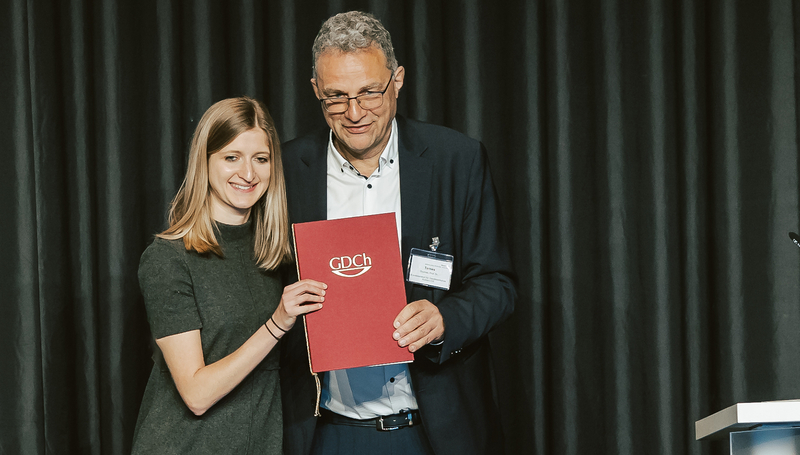
Cover picture: Joanna Houska at the award ceremony with Prof. Thomas Ternes, at the Annual Meeting of the German Water Chemistry Society in Limburg (photo: Nina Hermes, BfG).
 

Original publication

Extbase Variable Dump
array(3 items)
   publications => '23921,30070,30998,30345' (23 chars)
   libraryUrl => '' (0 chars)
   layout => '0' (1 chars)
Extbase Variable Dump
array(4 items)
   0 => Snowflake\Publications\Domain\Model\Publicationprototypepersistent entity (uid=23921, pid=124)
      originalId => protected23921 (integer)
      authors => protected'Houska, J.; Salhi, E.; Walpen, N.; von Gunten, U.' (69 chars)
      title => protected'Oxidant-reactive carbonous moieties in dissolved organic matter: selective q
         uantification by oxidative titration using chlorine dioxide and ozone
' (145 chars) journal => protected'Water Research' (14 chars) year => protected2021 (integer) volume => protected207 (integer) issue => protected'' (0 chars) startpage => protected'117790 (11 pp.)' (15 chars) otherpage => protected'' (0 chars) categories => protected'dissolved organic matter; oxidative titration; chlorine dioxide; ozone; elec
         tron-donating capacity; molecular tagging; electron-rich moieties; phenols;
         oxidation byproducts
' (172 chars) description => protected'The application of oxidants for disinfection or micropollutant abatement dur
         ing drinking water and wastewater treatment is accompanied by oxidation of m
         atrix components such as dissolved organic matter (DOM). To improve predicti
         ons of the efficiency of oxidation processes and the formation of oxidation
         products, methods to determine concentrations of oxidant-reactive phenolic,
         olefinic or amine-type DOM moieties are critical.<br />Here, a novel selecti
         ve oxidative titration approach is presented, which is based on reaction kin
         etics of oxidation reactions towards certain DOM moieties. Phenolic moieties
          were determined by oxidative titration with ClO<sub>2</sub> and O<sub>3</su
         b> for five DOM isolates and two secondary wastewater effluent samples. The
         determined concentrations of phenolic moieties correlated with the electron-
         donating capacity (EDC) and the formation of inorganic ClO<sub>2</sub>-bypro
         ducts (HOCl, ClO<sub>2</sub><sup>−</sup>, ClO<sub>3</sub><sup>−</sup>).
         ClO<sub>2</sub>-byproduct yields from phenol and DOM isolates and changes du
         e to the application of molecular tagging for phenols revealed a better unde
         rstanding of oxidant-reactive structures within DOM.<br />Overall, oxidative
          titrations with ClO<sub>2</sub> and O<sub>3</sub> provide a novel and promi
         sing tool to quantify oxidant-reactive moieties in complex mixtures such as
         DOM and can be expanded to other matrices or oxidants.
' (1422 chars) serialnumber => protected'0043-1354' (9 chars) doi => protected'10.1016/j.watres.2021.117790' (28 chars) uid => protected23921 (integer) _localizedUid => protected23921 (integer)modified _languageUid => protectedNULL _versionedUid => protected23921 (integer)modified pid => protected124 (integer)
1 => Snowflake\Publications\Domain\Model\Publicationprototypepersistent entity (uid=30070, pid=124) originalId => protected30070 (integer) authors => protected'Houska,&nbsp;J.; Manasfi,&nbsp;T.; Gebhardt,&nbsp;I.; von Gunten,&nbsp;U.' (73 chars) title => protected'Ozonation of lake water and wastewater: identification of carbonous and nitr
         ogenous carbonyl-containing oxidation byproducts by non-target screening
' (148 chars) journal => protected'Water Research' (14 chars) year => protected2023 (integer) volume => protected232 (integer) issue => protected'' (0 chars) startpage => protected'119484 (17 pp.)' (15 chars) otherpage => protected'' (0 chars) categories => protected'high resolution mass spectrometry; ozonation; carbonyl compounds; dissolved
         organic matter; lake water; wastewater; phenols
' (123 chars) description => protected'Ozonation of drinking water and wastewater is accompanied by the formation o
         f disinfection byproducts (DBPs) such as low molecular weight aldehydes and
         ketones from the reactions of ozone with dissolved organic matter (DOM). By
         applying a recently developed non-target workflow, 178 carbonous and nitroge
         nous carbonyl compounds were detected during bench-scale ozonation of two la
         ke waters and three secondary wastewater effluent samples and full-scale ozo
         nation of secondary treated wastewater effluent. An overlapping subset of ca
         rbonyl compounds (20%) was detected in all water types. Moreover, wastewater
          effluents showed a significantly higher fraction of <em>N</em>-containing c
         arbonyl compounds (30%) compared to lake water (17%). All carbonyl compounds
          can be classified in 5 main formation trends as a function of increasing sp
         ecific ozone doses. Formation trends upon ozonation and comparison of result
         s in presence and absence of the <sup>•</sup>OH radical scavenger DMSO in
         combination with kinetic and mechanistic information allowed to elucidate po
         tential carbonyl structures. A link between the detected carbonyl compounds
         and their precursors was established by ozonating six model compounds (pheno
         l, 4-ethylphenol, 4-methoxyphenol, sorbic acid, 3-buten-2-ol and acetylaceto
         ne). About one third of the detected carbonous carbonyl compounds detected i
         n real waters was also detected by ozonating model compounds.<br />Evaluatio
         n of the non-target analysis data revealed the identity of 15 carbonyl compo
         unds, including hydroxylated aldehydes and ketones (e.g. hydroxyacetone, con
         fidence level (CL) = 1), unsaturated dicarbonyls (e.g. acrolein, CL = 1;
          2-butene-1,4-dial, CL = 1; 4-oxobut-2-enoic acid, CL = 2) and also a ni
         trogen-containing carbonyl compound (2-oxo-propanamide, CL =1).<br />Overall
         , this study shows the formation of versatile carbonous and nitrogenous carb
         onyl compounds upon ozonation involving ozone and <sup>•</sup>OH reactions
         . Carbonyl compounds wit...
' (2196 chars) serialnumber => protected'0043-1354' (9 chars) doi => protected'10.1016/j.watres.2022.119484' (28 chars) uid => protected30070 (integer) _localizedUid => protected30070 (integer)modified _languageUid => protectedNULL _versionedUid => protected30070 (integer)modified pid => protected124 (integer)
2 => Snowflake\Publications\Domain\Model\Publicationprototypepersistent entity (uid=30998, pid=124) originalId => protected30998 (integer) authors => protected'Houska,&nbsp;J.; Stocco,&nbsp;L.; Hofstetter,&nbsp;T.&nbsp;B.; Gunten,&nbsp;
         U.&nbsp;von
' (87 chars) title => protected'Hydrogen peroxide formation during ozonation of olefins and phenol: mechanis
         tic insights from oxygen isotope signatures
' (119 chars) journal => protected'Environmental Science and Technology' (36 chars) year => protected2023 (integer) volume => protected57 (integer) issue => protected'' (0 chars) startpage => protected'18950' (5 chars) otherpage => protected'18959' (5 chars) categories => protected'ozonation; hydrogen peroxide; reaction mechanisms; olefins; phenol; oxygen i
         sotopes; isotope ratio mass spectrometry
' (116 chars) description => protected'Mitigation of undesired byproducts from ozonation of dissolved organic matte
         r (DOM) such as aldehydes and ketones is currently hampered by limited knowl
         edge of their precursors and formation pathways. Here, the stable oxygen iso
         tope composition of H<sub>2</sub>O<sub>2</sub> formed simultaneously with th
         ese byproducts was studied to determine if it can reveal this missing inform
         ation. A newly developed procedure, which quantitatively transforms H<sub>2<
         /sub>O<sub>2</sub> to O<sub>2</sub> for subsequent <sup>18</sup>O/<sup>16</s
         up>O ratio analysis, was used to determine the δ<sup>18</sup>O of H<sub>2</
         sub>O<sub>2</sub> generated from ozonated model compounds (olefins and pheno
         l, pH 3-8). A constant enrichment of <sup>18</sup>O in H<sub>2</sub>O<sub>2<
         /sub> with a δ<sup>18</sup>O value of ∼59‰ implies that <sup>16</sup>O-
         <sup>16</sup>O bonds are cleaved preferentially in the intermediate Criegee
         ozonide, which is commonly formed from olefins. H<sub>2</sub>O<sub>2</sub> f
         rom the ozonation of acrylic acid and phenol at pH 7 resulted in lower <sup>
         18</sup>O enrichment (δ<sup>18</sup>O = 47-49‰). For acrylic acid, enhanc
         ement of one of the two pathways followed by a carbonyl-H<sub>2</sub>O<sub>2
         </sub> equilibrium was responsible for the smaller δ<sup>18</sup>O of H<sub
         >2</sub>O<sub>2</sub>. During phenol ozonation at pH 7, various competing re
         actions leading to H<sub>2</sub>O<sub>2</sub> via an intermediate ozone addu
         ct are hypothesized to cause lower δ<sup>18</sup>O in H<sub>2</sub>O<sub>2<
         /sub>. These insights provide a first step toward supporting pH-dependent H<
         sub>2</sub>O<sub>2</sub> precursor elucidation in DOM.
' (1650 chars) serialnumber => protected'0013-936X' (9 chars) doi => protected'10.1021/acs.est.3c00788' (23 chars) uid => protected30998 (integer) _localizedUid => protected30998 (integer)modified _languageUid => protectedNULL _versionedUid => protected30998 (integer)modified pid => protected124 (integer)
3 => Snowflake\Publications\Domain\Model\Publicationprototypepersistent entity (uid=30345, pid=124) originalId => protected30345 (integer) authors => protected'Manasfi,&nbsp;T.; Houska,&nbsp;J.; Gebhardt,&nbsp;I.; von Gunten,&nbsp;U.' (73 chars) title => protected'Formation of carbonyl compounds during ozonation of lake water and wastewate
         r: development of a non-target screening method and quantification of target
          compounds
' (162 chars) journal => protected'Water Research' (14 chars) year => protected2023 (integer) volume => protected237 (integer) issue => protected'' (0 chars) startpage => protected'119751 (14 pp.)' (15 chars) otherpage => protected'' (0 chars) categories => protected'carbonyl compounds; disinfection byproducts; ozonation; dissolved organic ma
         tter; non-target analysis; high-resolution mass spectrometry
' (136 chars) description => protected'Ozonation of natural waters is typically associated with the formation of ca
         rbonyl compounds (aldehydes, ketones and ketoacids), a main class of organic
          disinfection byproducts (DBPs). However, the detection of carbonyl compound
         s in water and wastewater is challenged by multiple difficulties inherent to
          their physicochemical properties. A non-target screening method involving t
         he derivatisation of carbonyl compounds with <em>p</em>-toluenesulfonylhydra
         zine (TSH) followed by their analysis using liquid chromatography coupled to
          electrospray ionisation high-resolution mass spectrometry (LC-ESI-HRMS) and
          an advanced non-target screening and data processing workflow was developed
         . The workflow was applied to investigate the formation of carbonyl compound
         s during ozonation of different water types including lake water, aqueous so
         lutions containing Suwannee River Fulvic acid (SRFA), and wastewater. A high
         er sensitivity for most target carbonyl compounds was achieved compared to p
         revious derivatisation methods. Moreover, the method allowed the identificat
         ion of known and unknown carbonyl compounds. 8 out of 17 target carbonyl com
         pounds were consistently detected above limits of quantification (LOQs) in m
         ost ozonated samples. Generally, the concentrations of the 8 detected target
          compounds decreased in the order: formaldehyde &gt; acetaldehyde &gt; glyox
         ylic acid &gt; pyruvic acid &gt; glutaraldehyde &gt; 2,3-butanedione &gt; gl
         yoxal &gt; 1-acetyl-1-cyclohexene. The DOC concentration-normalised formatio
         n of carbonyl compounds during ozonation was higher in wastewater and SRFA-c
         ontaining water than in lake water. The specific ozone doses and the type of
          the dissolved organic matter (DOM) played a predominant role for the extent
          of formation of carbonyl compounds. Five formation trends were distinguishe
         d for different carbonyl compounds. Some compounds were produced continuousl
         y upon ozonation even at high ozone doses, while others reached a maximum co
         ncentration at a certain...
' (2551 chars) serialnumber => protected'0043-1354' (9 chars) doi => protected'10.1016/j.watres.2023.119751' (28 chars) uid => protected30345 (integer) _localizedUid => protected30345 (integer)modified _languageUid => protectedNULL _versionedUid => protected30345 (integer)modified pid => protected124 (integer)
Houska, J.; Salhi, E.; Walpen, N.; von Gunten, U. (2021) Oxidant-reactive carbonous moieties in dissolved organic matter: selective quantification by oxidative titration using chlorine dioxide and ozone, Water Research, 207, 117790 (11 pp.), doi:10.1016/j.watres.2021.117790, Institutional Repository
Houska, J.; Manasfi, T.; Gebhardt, I.; von Gunten, U. (2023) Ozonation of lake water and wastewater: identification of carbonous and nitrogenous carbonyl-containing oxidation byproducts by non-target screening, Water Research, 232, 119484 (17 pp.), doi:10.1016/j.watres.2022.119484, Institutional Repository
Houska, J.; Stocco, L.; Hofstetter, T. B.; Gunten, U. von (2023) Hydrogen peroxide formation during ozonation of olefins and phenol: mechanistic insights from oxygen isotope signatures, Environmental Science and Technology, 57, 18950-18959, doi:10.1021/acs.est.3c00788, Institutional Repository
Manasfi, T.; Houska, J.; Gebhardt, I.; von Gunten, U. (2023) Formation of carbonyl compounds during ozonation of lake water and wastewater: development of a non-target screening method and quantification of target compounds, Water Research, 237, 119751 (14 pp.), doi:10.1016/j.watres.2023.119751, Institutional Repository