
Archive detail

Producing bioplastics from wastewater

February 21, 2023 | Claudia Carle

Wastewater treatment plants can do more than just wastewater treatment. In the future, they should also recover resources. One approach that researchers at Eawag are pursuing is the conversion of the organic carbon contained in wastewater into bioplastics with the help of bacteria.

The treatment of wastewater to protect human health and water bodies remains the primary task of wastewater treatment plants. In addition, the recovery of resources is becoming increasingly important on the path to circular economy. Wastewater, for example, contains a lot of organic carbon that is often converted into methane for further energy production. Antoine Brison and Nicolas Derlon from Eawag’s Process Engineering Department have now investigated whether and how bioplastics could be obtained instead from organic carbon as a higher-value product. To do this, they work with bacteria that are able to store organic carbon as polyhydroxyalkanoates (PHA). These biopolymers serve as energy and carbon source for the bacteria. They can be extracted from the bacterial cells and further processed to biodegradable plastic.

If bioplastics could be produced from wastewater, this would offer several advantages over current production methods. PHAs are at present produced from primary feedstock such as sugar or vegetable oils under sterile conditions. This results in high production costs, which is why PHA bioplastics, despite their attractive properties, cannot compete with petroleum-based plastics so far and therefore remain a niche product. The use of organic carbon from wastewater, which is available for free, and the use of mixed microbial cultures, which do not require energy-intensive, sterile conditions, are therefore a promising approach.

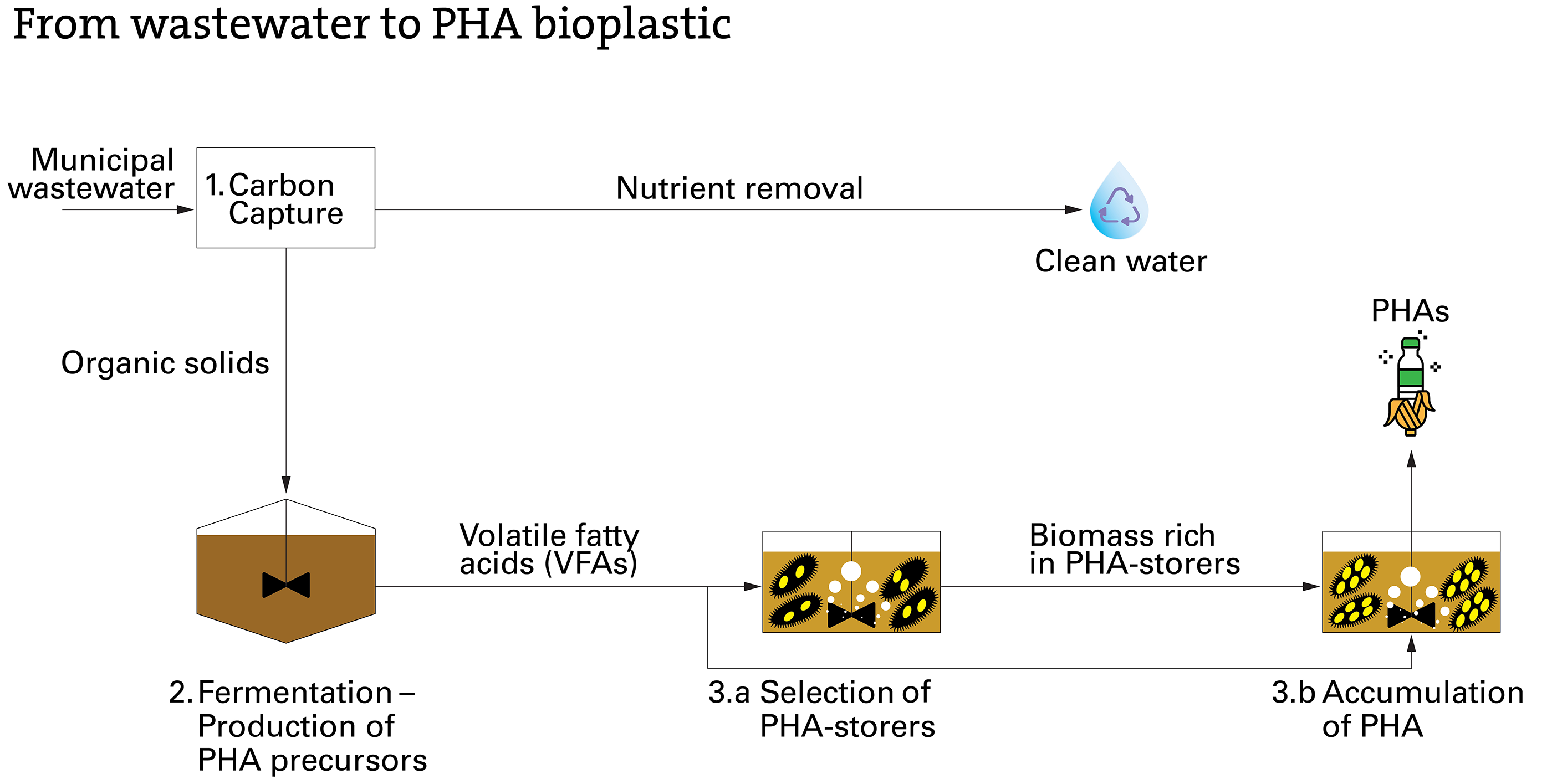
It takes three steps to produce these bioplastics from wastewater. First, as much of the organic carbon as possible must be extracted from the wastewater. Subsequently, this carbon must be fermented into volatile fatty acids, the precursors of PHA. Finally the researchers can selectively grow PHA-storing bacteria in the acid-rich substrate.
 

Space-saving microsieves for separating the carbon

For the separation of organic carbon from wastewater, the researchers compared two different methods: On the one hand, the primary settler available in most wastewater treatment plants, and on the other hand, microsieves as an alternative separation technology. The results show that both methods are equally efficient at removing organic carbon from wastewater. The yield was particularly high when flocculants were added to the wastewater beforehand, so that smaller particles clumped together to form larger ones and could thus be separated better. In this way, about 60% of the organic carbon contained in the wastewater could be recovered. The fermentation of carbon captured with the two different separation technologies produced substrates that had a similar fatty acid composition and abundance, and are therefore equally suitable for the production of PHA plastic. However, a major advantage of microsieves is that they are significantly smaller - their space requirement is only about 10 to 15 % of that of primary settlers. This has also convinced some Swiss wastewater treatment plants (WWTP), such as the WWTP Sihltal (Zurich), which will be using microsieves from 2023.
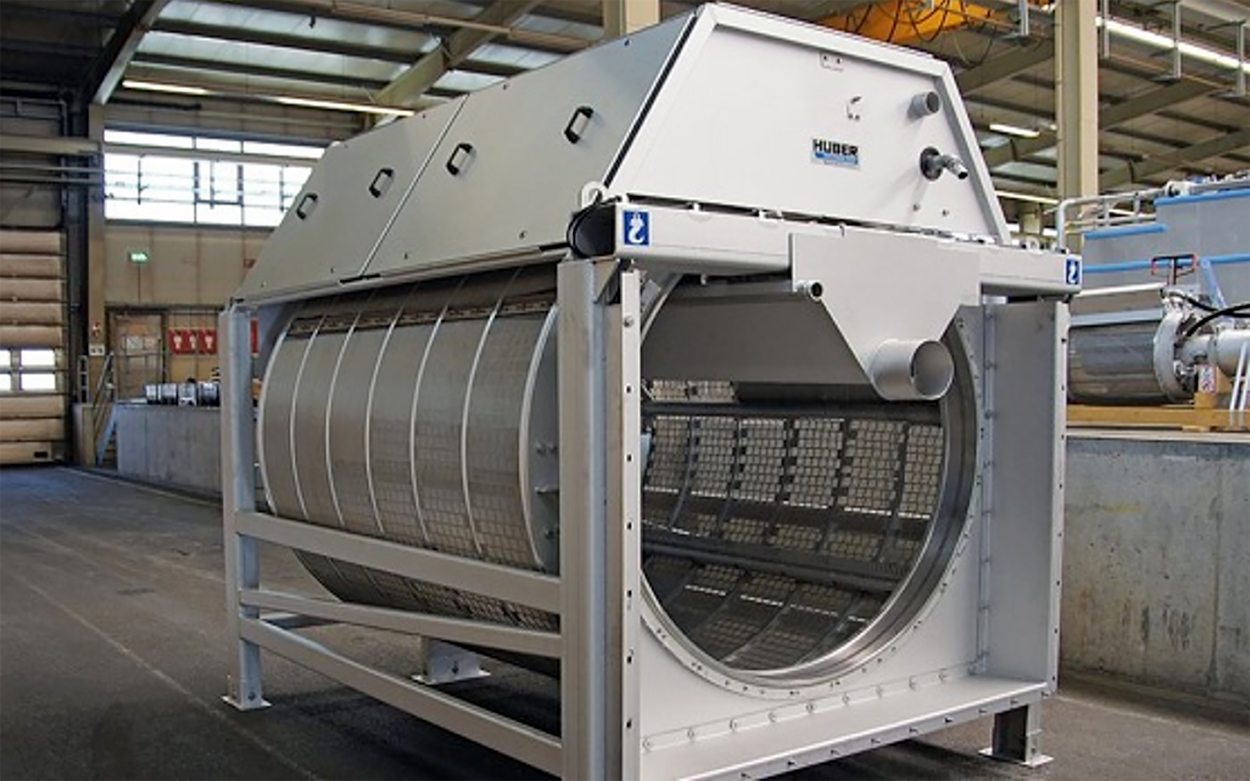
 

With these microsieves, the organic carbon can be separated from the wastewater just as efficiently as in the previously used primary settlers, except that the microsieves require significantly less space. (Photo: Huber)

PHA-storing bacteria have an advantage in nutrient-limited environments

For PHA-production, a biomass enriched in PHA-storing bacteria must be grown on the fatty acid-rich substrate. The researchers therefore investigated under which conditions these bacteria grow best and can prevail over other, non-PHA storing bacteria. Since PHA are storage substances that bacteria only produce under restricted growth conditions, e.g. when an important nutrient such as phosphorus is missing, it was reasonable to assume that nutrient deficiencies could be a selection advantage for PHA storing bacteria. The researchers therefore experimented with synthetic wastewater with different ratios of carbon to phosphorus in the experimental hall at Eawag. They found that the proportion of PHA storing bacteria in the microbial community actually increased when the phosphorus availability decreased. In the optimal case, the PHA storing bacteria dominated with over 90%, at the same time also formed the most PHA plastic and completely purified the wastewater of carbon and phosphorus.

Subsequently, the experiments were carried out with real wastewater whose composition fluctuated over the course of the 150-day trial. Although this meant that the nutrients phosphorus and nitrogen were not consistently limiting, up to 70% of the biomass was in the form of PHA at the end of the trial.

Possible applications of bioplastics from wastewater

Further investigations are still needed to better understand and optimise the processes producing bioplastics from wastewater before pilot tests can take place in public wastewater treatment plants.

And where do the researchers see the potential applications, if bioplastics could one day be actually produced from wastewater? “Even if these plastics might eventually become economically viable, it would be impossible to produce enough volume to cover society’s demand for their petro-chemical counterparts,” says Antoine Brison. Another major obstacle to the utilisation of bioplastics from wastewater is that the legal framework conditions and social acceptance are still lacking. Brison therefore sees potential in more specific niche applications for the bioplastics made form wastewater - for example as coating for fertilizers to achieve a slow release. Another possibility is self-healing concrete, which a Dutch company is working on. Therein, PHAs could serve as a carbon source for bacteria that heal cracks in concrete when water penetrates by stimulating the formation of lime.
 

A reactor that is suitable for wastewater treatment plants

Up to now, so-called sequencing batch reactors (SBR) have been used for the environmental production of PHA bioplastics, which are fed with the initial substrate in batches. However, wastewater treatment plants operate with a continuous flow. The researchers therefore investigated whether a continuous stirred-tank reactor (CSTR) would also be suitable, which would significantly facilitate the integration of PHA production in existing WWTPs. It turned out that even significantly more PHA-storing biomass could be produced in this reactor from the same amount of wastewater.

Cover picture: Bioplastics produced from wastewater (Photo: Antoine Brison, Eawag)
 

Original publications

Extbase Variable Dump
array(2 items)
   publications => '24329,25618' (11 chars)
   libraryUrl => '' (0 chars)
Extbase Variable Dump
array(2 items)
   0 => Snowflake\Publications\Domain\Model\Publicationprototypepersistent entity (uid=24329, pid=124)
      originalId => protected24329 (integer)
      authors => protected'Brison, A.; Rossi, P.; Gelb, A.; Derlon, N.' (63 chars)
      title => protected'The capture technology matters: composition of municipal wastewater solids d
         rives complexity of microbial community structure and volatile fatty acid pr
         ofile during anaerobic fermentation
' (187 chars) journal => protected'Science of the Total Environment' (32 chars) year => protected2022 (integer) volume => protected815 (integer) issue => protected'' (0 chars) startpage => protected'152762 (13 pp.)' (15 chars) otherpage => protected'' (0 chars) categories => protected'volatile fatty acids; fermentation of municipal wastewater solids; micro-sie
         ve; high-rate activated sludge; thermal-alkaline pre-treatment; anaerobic mi
         crobial community structure
' (179 chars) description => protected'The production of volatile fatty acids (VFAs) represents a relevant option t
         o valorize municipal wastewater (MWW). In this context, different capture te
         chnologies can be used to recover organic carbon from wastewater in form of
         solids, while pre-treatment of those solids has the potential to increase VF
         A production during subsequent fermentation. Our study investigates how VFA
         composition produced by fermentation is influenced (i) by the choice of the
         capture technology, as well as (ii) by the use of thermal alkaline pre-treat
         ment (TAP). Therefore, the fermentation of solids originating from a primary
          settler, a micro-sieve, and a high-rate activated sludge (HRAS) system was
         investigated in continuous lab-scale fermenters, with and without TAP. Our s
         tudy demonstrates that the capture technology strongly influences the compos
         ition of the produced solids, which in turn drives the complexity of the fer
         menter's microbial community and ultimately, of the VFA composition. Solids
         captured with the primary settler or micro-sieve consisted primarily of poly
         saccharides, and led to the establishment of a microbial community specializ
         ed in the degradation of complex carbohydrates. The produced VFA composition
          was relatively simple, with acetate and propionate accounting for >90% o
         f the VFAs. In contrast, the HRAS system produced biomass-rich solids associ
         ated with higher protein contents. The microbial community which then develo
         ped in the fermenter was therefore more diversified and capable of convertin
         g a wider range of substrates (polysaccharides, proteins, amino acids). Ulti
         mately, the produced VFA composition was more complex, with equal fractions
         of isoacids and propionate (both ~20%), while acetate remained the dominant
         acid (~50%). Finally, TAP did not significantly modify the VFA composition w
         hile increasing VFA yields on HRAS and sieved material by 35% and 20%, respe
         ctively. Overall, we demonstrated that the selection of the technology used
         to capture organic subst...
' (2119 chars) serialnumber => protected'0048-9697' (9 chars) doi => protected'10.1016/j.scitotenv.2021.152762' (31 chars) uid => protected24329 (integer) _localizedUid => protected24329 (integer)modified _languageUid => protectedNULL _versionedUid => protected24329 (integer)modified pid => protected124 (integer)
1 => Snowflake\Publications\Domain\Model\Publicationprototypepersistent entity (uid=25618, pid=124) originalId => protected25618 (integer) authors => protected'Brison, A.; Rossi, P.; Derlon, N.' (48 chars) title => protected'Influent carbon to phosphorus ratio drives the selection of PHA-storing orga
         nisms in a single CSTR
' (98 chars) journal => protected'Water Research X' (16 chars) year => protected2022 (integer) volume => protected16 (integer) issue => protected'' (0 chars) startpage => protected'100150 (11 pp.)' (15 chars) otherpage => protected'' (0 chars) categories => protected'polyhydroxyalkanoates (PHAs); dual carbon and phosphorus limitation; growth
         conditions; cellular phosphorus requirements; biomass PHA content; long-term
          selection
' (162 chars) description => protected'Enriching a biomass with a high fraction of polyhydroxyalkanoate-storing org
         anisms (PHA-storers) represents an essential step in the production of PHAs
         (bioplastics) from municipal wastewater using mixed microbial cultures. A ma
         jor challenge is however to create selective growth conditions that are favo
         urable to PHA-storers. Our study thus investigates to what extent the influe
         nt COD to phosphorus (COD:P) ratio can be used as a tool for the robust sele
         ction of PHA-storers in a single continuous-flow stirred-tank reactor (CSTR)
         . Therefore, we operated five CSTRs in parallel, fed with synthetic wastewat
         er (50% acetate - 50% propionate) with different COD:P ratios (200−1000 gC
         OD gP<sup>−1</sup>), and performed a detailed analysis of the microbial co
         mmunities over long-term (30−70 solid retention times). Our study demonstr
         ates that efficient and robust selection of PHA-storers can be achieved in a
          single CSTR at high influent COD:P ratios. The selective advantage for PHA-
         storers increases with the influent COD:P ratio, but only if growth conditio
         ns remain limited by both C-substrate and P. In contrast, selection performa
         nce deteriorates when COD:P ratios are too high and growth conditions are li
         mited by P only. At an optimal COD:P ratio of 800 gCOD gP<sup>−1</sup>, a
         stable microbial community consisting of &gt;90% PHA-storers and dominated b
         y Pannonibacter sp. was selected in the long-term. Finally, our results sugg
         est that high COD:P ratios provide a selective advantage to microorganisms w
         ith low cellular P requirements, explaining why different PHA-storers (i.e.,
          Xanthobacter sp. vs. Pannonibacter sp.) were selected depending on the infl
         uent COD:P ratio (i.e., 200 vs. 800 gCOD gP<sup>−1</sup>). Overall, our re
         sults provide relevant insights for the development of a new approach for se
         lecting PHA-storers, based on the use of a single CSTR and control of the in
         fluent COD:P ratio.
' (1919 chars) serialnumber => protected'2589-9147' (9 chars) doi => protected'10.1016/j.wroa.2022.100150' (26 chars) uid => protected25618 (integer) _localizedUid => protected25618 (integer)modified _languageUid => protectedNULL _versionedUid => protected25618 (integer)modified pid => protected124 (integer)
Brison, A.; Rossi, P.; Gelb, A.; Derlon, N. (2022) The capture technology matters: composition of municipal wastewater solids drives complexity of microbial community structure and volatile fatty acid profile during anaerobic fermentation, Science of the Total Environment, 815, 152762 (13 pp.), doi:10.1016/j.scitotenv.2021.152762, Institutional Repository
Brison, A.; Rossi, P.; Derlon, N. (2022) Influent carbon to phosphorus ratio drives the selection of PHA-storing organisms in a single CSTR, Water Research X, 16, 100150 (11 pp.), doi:10.1016/j.wroa.2022.100150, Institutional Repository

Brison, A., Rossi, P. and Derlon, N. (2023): Single CSTR can be as effective as an SBR in selecting PHA-storing biomass from municipal wastewater-derived feedstock. Water Research X, Vol. 18. DOI: https://www.sciencedirect.com/science/article/pii/S2589914723000014

Funding / Cooperations

  • Eawag
  • EPFL