Archive detail

The impact of climate change on life in freshwater and terrestrial ecosystems

Ecological communities in rivers and lakes are responding to climate change in a similar way to communities on land. This is shown by the first comprehensive comparison of freshwater and terrestrial ecosystems around the globe, co-led by Eawag and WSL. When temperatures rise, warm-loving species are the main beneficiaries. One surprising exception may be the plankton.

As it gets warmer, many species are forced to leave their established habitats, moving northwards or upwards in elevation in search of cooler climates. Locally, cold-adapted species may be lost, displaced by warm-loving species. Over time, warm-loving species become more prevalent, and researchers refer to this turnover as thermophilisation.

“Globally, we already have a relatively good understanding of how, and how quickly, ecological communities in terrestrial and marine environments are responding to climate change,” explains Anita Narwani, head of the Algal Biodiversity and Ecosystem Functioning group at the aquatic research institute Eawag. “However, how freshwater communities are responding to warming compared to terrestrial ones had not been systematically investigated or compared.” But, the habitats in lakes and rivers are of particular interest. Their species richness is disproportionately high compared to both terrestrial and marine ecosystems per unit area of habitat, and at the same time, the rate of species decline is particularly dramatic. Freshwater ecosystems are also among the most sensitive habitats to human impacts, possibly due distinct spatial boundaries, limiting the potential for species to escape via dispersal.

Comparison of responses in freshwater and on land

As part of the Blue-Green Biodiversity BGB research initiative, an international team of scientists led by Anita Narwani and Christian Rixen from the WSL Institute for Snow and Avalanche Research SLF has now analysed the species communities in freshwater and terrestrial systems for the first time in a systematic, global study. They used all the data available worldwide, totalling 13,324 data sets, including 6,201 terrestrial communities with plants, birds, insects and mammals and 7,123 aquatic communities with fish, insects, phytoplankton and zooplankton. The data covers a total of 17,431 species and periods of 5 to 38 years between 1980 and 2019. “As we only have little data from the tropical and polar regions, however, our main conclusions are limited to the temperate latitudes,” Anita Narwani qualifies.

“We have found that there are no significant differences between freshwater and terrestrial ecosystems in the overall rate of thermophilisation. So we observe the same pattern in freshwater as on land: a trend towards a greater prevalence of warm-loving species, while species adapted to the cold become rarer,” summarises Imran Khaliq, lead author of the study, which was published recently in the journal Nature Communications. He carried out the analyses as a postdoctoral researcher in Anita Narwani's team. “However, the rate of thermophilisation in response to temperature change differs. On land, the species composition has changed faster," says Imran Khaliq. “This difference may be attributed to the slower warming experienced within the freshwater realm, which puts less pressure on the aquatic communities to respond.”
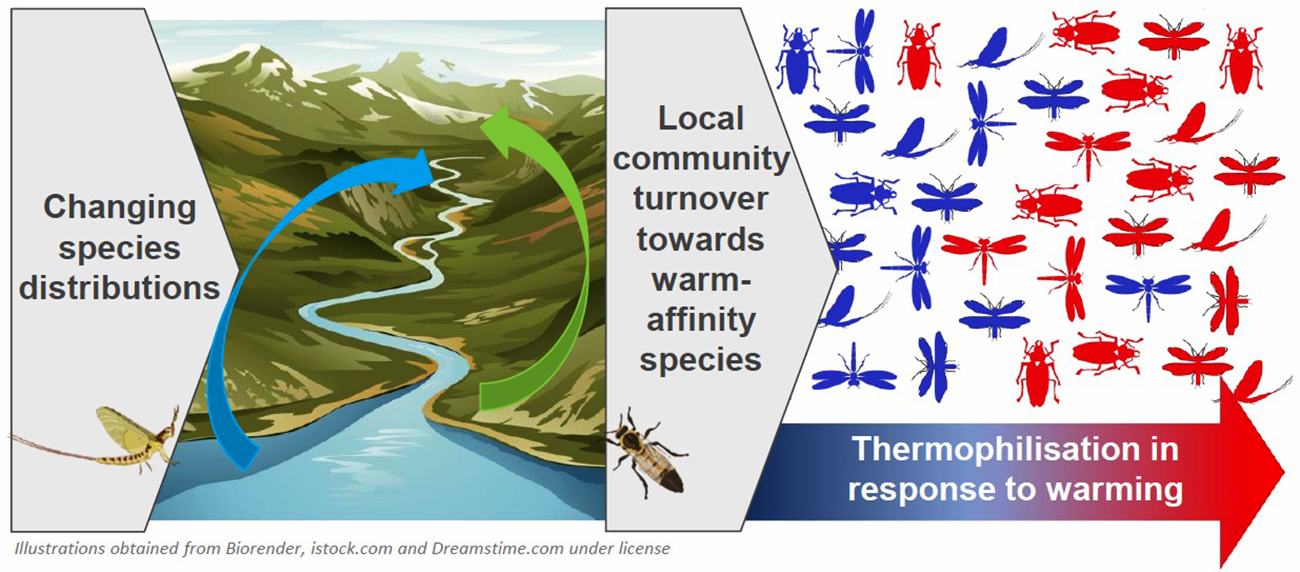
 

If the climate changes, the distribution of species also changes. Locally, species adapted to the cold can be lost and displaced by species that favour warmth. Scientists refer to this process as thermophilisation. (Graphic: Eawag, illustrations obtained from Biorender, istock.com and dreamstime.com)

The surprise: cold-loving plankton are doing alright

Plankton communities are an exception; they are responding differently than expected. Here, analyses suggest that cold-loving species may benefit from climate change. “That surprised us,” says Imran Khaliq. “And the reasons for this are not really understood at the moment.” A simple explanation would be that cold-loving species used to live in regions with temperatures below their optimal, or preferred, temperature. This phenomenon has already been documented for marine systems. Warming would therefore initially be good for them before the rise in temperature becomes so strong that the cold-loving species come under pressure and ultimately disperse away or die out. This is also supported by the fact that lakes and rivers have warmed less quickly than habitats on land.

Another explanation could be that cold-loving species are well adapted to other environmental changes such as nutrient availability. The observed increase in cold-loving plankton species could therefore also be due to a reason other than global warming. “However, we cannot test these hypotheses with the available data”, explains Anita Narwani. She is already busy planning another research project to characterise the spatial distribution of species in 240 Swiss lakes in order to find an explanation for this surprising observation.

High biodiversity - high resilience

“Another interesting result was that in terrestrial ecosystems, a high species richness makes the communities less sensitive to climate change,” adds Anita Narwani. “Species-rich communities on land therefore respond more slowly to rising temperatures than species-poor communities.” This does not mean that these communities will not come under stress at some point. It may just take longer. “There may also be an extinction debt; when there is a delay between the cause, in this case climate change, and the final disappearance of a species. And this final disappearance can then happen very quickly.” Although the researchers have observed a similar trend in freshwater, i.e. greater resilience in more species-rich communities, it is much less pronounced and not significant.

The results of the study and the comparison of aquatic and terrestrial ecosystems help to understand how ecological communities are reacting to climate change and where differences in their responses come from. “Knowing the reasons is key to developing better strategies for the protection and management of ecosystems and identifying those species that are particularly vulnerable to local extinctions,” summarises Anita Narwani.
 

Blue-Green Biodiversity Research Initiative

The research project "The architecture of community structure, functional traits and trophic networks across blue-green ecosystems" contributes to the Blue-Green Biodiversity research initiative - an Eawag-WSL collaboration addressing biodiversity at the interface of aquatic and terrestrial ecosystems. The initiative is funded by the ETH Board.

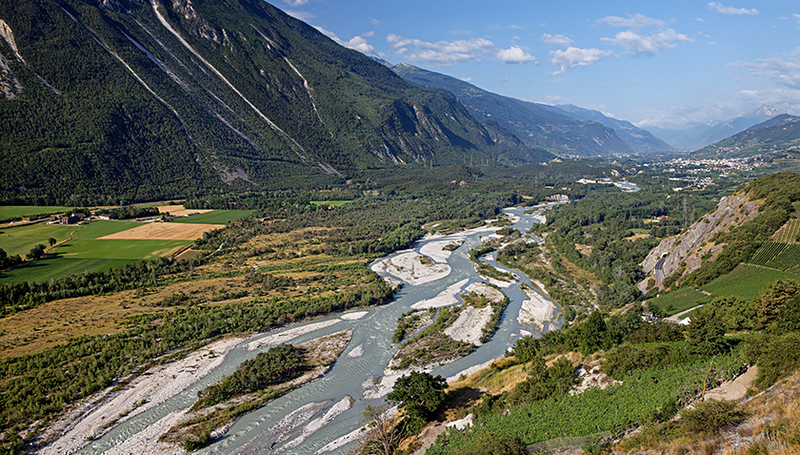
Cover picture: View from Varen Church of the Pfynwald floodplain with the Rhone (looking downstream), gravel banks and dry gravel terraces with a pine forest. (Photo: Jan Ryser/FOEN)
 

Original publications

Extbase Variable Dump
array(3 items)
   publications => '32599,26259' (11 chars)
   libraryUrl => '' (0 chars)
   layout => '0' (1 chars)
Extbase Variable Dump
array(2 items)
   0 => Snowflake\Publications\Domain\Model\Publicationprototypepersistent entity (uid=32599, pid=124)
      originalId => protected32599 (integer)
      authors => protected'Khaliq, I.; Rixen, C.; Zellweger, F.; Graham, C. H.
         ; Gossner, M. M.; McFadden, I. R.; Antão, L.; Brod
         ersen, J.; Ghosh, S.; Pomati, F.; Seehausen, O.; Roth,&n
         bsp;T.; Sattler, T.; Supp, S. R.; Riaz, M.; Zimmermann,&
         nbsp;N. E.; Matthews, B.; Narwani, A.
' (356 chars) title => protected'Warming underpins community turnover in temperate freshwater and terrestrial
          communities
' (88 chars) journal => protected'Nature Communications' (21 chars) year => protected2024 (integer) volume => protected15 (integer) issue => protected'' (0 chars) startpage => protected'1921 (9 pp.)' (12 chars) otherpage => protected'' (0 chars) categories => protected'' (0 chars) description => protected'Rising temperatures are leading to increased prevalence of warm-affinity spe
         cies in ecosystems, known as thermophilisation. However, factors influencing
          variation in thermophilisation rates among taxa and ecosystems, particularl
         y freshwater communities with high diversity and high population decline, re
         main unclear. We analysed compositional change over time in 7123 freshwater
         and 6201 terrestrial, mostly temperate communities from multiple taxonomic g
         roups. Overall, temperature change was positively linked to thermophilisatio
         n in both realms. Extirpated species had lower thermal affinities in terrest
         rial communities but higher affinities in freshwater communities compared to
          those persisting over time. Temperature change’s impact on thermophilisat
         ion varied with community body size, thermal niche breadth, species richness
          and baseline temperature; these interactive effects were idiosyncratic in t
         he direction and magnitude of their impacts on thermophilisation, both acros
         s realms and taxonomic groups. While our findings emphasise the challenges i
         n predicting the consequences of temperature change across communities, cons
         ervation strategies should consider these variable responses when attempting
          to mitigate climate-induced biodiversity loss.
' (1263 chars) serialnumber => protected'' (0 chars) doi => protected'10.1038/s41467-024-46282-z' (26 chars) uid => protected32599 (integer) _localizedUid => protected32599 (integer)modified _languageUid => protectedNULL _versionedUid => protected32599 (integer)modified pid => protected124 (integer)
1 => Snowflake\Publications\Domain\Model\Publicationprototypepersistent entity (uid=26259, pid=124) originalId => protected26259 (integer) authors => protected'McFadden, I. R.; Sendek, A.; Brosse, M.; Bach, P.&n
         bsp;M.; Baity‐Jesi, M.; Bolliger, J.; Bollmann, K.; Brocker
         hoff, E. G.; Donati, G.; Gebert, F.; Ghosh, S.; Ho,
          H.‐C.; Khaliq, I.; Lever, J. J.; Logar, I.; Moor
         , H.; Odermatt, D.; Pellissier, L.; de Queiroz, L. 
         J.; Rixen, C.; Schuwirth, N.; Shipley, J. R.; Twining,&n
         bsp;C. W.; Vitasse, Y.; Vorburger, C.; Wong, M. K.&
         nbsp;L.; Zimmermann, N. E.; Seehausen, O.; Gossner, M.&n
         bsp;M.; Matthews, B.; Graham, C. H.; Altermatt, F.; Narw
         ani, A.
' (696 chars) title => protected'Linking human impacts to community processes in terrestrial and freshwater e
         cosystems
' (85 chars) journal => protected'Ecology Letters' (15 chars) year => protected2023 (integer) volume => protected26 (integer) issue => protected'2' (1 chars) startpage => protected'203' (3 chars) otherpage => protected'218' (3 chars) categories => protected'' (0 chars) description => protected'Human impacts such as habitat loss, climate change and biological invasions
         are radically altering biodiversity, with greater effects projected into the
          future. Evidence suggests human impacts may differ substantially between te
         rrestrial and freshwater ecosystems, but the reasons for these differences a
         re poorly understood. We propose an integrative approach to explain these di
         fferences by linking impacts to four fundamental processes that structure co
         mmunities: dispersal, speciation, species-level selection and ecological dri
         ft. Our goal is to provide process-based insights into why human impacts, an
         d responses to impacts, may differ across ecosystem types using a mechanisti
         c, eco-evolutionary comparative framework. To enable these insights, we revi
         ew and synthesise (i) how the four processes influence diversity and dynamic
         s in terrestrial versus freshwater communities, specifically whether the rel
         ative importance of each process differs among ecosystems, and (ii) the path
         ways by which human impacts can produce divergent responses across ecosystem
         s, due to differences in the strength of processes among ecosystems we ident
         ify. Finally, we highlight research gaps and next steps, and discuss how thi
         s approach can provide new insights for conservation. By focusing on the pro
         cesses that shape diversity in communities, we aim to mechanistically link h
         uman impacts to ongoing and future changes in ecosystems.
' (1425 chars) serialnumber => protected'1461-023X' (9 chars) doi => protected'10.1111/ele.14153' (17 chars) uid => protected26259 (integer) _localizedUid => protected26259 (integer)modified _languageUid => protectedNULL _versionedUid => protected26259 (integer)modified pid => protected124 (integer)
Khaliq, I.; Rixen, C.; Zellweger, F.; Graham, C. H.; Gossner, M. M.; McFadden, I. R.; Antão, L.; Brodersen, J.; Ghosh, S.; Pomati, F.; Seehausen, O.; Roth, T.; Sattler, T.; Supp, S. R.; Riaz, M.; Zimmermann, N. E.; Matthews, B.; Narwani, A. (2024) Warming underpins community turnover in temperate freshwater and terrestrial communities, Nature Communications, 15, 1921 (9 pp.), doi:10.1038/s41467-024-46282-z, Institutional Repository
McFadden, I. R.; Sendek, A.; Brosse, M.; Bach, P. M.; Baity‐Jesi, M.; Bolliger, J.; Bollmann, K.; Brockerhoff, E. G.; Donati, G.; Gebert, F.; Ghosh, S.; Ho, H.‐C.; Khaliq, I.; Lever, J. J.; Logar, I.; Moor, H.; Odermatt, D.; Pellissier, L.; de Queiroz, L. J.; Rixen, C.; Schuwirth, N.; Shipley, J. R.; Twining, C. W.; Vitasse, Y.; Vorburger, C.; Wong, M. K. L.; Zimmermann, N. E.; Seehausen, O.; Gossner, M. M.; Matthews, B.; Graham, C. H.; Altermatt, F.; Narwani, A. (2023) Linking human impacts to community processes in terrestrial and freshwater ecosystems, Ecology Letters, 26(2), 203-218, doi:10.1111/ele.14153, Institutional Repository

Cooperations

  • Swiss Federal Institute of Aquatic Science and Technology Eawag
  • Swiss Federal Institute for Forest, Snow and Landscape Research WSL
  • Zoology, Government (defunct) post-graduate college, Pakistan
  • ETH Zürich
  • University of Amsterdam
  • University of Helsinki
  • Universität Bern
  • Hintermann & Weber AG, Reinach
  • Swiss Ornithological Institute
  • Denison University
  • Senckenberg Research Institute and Natural History Museum Frankfurt
  • Goethe University Frankfurt