Archive detail

Unravelling complex relationships between humans and nature

June 23, 2020 | Bärbel Zierl

A new social-ecological approach allows complex relationships in ecosystem governance to be modelled as abstract but easily grasped networks.

Environmental problems are generally complex, and the ecological processes and actors involved are often closely interlinked. Social-ecological networks make it possible to untangle such complex relationships. In these networks, social and ecological components and the interactions between them are represented as nodes and links.

This approach is being used to study ecosystem governance by political scientist Manuel Fischer and his research group in the Policy Analysis and Environmental Governance cluster of the Environmental Social Sciences department. Fischer explains: “Our aim is, firstly, to provide organisations with information to help them better coordinate their activities. Secondly, this approach enables us to compare various ecosystem governance situations and identify structural determinants of successful governance.”

Social-ecological networks in Swiss wetlands governance

In the Wetlands project, the researchers are studying twelve alluvial plains in Switzerland. The new approach adopted involves analysing, not the spatial connectivity of wetlands, but the functional interactions between ecosystem governance topics such as flood protection, recreation, energy production and biodiversity. The multiplicity of actors gives rise to an intricate social-ecological network. Fischer says: “We’re now investigating how such a network needs to be structured to permit good governance of wetlands.” Is it beneficial for flood protection if the canton and tourism work together? Does the lack of contact between power plant operator and environmental consultancy prevent effective species conservation? And why do certain actors successfully coordinate their efforts while others do not, even though the areas concerned are interdependent. “We’re eager to see the results,” says Fischer. “We currently suspect that, apart from technical reasons, human factors often play a role, such as power struggles, conflicting interests or empathy.”

The Eawag team is part of an international scientific group promoting further development of the network approach. In an article entitled “Improving network approaches to the study of complex social-ecological interdependencies”, published in Nature Sustainability in summer 2019, the group presents some unifying research design considerations to facilitate comparison across case studies using a network approach. In addition, the authors propose a typology of causal assumptions, which should permit the development of generalisable theories.
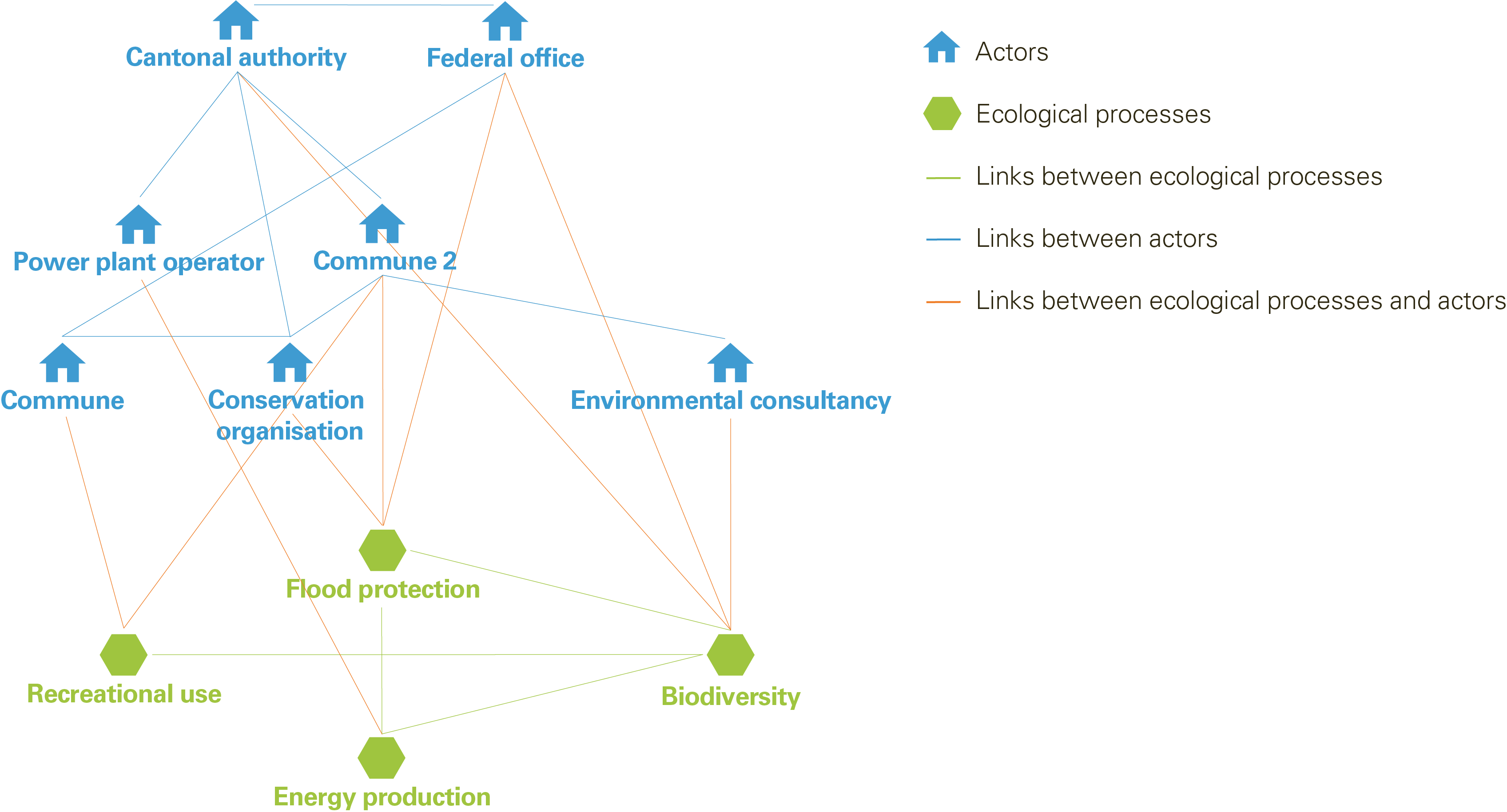
 

Interplay of actors in wetlands governance
(Figure: Peter Penicka)

Cover picture: Mario Angst, WSL

Original publication

Extbase Variable Dump
array(2 items)
   publications => '18991' (5 chars)
   libraryUrl => '' (0 chars)
Extbase Variable Dump
array(1 item)
   0 => Snowflake\Publications\Domain\Model\Publicationprototypepersistent entity (uid=18991, pid=124)
      originalId => protected18991 (integer)
      authors => protected'Bodin, Ö.; Alexander, S. M.; Baggio, J.; Barnes, M
         . L.; Berardo, R.; Cumming, G. S.; Dee, L. E.;
          Fischer, A. P.; Fischer, M.; Mancilla Garcia, M.; Guerr
         ero, A. M.; Hileman, J.; Ingold, K.; Matous, P.; Mo
         rrison, T. H.; Nohrstedt, D.; Pittman, J.; Robins, 
         G.; Sayles, J. S.
' (407 chars) title => protected'Improving network approaches to the study of complex social–ecological int
         erdependencies
' (90 chars) journal => protected'Nature Sustainability' (21 chars) year => protected2019 (integer) volume => protected2 (integer) issue => protected'7' (1 chars) startpage => protected'551' (3 chars) otherpage => protected'559' (3 chars) categories => protected'' (0 chars) description => protected'Achieving effective, sustainable environmental governance requires a better
         understanding of the causes and consequences of the complex patterns of inte
         rdependencies connecting people and ecosystems within and across scales. Net
         work approaches for conceptualizing and analysing these interdependencies of
         fer one promising solution. Here, we present two advances we argue are neede
         d to further this area of research: (i) a typology of causal assumptions exp
         licating the causal aims of any given network-centric study of social–ecol
         ogical interdependencies; (ii) unifying research design considerations that
         facilitate conceptualizing exactly what is interdependent, through what type
         s of relationships and in relation to what kinds of environmental problems.
         The latter builds on the appreciation that many environmental problems draw
         from a set of core challenges that re-occur across contexts. We demonstrate
         how these advances combine into a comparative heuristic that facilitates lev
         eraging case-specific findings of social–ecological interdependencies to g
         eneralizable, yet context-sensitive, theories based on explicit assumptions
         of causal relationships.
' (1164 chars) serialnumber => protected'' (0 chars) doi => protected'10.1038/s41893-019-0308-0' (25 chars) uid => protected18991 (integer) _localizedUid => protected18991 (integer)modified _languageUid => protectedNULL _versionedUid => protected18991 (integer)modified pid => protected124 (integer)
Bodin, Ö.; Alexander, S. M.; Baggio, J.; Barnes, M. L.; Berardo, R.; Cumming, G. S.; Dee, L. E.; Fischer, A. P.; Fischer, M.; Mancilla Garcia, M.; Guerrero, A. M.; Hileman, J.; Ingold, K.; Matous, P.; Morrison, T. H.; Nohrstedt, D.; Pittman, J.; Robins, G.; Sayles, J. S. (2019) Improving network approaches to the study of complex social–ecological interdependencies, Nature Sustainability, 2(7), 551-559, doi:10.1038/s41893-019-0308-0, Institutional Repository