News Detail

Centralised or decentralised – that is the question

September 27, 2018 | Stephanie Schnydrig

Dealing with wastewater right where it is being produced, instead of in central treatment plants, can be more flexible and economical depending on the location. In Switzerland, however, there are very few such decentralised wastewater treatment plants – although, as Eawag researchers have established, there is a surprisingly strong market potential for them. 

In this country, wastewater is generally channelled for many kilometres to central wastewater treatment plants (WTPs) via the underground pipes of our sewerage system. But the system is sometimes fraught with problems, such as leaking pipes, or overflowing drains in heavy precipitation. Maintenance costs are also high. These factors beg the question therefore of whether it is still worth investing in the existing network, or whether there may be other solutions that would be more cost effective – such as treating wastewater in situ.

Significant potential for decentralised treatment plants

Such decentralised wastewater treatment plants are still rare in Switzerland. Currently just three percent of the population are using that kind of system. Scientists at Eawag working with geographer Sven Eggimann – who is now a research fellow at the University of Oxford – have been working to ascertain which locations would lend themselves to this kind of wastewater treatment. With this information they have been able to estimate the market potential for decentralised installations.

The team of researchers used a computer model that calculated the most cost-effective wastewater infrastructure for every Swiss household. The calculations were based on the costs of sewerage maintenance, monitoring and transport. The researchers found that decentralised wastewater treatment plants would be worthwhile for around 10 percent of the Swiss population. “There is significant potential in rural areas in particular”, says Ulrike Feldmann, Environmental Social Scientist and co-author of the study. In these areas, a good 30 percent of inhabitants would be a worthwhile target for decentralised WTPs. The researchers recently published their findings in the international journal “Land Use Policy”.

Commercial production potential

Which wastewater treatment method is the more cost effective depends partly on the population density of the area in question. The researchers employed this knowledge to estimate the market potential for decentralised WTPs across the whole of Europe. They came to the conclusion that around 100,000 installations could be sold annually on the European market – a volume that would permit commercial production.

“Of course, these findings are not a forecast of how many decentralised installations will be built in the near future”, stresses Ulrike Feldmann. The model, she says, is based on a number of highly simplified assumptions. Nevertheless, it does allow the market potential for local installations to be estimated. “These figures indicate that, in the long run, it is worth investing in research into and promotion of innovative, decentralised systems”, says Feldmann.
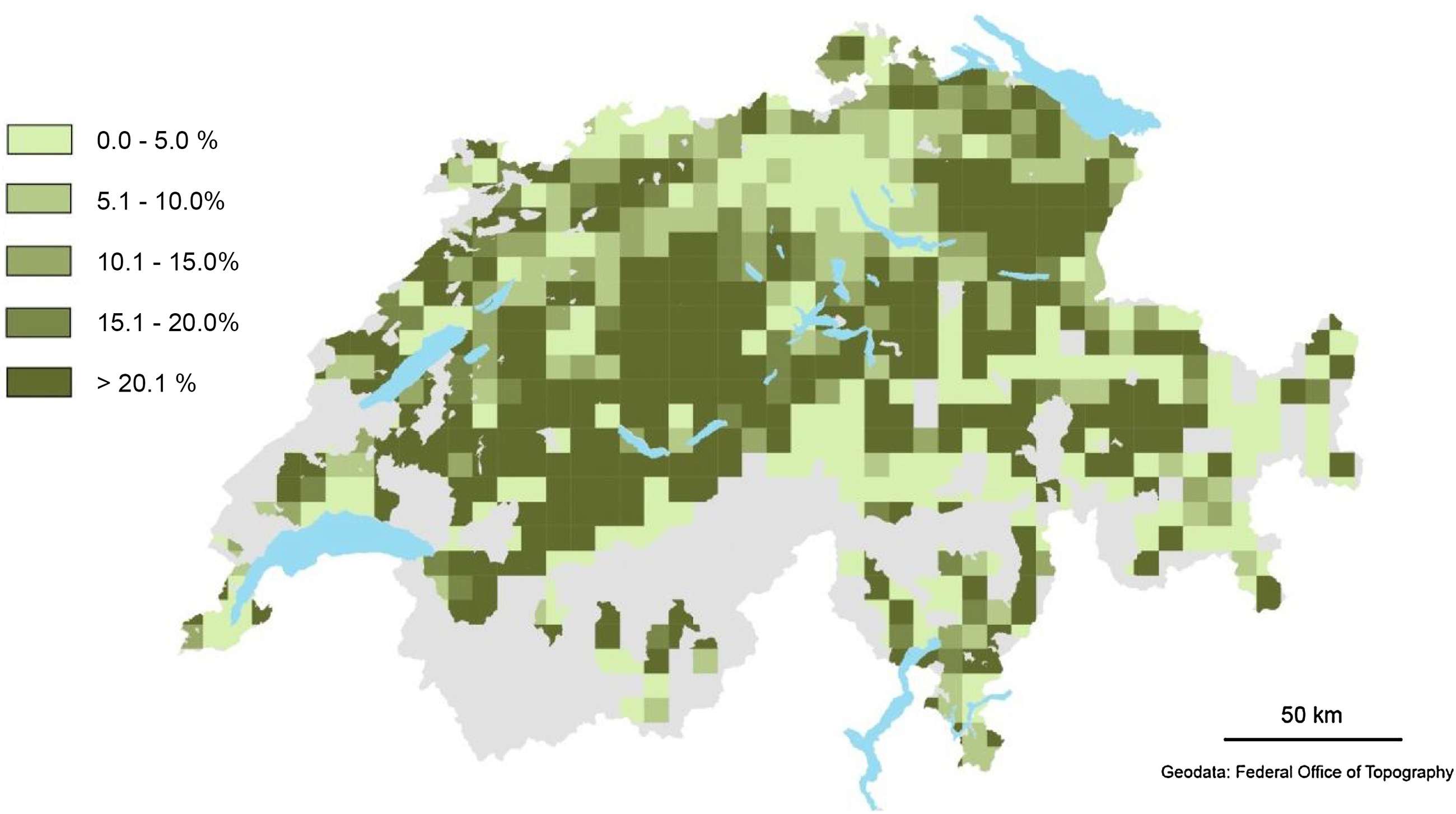
This map shows the market potential of decentralised wastewater treatment plants in Switzerland.
(Figure: Eggimann et al., 2018)

Original publication

Extbase Variable Dump
array(2 items)
   publications => '17232' (5 chars)
   libraryUrl => '' (0 chars)
Extbase Variable Dump
array(1 item)
   0 => Snowflake\Publications\Domain\Model\Publicationprototypepersistent entity (uid=17232, pid=124)
      originalId => protected17232 (integer)
      authors => protected'Eggimann, S.; Truffer, B.; Feldmann, U.; Maurer, M.' (71 chars)
      title => protected'Screening European market potentials for small modular wastewater treatment 
         systems – an inroad to sustainability transitions in urban water managemen
         t?
' (154 chars) journal => protected'Land Use Policy' (15 chars) year => protected2018 (integer) volume => protected78 (integer) issue => protected'' (0 chars) startpage => protected'711' (3 chars) otherpage => protected'725' (3 chars) categories => protected'decentralised wastewater treatment; conomies of scale; infrastructure planni
         ng; geographical information system; population density
' (131 chars) description => protected'Urban water management represents a core economic sector exposed to global w
         ater-related challenges. Recently, small modular system configurations have
         been identified to enable a potential sustainability transition in this last
         ing and rather conservative sector. The identification of current market pot
         entials of decentralised wastewater treatment is a first step to assess whet
         her decentralised treatment technologies could potentially be deployed on a
         larger scale in Europe, which would allow current decentralised wastewater t
         reatment technologies to develop and mature. The paper elaborates a method t
         o assess the market potential for decentralised wastewater treatment systems
          by starting from a raster-based geospatial modelling framework, to determin
         e the optimal degrees of centralisation for the case of Switzerland. The res
         ulting market potential is shown to be twenty times higher than the current
         market share of decentralised systems. In order to extrapolate these finding
         s to other countries, the calculated optimal degrees of centralisation were
         correlated with different spatial density measures to determine a reliable a
         nd widely available proxy: population density. Based on this indicator, the
         European market potentials for decentralised treatment systems are estimated
          to be about 100,000 units per annum serving around 35 million population eq
         uivalents. The paper concludes by discussing implications for future sustain
         ability transitions in urban water management by large-scale installation of
          small modular wastewater treatment systems.
' (1564 chars) serialnumber => protected'0264-8377' (9 chars) doi => protected'10.1016/j.landusepol.2018.07.031' (32 chars) uid => protected17232 (integer) _localizedUid => protected17232 (integer)modified _languageUid => protectedNULL _versionedUid => protected17232 (integer)modified pid => protected124 (integer)
Eggimann, S.; Truffer, B.; Feldmann, U.; Maurer, M. (2018) Screening European market potentials for small modular wastewater treatment systems – an inroad to sustainability transitions in urban water management?, Land Use Policy, 78, 711-725, doi:10.1016/j.landusepol.2018.07.031, Institutional Repository