News Detail

Cichlids: watching speciation in real time

August 24, 2018 | Stephanie Schnydrig

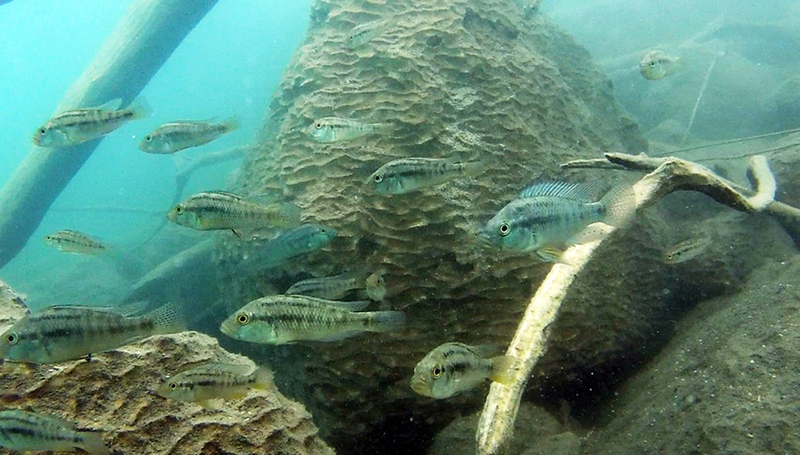
Cichlids belong to one of the largest fish families, with new species emerging all the time. These colourful, shimmering fish evolve so fast that Eawag researchers have now been able to practically observe them in the process of their evolution.

Within the space of several thousand years, one cichlid can evolve into hundreds of different species. These are the new findings of investigations in Victoria Lake, in Africa, where over 500 different cichlid species have emerged over the past 15,000 years. Now, for the first time ever, fish ecologists at Eawag have been able to observe the onset of such speciation – or adaptive radiation, as it is known – almost in real time. This unusual situation has been playing out in a crater lake in Tanzania, where cichlids of the genus Astatotilapia were introduced by humans around 50 years ago. The astounding thing is that, today, only a few decades later, the fish have already split into numerous different specialised forms.

On the basis of stomach analyses and stable isotopes, the researchers discovered that some of the cichlids being investigated were predominantly vegetarian, while others fed mostly on small fry or fish eggs. The fish also live at different depths and have different breeding colours. Admittedly, a general analysis of the situation indicates that we are not yet looking at actual individual species, as the genetic material is still too similar. The researchers estimate that in order for completely new species to evolve, it would take another few decades or even centuries.

Ole Seehausen, Head of the Department of Fish Ecology and Evolution, provides more in-depth insights into the cichlid research in Lake Chala in a
radio interview with Deutsche Rundfunk

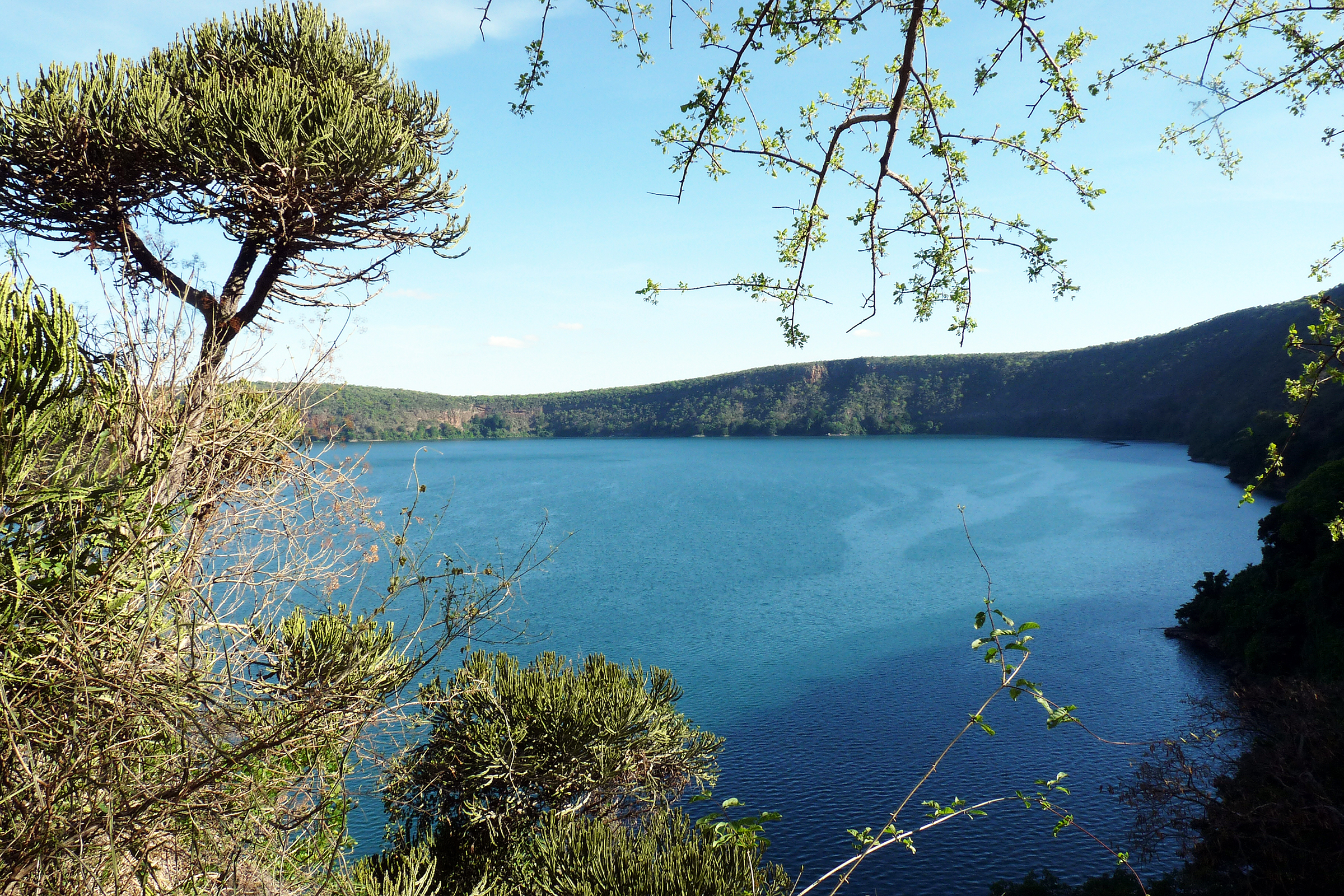
Lake Chala is a crater lake situated on the border between the African countries of Tanzania and Kenya.
(Photo: Florian N. Moser)

Original article

Extbase Variable Dump
array(2 items)
   publications => '17329' (5 chars)
   libraryUrl => '' (0 chars)
Extbase Variable Dump
array(1 item)
   0 => Snowflake\Publications\Domain\Model\Publicationprototypepersistent entity (uid=17329, pid=124)
      originalId => protected17329 (integer)
      authors => protected'Moser, F. N.; van Rijssel, J. C.; Mwaiko, S.; Meier
         , J. I.; Ngatunga, B.; Seehausen, O.
' (132 chars) title => protected'The onset of ecological diversification 50 years after colonization of a cra
         ter lake by haplochromine cichlid fishes
' (116 chars) journal => protected'Proceedings of the Royal Society B: Biological Sciences' (55 chars) year => protected2018 (integer) volume => protected285 (integer) issue => protected'1884' (4 chars) startpage => protected'20180171 (19 pp.)' (17 chars) otherpage => protected'' (0 chars) categories => protected'adaptive radiation; cichlid fish; incipient speciation; fitness surfaces; di
         sruptive selection; niche expansion
' (111 chars) description => protected'Adaptive radiation research typically relies on the study of evolution in re
         trospective, leaving the predictive value of the concept hard to evaluate. S
         everal radiations, including the cichlid fishes in the East African Great La
         kes, have been studied extensively, yet no study has investigated the onset
         of the intraspecific processes of niche expansion and differentiation shortl
         y after colonization of an adaptive zone by cichlids. Haplochromine cichlids
          of one of the two lineages that seeded the Lake Victoria radiation recently
          arrived in Lake Chala, a lake perfectly suited for within-lake cichlid spec
         iation. Here, we infer the colonization and demographic history, quantify ph
         enotypic, ecological and genomic diversity and diversification, and investig
         ate the selection regime to ask if the population shows signs of diversifica
         tion resembling the onset of adaptive radiation. We find that since their ar
         rival in the lake, haplochromines have colonized a wide range of depth habit
         ats associated with ecological and morphological expansion and the beginning
          of phenotypic differentiation and potentially nascent speciation, consisten
         t with the very early onset of an adaptive radiation process. Moreover, we d
         emonstrate evidence of rugged phenotypic fitness surfaces, indicating that c
         urrent ecological selection may contribute to the phenotypic diversification
         .
' (1369 chars) serialnumber => protected'0962-8452' (9 chars) doi => protected'10.1098/rspb.2018.0171' (22 chars) uid => protected17329 (integer) _localizedUid => protected17329 (integer)modified _languageUid => protectedNULL _versionedUid => protected17329 (integer)modified pid => protected124 (integer)
Moser, F. N.; van Rijssel, J. C.; Mwaiko, S.; Meier, J. I.; Ngatunga, B.; Seehausen, O. (2018) The onset of ecological diversification 50 years after colonization of a crater lake by haplochromine cichlid fishes, Proceedings of the Royal Society B: Biological Sciences, 285(1884), 20180171 (19 pp.), doi:10.1098/rspb.2018.0171, Institutional Repository