
News Detail
Equipping wastewater treatment plants for the future with sludge densification
March 3, 2026 |
Wastewater is purified in several stages in wastewater treatment plants (WWTPs). One of these stages is biological treatment, in which microorganisms break down organic substances and nutrients in the wastewater. These microorganisms form what is known as activated sludge in the clarifiers. If you were to look at this sludge under a microscope, you would be able to see that the microorganisms clump together into small, low-density "flocs" of bacteria. This sludge settles in the secondary clarifier and is thereby separated from the treated wastewater. The sedimented sludge is then returned to the biological treatment stage, where the microorganisms can continue to act on new wastewater.
Denser sludge accelerates wastewater treatment
The speed at which the activated sludge settles in the secondary clarifier often limits the amount of wastewater that can be treated in the sewage treatment plant. However, if the microorganisms form denser granules instead of flocs – referred to as granular sludge – this speeds up the sedimentation process. This can increase the amount of activated sludge in the biological treatment tank and thereby improve the performance of the wastewater treatment plant. This is an attractive option for many wastewater treatment plants in order to keep pace with increasing volumes of wastewater due to population growth, without having to build larger tanks.


Activated sludge under the microscope: on the left the microorganisms grow mainly in flocs, on the right in the form of denser granules. (Photos: Eawag)
Since 2015, several Swiss wastewater treatment plants have therefore introduced the process with granular sludge. The aquatic research institute Eawag accompanied some of these plants during the pilot phase, including the Neugut WWTP in Dübendorf, Zurich, in 2024. Recently published in the journal Aqua & Gas, the findings from this research project can be used to further optimise the process. In addition, Eawag carried out a measurement campaign in 10 wastewater treatment plants to find out how well sludge densification works and what operating conditions are required. These results have also just been published in Aqua & Gas.
Two levers for densifying activated sludge
There are two levers that can be applied to obtain denser activated sludge. On the one hand, hydrocyclones are used, in which the flocs are mechanically separated from the granules. While the flocs are discarded, the granules are returned to the activated sludge tank. In this way, the sludge is gradually enriched with the desired properties. On the other hand, the clarifiers need to provide the conditions necessary for promoting the growth of denser granules. "In our investigation, we found that the contact between the sludge and high concentrations of organic pollutants plays a particularly important role in densification," explains Nicolas Derlon, group leader in the Process Engineering department at Eawag, who led the measurement campaign. This means that the fresh wastewater must not be diluted too much with recycled activated sludge. If the wastewater contains more organic substances, these can diffuse into the interior of the granules allowing microorganisms to grow there and form compact aggregates.

The sedimentation of the sludge improved with an increasing proportion of granules in all the wastewater treatment plants analysed. "A plateau is only reached from a granule content of over 40% in the densified sludge – only then is the optimisation potential of sludge densifaction fully exploited," explains Nicolas Derlon. For many of the wastewater treatment plants involved, however, even minor improvements are sufficient. Thanks to successful sludge densifaction, flocculants no longer need to be added at the Neugut WWTP. These chemicals had previously been used to increase sludge sedimentation. Following the successful pilot test on a wastewater treatment line, further lines are now being converted.
Potential for improved nitrogen removal
A line at the Werdhölzli WWTP in Zurich was also converted in November 2025. This is because the wastewater treatment plant will have to increase its capacity by around 50% in future due to population growth. Eawag researchers are supporting the WWTP in introducing the process and are investigating how the maximum potential of the technology can be utilised. "If this succeeds, it would be significantly cheaper than other technologies that the WWTP operators are also considering," says Nicolas Derlon.
He would also like to investigate the potential of sludge densifaction for better nitrogen removal and for a possible reduction in the emission of environmentally harmful nitrous oxide in more detail. This would help wastewater treatment plants to comply with the new nitrogen removal requirements planned as part of the revision of the Water Protection Act. Winter in particular has so far been critical for nitrification and nitrogen removal, because the bacteria grow less well then. Sludge densifaction can increase the amount of activated sludge in the system. "As a result, there should be enough bacteria to maintain stable nitrogen removal even during the critical period," surmises Nicolas Derlon. The Werdhölzli WWTP now intends to verify this in practice.
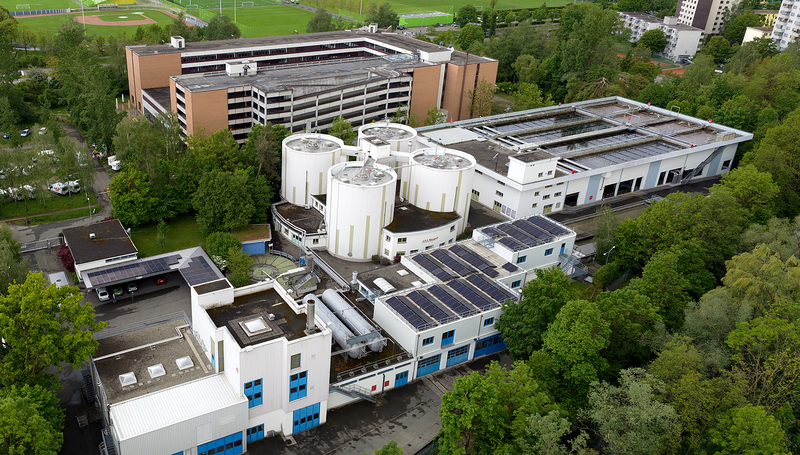
Cover picture: Thanks to sludge densifaction, the Neugut WWTP no longer requires the addition of flocculants, which were previously used to increase sludge sedimentation. (Photo: Neugut WWTP)
Original publications
Derlon, N.; Schwaller, V.; Gubser, N. (2026): Schlammgranulierung – 10 ARA über ihre Erfahrungen mit granuliertem Belebtschlamm, Aqua & Gas, 106(2),
Shilyaeva, E.; Fumasoli, A.; Hubaux, N.; Derlon, N. (2026): Schlammgranulierung – Erfahrungen der ARA Neugut, Aqua & Gas, 106(2),
Funding / Collaborations
- Eawag
- ARA Neugut
- Hunziker Betatech AG
- ARAconsult GmbH
- ARA Werdhölzli
- ERZ Entsorgung + Recycling Zürich