News Detail

Exceptional diversity of whitefish

May 9, 2025 | Andri Bryner

The diversity of whitefish species in Swiss lakes is unique and plays a central role in lake ecosystems. A comprehensive Eawag report now summarises the results of 150 years of research on these fish. They make it clear that the mechanisms and environmental conditions that have contributed to their development must be taken into account in order to preserve this species diversity. Last but not least, protecting whitefish diversity helps to preserve the natural yield potential of lakes as a source of food for humans.

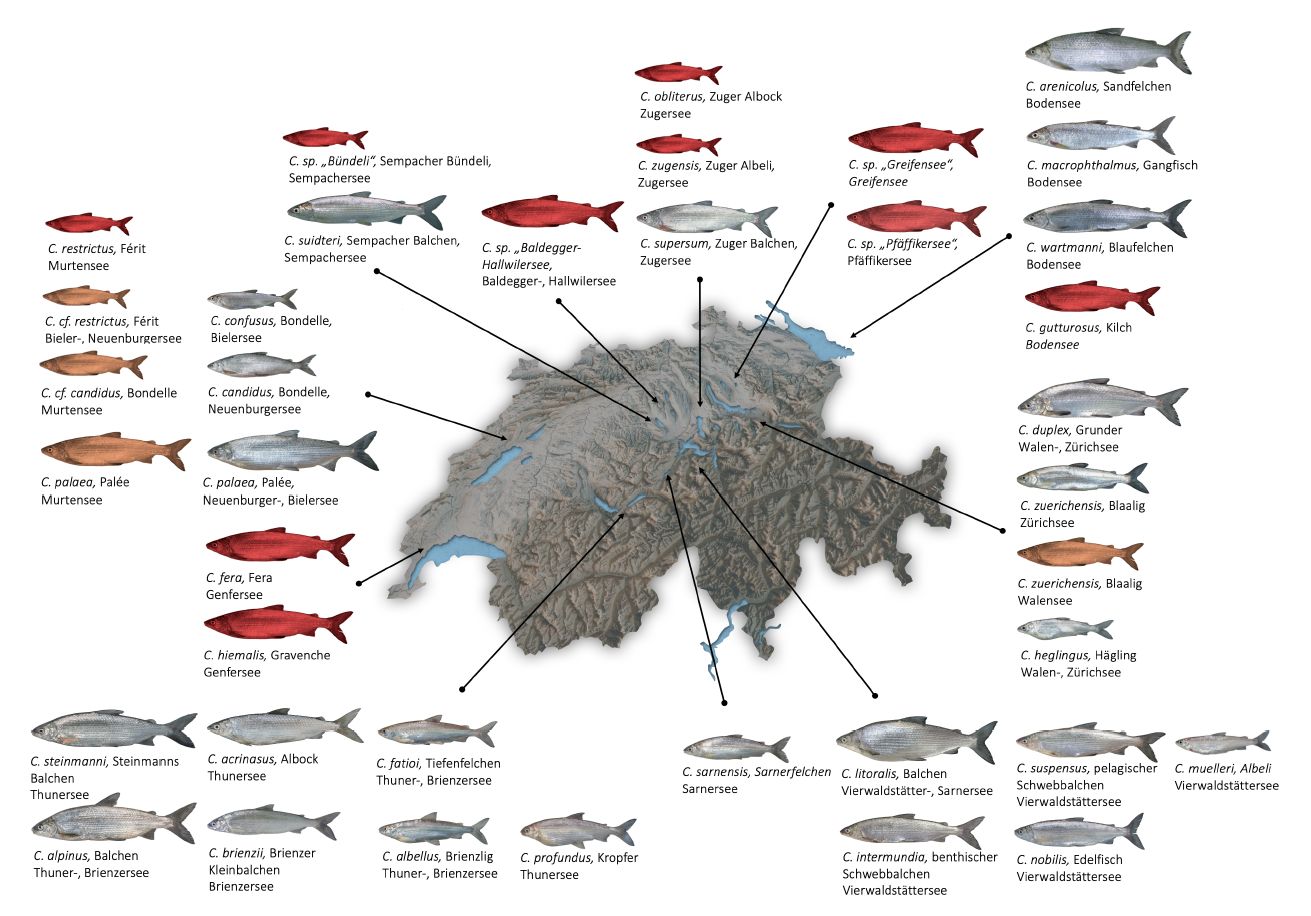
The diversity of whitefish species in the large Swiss lakes is unique. It has developed over the last 15,000 years or so and plays a central role in these ecosystems, as whitefish naturally represent by far the largest fish biomass in all habitats of the larger lakes - with the exception of the shallow shore zones. This large and diversified biomass has always represented a local and sustainable food resource for humans. According to fishing statistics from the Federal Office for the Environment (www.fischereistatistik.ch), whitefish have accounted for an average of 25 and 60 per cent of the total catch by anglers and professional fishermen over the last two decades. They also play a central role in lake ecosystems, as they represent by far the largest biomass in open water (pelagic) and in the deeper lake zones (profundal).
 

Understanding the mechanisms of speciation

Research into whitefish species diversity over the last two decades has improved our understanding of how this diversity has evolved, how it is ecologically and genetically structured, and why many species have become extinct over the last 80 years. The new findings show that the mechanisms and environmental conditions that led to the development of species diversity must be taken into account in order to preserve the remaining species diversity and ensure the long-term sustainable use of whitefish in fisheries.

Rethink management

The investigations have also shown that existing fisheries management should be partially reconsidered and new approaches developed. The federal and cantonal authorities are therefore currently working with Eawag on appropriate, scientifically based recommendations tailored to each lake. In addition, gaps in knowledge, for example in the ecology of individual whitefish species, must be closed in order to be able to take knowledge-based action in changing lake ecosystems in the future, for example as a result of climate change and invasive neozoa. Only in this way can biodiversity be preserved and utilised sustainably in the long term.

Great international responsibility

Switzerland's lakes are home to a diversity of 24 (originally at least 34) genetically, morphologically and ecologically distinct whitefish species that is unique in Europe. All of these species are found exclusively in Swiss lakes and the international waters of Lake Constance and Lake Geneva. Switzerland therefore bears a major international responsibility for the conservation of this unique biodiversity.
 

Extbase Variable Dump
array(3 items)
   publications => '34610,34055' (11 chars)
   libraryUrl => '' (0 chars)
   layout => '0' (1 chars)
Extbase Variable Dump
array(2 items)
   0 => Snowflake\Publications\Domain\Model\Publicationprototypepersistent entity (uid=34610, pid=124)
      originalId => protected34610 (integer)
      authors => protected'Selz, O. M.; Vonlanthen, P.; Kreienbühl, T.; Seehausen,
          O.
' (84 chars) title => protected'Die aussergewöhnliche Vielfalt der Felchen der Schweiz - Ergebnisse aus 150
          Jahren Forschung
' (93 chars) journal => protected'' (0 chars) year => protected2025 (integer) volume => protected0 (integer) issue => protected'' (0 chars) startpage => protected'280 p' (10 chars) otherpage => protected'' (0 chars) categories => protected'' (0 chars) description => protected'Die Artenvielfalt der Felchen in den grossen Seen der Schweiz ist einzigarti
         g. Sie hat sich in den letzten rund 15 000 Jahren entwickelt und spielt eine
          zentrale Rolle in diesen Ökosystemen, da Felchen natürlicherweise die bei
         
         
         ifizierte Biomasse stellt seit jeher eine lokale und nachhaltige Nahrungsres
         source für den Menschen dar. Die Erforschung der Felchenartenvielfalt in de
         n letzten zwei Jahrzehnten hat unser Verständnis darüber verbessert, wie d
         iese Vielfalt entstanden ist, wie sie ökologisch und genetisch strukturiert
          ist, und warum viele Arten in den vergangenen 80 Jahren ausgestorben sind.
         Die neuen Erkenntnisse zeigen, dass für den Erhalt der verbleibenden Artenv
         ielfalt und einer langfristig nachhaltigen fischereilichen Nutzung der Felch
         en die Mechanismen und Umweltbedingungen berücksichtigt werden müssen, die
          zur Entstehung der Artenvielfalt geführt haben. Der Schutz der Artenvielfa
         lt und der damit verbundenen ökologischen Vielfalt der Felchen innerhalb ei
         nes Sees trägt dazu bei, das natürliche Ertragspotenzial des Sees als Nahr
         ungsquelle für den Menschen zu erhalten.<br />Die Untersuchungen haben auch
          aufgezeigt, dass das bestehende Fischereimanagement teilweise überdacht un
         d neue Ansätze entwickelt werden sollten. Zudem müssen Wissenslücken, bei
         spielsweise im Bereich der Ökologie vieler Felchenarten, geschlossen werden
         , um auch zukünftig in veränderten Seeökosystemen (z. B. mit Klimawandel
         und invasiven Neozoen) wissensbasiert handeln zu können. Nur so kann die Ar
         tenvielfalt langfristig erhalten und nachhaltig genutzt werden.
' (1735 chars) serialnumber => protected'' (0 chars) doi => protected'' (0 chars) uid => protected34610 (integer) _localizedUid => protected34610 (integer)modified _languageUid => protectedNULL _versionedUid => protected34610 (integer)modified pid => protected124 (integer)
1 => Snowflake\Publications\Domain\Model\Publicationprototypepersistent entity (uid=34055, pid=124) originalId => protected34055 (integer) authors => protected'Seehausen,&nbsp;O.; Vonlanthen,&nbsp;P.; Selz,&nbsp;O.&nbsp;M.' (62 chars) title => protected'Beachtliche Vielfalt der Schweizer Felchen. Ergebnisse aus 150 Jahren Forsch
         ung
' (79 chars) journal => protected'Aqua & Gas' (10 chars) year => protected2025 (integer) volume => protected0 (integer) issue => protected'3' (1 chars) startpage => protected'64' (2 chars) otherpage => protected'73' (2 chars) categories => protected'' (0 chars) description => protected'Die Artenvielfalt der Felchen in den Schweizer Seen ist einzigartig und spie
         lt eine zentrale Rolle in diesen Ökosystemen. Die hier aufgeführten wissen
         schaftlichen Erkenntnisse verdeutlichen, dass für den Erhalt dieser Artenvi
         elfalt und eine langfristig nachhaltige fischereiliche Nutzung die Mechanism
         en und Umweltbedingungen berücksichtigt werden müssen, die zur Entstehung
         dieser Arten beigetragen haben. Der Schutz dieser Artenvielfalt in den versc
         hiedenen Seen trägt dazu bei, das natürliche Ertragspotenzial der Seen als
          Nahrungsquelle für den Menschen zu bewahren.
' (578 chars) serialnumber => protected'2235-5197' (9 chars) doi => protected'' (0 chars) uid => protected34055 (integer) _localizedUid => protected34055 (integer)modified _languageUid => protectedNULL _versionedUid => protected34055 (integer)modified pid => protected124 (integer)
Selz, O. M.; Vonlanthen, P.; Kreienbühl, T.; Seehausen, O. (2025) Die aussergewöhnliche Vielfalt der Felchen der Schweiz - Ergebnisse aus 150 Jahren Forschung, 280 p, Institutional Repository
Seehausen, O.; Vonlanthen, P.; Selz, O. M. (2025) Beachtliche Vielfalt der Schweizer Felchen. Ergebnisse aus 150 Jahren Forschung, Aqua & Gas, 64-73, Institutional Repository

Cover picture: Pair of whitefish (C. lavaretus) spawning near the shore in Lac d'Aiguebelette (Photo: Alamy).

Financing

  • Eawag
  • Bundesamt für Umwelt